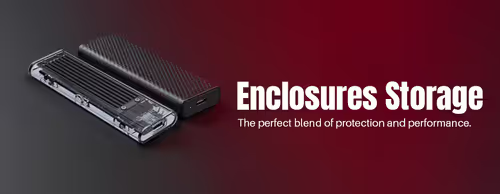
Drive Enclosures for SSDs & HDDs 💾
NVMe & SATA SSD Enclosures (10)


How to Choose a Drive Enclosure
The right enclosure depends on the drive you're putting in it and how fast you want it to run. A mismatch — say, a fast NVMe SSD in a slow USB enclosure — wastes the drive's speed, while the right pairing gives you portable storage that rivals an internal disk. The guide below covers the choices that matter.
Match the enclosure to the drive you have. 2.5" enclosures fit laptop SATA SSDs and hard drives. 3.5" enclosures take larger desktop hard drives and usually need a mains power adapter. M.2 enclosures house the small stick-shaped NVMe (and some SATA) SSDs. Check which type your drive is before buying — they aren't interchangeable.
For a hard drive, USB 3.0/3.1 is plenty since the disk itself is the limit. For a fast SSD, look for USB 3.2 Gen 2 (10 Gbps) or, for NVMe drives, an enclosure rated higher still — otherwise the enclosure caps your drive's speed. Support for UASP also helps the enclosure run closer to the drive's real performance.
Not always. M.2 comes in two flavours — NVMe (PCIe) and SATA — and many enclosures support only one. There are also different physical lengths (2280 is most common). Check that the enclosure matches your drive's interface and length, or choose one that explicitly supports both NVMe and SATA M.2.
For fast NVMe SSDs, aluminium helps because it draws heat away and keeps the drive from throttling during long transfers. For a hard drive or a casual-use SSD, a sturdy plastic housing is fine and lighter to carry. If you'll push sustained large transfers, lean towards aluminium with a thermal pad.
2.5" SSD and laptop-drive enclosures and most M.2 enclosures draw power from the USB port, so a single cable does it. 3.5" desktop hard drives need more power than USB provides and ship with a mains adapter. If you want a single-cable portable drive, stick to 2.5" or M.2 rather than 3.5".