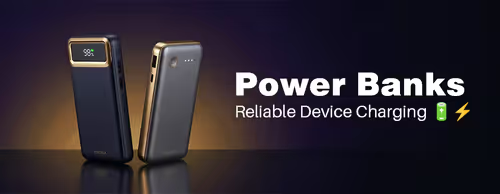
Power Banks & Portable Chargers 🔋
Power Banks & Portable Chargers (21)


How to Choose a Power Bank
Two numbers decide most of it: capacity (mAh, how much charge it holds) and output (Watts and ports, how fast and how many devices it charges). Match both to your hardest device — usually a laptop or handheld — and the rest looks after itself. The guide below covers the details worth checking.
For phone top-ups, a 5,000–10,000mAh bank is light and enough for a day. For multiple devices or a full tablet recharge, step up to 20,000mAh or more. Bear in mind the rated capacity is the internal cell total — after voltage conversion you get somewhat less out, so size up rather than down if you're cutting it fine.
Only if it supports USB-C Power Delivery (PD) at enough wattage for the device — laptops and gaming handhelds need far more than a phone. Check the bank's rated PD output in Watts against what your device draws. A high mAh figure alone doesn't mean it can power a laptop, so the output spec is the one that matters here.
Charging speed depends on the bank's output standard and the cable. USB-C PD and similar fast-charge protocols deliver more power to compatible phones and laptops, while older USB-A ports are slower. Use a cable rated for the wattage you want, as a thin or old cable will bottleneck even a capable power bank.
Multi-port banks let you charge a phone, earbuds and a tablet at once, though total output is shared across the ports. Look for at least one USB-C port for modern devices and fast charging. If you carry a laptop, make sure that USB-C port supports PD at the wattage you need.
Most airlines allow power banks up to around 100Wh (roughly 27,000mAh) in carry-on luggage, and they must not go in checked baggage. Larger units may be restricted or need approval. Check your specific airline's rules before you fly, since limits and quantities vary by carrier.