Roadmap Preview · Q3 2026
AMD Ryzen AI 400. — Zen 6, RDNA 4, and a 55 TOPS NPU.
The successor to Strix Point lands in late 2026 with a meaningful NPU jump, an architecture refresh, and battery-life claims that sound too good to be true. Here's what's actually confirmed versus rumoured.
- NPU (rumoured)
- 55 TOPS
- global launch
- Q3 2026
- battery target
- 25+ hrs
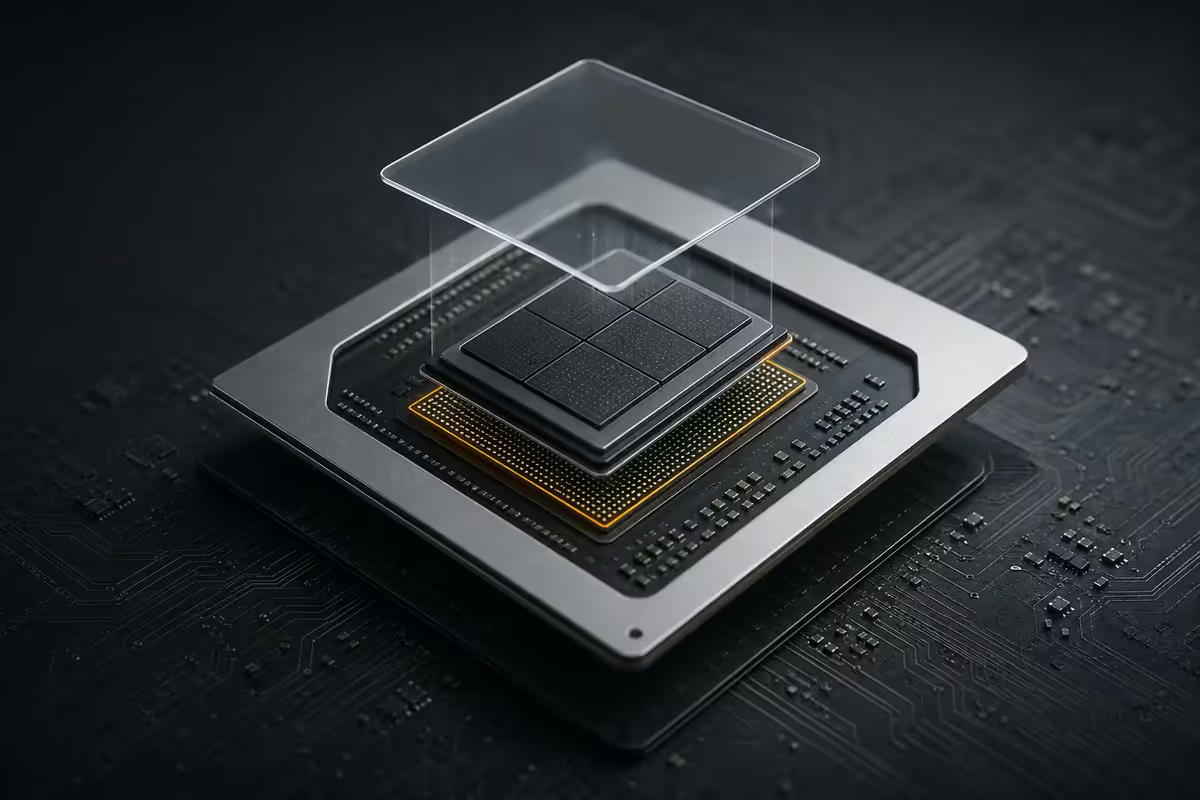
Ryzen AI 400 vs Strix Halo — where it sits
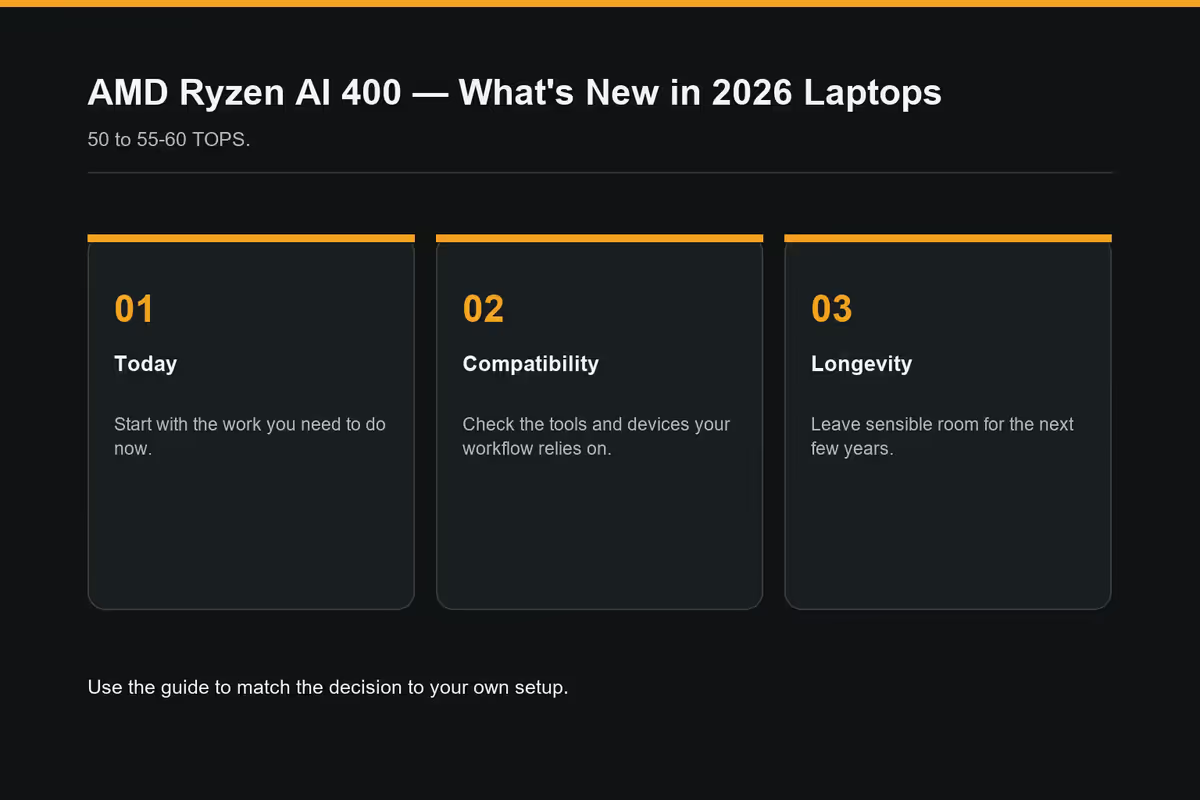
AMD's mobile line-up has fragmented in interesting ways. Understanding where Ryzen AI 400 fits requires understanding what it's not replacing.
Strix Halo (branded Ryzen AI Max 300/Pro 300) is AMD's halo product — a 16-core Zen 5 die paired with a massive 40-CU iGPU, targeted at desktop-replacement laptops, workstation mobile machines and small-form-factor mini-PCs. It launched in early 2026 and remains the apex of AMD mobile silicon for at least 12-18 months. Ryzen AI 400 isn't replacing Strix Halo — it's the successor to Strix Point (Ryzen AI 300), targeting thin-and-light Copilot+ ultrabooks and mainstream productivity laptops.
Think of it as three tiers running concurrently:
| Tier | Series | 2026 typical use |
|---|---|---|
| Halo / DTR | Ryzen AI Max 300 (Strix Halo) | Workstation laptops, ROG Flow Z13-class |
| Mainstream premium (NEW) | Ryzen AI 400 (Sound Wave / Medusa Point) | Copilot+ thin-and-light, premium ultrabooks |
| Mainstream value | Ryzen AI 300 (Strix Point) — clearance | R20-25k ultrabook bargains H2 2026 |
| Budget | Ryzen 200 / 8000 series | Sub-R15k laptops, education |
For most SA buyers walking into Incredible Connection or browsing Evetech, the practical decision is between Ryzen AI 300 on clearance (excellent value in late 2026) and Ryzen AI 400 fresh stock (premium price for the latest generation). Strix Halo remains a specialist purchase.
The NPU TOPS jump — 50 to 55-60
The headline feature on Ryzen AI 400 is the NPU upgrade. Ryzen AI 300's XDNA 2 NPU sits at 50 TOPS — comfortably above Microsoft's 40-TOPS Copilot+ certification threshold. Ryzen AI 400 is expected to push that figure to 55-60 TOPS via an XDNA 2.5 or XDNA 3 architectural refresh.
What does this actually unlock? In 2026, NPUs run three categories of workload:
- Windows Copilot+ features — Recall, Click to Do, Studio Effects in Teams/Zoom, live captions, Cocreator in Paint. These all run today on 40+ TOPS hardware. The jump to 55 TOPS makes them faster and lower-power, not differently capable.
- Background AI tasks — semantic file search, Phi Silica local language models, real-time photo enhancement. More TOPS means these run more aggressively without draining battery.
- Local generative AI — Stable Diffusion turbo models, small-context LLM inference (sub-7B parameter models), AI-driven video upscaling. This is where the TOPS jump becomes practically meaningful. Generating an image locally in 8 seconds vs 14 seconds changes the workflow.
If you don't use any of these features — and many users genuinely don't — the NPU upgrade won't change your day. The CPU/GPU/battery improvements will matter more.
Zen 6 cores — rumour vs confirmed
AMD's public roadmap (Computex 2025 and subsequent Financial Analyst Day disclosures) confirms Zen 6 as the architecture targeted for late-2026 mobile and desktop launches. What hasn't been confirmed is whether the entire Ryzen AI 400 stack ships with Zen 6, or whether lower SKUs use a refreshed Zen 5+ on a refined process node.
Reasonable expectations based on leaks and AMD's historical product cadence:
- Ryzen AI 9 400-series — flagship SKUs almost certainly use full Zen 6 cores, with 12 cores rumoured (8 Zen 6 + 4 Zen 6c efficiency cores in a hybrid arrangement).
- Ryzen AI 7 400-series — likely Zen 6, possibly with reduced core count (10 cores total).
- Ryzen AI 5 400-series — could be Zen 5+ refresh, with the brand benefit of the 400 numbering rather than full architectural uplift.
The expected gen-on-gen CPU performance uplift is 15-20% in mixed productivity workloads — meaningful, on par with what Zen 5 delivered over Zen 4, but not transformative. The bigger story is power efficiency: Zen 6 should drop sustained-load wattage by 10-15% at iso-performance, directly feeding the battery claims.
RDNA 4 mobile graphics — efficiency over raw power
Ryzen AI 300's Strix Point shipped with a 16-CU RDNA 3.5 iGPU that delivered surprisingly capable 1080p gaming at low-medium settings. Ryzen AI 400 is expected to ship RDNA 4 mobile graphics, likely retaining the 16-CU configuration but with significant architectural improvements.
RDNA 4's headline gains on desktop (RX 9070-series) include improved ray tracing throughput and FSR 4 AI upscaling. Mobile expectations:
- 10-15% iso-power performance uplift over RDNA 3.5 — roughly the difference between playing eSports titles at 1080p high vs 1080p ultra.
- FSR 4 native support — AI-driven upscaling that runs partially on the NPU, freeing GPU resources. This is potentially the most important graphical feature for thin-and-light gaming.
- Improved video encode/decode — AV1 hardware encode is critical for content creators streaming or rendering local video.
Don't expect Ryzen AI 400 thin-and-lights to become dedicated gaming laptops — the 16-CU iGPU is still entry-tier compared to a discrete RTX 4060 mobile or higher. But for a fanless or near-silent ultrabook to handle Apex Legends at 60fps medium 1080p? That's the bar.
Battery life — 25-hour claims, 14-18 hour reality
AMD has talked publicly about "all-day battery" targets exceeding 25 hours of light productivity for Ryzen AI 400 thin-and-lights. These are marketing-best-case figures: minimum brightness, web browsing, Wi-Fi on, no background sync.
Real-world expectations:
- 14-18 hours mixed office work — Word/Excel/Edge/Teams at 50% brightness, typical Wi-Fi load. A meaningful uplift from Ryzen AI 300's 10-13 hour real-world performance.
- 8-11 hours video conferencing — Teams or Zoom heavy use drains battery faster due to camera, mic and NPU effects loading.
- 5-7 hours light gaming — iGPU at sustained load on battery throttles to preserve runtime. Not a portable gaming target.
The N3 (or possibly N2) process node, Zen 6's efficiency gains, RDNA 4's improved power gating, and a more aggressive NPU offload of background tasks all combine to deliver this. The 25-hour marketing figure isn't a lie — it's just an aspirational best case.
Copilot+ PC certification — what changes
Every Ryzen AI 400 laptop will ship Copilot+ certified by default. The certification requirements (as of mid-2026) are:
- NPU rated at 40+ TOPS (Ryzen AI 400 exceeds at 55+).
- 16GB RAM minimum (most ship with 32GB).
- 256GB SSD minimum (most ship 512GB or 1TB).
- Pluton security processor enabled.
- Windows 11 24H2 or later (Windows 12 expected to introduce new certification tier).
The features unlocked by certification — Recall, Click to Do, Cocreator, Studio Effects, semantic Search, Live Captions with translation — are evolving. By the time Ryzen AI 400 ships in Q3 2026, Microsoft is expected to have introduced additional NPU-accelerated features that previous-gen 40-TOPS hardware will run more slowly. Future-proofing is real here for anyone planning to keep a laptop for 4-5 years.
Should you wait — or buy Ryzen AI 300 now?
The honest answer depends on three questions:
1. When do you need the laptop? If you need it in 2026 H1, the question answers itself — buy Ryzen AI 300. If your replacement cycle hits late 2026 or early 2027, you have a real choice.
2. Do you actively use on-device AI features? Recall, Cocreator, local Stable Diffusion, semantic search, Phi Silica chat? If yes, Ryzen AI 400 will be meaningfully better. If you've never touched Copilot+ features and don't intend to start, the NPU upgrade is irrelevant.
3. How long will you keep this laptop? If you replace every 2-3 years, Ryzen AI 300 is fine. If you typically stretch a laptop to 5+ years, Ryzen AI 400's NPU headroom matters for future Windows feature compatibility.
| Your situation | Buy now or wait? |
|---|---|
| Replacing 5+ year old laptop, daily-driver | Buy Ryzen AI 300 in Q4 2026 clearance |
| Replacing 2-3 year old laptop, AI features matter | Wait for Ryzen AI 400 (Jan-Mar 2027 SA stock) |
| Need laptop within 60 days, any reason | Buy Ryzen AI 300 now — current is excellent |
| Plan to keep laptop 5+ years, do creative work | Wait for Ryzen AI 400 — future-proofing matters |
| Budget under R20,000 | Buy Ryzen AI 200/300 — AI 400 won't fit budget |
| Heavy local LLM / image generation user | Wait for Ryzen AI 400 — NPU jump is your feature |
South African availability and pricing
AMD has signalled a Q3 2026 global launch for Ryzen AI 400. OEM laptops (Lenovo, ASUS, HP, Dell, Acer) typically follow the silicon reveal by 4-8 weeks. South African retail availability via Evetech, Incredible Connection, Takealot and the major OEM direct stores typically lags global launches by 6-10 weeks.
Expected SA timeline:
- August 2026 — AMD silicon reveal at Hot Chips / IFA Berlin. Embargo lifts on benchmarks.
- September-October 2026 — global OEM launches at IFA. Pre-orders open internationally.
- October-December 2026 — first Ryzen AI 400 laptops land in SA at premium pricing, limited SKU variety.
- January-March 2027 — mainstream SA stock arrives, more SKU variety, sensible pricing.
- April-June 2027 — Ryzen AI 300 clearance bottoms out, AI 400 mid-tier pricing settles.
Expected SA launch pricing in Rands (based on current Ryzen AI 300 mappings plus generational premium):
| SKU tier | Typical SA launch price | Mid-2027 settled price |
|---|---|---|
| Ryzen AI 5 400 ultrabook | R20,000 - R24,000 | R17,000 - R20,000 |
| Ryzen AI 7 400 thin-and-light | R26,000 - R32,000 | R22,000 - R27,000 |
| Ryzen AI 9 400 premium | R36,000 - R44,000 | R30,000 - R36,000 |
| Ryzen AI 9 400 HX flagship | R44,000 - R55,000 | R38,000 - R45,000 |
| Ryzen AI 300 clearance (Q4 2026) | R15,000 - R28,000 | discontinued |
Key takeaways
- Ryzen AI 400 succeeds Strix Point, not Strix Halo — mainstream Copilot+ ultrabooks, not workstation replacements.
- NPU jumps from 50 to ~55-60 TOPS, RDNA 4 mobile graphics, Zen 6 on top SKUs (Zen 5+ likely on lower tiers).
- Battery target 25+ hours marketing, 14-18 hours real-world mixed office work — meaningful uplift on Ryzen AI 300.
- SA first stock October-December 2026, mainstream availability January-March 2027.
- If you need a laptop in 2026, buy Ryzen AI 300 on clearance — Ryzen AI 400 is meaningful but not transformative.
Frequently asked questions
When will AMD Ryzen AI 400 laptops launch in South Africa?
AMD has signalled a Q3 2026 global launch for Ryzen AI 400, with OEM laptops (Lenovo, ASUS, HP) following 4-8 weeks after the silicon reveal. SA availability via Evetech, Incredible Connection and Takealot typically lags global launches by 6-10 weeks. Expect first Ryzen AI 400 laptops in SA between October and December 2026, with mainstream stock from January 2027.How does Ryzen AI 400 compare to Strix Halo?
Strix Halo (Ryzen AI Max 395+) is the current desktop-replacement halo product with 16 Zen 5 cores and a massive 40-CU iGPU. Ryzen AI 400 is the mainstream successor to Strix Point — thinner-and-lighter laptops, 12 cores rumoured (Zen 6), RDNA 4 graphics, NPU rumoured at 55-60 TOPS. Ryzen AI 400 won't beat Strix Halo on raw GPU performance, but it'll out-pace it in NPU AI tasks and battery life.Is the NPU TOPS number actually useful for me?
For most users today, the NPU runs Windows Copilot+ features — live translation, Studio Effects in Teams, Recall, Cocreator in Paint, semantic search. The 40 TOPS minimum for Copilot+ certification will likely double on Ryzen AI 400 to around 55-60 TOPS, enabling local Stable Diffusion image generation, larger LLM inference and more aggressive background AI tasks. If you don't use any AI features, the NPU TOPS jump won't change your day.Should I wait for Ryzen AI 400 or buy a Ryzen AI 300 laptop now?
Buy now if you need a laptop in 2026 H1 — Ryzen AI 300 (Strix Point) is excellent and well-discounted as inventory clears. Wait for Ryzen AI 400 if you specifically want larger on-device AI workloads (local image generation, LLM inference), longer battery life on a single charge, or future-proofing against Windows 12 / next-gen Copilot+ requirements. The gen-on-gen CPU uplift is expected at 15-20%, which is meaningful but not transformative.What is Copilot+ PC certification and does it matter?
Copilot+ PC is Microsoft's certification for laptops with an NPU rated at 40+ TOPS, plus 16GB RAM and 256GB SSD minimums. Certified machines unlock Windows AI features like Recall, Click to Do, improved Windows Studio Effects and Cocreator. Ryzen AI 400 will exceed the TOPS threshold comfortably. The certification matters if you use these features actively; otherwise it's a sticker.Will Zen 6 cores really arrive on Ryzen AI 400?
Confirmed via AMD's public roadmap: Zen 6 is the architecture targeted for late-2026 mobile and desktop launches. Whether the entire Ryzen AI 400 stack uses Zen 6 (versus a Zen 5+ refresh on lower SKUs) hasn't been fully confirmed. Reasonable expectation: top-tier Ryzen AI 9 400-series uses Zen 6, mid-tier may use Zen 5+ on a refined process node.How much battery life uplift can I expect?
AMD has talked publicly about 'all-day battery' targets exceeding 25 hours in light productivity workloads on Ryzen AI 400. Real-world results typically come in at 60-70% of marketing claims — so expect 14-18 hours of mixed office work, a meaningful uplift from the 10-13 hours Ryzen AI 300 currently delivers. The N3 (or N2) process node and RDNA 4 efficiency gains drive this.Will Ryzen AI 400 laptops be expensive in South Africa?
Launch pricing for Ryzen AI 400 thin-and-light laptops in SA will likely start around R26,000-R32,000 for mainstream Ryzen AI 7 SKUs, with Ryzen AI 9 flagship configurations reaching R40,000-R55,000 depending on display, RAM and SSD. These prices track current Ryzen AI 300 launch pricing plus a 5-8% generational premium. Expect meaningful discounts within 4-6 months of launch as second-wave inventory arrives.
Get the Evetech app
Exclusive app-only prices, daily flash sales, and free delivery on orders over R4,000 — download the app and start saving.