Apple vs Google · Platform Comparison
MacBook vs Googlebook. — One platform is finished. One is still becoming.
Apple silicon owns the polished-premium laptop tier. Google's premium laptop ambition keeps stalling, restarting and rumour-ing. Here's the honest read on what each actually delivers in 2026 — and where the rumoured Googlebook would land.
- last Pixelbook
- 2019
- MacBook Air battery
- 18 hrs
- MacBook entry SA
- R26k+
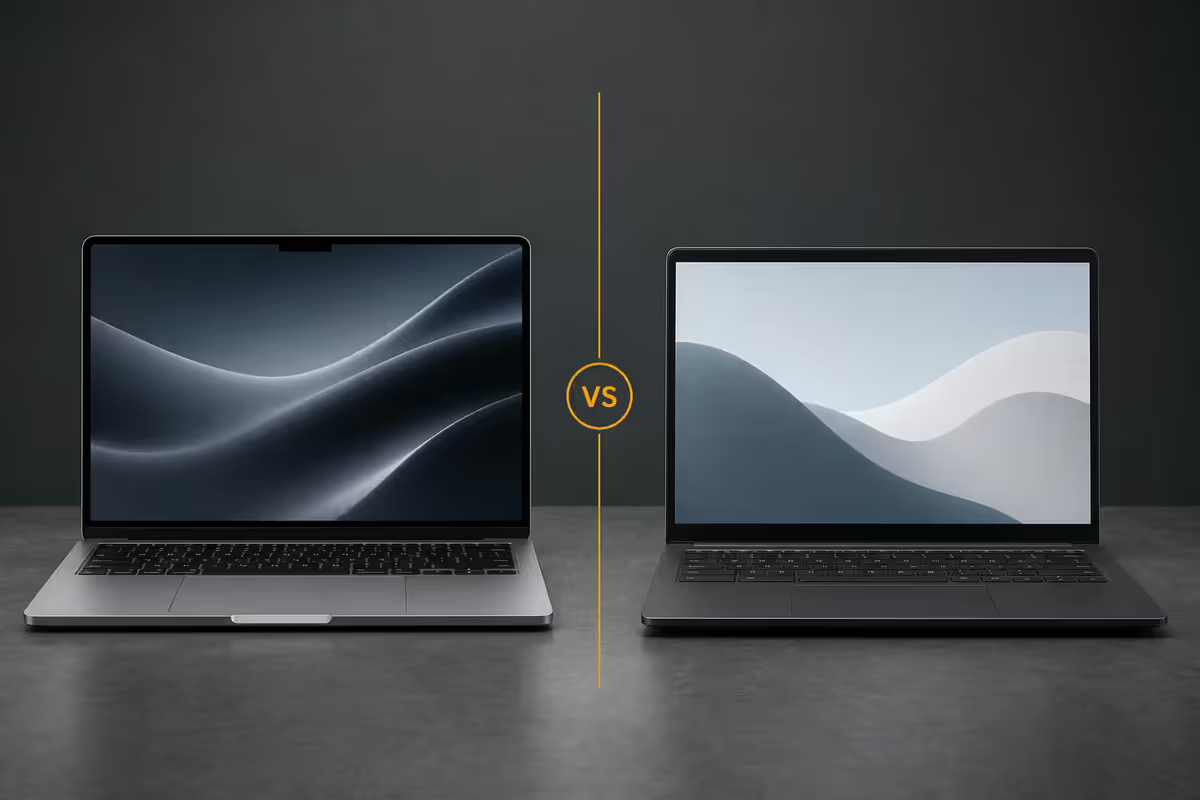
What "Googlebook" actually means in 2026
There is no laptop on shop shelves today branded "Googlebook." Google's premium laptop story peaked in 2019 with the Pixelbook Go — a beautifully built, $649-and-up ChromeOS laptop that drew strong reviews and quiet sales. In 2022 Google reportedly disbanded the in-house Pixelbook hardware team. In 2023 the Pixelbook brand was effectively shelved. Yet every year since, rumours surface of a successor — sometimes pitched as a Pixelbook revival, sometimes as a Fuchsia OS device, more recently as an Android-ChromeOS converged laptop running on Tensor G-series silicon.
We're using "Googlebook" as a shorthand for that credible Google premium laptop concept: high-quality industrial design, ARM-based Google silicon, a mature ChromeOS/Android-fused platform, deep Gemini integration, and a price aimed squarely at MacBook Air. Whether that ships in late 2026, 2027 or never, the conceptual comparison reveals where Apple is genuinely vulnerable and where it isn't.
The MacBook line, in contrast, ships unbroken yearly refreshes. As of 2026 the lineup is MacBook Air 13/15 on M4 silicon, and MacBook Pro 14/16 on M4 Pro and M4 Max. It is a complete, mature product line with predictable upgrade cycles. That predictability is itself a competitive advantage Google currently does not match.
Platform maturity — the unfinished vs the finished
macOS is roughly forty years old. It runs every category of professional creative tool natively. Apple silicon adds a second layer of maturity — every major creative app has been ported and optimised for Apple's ARM architecture by 2026.
ChromeOS turned fifteen in 2026. It started as a glorified browser, then absorbed Android apps in 2016, then added a Linux container in 2018, then progressively closed the gap with web-app versions of professional tools. By 2026 it is genuinely capable for cloud-first workflows. What it still cannot do natively is run Adobe Creative Cloud desktop apps, Final Cut, Logic Pro, DaVinci Resolve at professional capacity, or any of the Microsoft Office desktop features that enterprise users rely on.
A converged Android-ChromeOS Googlebook would inherit Android's enormous tablet app library — which has visibly improved since Google's foldable push — and Linux container support for development. That genuinely lifts the platform. It still does not solve the fundamental Adobe and native-pro-app gap.
App ecosystems — the practical gap
The clearest, most measurable difference between the two platforms isn't the chip or battery life — it's what software actually runs natively.
| Software category | MacBook | Googlebook (concept) |
|---|---|---|
| Adobe Photoshop / Illustrator | Full native desktop | Web subset only |
| Adobe Premiere / After Effects | Full native desktop | None |
| Final Cut Pro / Logic Pro | Native (Apple exclusive) | None |
| Microsoft Office | Full native desktop | Web only |
| Google Workspace | Web (good) | Native, deepest integration |
| Native dev (Xcode, iOS, macOS) | Required platform | Not possible |
| Web dev (VS Code, Node, Docker) | Full native | Linux container, capable |
| Android emulator / dev | Slower (cross-arch) | Native (likely) |
| Gaming (modern AAA) | Limited but growing | Cloud gaming only |
The pattern is stark. If you live in Google Workspace and Android, the Googlebook concept genuinely beats a MacBook for fit and integration. If you live in Adobe, Microsoft, or native macOS apps, there is no Googlebook story — the gap is structural, not closeable by faster silicon.
Gemini vs Apple Intelligence — different philosophies
AI integration is the closest thing to a head-to-head fight, because both Apple and Google are competing aggressively here in 2026.
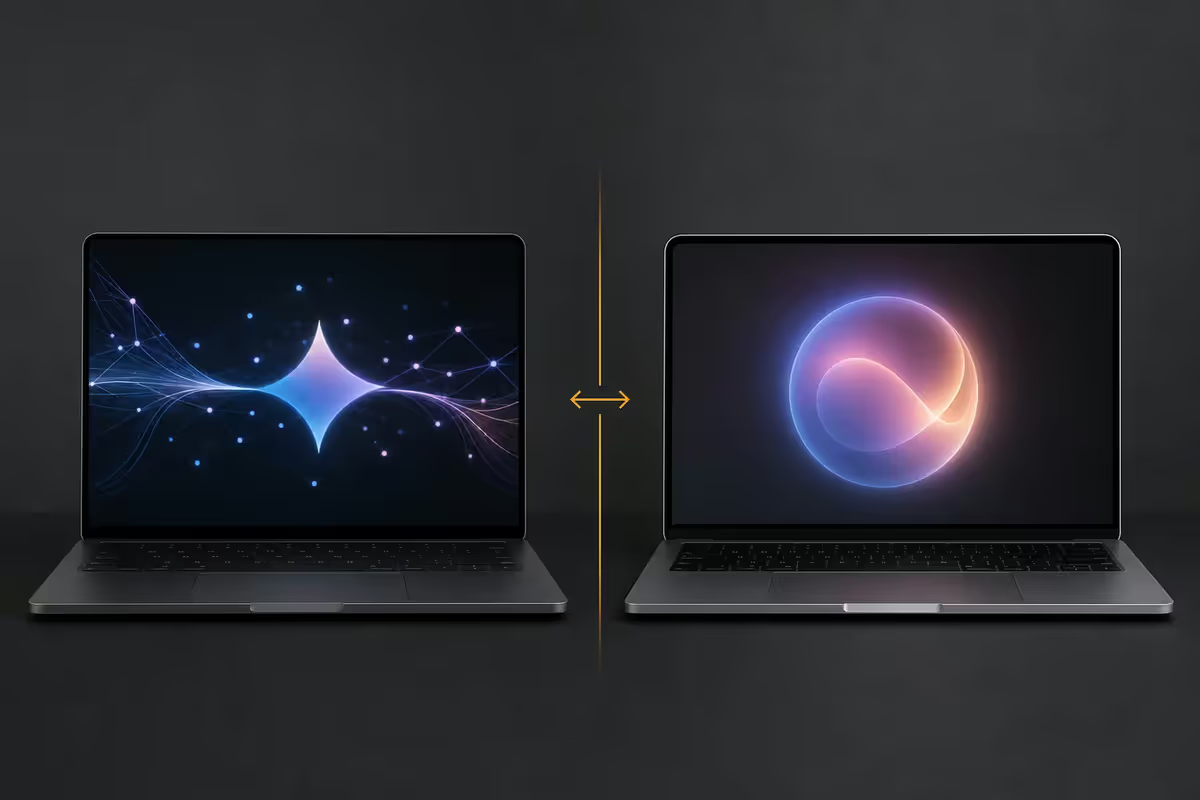
Gemini on a Googlebook would offer the most capable consumer AI assistant available on any laptop — multimodal reasoning, image generation, code assistance, real-time translation, deep document analysis, and tight integration with every Workspace app. Gemini's strength is its raw capability ceiling: it does more, understands more context, and handles more file types than its peers.
Apple Intelligence on a MacBook takes the opposite approach. Most AI features run on-device, with selective Private Cloud Compute escalation when needed. Apple Intelligence handles writing tools, summarisation, Siri upgrades, image clean-up and a polished integration with Mail, Notes and Pages. Its strength is privacy and OS-integration polish — every feature feels like part of macOS, not bolted on.
Which matters more depends entirely on what you do. Researchers, developers, marketers, students writing dissertations — Gemini's capability ceiling is genuinely useful. Privacy-sensitive professionals, lawyers, anyone handling client data — Apple Intelligence's on-device-first model is a better fit.
Hardware, build and battery
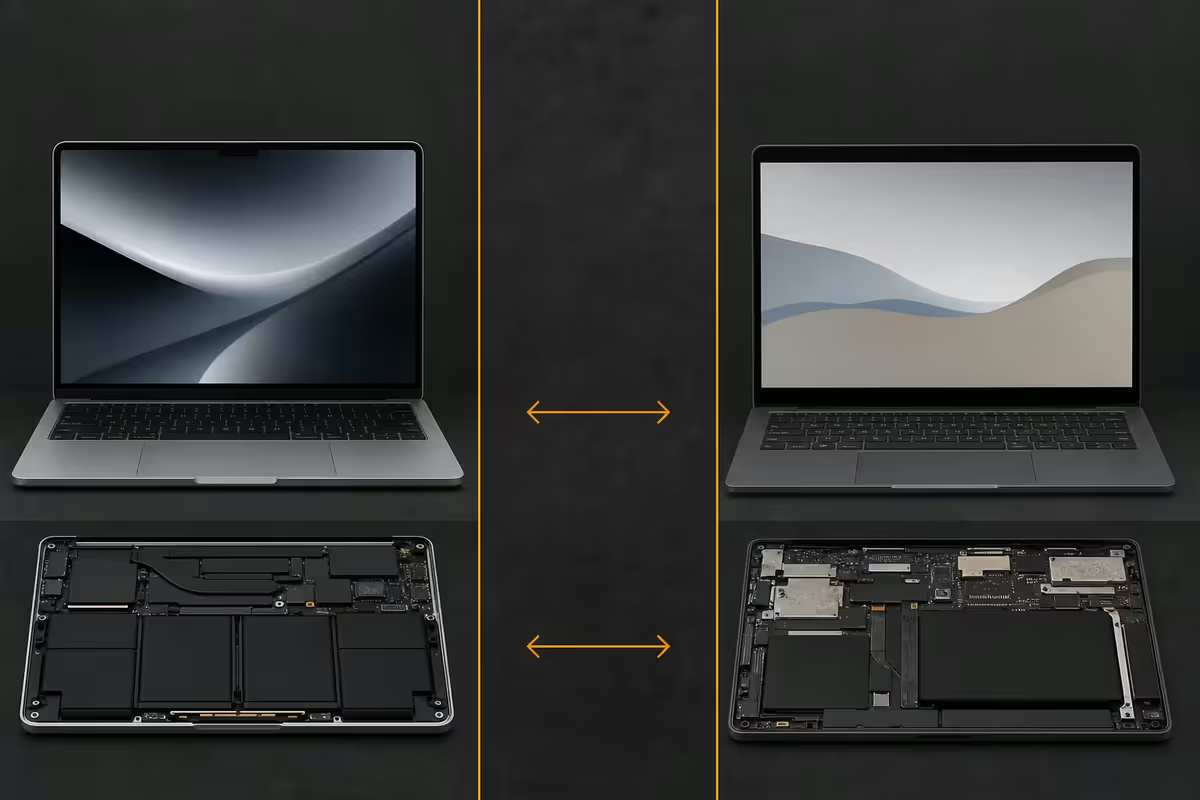
The MacBook Air M4 sets the bar for thin-and-light laptop hardware in 2026. 1.24 kg, 11.3 mm thick, fanless, all-day battery, and Apple silicon that competes with discrete-GPU Windows laptops on day-to-day workloads. The MacBook Pro 14 with M4 Pro pushes that further with active cooling, miniLED HDR display and proper port selection.
A Pixelbook-successor Googlebook would likely match Apple's industrial design quality — the original Pixelbook Go was widely praised as the best-built ChromeOS laptop ever made. Build quality is not where Google falls down. Battery life is. The Pixelbook Go hit 11-12 hours real-world. MacBook Air M4 hits 16-18 hours. Even on a hypothetical Tensor G-series ARM chip with aggressive efficiency tuning, closing that 5-6 hour gap is a tall order — Apple silicon has a multi-year head start on real-world laptop efficiency.
SA pricing reality — what each costs locally
| Model | Configuration | SA street price |
|---|---|---|
| MacBook Air 13 M4 | 16GB / 256GB | R26,000-R29,000 |
| MacBook Air 15 M4 | 16GB / 512GB | R34,000-R38,000 |
| MacBook Pro 14 M4 Pro | 24GB / 512GB | R45,000-R52,000 |
| MacBook Pro 16 M4 Max | 36GB / 1TB | R72,000-R85,000 |
| Googlebook (rumoured premium) | 16GB / 256GB (speculative) | R28,000-R38,000 est. |
| Chromebook Plus (Acer/Lenovo) | Premium ChromeOS today | R12,000-R18,000 |
Who each laptop is actually for
Buy the MacBook if…
- Your workflow touches Adobe Creative Cloud, Final Cut, Logic, Davinci Resolve, Cinema 4D or any professional creative tool.
- You're a software developer working in iOS/macOS, mobile (Flutter, React Native cross-arch matters), or any native compiled stack.
- You're a music producer, video editor, photographer with a Lightroom Classic library, or designer who needs the full Adobe stack.
- You're already in the Apple ecosystem — iPhone, iPad, AirPods, Apple Watch — and Continuity matters.
- You need the longest battery life and the most predictable, supported laptop platform money can buy.
Choose the Googlebook (or premium Chromebook today) if…
- Your day is genuinely Workspace, Gmail, Docs, Sheets, Meet, Drive, plus a few SaaS web apps.
- You're a cloud-first developer happy in VS Code (web), GitHub Codespaces, Replit or remote container workflows.
- You're an Android-first user who wants tight phone-laptop integration in the way iPhone-MacBook owners take for granted.
- You want a beautiful premium laptop without paying Apple silicon prices and don't need native pro creative tools.
- You believe Gemini's AI capability is meaningfully better than Apple Intelligence for your work — and that gap matters more than ecosystem maturity.
What would change the calculus
A genuinely competitive Googlebook would need three things to land that the rumours don't yet credibly deliver. First, native Adobe Creative Cloud on ChromeOS — at the very least Photoshop and Lightroom at full desktop parity. Without that, every creative professional remains MacBook-locked. Second, Microsoft Office desktop parity for the enterprise market. Web Office is fine for personal use but enterprise IT teams require the full desktop feature set. Third, a five-year minimum software support commitment matching Apple's. ChromeOS device support timelines have improved but are still a concern for buyers spending R30,000+.
If Google delivers all three with a Pixelbook successor, the laptop conversation in SA genuinely changes. Until then, MacBook owns the high end and Google owns the cloud-first volume tier — distinct markets that rarely cross over.
Key takeaways
- No premium "Googlebook" currently ships. The story is a rumoured Pixelbook successor on Android-ChromeOS converged platform.
- MacBook owns native pro creative tools (Adobe, Final Cut, Logic, Office desktop). ChromeOS still cannot match this structurally.
- For genuinely cloud-first Workspace users, ChromeOS in 2026 is already adequate as a primary laptop.
- Gemini wins raw AI capability; Apple Intelligence wins on-device privacy and OS-integration polish. Both useful, different strengths.
- SA reality: MacBook Air M4 from R26,000 is the shipping premium-laptop pick. Chromebook Plus at R12k-R18k covers the cloud-first volume tier.
Frequently asked questions
Does a Google laptop called a Googlebook actually exist?
Not as a current shipping product under that exact name. Google's premium laptop line peaked with the Pixelbook Go (2019). The Pixelbook brand was effectively shelved in 2023. What this guide compares is the credible premium Google laptop concept — a Pixelbook successor running a more mature ChromeOS/Android-converged platform — against current MacBook Air and MacBook Pro on Apple silicon.Why hasn't Google made a high-end laptop since the Pixelbook?
Google killed its Pixelbook team in 2022 to refocus on lower-cost Chromebook partnerships with Acer, HP, Lenovo and Asus. A new premium push remains rumoured around an Android-ChromeOS converged platform (sometimes referenced as a Fuchsia or Android-laptop pivot) but nothing has officially launched. The MacBook line, by contrast, ships unbroken yearly refreshes.Is ChromeOS finally usable as a primary work laptop in 2026?
For cloud-first Workspace users — Gmail, Docs, Sheets, Meet — yes, comfortably. ChromeOS now runs Android apps natively and a Linux container for proper Linux development. Where it still falls down: native Adobe Creative Cloud (Photoshop web is limited), Microsoft Office desktop features, professional video editing, anything DAW-based for music, and a large slice of gaming. A MacBook handles all of those without compromise.Gemini on a Googlebook vs Apple Intelligence on a MacBook — which is better?
Gemini is currently the stronger AI assistant on text reasoning, code completion, image generation and live multimodal use. Apple Intelligence focuses on private on-device summarisation, writing tools and Siri upgrades. If AI capability matters more than privacy, Gemini wins. If on-device, private, OS-integrated AI for writing and personal data matters more, Apple Intelligence is more polished.Can a Googlebook run Microsoft Office and Adobe properly?
Web versions only. Microsoft Office for Web works fine for basic editing. Adobe Photoshop Web and Illustrator on the Web are limited subsets of the desktop apps. Professional features — advanced Photoshop scripting, After Effects, Premiere Pro, Lightroom Classic — do not have ChromeOS equivalents. MacBook runs the full native suites without compromise.What does a premium Google laptop typically cost in SA versus a MacBook?
The Pixelbook Go retailed around R22,000-R26,000 in SA when last imported. A speculative new Googlebook would likely land R28,000-R38,000 to compete with MacBook Air M-series at R26,000-R38,000. MacBook Pro 14 starts around R45,000 and climbs past R85,000 fully configured. ChromeOS is generally cheaper at every tier than equivalent Apple silicon.Battery life — MacBook or Googlebook?
MacBook Air M4 reliably delivers 16-18 hours mixed use. The Pixelbook Go hit 11-12 hours. A modern Googlebook on a hypothetical Tensor G-series ARM chip could plausibly close that gap to within 1-2 hours, but Apple silicon's lead in real-world battery efficiency remains substantial as of 2026.Who should choose a Googlebook over a MacBook?
Cloud-first workers fully invested in Google Workspace, who live in Chrome, Docs, Sheets, Meet, Drive, Gmail and Android apps. Students whose institutions are Workspace-only. Anyone whose actual workload is the browser plus a few SaaS tools. If your day is Adobe, Final Cut, Logic, native dev tools, Office desktop or pro video — buy the MacBook.
Get the Evetech app
Exclusive app-only prices, daily flash sales, and free delivery on orders over R4,000 — download the app and start saving.