CPU Comparison Guide
AMD vs Intel 2026. — Honest head-to-head, no fanboy nonsense.
For the first time in 20 years, the answer isn't "it depends." For most builders in 2026, the right answer is clear — and the gap between the two camps has stopped shrinking and started widening in three specific places.
- cores top-tier
- 16 vs 24
- platforms
- AM5 vs LGA1851
- ryzen · intel split
- Gaming · Prod
What's actually different in 2026
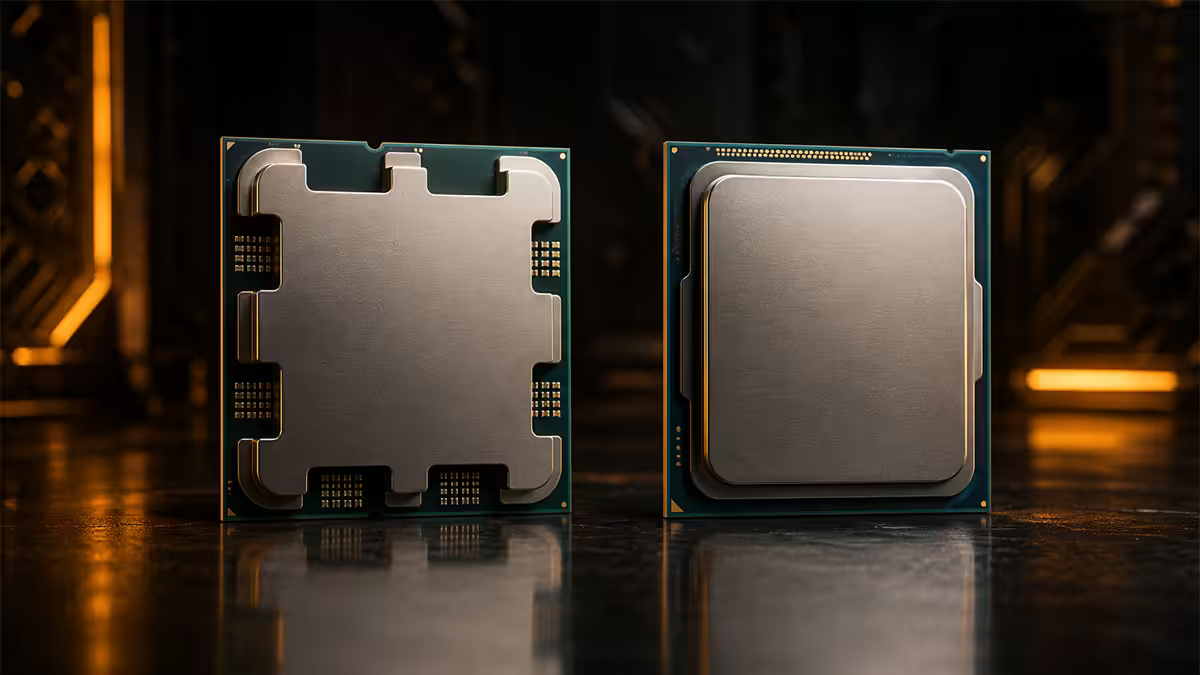
The two CPU camps have stopped looking like each other. For most of the late 2010s and early 2020s, every AMD vs Intel comparison ended with "it's close, it depends, both are fine." That's no longer true in 2026 — and the divergence is partly architectural and partly strategic.
AMD doubled down on 3D V-Cache as a gaming weapon. By stacking extra L3 cache directly on top of the CPU die, the X3D parts get a cache size (96MB on the Ryzen 7 9800X3D) that no Intel desktop part can match. Games love cache. The result: AMD now sweeps gaming benchmarks at every meaningful price tier.
Intel pivoted to a chiplet/tile architecture with Core Ultra 200 (codename Arrow Lake), separating compute, graphics, IO and SoC tiles into distinct dies bonded by Foveros packaging. The trade-off: better thermals and a modernised iGPU, but a step backwards in gaming compared to the previous-generation 14900K. Productivity scaling held up; gaming did not.
| Category | AMD Ryzen 9000 | Intel Core Ultra 200 |
|---|---|---|
| Top-tier model | Ryzen 9 9950X3D | Core Ultra 9 285K |
| Max cores / threads | 16C / 32T | 24C / 24T (8P + 16E) |
| Architecture | Zen 5 + 3D V-Cache | Lion Cove + Skymont |
| Socket | AM5 (2022-2027+) | LGA1851 (2024-?) |
| RAM | DDR5-6000 EXPO | DDR5-6400 XMP |
| iGPU | RDNA 2 (basic) | Xe-LPG (decent) |
| Hyper-threading / SMT | Yes | No (removed) |
Intel's removal of hyper-threading is the architectural detail most people miss. Core Ultra 200 has 24 physical cores but only 24 threads — there are no logical doubles. AMD's 16-core Ryzen 9 still presents 32 threads to the OS. For thread-hungry workloads (compiling, virtualisation, rendering many simultaneous tasks), this gap matters.
Gaming performance head-to-head
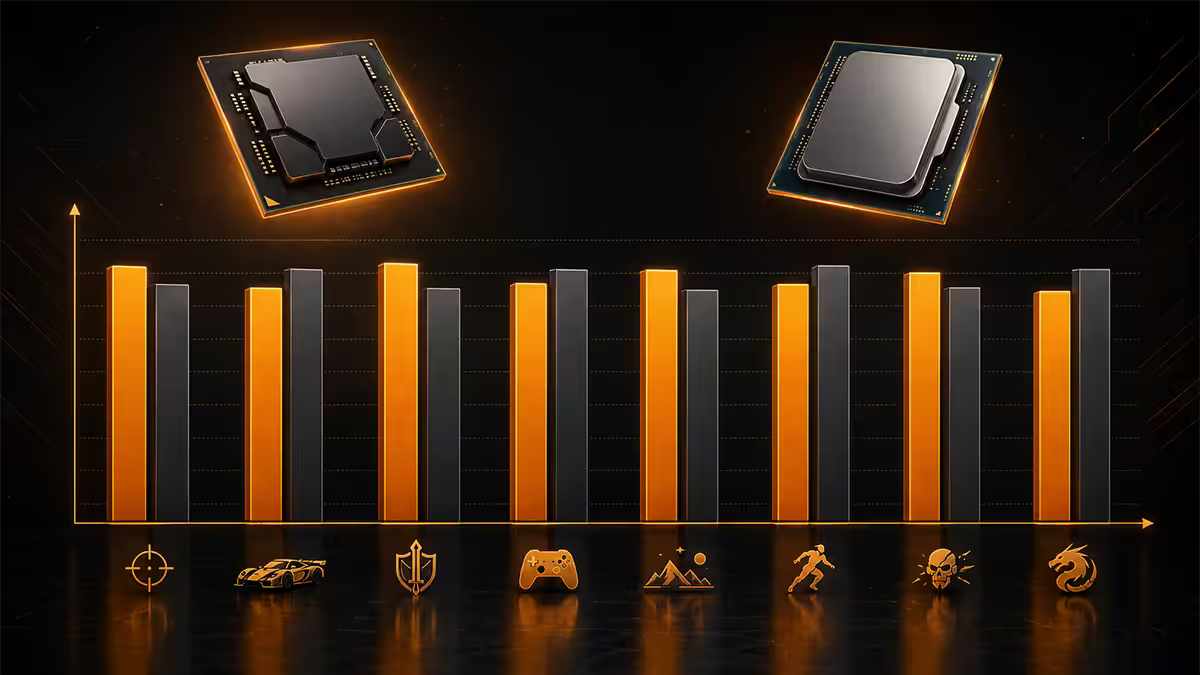
This is where AMD has built its 2026 lead. The Ryzen 7 9800X3D and Ryzen 9 9950X3D are the two fastest gaming CPUs available — full stop, no asterisk.
Average gaming benchmark deltas (1440p, RTX 4090 paired)
| Game | Ryzen 7 9800X3D | Core Ultra 7 265K | Delta |
|---|---|---|---|
| Cyberpunk 2077 (RT Ultra) | 142 fps avg | 118 fps avg | +20% AMD |
| Counter-Strike 2 | 612 fps avg | 524 fps avg | +17% AMD |
| Baldur's Gate 3 (Act 3) | 168 fps avg | 140 fps avg | +20% AMD |
| Microsoft Flight Sim 2024 | 94 fps avg | 76 fps avg | +24% AMD |
| Hogwarts Legacy | 132 fps avg | 122 fps avg | +8% AMD |
| Starfield (city interior) | 108 fps avg | 96 fps avg | +13% AMD |
The 8-24% lead isn't a single benchmark fluke — it's consistent across simulators, AAA single-player, esports and CPU-bound RPGs. The 3D V-Cache reduces L3 cache misses dramatically, which is exactly where most game engines spend their CPU time.
Intel does compete in two specific categories: highly multi-threaded simulator titles (rare) and a few esports games at low resolutions on very high refresh rate monitors (where the CPU bottleneck shifts back to clock speed, not cache). For almost every gamer, AMD wins.
Productivity head-to-head
This is the closer fight. AMD and Intel trade wins depending on the specific workload, and "productivity" hides a wide range of behaviours.
Cinebench 2024 (multi-core, higher is better)
| CPU | AMD score | Intel score | Winner |
|---|---|---|---|
| Top-tier (9950X / 285K) | 2,180 | 2,090 | AMD +4% |
| Upper-mid (9700X / 265K) | 1,420 | 1,480 | Intel +4% |
| Mid (7600X / 245K) | 980 | 1,020 | Intel +4% |
Blender BMW render (lower is better — seconds)
| CPU | AMD time | Intel time | Winner |
|---|---|---|---|
| 9950X vs 285K | 38 sec | 42 sec | AMD by 10% |
| 9700X vs 265K | 58 sec | 55 sec | Intel by 5% |
Adobe Premiere Pro: Intel's Core Ultra 9 285K wins playback timeline performance and H.265 export by 6-9% over the Ryzen 9 9950X. Adobe's encoder optimisations still favour Intel architectures, particularly when QuickSync is used as a hardware accelerator.
Compile workloads (C++, Rust, Linux kernel): AMD's 32 SMT threads win consistently — typically 8-15% faster end-to-end than Intel's 24-thread equivalent. This is where hyper-threading absence hurts Intel most.
Virtualisation and Docker: AMD wins by a wide margin (15-25%) thanks to thread count, larger cache and lower power draw under sustained load.
Power consumption & thermals
If gaming is AMD's biggest 2026 lead, power efficiency is the second-biggest — and it's not close.
| Workload | Ryzen 9 9950X | Core Ultra 9 285K |
|---|---|---|
| Idle desktop | 22W package | 18W package |
| Gaming (Cyberpunk) | 95W package | 155W package |
| Cinebench R23 multi-core | 175W package | 258W package |
| Blender sustained | 168W package | 245W package |
| Peak observed | 192W | 295W |
Practical implications: an AMD build runs noticeably cooler and quieter. A 240mm AIO is overkill on a Ryzen 9 9950X; the same cooler will throttle under sustained load on a Core Ultra 9 285K. Intel users need 360mm AIOs or premium air (Noctua NH-D15 G2) for sustained workloads. AMD users get away with R1,500-R2,500 less spend on cooling.
Idle power favours Intel marginally (the chiplet architecture has slightly higher idle power on AMD), but the gap is tiny — about R5-R8 a month at SA Eskom rates. Under load, the gap is dramatic and pushes monthly electricity costs in AMD's favour by R30-R80 per month for power users.
Platform longevity & upgrade path
Sockets matter more than people remember when they're shopping. The CPU you buy today might be your CPU for four years — but the motherboard you buy today should ideally accept the CPU you'll buy in three.
AMD AM5: launched 2022 with Ryzen 7000. Now on its third generation (Ryzen 9000). AMD has publicly committed to AM5 through 2027+, and Ryzen 10000 (Zen 6) on AM5 has already been confirmed. If you buy a B650 or X670 motherboard today, it will accept at least two more generations of CPU with BIOS updates.
Intel LGA1851: launched late 2024 with Core Ultra 200. Intel has not publicly committed to multi-generation support. Historical pattern: Intel changes sockets every 2 generations (LGA1700 ran 12th/13th/14th gen as an exception, but LGA1200 and LGA1151 each ran only 2 generations). Most analysts expect LGA1851 to be replaced by Intel's "Panther Lake" or next-generation desktop platform.
Motherboard pricing in SA (2026)
| Tier | AMD (B650 / X670) | Intel (B860 / Z890) |
|---|---|---|
| Entry (good VRM, mATX) | R3,500-R4,500 | R4,500-R5,800 |
| Mid-range (ATX, Wi-Fi) | R5,200-R7,000 | R6,500-R8,800 |
| High-end (X670E / Z890) | R8,000-R12,000 | R10,000-R15,000 |
| Flagship (X670E Apex / Z890 Dark Hero) | R12,500-R18,000 | R15,000-R22,000 |
Total motherboard saving for AMD: roughly R1,000-R3,000 across the typical build budget. That money can go straight into a better GPU or a 990 Pro Plus SSD.
Per-tier matchups for 2026
Budget tier (R4,500-R6,500 CPU)
| Spec | Ryzen 5 7500F | Core Ultra 5 245 |
|---|---|---|
| Cores / threads | 6C / 12T | 10C / 10T (6P + 4E) |
| Base / boost | 3.7 / 5.0 GHz | 3.5 / 4.9 GHz |
| SA price | R4,800 | R6,200 |
| Gaming (avg 1080p) | Excellent | Very good |
| iGPU | None (F suffix) | Xe-LPG |
| Mobo entry | R3,500 | R4,500 |
Verdict: Ryzen 5 7500F wins on price-to-performance for gaming. The 245 wins only if you specifically need the iGPU for backup display output. Total budget build saving: roughly R2,400 with AMD.
Mid tier (R8,000-R12,000 CPU)
| Spec | Ryzen 7 9800X3D | Core Ultra 7 265K |
|---|---|---|
| Cores / threads | 8C / 16T | 20C / 20T (8P + 12E) |
| L3 cache | 96MB (3D V-Cache) | 36MB |
| SA price | R10,500 | R9,200 |
| Gaming | Class-leading | Very good (15-20% slower) |
| Productivity | Strong (8C bottleneck) | Excellent (20 cores) |
| Power gaming | 80W | 140W |
Verdict: the most-debated matchup in 2026. The 9800X3D wins gaming convincingly; the 265K wins multi-core productivity by similar margins. For most buyers, the 9800X3D is the right pick — gaming gains are larger than productivity gains for typical mixed-use workflows. The 265K wins only if your hours-per-day in Premiere Pro or heavy-thread workloads exceed your hours-per-day gaming.
High-end tier (R14,000-R20,000 CPU)
| Spec | Ryzen 9 9950X3D | Core Ultra 9 285K |
|---|---|---|
| Cores / threads | 16C / 32T | 24C / 24T (8P + 16E) |
| L3 cache | 128MB | 36MB |
| SA price | R17,500 | R16,800 |
| Gaming | #1 globally | 15-20% behind |
| Cinebench multi | 2,180 | 2,090 |
| Adobe Premiere | Strong | +6-9% better |
Verdict: Ryzen 9 9950X3D for gaming + content creators. Core Ultra 9 285K only for pure Adobe Premiere workstations or corporate buyers with software stack lock-in. For everyone else, the 9950X3D is the better all-rounder.
When to pick which
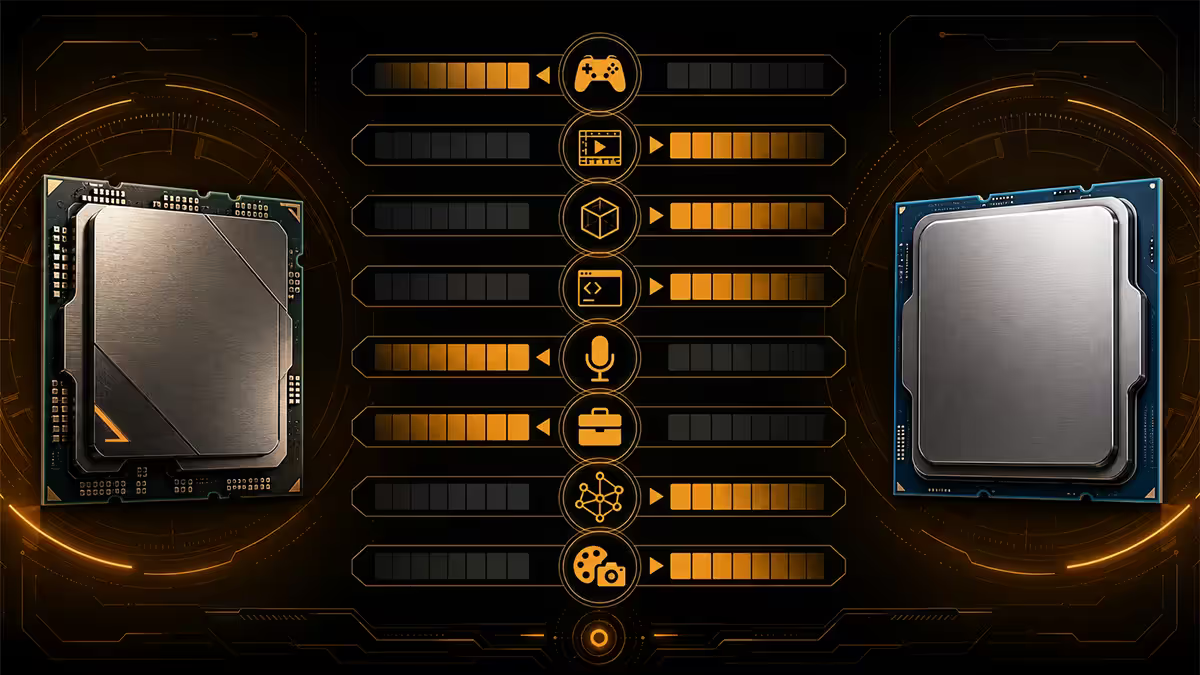
Pick AMD if…
- Gaming is more than 20% of your CPU usage time.
- You stream with NVENC (which is now most streamers).
- You compile code, run Docker, or work in heavily threaded development environments.
- You want a confirmed 2027+ upgrade path on the same motherboard.
- You're building in a small case where heat and power matter.
- Your case is SFF and you can't fit a 360mm AIO.
- Total build budget is below R30,000 (the motherboard saving compounds).
Pick Intel if…
- You spend more than four hours a day in Adobe Premiere Pro or Lightroom Classic.
- Your workplace IT environment is Intel-validated and certified.
- You're building an SFF rig and need a strong iGPU as a fallback display path.
- Your specific application has QuickSync acceleration that AMD's encoder can't match.
- You're upgrading from a 12th/13th-gen Intel and want to keep DDR5 RAM and similar BIOS layout familiarity.
Common AMD vs Intel mistakes
Buying Intel because it "feels safer". The brand-equity gap closed years ago. AMD's market share in the SA enthusiast segment passed Intel in 2023 and continues growing. Buying Intel for reputation rather than workload fit means leaving real performance on the table.
Buying X3D for productivity. The Ryzen 7 9800X3D and 9950X3D are gaming-optimised. Their X3D cache mostly doesn't help Cinebench, Blender, or compile workloads — sometimes hurts them slightly (lower base clock to fit thermals). If gaming is less than 30% of your CPU time, buy the non-X3D Ryzen instead.
Pairing a top CPU with a budget motherboard. A R3,500 B650 board with weak VRMs will throttle a Ryzen 9 9950X3D under load. Match the motherboard tier to the CPU tier — roughly R6,000-R8,000 mobo for a Ryzen 9, R4,500-R6,000 for Ryzen 7.
Buying Core Ultra 9 285K for gaming. The 285K is slower at gaming than the previous-generation Core i9-14900K and 15-20% slower than the Ryzen 7 9800X3D, while costing twice as much. If gaming is the primary use case, the 285K is the wrong pick at any price.
Skipping EXPO / XMP on RAM. Both AMD and Intel sell DDR5 kits at default 4800 MT/s without profile enable. Failing to activate EXPO (AMD) or XMP (Intel) in BIOS costs 8-15% performance for free. Always enable the profile.
Key takeaways
- AMD wins 2026 outright for gaming — the Ryzen 7 9800X3D leads every benchmark by 8-22%.
- Intel still wins Adobe Premiere, Lightroom Classic, and very specific single-threaded enterprise apps.
- AMD draws ~95W gaming vs Intel's 155W — much cooler, quieter and cheaper to cool.
- AM5 is confirmed through 2027+; LGA1851 has no published multi-generation roadmap.
- Motherboards are R800-R2,500 cheaper at every AMD tier in SA. Total build saving: meaningful.
Frequently asked questions
Is AMD or Intel better for gaming in 2026?
AMD wins gaming in 2026 thanks to 3D V-Cache. The Ryzen 7 9800X3D and Ryzen 9 9950X3D lead every gaming benchmark by 8-22% over Intel's Core Ultra 9 285K at 1080p and 1440p. Intel's only gaming advantage is in a few CPU-bound esports titles at very high refresh rates, and even there the margin is within 3-5%.Is Intel still better for productivity work?
Sometimes. Intel wins Adobe Premiere, Lightroom and single-threaded benchmarks by 4-9%. AMD wins or ties in Cinebench multi-core, Blender, compile workloads and virtualisation. For mixed productivity, AMD is the safer pick.Which CPU platform lasts longer — AM5 or LGA1851?
AM5 is confirmed through 2027+ with Ryzen 10000 (Zen 6) coming. LGA1851 has no published multi-generation roadmap and historically Intel changes sockets every 2 generations. AM5 is safer long-term.Does AMD or Intel use less power?
AMD wins power efficiency by a wide margin. Ryzen 9 9950X draws 170W full-load; Core Ultra 9 285K draws 250W+. Gaming gap is even wider — Ryzen 7 9800X3D at 80-100W vs Core Ultra 7 265K at 130-170W.Are AMD motherboards cheaper than Intel motherboards in South Africa?
Yes — by R800-R2,500 at every tier. AM5 B650 boards start ~R3,500; equivalent LGA1851 B860 boards start ~R4,500. High-end X670E vs Z890 gap is R2,000+.Do AMD and Intel both use DDR5 RAM in 2026?
Yes. AM5 has been DDR5-only since 2022. LGA1851 is also DDR5-only — Intel dropped DDR4 with Core Ultra 200. Both support DDR5-6000 to DDR5-8000 with EXPO (AMD) or XMP (Intel) profiles.Should I buy AMD or Intel for a streaming PC?
AMD for most streamers. Modern GPU NVENC encoding handles streaming without taxing the CPU, so the gaming-leading Ryzen 7 9800X3D delivers higher in-game FPS and identical stream quality. Intel only wins for x264-CPU encoders.What is the difference between AMD X3D chips and regular Ryzen?
X3D chips stack additional L3 cache on top of the CPU die. 96MB on Ryzen 7 9800X3D vs 32MB on 9700X. Extra cache massively boosts gaming (15-25%) but doesn't help productivity. X3D for gaming; non-X3D for productivity.
Get the Evetech app
Exclusive app-only prices, daily flash sales, and free delivery on orders over R4,000 — download the app and start saving.