Apple Silicon Complete Family Guide
Apple Silicon, M1 to M5. — Five generations, twenty-six chips, one family.
Six years since Apple shipped the M1 and changed the laptop industry. Five generations later, the family map is genuinely confusing. Here's every chip, what it does, and which one is still the smart buy in 2026.
- M1 to M5
- 5 gens
- base / Pro / Max / Ultra
- 4 tiers
- software support
- 7+ yrs
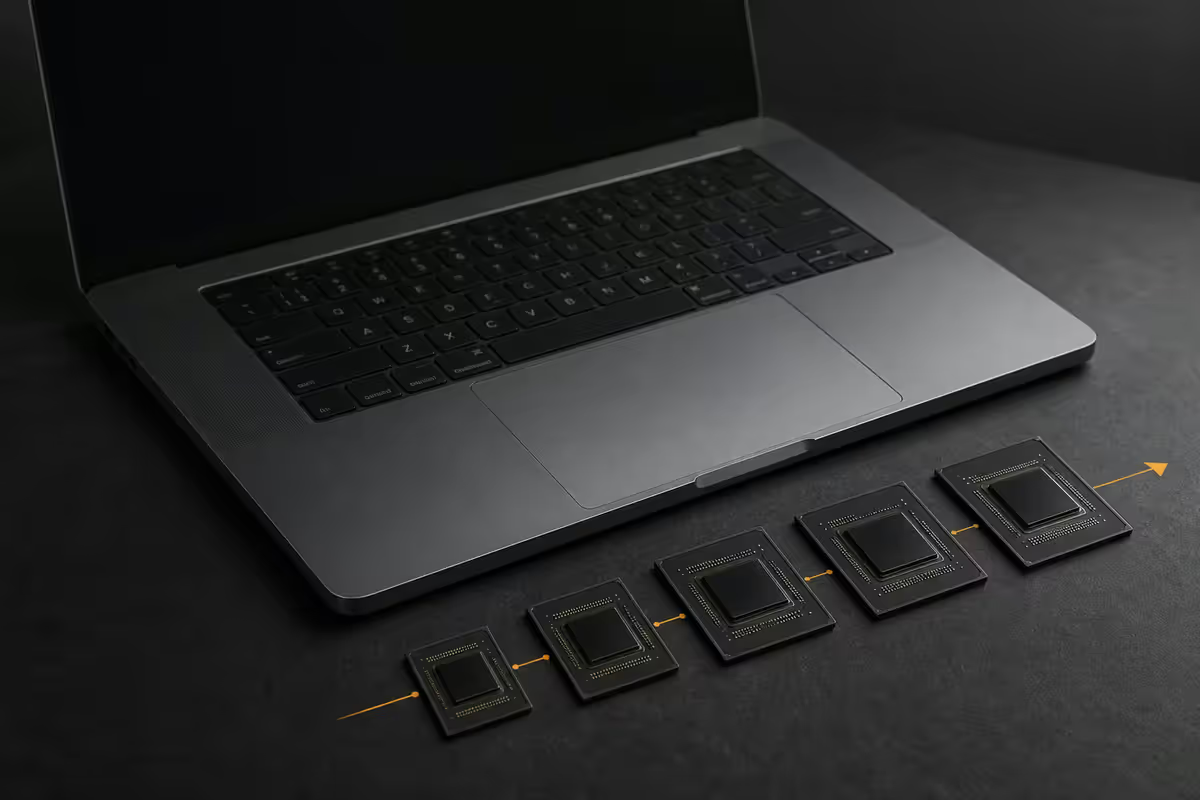
The Apple Silicon family — at a glance
Apple has shipped five generations of Apple Silicon since November 2020. Each generation has 3-4 tier variants. Understanding the matrix is the first step to making a smart 2026 buying decision.
| Gen | Launched | Process | Base RAM | Still worth buying? |
|---|---|---|---|---|
| M1 | Nov 2020 | 5nm N5 | 8 GB | Refurb only — entry users |
| M2 | Jun 2022 | 5nm N5P | 8 GB | Refurb only — budget sweet spot |
| M3 | Oct 2023 | 3nm N3B | 8 GB | Excellent refurb value |
| M4 | May 2024 | 3nm N3E | 16 GB | Best new-buy value post-M5 launch |
| M5 | 2026 | 3nm N3P | 16 GB | Latest — buy for longest life |
M1 (2020) — the disruptor
The chip that changed laptops. Released November 2020, the M1 delivered 2-3x perf-per-watt over the Intel Macs it replaced, plus 15+ hour battery life in a MacBook Air. Made Intel obsolete in the consumer Mac line within 12 months.
Key specs: 8-core CPU (4P + 4E), 7 or 8-core GPU, 16-core Neural Engine, 8 or 16 GB unified memory, 5nm N5 TSMC process. ~16 billion transistors.
What it powered: MacBook Air M1 (2020), MacBook Pro 13 M1 (2020), Mac mini M1 (2020), iMac M1 (2021), iPad Pro 2021, iPad Air 2022. The M1 Pro/Max variants powered the MacBook Pro 14/16 redesign in 2021.
Still worth buying in 2026? For refurbished entry users only. Refurbished M1 MacBook Air sells for R8,500-R11,000 in SA in 2026. macOS Sequoia still runs on it. Browser, Office, video calls, Spotify, Netflix — all fine. Skip M1 if you want: Apple Intelligence (needs M4 or later for full features), local LLM inference, video editing 4K+ workflows.
M2 (2022) — refinement
Modest gen-on-gen improvement (~10-15% over M1) on the same 5nm family. Refined cores, slightly more GPU cores, better memory bandwidth. The M2 generation introduced the redesigned MacBook Air 13/15 in 2022/2023 and got the MacBook Pro 13 retired.
Key specs: 8-core CPU, 10-core GPU, 16-core Neural Engine, 8/16/24 GB unified memory, 5nm N5P TSMC process. ~20 billion transistors.
What it powered: MacBook Air 13 M2 (2022), MacBook Air 15 M2 (2023), MacBook Pro 13 M2 (2022 — last MBP 13), Mac mini M2 (2023), Mac Studio M2 Max/Ultra (2023), Vision Pro (2024).
Still worth buying in 2026? Refurbished MacBook Air M2 at R11,500-R13,500 is the sub-R14k Mac value champion. Same comments as M1 — fine for daily browser/Office, falling short for AI-heavy or creative-heavy workflows.
M3 (2023) — first 3nm
First Apple Silicon on TSMC's 3nm process (N3B). Significant perf-per-watt jump (~25% over M2). Introduced hardware ray tracing on Apple GPU. Mid-generation refresh of the MacBook Pro 14/16 line.
Key specs: 8-core CPU, 8-10 core GPU with hardware ray tracing, 16-core Neural Engine (18 TOPS), 8/16/24 GB unified memory, 3nm N3B TSMC process. ~25 billion transistors.
What it powered: MacBook Pro 14/16 M3 (Oct 2023), MacBook Air M3 (March 2024), iMac M3 (Oct 2023), iPad Pro M3 (delayed to M4 instead).
Still worth buying in 2026? Refurbished MacBook Air M3 at R13,000-R15,000 is genuinely excellent — first 3nm chip, GPU ray tracing, near-M4 performance, still receiving full macOS updates through 2030+. The 8GB base is the only meaningful weakness; refurb M3 with 16GB at R15,500 is the sweet spot.
M4 (2024) — AI lift
The first chip designed with Apple Intelligence in mind. Major Neural Engine upgrade to 38 TOPS. Adopted the new N3E process (refined 3nm), with significant perf-per-watt gain over M3. First chip in the family where Apple Intelligence runs comfortably.
Key specs: 8-10 core CPU, 10-core GPU, 16-core Neural Engine (38 TOPS), 8/16/24/32 GB unified memory, 3nm N3E TSMC process. ~28 billion transistors.
What it powered: iPad Pro M4 (May 2024), MacBook Pro 14 base M4 (late 2024), iMac M4, Mac mini M4. M4 Pro/Max in MacBook Pro 14/16 Pro/Max (late 2024). M4 Ultra in Mac Studio Ultra (early 2025).
Still worth buying in 2026? Genuinely yes — and arguably the smartest new Mac buy in 2026 thanks to post-M5 launch discounts. M4 inventory drops 10-20% the week M5 ships. M4 MacBook Air at R18,500 (was R22,999 RRP) is excellent value with Apple Intelligence support and 7+ year software-update window.
M5 (2026) — 16GB base
The 2026 latest generation. Refined N3P process (~5-10% perf-per-watt gain over M4). The headline change is structural rather than performance-related: 16GB unified memory standard on every base Mac. First M-chip with native AV1 encode. 50 TOPS Neural Engine for full Apple Intelligence support.
Key specs: 8-core CPU, 10-12 core GPU, 16-core Neural Engine (50 TOPS), 16/24 GB unified memory standard, 120 GB/s bandwidth, 3nm N3P TSMC process. ~28 billion transistors.
What it powers: MacBook Air 13/15 M5, MacBook Pro 14 base M5, iPad Pro M5, Mac mini M5, iMac M5 (late 2026). M5 Pro/Max in Q4 2026 / Q1 2027 MacBook Pro Pro/Max and Mac Studio.
Should you buy in 2026? Yes for the longest software-support window and the only base Mac with 16GB RAM standard. SA launch RRP R19,999, softening to ~R18,000 at independents within 6 weeks. Full M5 deep dive here.
Pro, Max, Ultra — what changes across tiers
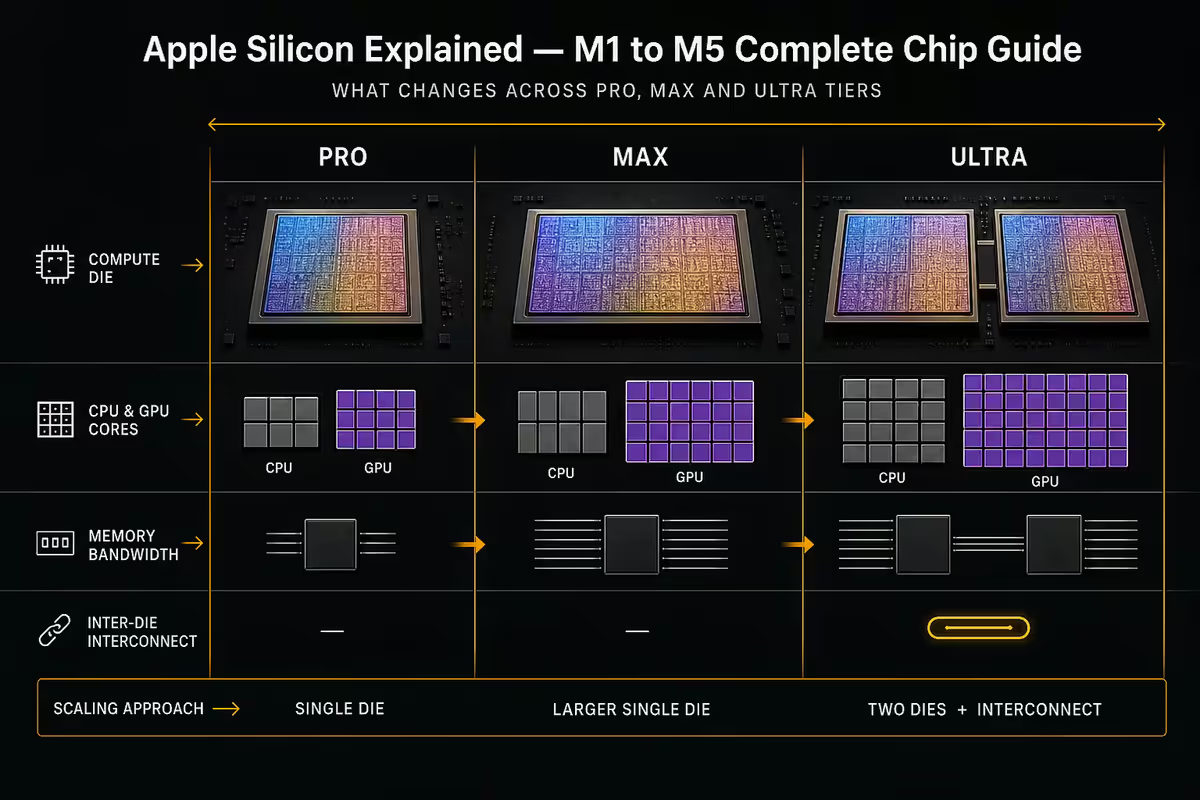
Within each generation, Apple offers stepped-up variants for users who need more compute. The naming is consistent: Pro → Max → Ultra, with each step adding cores, memory and price.
| Tier | CPU cores | GPU cores | Max RAM | Macs that use it |
|---|---|---|---|---|
| Base (e.g. M5) | 8 (4P + 4E) | 10-12 | 24 GB | Air, Mac mini, base MBP 14 |
| Pro (e.g. M4 Pro) | 10-12 (8-10P + 4E) | 16-20 | 36-48 GB | MBP 14 Pro, Mac mini Pro |
| Max (e.g. M4 Max) | 12-16 | 32-40 | 96-128 GB | MBP 14/16 Max, Mac Studio |
| Ultra (e.g. M4 Ultra) | 24-32 | 60-80 | 192 GB | Mac Studio Ultra, Mac Pro |
How tiers are built: Pro = wider base die with more cores. Max = even wider die. Ultra = literally two Max dies fused via Apple's UltraFusion silicon bridge (3 TB/s interconnect bandwidth). The Ultra is the only Apple Silicon variant that isn't a single die.
Pricing pattern: Each tier roughly doubles the price of the one below. M5 base R19,999 → M5 Pro ~R39,999 → M5 Max ~R69,999 → M5 Ultra ~R119,999+ (when they launch).
Who needs each tier:
- Base: most users. Office, browser, video calls, light photo editing, casual coding.
- Pro: Heavy creative work — video editing (1080p/4K), 3D, large Lightroom catalogues, daily Xcode use.
- Max: Professional video production (8K, multi-stream timelines), 3D rendering, machine learning training.
- Ultra: Workstation-class work — film post-production, finite element analysis, server workloads, large-scale ML inference.
2026 second-hand market reality
SA refurbished and second-hand Apple Silicon prices reflect remarkable value retention. Six-year-old M1 Airs still sell for half their original price — almost no other consumer tech holds value this well.
| Chip | Mac (used) | 2026 SA price | Best for |
|---|---|---|---|
| M1 (2020) | MacBook Air 13 M1, 8/256 | R8,500-R11,000 | Entry user, student, second laptop |
| M1 Pro (2021) | MacBook Pro 14 M1 Pro, 16/512 | R14,000-R17,000 | Creative work on a budget |
| M2 (2022) | MacBook Air 13 M2, 8/256 | R11,500-R13,500 | Modern feel, more battery, slightly faster |
| M2 Pro (2023) | Mac mini M2 Pro, 16/512 | R12,000-R15,000 | Desktop value champion |
| M3 (2023) | MacBook Air M3, 8/256 | R13,000-R15,000 | 3nm chip, ray tracing, modern AI-ready |
| M3 Pro (2023) | MacBook Pro 14 M3 Pro, 18/512 | R23,000-R27,000 | Prosumer creative + dev sweet spot |
| M4 (2024) | MacBook Air M4, 16/256 | R17,000-R19,500 | Apple Intelligence, near-new feel |
| M4 Pro (2024) | MacBook Pro 14 M4 Pro, 24/512 | R34,000-R39,500 | True workstation, 2026 sweet spot★ |
The 2026 sweet spot — M4 Pro / M5 base
Across the family, two chips genuinely stand out as 2026 buys:
M5 base — for new buyers, students, professionals
First base M-chip with 16GB RAM standard. Full Apple Intelligence support. 7+ year software window through 2033+. SA launch RRP R19,999. The right answer for most buyers.
M4 Pro — for creatives, developers, prosumers
Post-M5-launch discount makes the MBP 14 M4 Pro (R39,999) a genuine workstation at near-base price. 12-core CPU + 18-20 GPU + 36GB RAM = true Pro performance. Still supported through 2031+. The right answer for the 20% who need real GPU compute and RAM headroom.
For everyone else — refurbished M3 Air
R13,000-R15,000 for the M3 MacBook Air with 16GB RAM is the best low-budget Mac purchase you can make in SA in 2026. Will run macOS happily through 2030+. Skip M1 unless your budget is genuinely R10k or below.
Common Apple Silicon buying mistakes
Buying the 8GB base. Across every generation, 8GB has been the wrong choice for buyers who keep their Macs 4+ years. M5's 16GB standard fixes this — but for M1/M2/M3/M4 buyers, always pay for 16GB.
Buying the Pro chip "to be safe". If your workload is browser, Office and video calls, the Pro chip is wasted money. The base chip is faster than you think; the RAM upgrade matters more.
Skipping refurbished. Apple Silicon Macs hold value because they last. The refurbished M2/M3 market is genuinely good value, not a downgrade.
Buying Ultra without the workload. The Ultra is for finite element analysis, 8K video and ML training. If you're a freelancer or even a small studio, you don't need it — the Max is plenty.
Waiting indefinitely for the next chip. Apple ships an M-chip every 12-18 months. Wait for M6, you'll be waiting for M7. Buy when you need it.
Key takeaways
- Five Apple Silicon generations: M1 (2020) → M2 (2022) → M3 (2023) → M4 (2024) → M5 (2026). Each has 3-4 tier variants.
- 2026 sweet spots: M5 base (new buyers, R19,999) and M4 Pro (creatives/devs at R39,999 after M5 launch discount).
- M1 still works for entry users — refurb M1 Air at R8,500-R11,000 is the budget champion.
- Pro/Max/Ultra each roughly doubles the price of the tier below. Most users don't need above base.
- Always pay for 16GB RAM on M1-M4. M5 ships with 16GB standard — the single biggest practical upgrade in five years.
Frequently asked questions
What are the Apple Silicon chips in order?
M1 (2020) → M2 (2022) → M3 (2023) → M4 (2024) → M5 (2026). Each generation has 4 tiers: base, Pro, Max, Ultra. ~26 mainstream variants total across the five gens.Is an M1 Mac still worth buying in 2026?
Yes for entry users. Refurbished M1 Air at R8,500-R11,000 handles browser, Office, video calls, Spotify perfectly. Still receives macOS Sequoia updates. Skip M1 if you want Apple Intelligence or buy-and-hold longevity.What is the best Apple Silicon Mac to buy in 2026?
For entry users — MacBook Air M5 (R19,999) or refurb M3 Air (R13,000). For prosumers — MacBook Pro 14 M4 Pro (R39,999). For workstation users — Mac Studio M4 Max (R49,999) or wait for M5 Max in early 2027.M-chip Pro vs Max vs Ultra — what's the difference?
Base = entry Macs. Pro = stronger CPU, 2x GPU, 24-36GB RAM. Max = even stronger GPU (32-40 cores), 48-96GB RAM. Ultra = two Max dies fused via UltraFusion — 24-32 CPU, 60-80 GPU, 64-192GB RAM. Each tier roughly doubles the price.How long do Apple Silicon Macs last?
7+ years of macOS support based on the M1 precedent. Aluminium chassis lasts 10+ years. Battery replacement typically year 4-5 at R3,500-R4,500. SSD has 600 TBW endurance — 8-12 years for typical users.What is perf-per-watt on Apple Silicon?
Performance per watt = compute delivered per unit of power. Apple's biggest advantage over Intel: M1 was 2-3x Intel's perf-per-watt at launch; M5 is ~4x M1. Real-world: fanless silent operation, 15-18 hour battery, cool to the touch under load.Should I buy a refurbished Apple Silicon Mac in 2026?
Refurbished M3 and M4 are excellent value. Apple Certified Refurb = 12-month warranty, 15-20% off. Independents (iStore Refurb, Digicape) = 6-12 month warranty, 25-40% off. Avoid Gumtree without warranty.What is the M-chip sweet spot for value?
M4 Pro in MacBook Pro 14 (R39,999) for creatives and developers, or M5 base in MacBook Pro 14 (R29,999) for prosumers. Both will feel fast in 2030.
Get the Evetech app
Exclusive app-only prices, daily flash sales, and free delivery on orders over R4,000 — download the app and start saving.