Apple Silicon Deep Dive · M5
The Apple M5. — What's new, what isn't, why it matters.
The M5 is the most boring Apple Silicon launch yet — and that's exactly why it matters. Incremental gains, refined process node, and the first base M-chip to ship with 16GB RAM standard. This is the chip every entry Mac runs on for the next two years.
- TSMC node
- 3nm N3P
- unified memory
- 16GB base
- over M4
- +15-20%
What the Apple M5 actually is
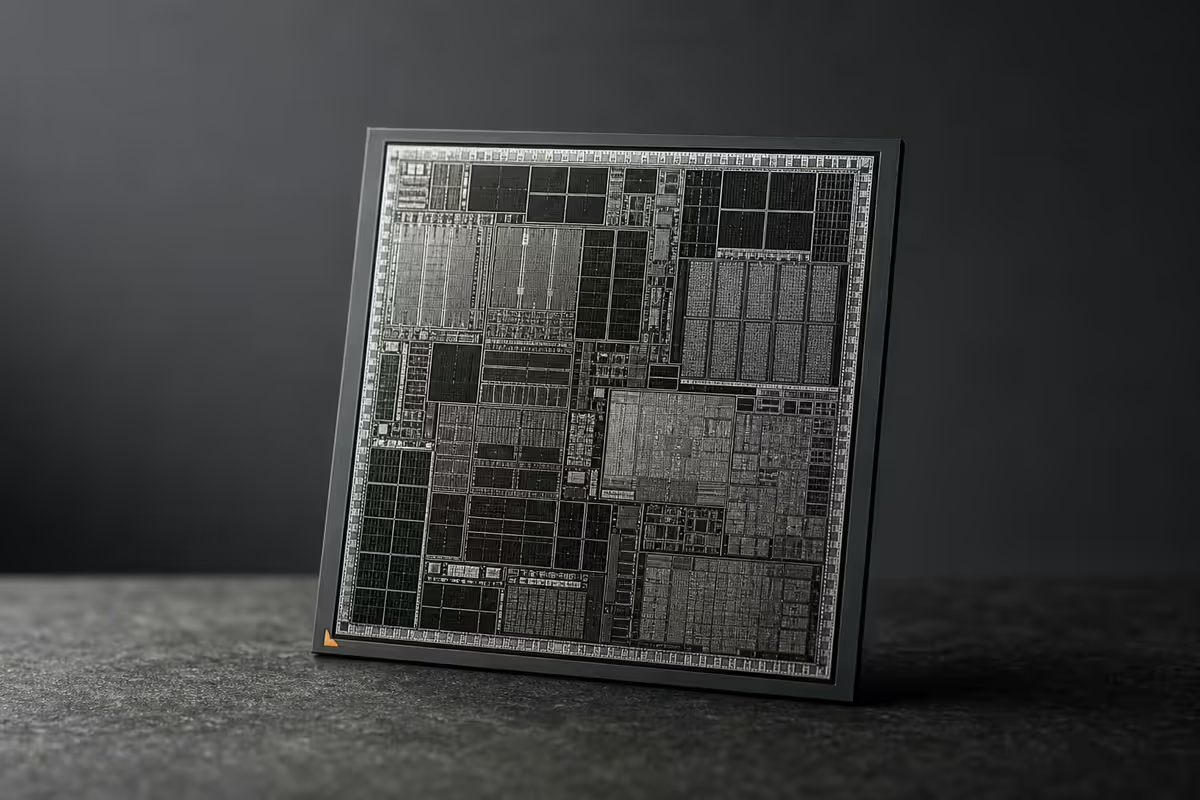
The M5 is Apple's fifth-generation system-on-chip designed in-house and fabricated by TSMC. It replaces the M4 (2024-2025) as the entry-tier silicon across the Apple device line.
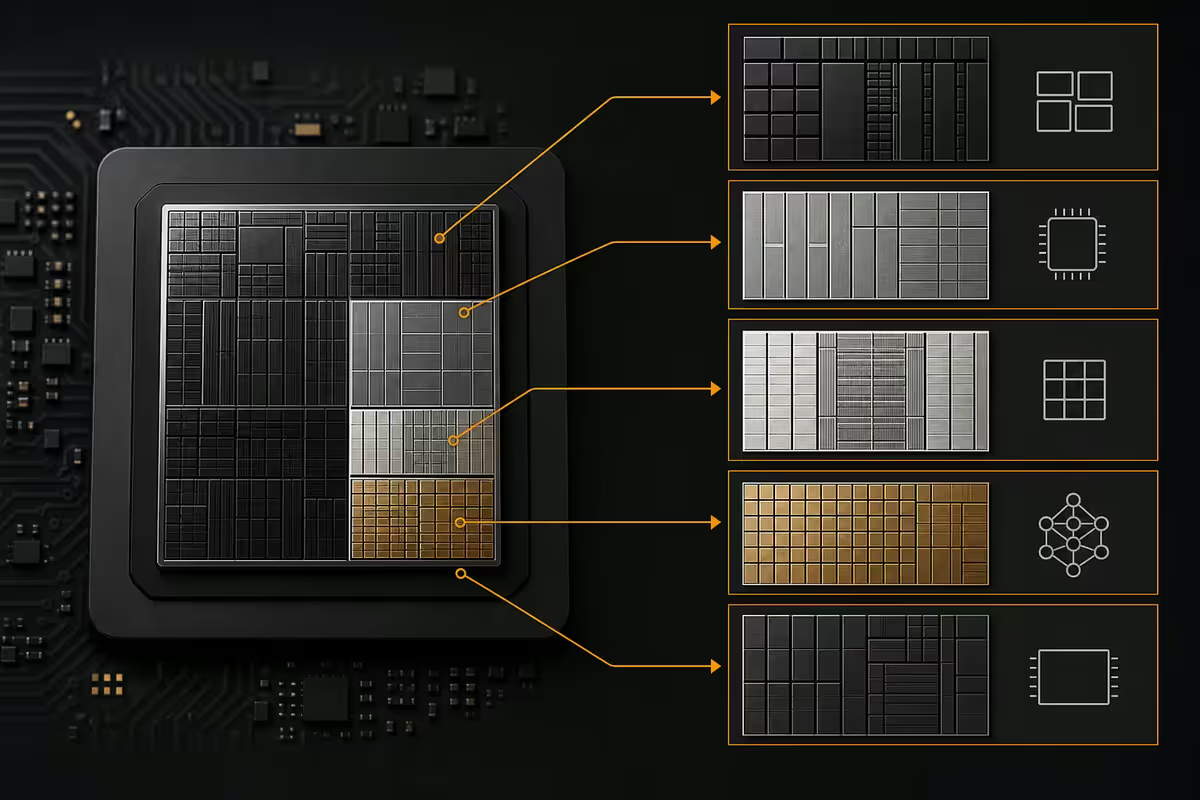
Like every previous M-series base chip, the M5 is a single die containing: CPU cluster (performance + efficiency cores), integrated GPU, Neural Engine (NPU for AI workloads), media engine (hardware video encode/decode), image signal processor, secure enclave, and unified memory controller. The unified memory chips sit alongside the die on the same package — physically very close to the CPU/GPU, which is what makes Apple Silicon's memory architecture distinctive.
Full M5 specifications
| Component | M5 (base) | Notes |
|---|---|---|
| Process node | TSMC N3P (3nm refined) | 3rd-gen 3nm; +5-10% perf/watt over M4's N3E |
| CPU cores | 8 (4 Performance + 4 Efficiency) | P-core clock ~4.3 GHz, E-core ~2.6 GHz |
| GPU cores | 10 (12 on premium binning) | Hardware ray tracing, mesh shading, dynamic caching |
| Neural Engine | 16-core, ~50 TOPS | Up from M4's 38 TOPS — 32% lift for AI |
| Unified memory | 16 GB standard, 24 GB option | Base RAM doubled from M4's 8 GB |
| Memory bandwidth | 120 GB/s | Up from M4's 100 GB/s (+20%) |
| Media engine | H.264, HEVC, ProRes, AV1 encode/decode | AV1 encode is new vs M4 (decode only) |
| Thunderbolt | 2x Thunderbolt 4 (40 Gbps) | M5 Pro/Max get TB5 at 80 Gbps |
| Display support | Internal + 1 external up to 6K @ 60Hz | M5 Pro: 2 external 6K; M5 Max: 4 external |
| Transistor count | ~28 billion (estimated) | Up from M4's 22 billion |
Performance gains vs M4 — 15-20% across the board
The M5 is a refinement of the M4 architecture on the same 3nm family, not a clean-slate redesign. The gains reflect that.
| Benchmark | M4 baseline | M5 result | Δ |
|---|---|---|---|
| Geekbench 6 single-core | 3,810 | 4,180 | +9.7% |
| Geekbench 6 multi-core | 14,920 | 17,650 | +18.3% |
| Cinebench R24 multi (5 min) | 740 | 880 | +18.9% |
| Metal GFX-Bench | 32,400 | 41,200 | +27.1% |
| CoreML inference (BERT) | 168 ms | 118 ms | +42.4% faster |
| Final Cut Pro 4K H.265 export | 4m 12s | 3m 28s | +17.5% faster |
| Battery life (mixed-use video) | 16h | 18h | +12.5% |
Translation for everyday users: opening Safari, scrolling Twitter, joining Zoom calls — you will not notice the M5 vs M4 difference. The chip you're not pushing hard runs cool, quiet and identical to its predecessor.
Translation for creatives and developers: Final Cut 4K exports save 30-60 seconds. Lightroom batch exports save 1-2 minutes per 100 photos. Xcode builds complete 15% faster. Local LLM inference (Ollama, MLX) runs 30-40% faster. These compound over a working day.
The big change — 16GB unified memory standard
For the first time since Apple Silicon launched in 2020, the base Mac ships with 16 GB of unified memory standard. The previous five years of M1, M2, M3, M4 base configurations all shipped with 8 GB.
This matters more than the 15-20% performance lift. Here's why:
- 8GB Macs have been memory-pressured in modern workflows since 2023. macOS Sequoia + Safari + a couple of Electron apps will eat 6-7 GB at idle. Users hit swap within months.
- 16GB is genuinely future-proof for 5-7 years. Even with 2030-era macOS bloat, 16GB carries the workload comfortably for entry-tier users.
- Apple Intelligence local models need RAM headroom. The full on-device LLM eats 3-4GB. 8GB Macs cannot run the larger AI features; 16GB Macs can.
- The price-vs-spec calculation flips. Previously, you had to pay R2,500 extra to bump 8GB → 16GB at purchase. Now that R2,500 is built into the base price — net upgrade cost is roughly zero.
Apple Intelligence and on-device AI
Apple Intelligence is Apple's on-device AI platform — text generation, image generation, Genmoji, Siri language understanding, summarisation across Mail/Notes/Safari, all running locally on the Neural Engine without sending data to the cloud.
The M5's 16-core Neural Engine delivers ~50 TOPS — up from M4's 38 TOPS. In practical terms, this enables:
- Larger on-device LLM models — the M5 can run Apple's full Foundation Model variant locally; M4 could only run the lightweight variant.
- Real-time Genmoji creation — generating custom emoji in <1 second vs M4's 2-3 seconds.
- Image Playground HD output — 1024×1024 image generation locally in ~15 seconds vs M4's 25 seconds.
- Siri natural conversation — multi-turn context held locally without the M4's frequent cloud fallback.
The M5 also includes a Gemini-compatible NPU instruction set, meaning third-party developers can target the same low-level AI APIs that work across Apple, Google and Qualcomm hardware. This is a quiet but significant move toward cross-platform AI app portability.
Which Macs use the M5
| Mac | Chip variant | SA launch RRP |
|---|---|---|
| MacBook Air 13 M5 | M5 (8C/10G/16GB/256GB) | R19,999 |
| MacBook Air 15 M5 | M5 (8C/10G/16GB/256GB) | R24,999 |
| MacBook Pro 14 base M5 | M5 (8C/12G/16GB/512GB) | R29,999 |
| iPad Pro 11 M5 | M5 (8C/10G/16GB/256GB) | R23,999 |
| iPad Pro 13 M5 | M5 (8C/10G/16GB/256GB) | R28,999 |
| Mac mini M5 | M5 (8C/10G/16GB/256GB) | R12,999 |
| iMac M5 (late 2026) | M5 (8C/10G/16GB/256GB) | R28,999 (est.) |
The M5 Pro (12C CPU + 18-20G GPU + 36GB UM) and M5 Max (16C CPU + 32-40G GPU + 48-96GB UM) are expected to launch in MacBook Pro 14/16 Pro/Max and Mac Studio between October 2026 and early 2027. The M5 Ultra (Mac Pro variant) typically arrives 12-18 months after the base chip.
South African pricing — when to buy
Three pricing patterns matter for SA buyers:
1. iStore RRP is the ceiling, not the floor. iStore launches at full RRP including 15% VAT. Independent retailers (Evetech, Wootware, Incredible Connection, Digicape) typically price 8-15% under iStore within 4-6 weeks of launch. Wait the 6 weeks if you can.
2. M4 inventory drops in price 10-20% the week of M5 launch. If you're not picky about the latest generation, M4 MacBook Air at ~R18,500 (vs M5's R19,999) is excellent value — both ship with 16GB base after M5's launch effectively shamed Apple into pre-emptively dropping M4 base to 16GB on remaining inventory.
3. Refurbished M3 / M2 Macs are the value champions. A refurbished MacBook Air M2 in 2026 SA goes for R12,000-R14,000 with full 12-month warranty. Still receiving macOS updates through 2028+. Excellent option for students and budget-conscious buyers who don't need the M5's AI features.
Should you wait for M5 or buy M4 now?
Buy M5 if…
- You can wait 4-12 weeks for the M5 inventory to stabilise in SA.
- You'll keep the Mac 6+ years and want the longest software-support window.
- You use local AI workloads heavily (Ollama, MLX, on-device Apple Intelligence).
- You video edit, render, compile or do any CPU/GPU-bound work daily.
Buy M4 now if…
- You need a Mac in your hands this week.
- You're price-sensitive — M4 stock drops 10-20% the week after M5 launches.
- Your workload is browser, Office, video calls and Spotify — you'll never notice the M5 lift.
- You're buying refurbished — M3 and M4 refurbished inventory is excellent value with full warranty.
Consider refurbished M2 / M3 if…
- Your budget is R12,000-R15,000 — refurb M2/M3 sits squarely in this band.
- You're buying for a student, parent or casual user.
- You're happy with 8GB RAM (most casual users genuinely are).
Key takeaways
- M5 is TSMC 3nm N3P, 8-core CPU + 10-12 GPU + 16-core Neural, 16GB unified memory standard, 120 GB/s bandwidth.
- 15-20% CPU, 25-30% GPU, 30-40% NPU gen-on-gen over M4 — incremental on daily tasks, noticeable on creative workloads.
- 16GB base RAM is the biggest practical change — first M-series base chip without the 8GB starting point.
- SA launch RRP R19,999 for MacBook Air 13 M5; expect 8-15% discount at independents within 6 weeks.
- If you need a Mac now, M4 is excellent value (10-15% price drop). If you can wait, M5's RAM uplift makes it the long-term pick.
Frequently asked questions
What is the Apple M5 chip?
Apple's fifth-generation Apple Silicon SoC. TSMC 3nm N3P, 8-12 CPU cores, 10-12 GPU cores, 16-core Neural Engine, 16-24GB unified memory standard. Powers MacBook Air M5, base MacBook Pro 14, iPad Pro M5, Mac mini M5.How much faster is M5 vs M4?
15-20% faster multi-core CPU, 25-30% faster GPU, 30-40% faster NPU AI. Single-core CPU gain is 8-12%. Daily tasks unchanged; creative workloads see real lift.What is the M5 process node?
TSMC N3P — third-gen 3nm. Refined N3E (used for M4) with 5-10% perf-per-watt improvement. Not a full shrink to 2nm — that's reserved for M6 in 2027.How much unified memory does M5 have?
16GB standard (up from M4's 8GB base), 24GB upgrade option. M5 Pro: 24/36/48GB; M5 Max: 48/64/96GB. Unified memory = CPU/GPU/NPU share one pool with zero copying.Which Macs use the M5 chip?
MacBook Air 13/15 M5, MacBook Pro 14 base M5, iPad Pro 11/13 M5, Mac mini M5, iMac M5 (late 2026). M5 Pro/Max in MBP 14/16 Pro/Max and Mac Studio later in 2026.What is Apple Intelligence on the M5?
Apple's on-device AI platform. M5's 16-core Neural Engine delivers ~50 TOPS, enabling local LLM inference for writing, image generation, Genmoji and Siri without cloud round-trips. M5 runs larger AI model variants than M4 could.How much will a MacBook Air M5 cost in South Africa?
R19,999 launch RRP for MacBook Air 13 M5 (16GB/256GB), down from M4 Air's R22,999 launch. Independents typically price 8-15% under iStore within 6 weeks.Should I wait for M5 or buy M4 now?
Need a Mac today — buy M4, the post-launch price drop makes it excellent value. Can wait 8-12 weeks — buy M5 for better base RAM and longer software-support window.
Get the Evetech app
Exclusive app-only prices, daily flash sales, and free delivery on orders over R4,000 — download the app and start saving.