Laptop Buyer's Guide
Intel Core Ultra vs Core i. — What the rebrand actually changed.
Intel's 2024 mobile rebrand wasn't just a logo swap. New NPU silicon, a generation-leap iGPU and a scoring reset that breaks the old "i7 is better than i5" mental model. Here's what laptop shoppers in 2026 actually need to know.
- rebrand year
- 2024
- series 2 NPU
- 48 TOPS
- on new mobile
- No "i"
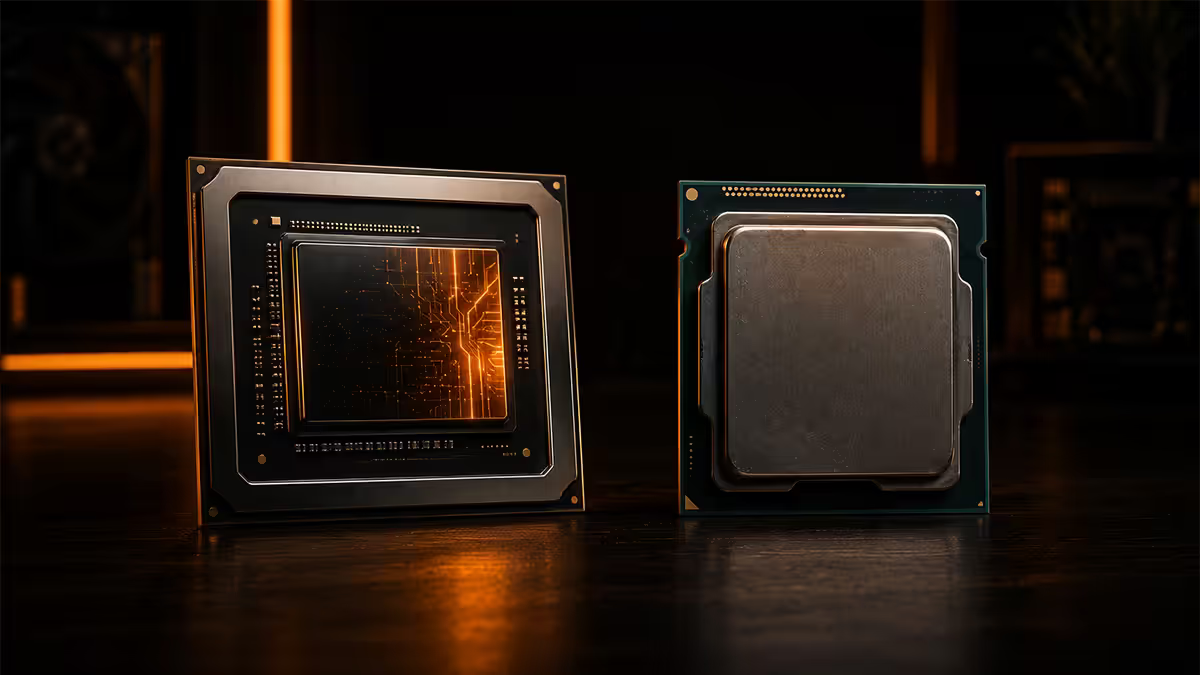
The 2024 rebrand — why it happened
For 16 years — from the 2008 Nehalem launch onward — Intel sold mobile CPUs under one of the most recognised tech brands of the modern era: Core i3 / i5 / i7 / i9. A simple gradient that almost any buyer understood at a glance. So why throw it away in 2024?
Two pressures converged. First, the silicon was changing in a way that the old naming couldn't reflect honestly. Meteor Lake (the architecture that became Core Ultra Series 1) was Intel's first tile-based mobile chip — separate compute, graphics, SoC and IO tiles bonded together with Foveros packaging instead of one monolithic die. The compute tile shrank to a new node while the rest stayed on older, cheaper silicon. Calling that a "14th-gen Core i7" alongside a refresh of the older monolithic Raptor Lake design would have been actively misleading.
Second, the AI PC narrative had arrived. Microsoft was about to launch Copilot+ and demand 40 TOPS of dedicated NPU performance from any laptop wanting the badge. Intel needed a marketing reset to communicate "this is the new AI-era chip" — something the old "Core i7" naming couldn't carry without confusion against legacy stock.
So in December 2023 Intel announced the brand split: Core Ultra for premium mobile chips with NPU, and a stripped-down Core 3 / 5 / 7 (no "i", no "Ultra") for lower-power and budget laptop chips. The legacy Core i lineup got one final desktop refresh (14th-gen) and that was the end of "i" on new mobile silicon.
Series 1 vs Series 2 — the practical comparison
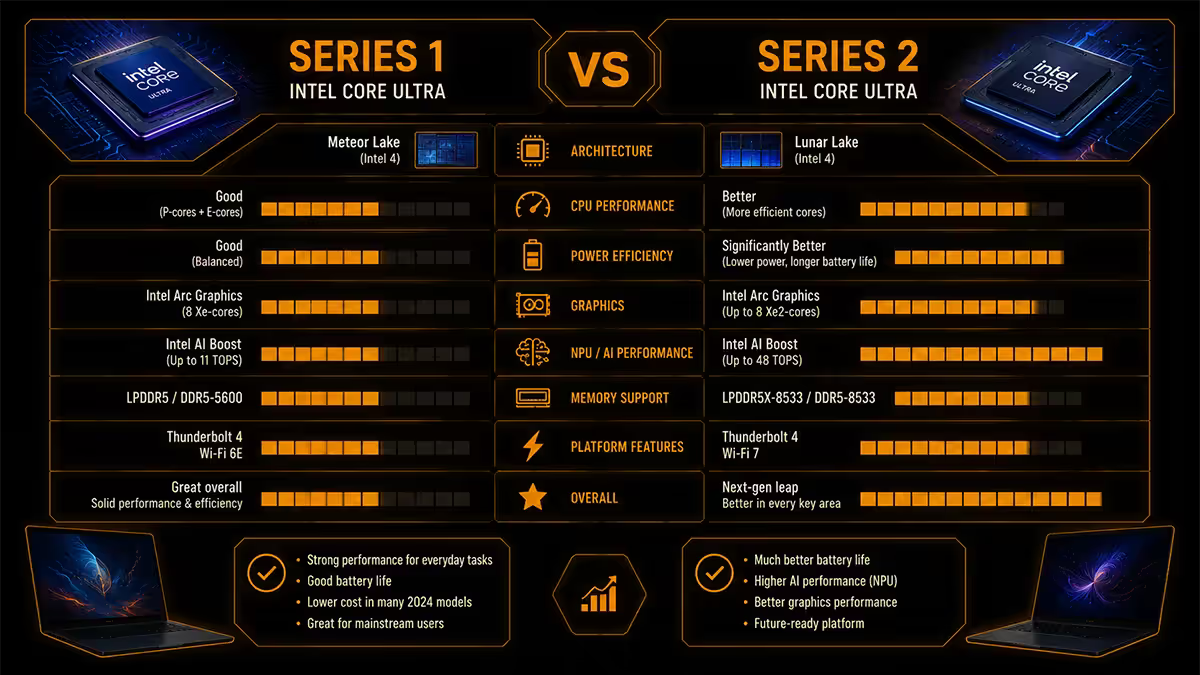
Intel's "Series" numbering covers a generation of chips, not a single product. Each series may contain multiple architectures targeting different laptop classes.
| Series | Codenames | NPU TOPS | iGPU | Launch |
|---|---|---|---|---|
| Series 1 | Meteor Lake (mobile) | ~11 | Arc (Xe-LPG) | Dec 2023 |
| Series 2 | Lunar Lake (thin-and-light) | 48 | Arc Xe2 (Battlemage) | Sep 2024 |
| Series 2 | Arrow Lake H/HX (gaming, workstation) | ~13 | Arc Xe-LPG | Jan 2025 |
| Series 2 (desktop) | Arrow Lake S (Core Ultra 200K) | ~13 | Arc Xe-LPG (basic) | Oct 2024 |
| Series 3 (expected) | Panther Lake (mobile) | 60+ (est) | Arc Xe3 | Late 2025-2026 |
Here's the practical reality: Lunar Lake (Series 2 thin-and-light) is the headline product. It's where the Copilot+ NPU, the new Arc Xe2 graphics and Intel's class-leading battery life all converge. If you're buying an ultrabook or premium thin-and-light in 2026, Lunar Lake is what you want — typical chip names start with "Core Ultra 7 256V" or "Core Ultra 9 288V".
Arrow Lake H/HX is the gaming and workstation side. Higher TDP, bigger CPU configurations (up to 24 cores), but a smaller NPU because the assumption is you'll pair it with a discrete RTX GPU that handles AI acceleration. Common in gaming laptops and mobile workstations from MSI, Lenovo Legion and Razer.
The naming reset — Ultra 7 isn't the old i7
The classic intuition — "i7 is better than i5, i9 is better than i7" — still works directionally with Core Ultra, but the scoring has been reset. Core Ultra 5, 7 and 9 remain the gradient. There is no Core Ultra 3 — sub-Ultra chips are simply called Core 3 / 5 / 7 (notice no "Ultra" prefix, and no "i").
The model numbers have also changed dramatically. The old "Core i7-13700H" structure has been replaced with names like Core Ultra 7 256V (Lunar Lake) or Core Ultra 7 265H (Arrow Lake H). The "V" suffix indicates Lunar Lake thin-and-light. The "H" suffix indicates Arrow Lake mobile. Series 1 chips had names like Core Ultra 7 155H.
For practical shopping, this means you can't compare numbers across generations. A Core Ultra 7 155H (Series 1) is older and slower than a Core Ultra 7 256V (Series 2 Lunar Lake) — even though the model numbers might suggest otherwise. The "V" suffix is the key signal of Lunar Lake, which is what you actually want for thin-and-light battery life.
The NPU — what it actually does in real life
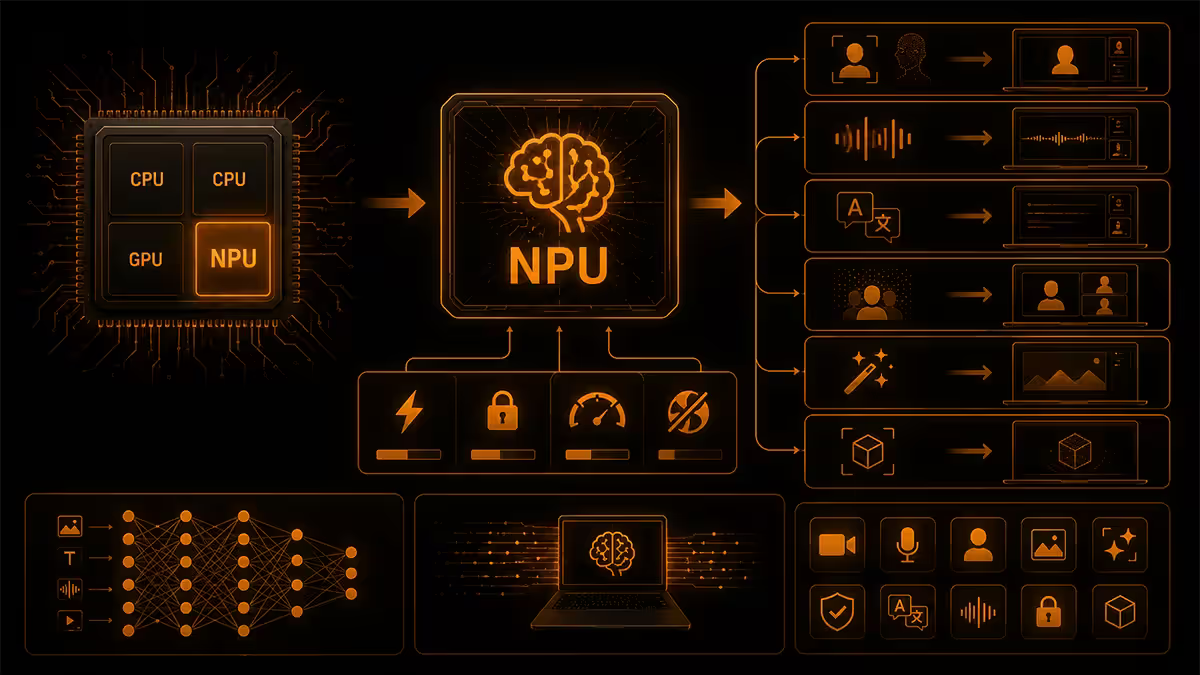
The Neural Processing Unit is the headline new silicon in Core Ultra. It's a dedicated block of the chip optimised for matrix multiplications — the math that powers most AI inference workloads. Unlike CPU or GPU, the NPU runs these workloads at extreme efficiency, often at a tenth of the power draw.
What does that mean in practical day-to-day terms? In 2026 the NPU primarily accelerates:
- Windows Studio Effects — background blur, eye contact correction, voice focus, automatic framing in Teams / Zoom / Google Meet. All handled by NPU instead of draining your CPU.
- Copilot+ on-device features — Recall, Live Captions with translation, Cocreator in Paint, on-device image generation in supported apps.
- Local AI models — small Llama, Phi and Gemma variants running entirely offline on the NPU for privacy-sensitive tasks.
- Audio enhancement — real-time noise suppression in Discord, Krisp, NVIDIA Broadcast equivalents.
- Adobe acceleration — Lightroom AI denoise, Photoshop generative fill, Premiere auto-reframe.
The TOPS (trillion operations per second) measurement tells you how much AI work the NPU can do per watt. Microsoft set 40 TOPS as the Copilot+ minimum. Series 1 Meteor Lake comes in around 11 TOPS — useful for Studio Effects but not Copilot+ certified. Series 2 Lunar Lake hits 48 TOPS — comfortably above the threshold.
Arc graphics — the integrated GPU leap
For 20 years, Intel's integrated graphics were a punchline. The gulf between iGPU and a real discrete GPU was simply too large for anything except office work and YouTube. Arc graphics changed that, and Arc Xe2 (in Lunar Lake) is the first integrated GPU that's genuinely competitive for casual gaming.
A Core Ultra 7 258V's Arc Xe2 iGPU can drive 1080p esports titles (Valorant, CS2, Rocket League, League of Legends, Apex Legends) at 60-90 FPS at medium settings. Modern AAA titles run at 30-45 FPS at 1080p low to medium with XeSS upscaling. That's not desktop RTX 4060 territory — but it's a credible "I can game on this thin-and-light when I'm not at my main rig" proposition.
Series 2 Arc also adds modern features that matter for content work: AV1 hardware encode and decode (huge for streamers and creators), XeSS 2 upscaling (comparable to NVIDIA DLSS in quality), and hardware ray tracing. None of these were viable on the old Iris Xe iGPU.
Why Core i still ships on desktop
Walk into a SA retailer in 2026 and you'll still see Core i7 14700K and Core i9 14900K stickers on prebuilts. That's not Intel forgetting about the rebrand — it's deliberate continuity for the desktop platform.
The 2024 Core Ultra rebrand was mobile-first. Meteor Lake never had a desktop variant. Desktop got one final Raptor Lake refresh (the 14th-gen Core i family) covering Q4 2023 through 2024. Then in October 2024, Arrow Lake S landed for desktop as Core Ultra 5 / 7 / 9 200-series — Core Ultra 9 285K, Core Ultra 7 265K and so on.
However, only the high-end "K" overclockable desktop chips switched to Ultra branding. The locked, non-K, lower-tier desktop chips and the entry-level Core i3 SKUs continued shipping under legacy "Core i" branding through 2026 for OEM continuity. Expect that to phase out as the next desktop generation lands.
Bottom line for desktop buyers: Core Ultra 5/7/9 200-series is the modern Arrow Lake K-series, the high-performance overclockable family. Core i3 / i5 / i7 14th-gen are legacy Raptor Lake. Both still ship. The legacy chips remain competitive for many workloads but won't get further generation updates.
Laptop buyer's checklist for 2026
If you're shopping an Intel laptop in 2026, the decision tree is simpler than the marketing suggests. Match your use case to the right Series and suffix.
| Use case | Right pick | Why |
|---|---|---|
| Student / general office (thin-and-light) | Core Ultra 5/7 V-series (Lunar Lake) | Battery life, NPU, lightest weight class |
| Creator / Adobe Suite (no dGPU) | Core Ultra 7 258V or 268V | Arc Xe2 + NPU accelerates Adobe AI features |
| Gaming laptop with discrete RTX | Core Ultra 7/9 H-series (Arrow Lake H) | Higher TDP CPU, dGPU handles graphics |
| Mobile workstation (CAD, simulation) | Core Ultra 9 HX (Arrow Lake HX) | Up to 24 cores, ECC support on some SKUs |
| Sub-R12k budget laptop | Core 5 / Core 7 (non-Ultra) | Modern arch, fine for office, no NPU |
| Legacy stock clearance | Core i7 13th/14th-gen | Solid performance, no NPU, ageing arch |
Series 3 — Panther Lake on the horizon
Intel's roadmap has Series 3 Panther Lake launching late 2025 into early 2026 — meaning by the time you read this, the first Panther Lake laptops are arriving in retail. Built on Intel's 18A node (the company's first major leap forward in process tech in years), Panther Lake targets meaningful gains in three directions.
First, NPU performance climbs further — early Intel disclosures suggest 60+ TOPS, comfortably ahead of Lunar Lake's 48. That headroom matters because Copilot+ features keep expanding and developers are starting to ship local AI models that benefit from any extra NPU capacity. Second, Arc Xe3 graphics refines the Battlemage architecture with better efficiency and rumoured ray-tracing performance jumps. Third, the 18A node delivers efficiency wins — early targets suggest 18A power efficiency rivals TSMC N3 (what Apple uses).
For a 2026 purchase the buying advice is straightforward: if you can wait for Panther Lake (Series 3), wait. If you need a laptop now, Lunar Lake Series 2 V-series is still excellent and won't feel obsolete for 3-4 years. The one machine to avoid in 2026 retail is Series 1 Meteor Lake — fine architecture, but the NPU is below Copilot+ threshold and battery life trails Series 2 by hours.
The Copilot+ implication
Microsoft's Copilot+ certification requires 40+ TOPS of dedicated NPU performance, 16 GB RAM minimum and 256 GB SSD minimum. That excludes Series 1 entirely. It includes most Series 2 Lunar Lake configurations and all Panther Lake. If specific Copilot+ features matter to you — particularly Recall (with its on-device search of everything you've seen on your PC) and the upcoming agentic Copilot features — you need a Copilot+ certified machine. Just looking at TOPS isn't enough; check for the certification badge.
Key takeaways
- Core Ultra is the 2024 mobile rebrand — tile-based packaging, dedicated NPU, modern Arc graphics. Real architectural break, not just a name swap.
- Series 1 (Meteor Lake) launched late 2023 with ~11 TOPS NPU. Series 2 (Lunar Lake / Arrow Lake) launched 2024 with 48 TOPS NPU on Lunar Lake.
- The "V" suffix means Lunar Lake — the chip you want for thin-and-light battery life and Copilot+ certification.
- Arc Xe2 graphics on Series 2 is the first iGPU genuinely playable for esports gaming and accelerated content work.
- Desktop still ships Core i alongside Core Ultra 200-series. Mobile has fully transitioned.
- For 2026 buyers: Lunar Lake V-series for ultrabooks, Arrow Lake H for gaming, wait for Panther Lake if you can.
Frequently asked questions
What's the difference between Intel Core Ultra and Core i?
Core Ultra is Intel's 2024 rebrand for premium mobile chips with a dedicated NPU and integrated Arc graphics. Core i (renamed simply Core 3/5/7 from 2024) covers the lower tier. The "i" is gone from all new mobile silicon. Desktop chips still use legacy Core i naming in some tiers.Should I buy a Core Ultra or Core i laptop in 2026?
For new purchases prioritise Core Ultra Series 2 (Lunar Lake). Modern NPU, Arc Xe2 graphics, class-leading battery. Older Core i7/i5 laptops still work for productivity but lag in efficiency and AI features.What does the NPU in Core Ultra actually do?
Accelerates AI workloads at low power — Windows Studio Effects (camera blur, eye contact, voice isolation), Copilot+ features (Recall, Live Captions), on-device AI models and audio noise suppression. Series 1 = 11 TOPS. Series 2 Lunar Lake = 48 TOPS.Is Core Ultra better than AMD Ryzen AI?
Competitive in 2026. AMD Ryzen AI 300 wins on multi-threaded productivity and gaming iGPU. Intel Core Ultra Series 2 wins on battery life and NPU performance for Copilot+. Both meet the 40 TOPS Copilot+ threshold.Why does Intel still sell Core i9 desktop chips?
Desktop got one final Raptor Lake refresh (14th-gen Core i) in 2023-24. Arrow Lake desktop launched Oct 2024 as Core Ultra 200-series at the high end. Lower-tier desktop SKUs continue under legacy Core i branding for OEM continuity through 2026.What is Intel Arc graphics on Core Ultra?
Intel's integrated graphics architecture, a generational leap from Iris Xe. Series 2 Lunar Lake uses Arc Xe2 (Battlemage). Playable 1080p gaming for esports titles, AV1 encode, XeSS 2 upscaling and hardware ray tracing.What's coming after Core Ultra Series 2?
Series 3 (Panther Lake) on Intel 18A node, expected late 2025 to early 2026. Higher NPU (60+ TOPS), Arc Xe3 graphics, improved efficiency. Premium ultrabooks first, broader rollout through 2026.Will Core Ultra laptops run all my Windows software?
Yes — Core Ultra is fully x86-64 compatible. Every Windows app made for an Intel laptop in the past decade runs natively. Unlike Snapdragon X ARM laptops, no emulation needed for legacy software.
Get the Evetech app
Exclusive app-only prices, daily flash sales, and free delivery on orders over R4,000 — download the app and start saving.