Glossary · Display Tech
Nano IPS. Fast IPS. Panel tech, decoded.
Two monitors both stickered "IPS" can be dramatically different — one a 75 Hz office panel, the other a 1ms 240 Hz colour-accurate flagship. The differences hide inside brand names from LG Display and AUO. Here's what each actually means.
- nano DCI-P3
- 98%
- fast IPS spec
- 1ms GtG
- panel makers
- 5
What "IPS" means by itself — and why that's not enough
Walk into any tech store in SA and you'll see "IPS" stickered on monitors costing R2,500 and R45,000 alike. So what does the label actually tell you?
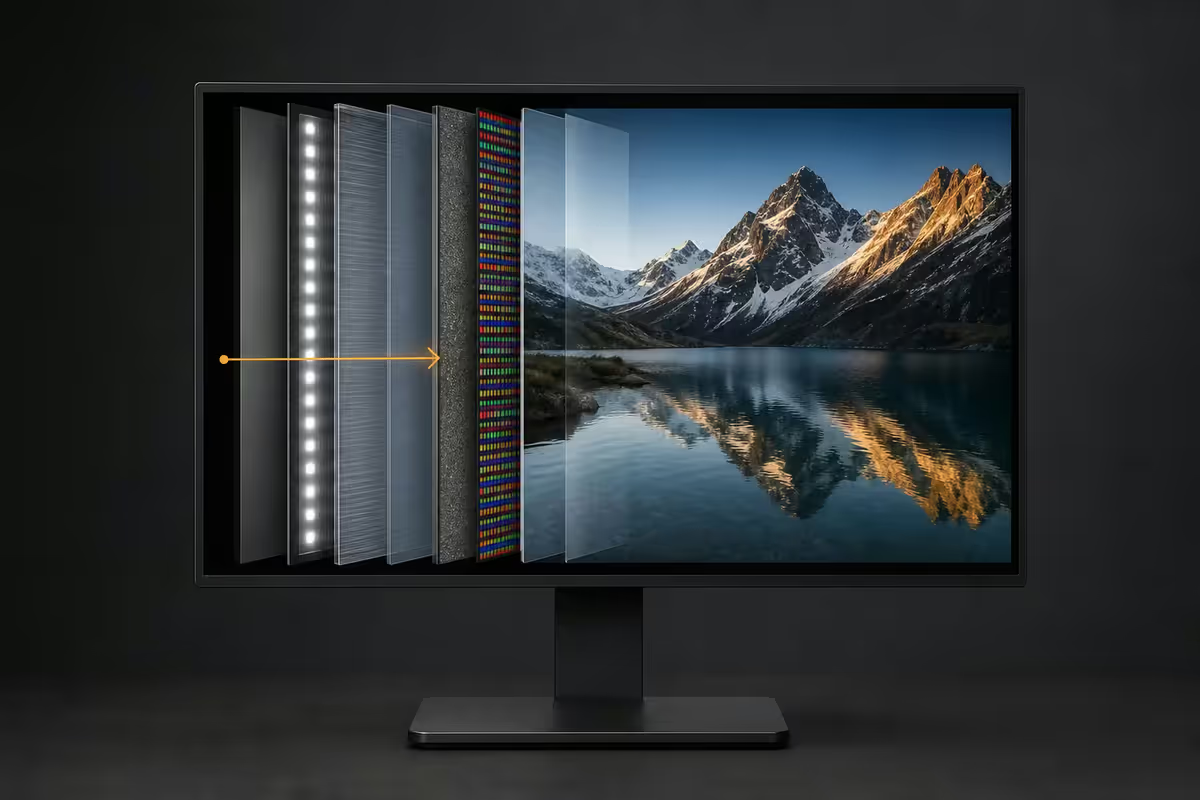
IPS stands for In-Plane Switching — a particular way of arranging the liquid crystal molecules inside the LCD layer. Compared to the older TN (Twisted Nematic) and the contrast-focused VA (Vertical Alignment), IPS sits the crystals horizontally between the polarisers, which gives two clear wins: much wider viewing angles (the image stays accurate when you move your head) and better baseline colour accuracy (especially in the off-axis edges of the screen).
What "IPS" doesn't tell you, by itself, is: the response time, the refresh rate, the brightness, the contrast, the gamut coverage, or which manufacturer made the panel. Two displays both labelled IPS could have wildly different specs. The 4ms 75 Hz office monitor and the 1ms 360 Hz Nano IPS Fast esports flagship both wear the badge with equal pride.
That's why LG Display introduced sub-brands. Nano IPS says "this is the colour-gamut-enhanced version". Fast IPS says "this is the response-time-enhanced version". The base "IPS" sticker doesn't disappear — both are still IPS at heart — but the sub-brand tells you which specific improvement the panel emphasises.
Nano IPS — the gamut play
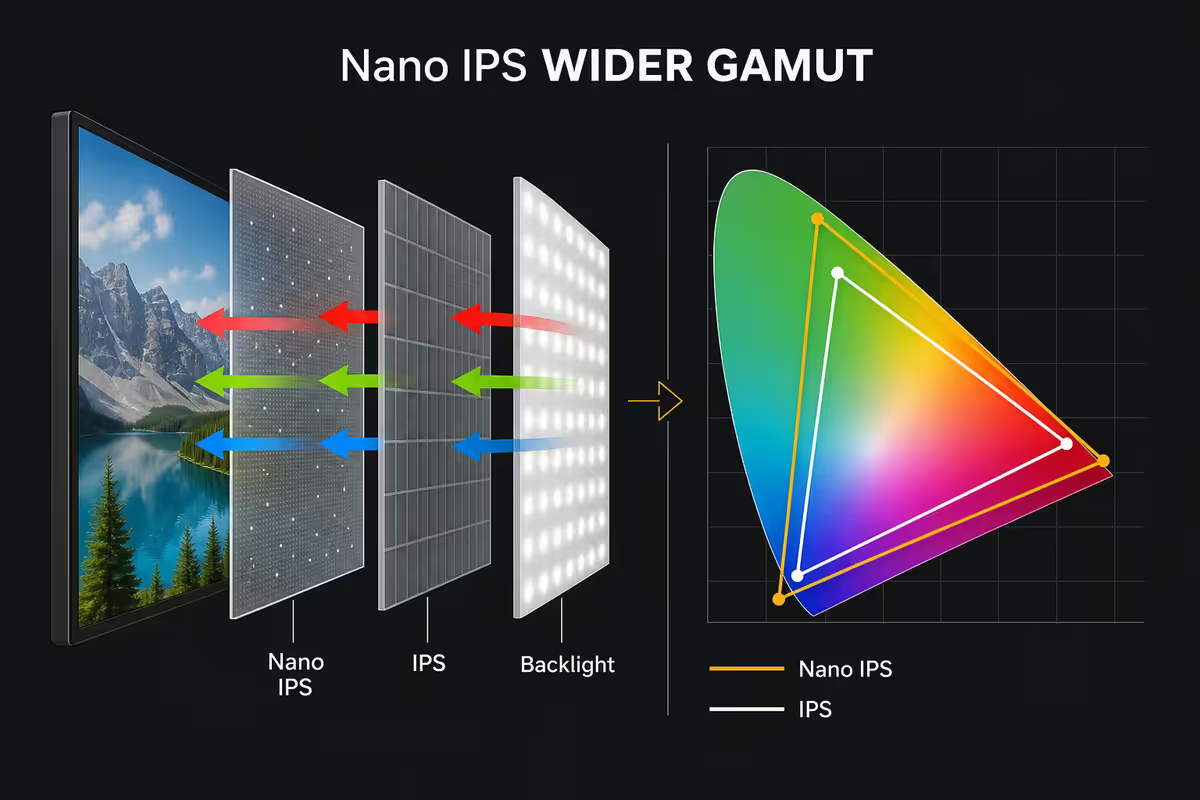
Nano IPS is LG Display's branding for IPS panels with a nano-particle layer on the LED backlight. The particles are tuned to absorb specific wavelengths of light that muddy the colour output — particularly the green-yellow contamination between the red and green primaries — leaving cleaner, more saturated red, green and blue light reaching the liquid crystal layer.
The practical result: ~98% DCI-P3 coverage, compared to ~85-90% for standard IPS and ~72% sRGB on entry IPS. DCI-P3 is the colour space used by HDR content, modern cinema and most professional photo and video work. Nano IPS panels also typically hit 135-140% sRGB volume — meaning they're capable of displaying colours outside the sRGB space, which matters for HDR.
Nano IPS first appeared on LG's UltraFine 5K and UltraGear 27GL850 in 2019 and has since spread to most premium IPS gaming and creator monitors. Notable Nano IPS panels in 2026 stock include the LG 27GP950 (4K 144 Hz Nano IPS), the Asus ROG Swift PG27UCDM (4K OLED hybrid that uses Nano IPS in some markets), and the Acer Predator XB323K (32" 4K 144 Hz Nano IPS).
Fast IPS — the response time play
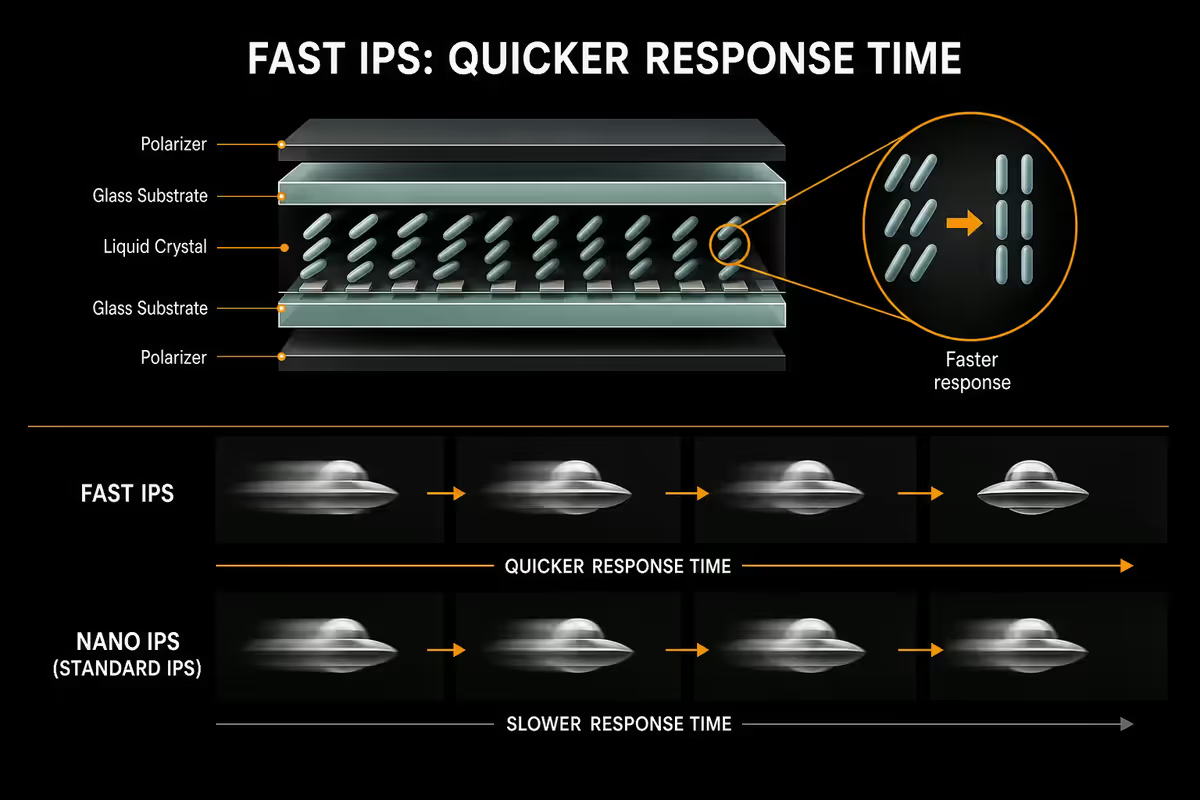
Fast IPS is LG Display's branding for IPS panels with sub-5ms response times — typically advertised as 1ms GtG (grey-to-grey) under ideal overdrive conditions. This is the response-time equivalent of what Nano IPS does for colour: a deliberate engineering pass to push one specific characteristic far beyond what standard IPS achieves.
Fast IPS uses a tweaked liquid crystal molecule arrangement that responds to electrical signals faster, combined with more aggressive overdrive tuning by the monitor's scaler. The downside used to be visible overshoot artefacts (where the overdrive pushes too hard and you see ghost trails); the 2023-2026 generation of Fast IPS panels have refined this to the point where overshoot is minimal at sensible overdrive settings.
The practical result for gaming: response times within striking distance of TN (the historically fastest LCD panel type) while keeping the viewing angles, contrast and baseline colour of IPS. Fast IPS dominates the 144 Hz to 360 Hz refresh tier of modern gaming monitors — the Asus PG279QM, MSI MAG274QRF-QD, Gigabyte M27Q (early version), the Dell Alienware AW2724DM, and most LG UltraGear models in that performance class.
A Fast IPS panel paired with a 240 Hz refresh rate gives you ~4.2ms between refreshes (1/240 second). With a 1ms-1.5ms real-world response, the pixel finishes its transition well within a single refresh cycle — meaning no motion blur from incomplete transitions. That's the technical reason Fast IPS feels noticeably smoother than even high-refresh standard IPS for competitive gaming.
Nano IPS Fast — when you want both
The flagship combination, marketed as "Nano IPS Fast" (sometimes "Nano IPS + 1ms"), bundles both technologies in a single panel. Wide gamut from the nano-particle backlight layer, fast response from the tweaked liquid crystal arrangement.
This is the spec sheet category you want if your use case crosses gaming and creator work — competitive esports on the same monitor where you'll later edit photos, colour-grade video, or work in Figma / Adobe. The flagship examples in SA stock for 2026 include:
- LG UltraGear 27GP950-B — 4K 144 Hz Nano IPS Fast, 1ms GtG, ~98% DCI-P3. The reference Nano IPS Fast monitor.
- Asus ROG Swift PG27AQDM — 1440p 240 Hz Nano IPS Fast (sometimes badged differently market-to-market).
- Acer Predator X32 FP — 4K 160 Hz Nano IPS Fast for premium gaming and HDR creator work.
- MSI MAG 321CUP QD — Quantum Dot Nano IPS Fast 4K 144 Hz, sub-R12k in SA when on promo.
The price premium for the combination is real — typically R3,000-R6,000 more than the same-resolution Fast IPS without Nano gamut, or vice versa. Whether that's worth it depends on whether you'll actually use both characteristics.
AUO's equivalents — same idea, different brand
LG Display isn't the only IPS-type panel maker in the world. AU Optronics (AUO), headquartered in Taiwan, makes equivalent panels with their own naming conventions. AUO's IPS-type technology is technically called AHVA (Advanced Hyper Viewing Angle) — a marketing rebrand of the same in-plane switching principle.
AUO didn't aggressively brand colour or speed sub-categories the way LG did. Their high-gamut panels are simply labelled "AHVA wide gamut" by monitor makers, and their fast-response panels are labelled "AHVA 1ms" or similar. The technology is comparable to Nano IPS and Fast IPS — wider gamut achieved through different methods (quantum dots in some cases instead of nano particles), and fast response via overdrive tuning.
Notable AUO panels in 2026 monitors include the Asus VG27AQ (AHVA-based, 1ms MPRT), many Gigabyte M-series monitors, the Dell U2723QE creator monitor, and several MSI Optix and BenQ EX panels. For most buyers AUO panels are functionally equivalent to LG Display ones — the brand differences matter more to OEMs and reviewers than end users.
Who actually makes the panels — and who sticks the brand on the box
There's a critical distinction between the panel manufacturer and the monitor brand. The monitor brand on the front of the box (LG, Asus, Acer, MSI, Gigabyte, Samsung, Dell, etc.) is usually not the company that physically fabricated the panel inside.
The world's premium IPS-type LCD panel manufacturers in 2026 are:
| Panel maker | Brand naming | Used by |
|---|---|---|
| LG Display | Nano IPS, Fast IPS, Nano IPS Fast | LG, most Asus ROG IPS, Acer, MSI MAG/MPG |
| AU Optronics (AUO) | AHVA (wide-gamut, 1ms variants) | Asus, Gigabyte M-series, Dell U-series, BenQ |
| Samsung Display | QD-OLED (replaced LCD focus), some legacy AD-PLS | Samsung Odyssey, Alienware QD-OLED, MSI MPG QD-OLED |
| BOE (China) | ADS / FFS variants (IPS-type) | Budget-tier monitors, OEM laptop panels |
| Innolux (Taiwan) | "IPS-type" generic naming | Mid-tier and budget monitors |
In practical terms: "Nano IPS" specifically means an LG Display panel. If a monitor advertises Nano IPS, the panel inside was fabricated in LG's facilities in South Korea or Vietnam, then shipped to Asus / Acer / MSI to be paired with their scaler, ports, stand and chassis. Same panel, different monitor brand.
Response time reality — what the spec sheet hides
"1ms GtG" is the most aggressive number a manufacturer can put on the box. The reality of measured response time in independent review labs is usually higher — but still impressive.
Why the gap? "1ms GtG" measures the fastest single grey-to-grey transition the panel can achieve under ideal overdrive settings. Real-world usage involves the average across all transitions (slow grey-to-grey, dark-to-light, light-to-dark, plus colour transitions). Independent labs like RTINGS and TFTCentral typically measure the average GtG rather than the best-case single number — and that average tends to land 2-3ms for top-tier Fast IPS panels.
This isn't deceptive, exactly — the spec is real for that specific transition — but it's optimistic. Comparing two monitors both rated "1ms GtG" by their manufacturers, the actual measured average can differ significantly. A well-tuned Fast IPS panel will average 2-3ms; a marketing-heavy "1ms GtG" budget IPS might average 5-7ms in tests despite the box claim.
When Nano matters, when Fast matters, when both matter
The decision tree is genuinely simple once you know what each technology emphasises.
Buy Fast IPS (not Nano) when: Your priority is competitive esports — Valorant, CS2, Apex Legends, Overwatch, Rocket League, League of Legends, fighting games. Response time matters far more than gamut. You'll get top-tier speed without the Nano price premium.
Buy Nano IPS (not Fast) when: Your primary work is photo or video editing, design, illustration, content creation. The 98% DCI-P3 gamut transforms how accurate your colours land in delivered output. Response time isn't critical because you're not playing high-stakes esports on the same monitor.
Buy Nano IPS Fast when: You do both, on the same monitor, and have the budget. Premium gaming setup that also serves as your daily Adobe Suite or Figma workstation. The combined-spec premium is real but justified if both use cases matter to you.
Skip both and consider OLED when: Your gaming budget is over R15,000 and you've never tried OLED. The contrast and response time of QD-OLED on Samsung G80SD or LG 27GR95QE eclipses any LCD-based IPS — though OLED brings its own trade-offs (burn-in risk, lower full-screen brightness for HDR, higher cost).
Across the 200,000+ custom PCs we've shipped from Centurion, the single biggest monitor regret customers raise on follow-up calls isn't "I bought the wrong refresh rate" — it's "I bought a plain IPS panel and didn't realise how different Nano or Fast would feel". Once you've experienced a true 1ms Fast IPS at 240 Hz in CS2 or Apex, going back to a 5ms 144 Hz feels like swimming in jelly. Spend the extra R1,500-R3,000 on the panel tier that matches your actual use case — it's the screen you stare at all day.
Evetech Display Team · Behind the Build
A quick decision matrix
| Use case | Right pick | SA price range |
|---|---|---|
| Competitive esports primary | Fast IPS 240 Hz+ | R6,500-R12,000 |
| Casual + creator hybrid | Nano IPS 144 Hz | R7,500-R14,000 |
| Premium do-everything | Nano IPS Fast 4K 144 Hz | R13,000-R22,000 |
| Pure photo/video editing | Nano IPS 4K, factory-calibrated | R12,000-R28,000 |
| Office work + light gaming | Standard IPS 75-144 Hz | R3,000-R6,500 |
| Anti-LCD enthusiast / OLED tier | QD-OLED 1440p 240 Hz | R18,000-R30,000+ |
Key takeaways
- "IPS" alone is meaningless — could be 75 Hz office or 240 Hz flagship. Look at full specs.
- Nano IPS is LG Display's wide-gamut tech — ~98% DCI-P3 via nano-particle backlight filtering.
- Fast IPS is LG Display's response-time tech — 1ms GtG via tuned liquid crystal arrangement.
- Nano IPS Fast combines both — premium gaming and creator crossover, R13k-R22k for 4K 144 Hz tier.
- AUO's AHVA panels are functional equivalents — wide gamut and fast response via different methods.
- The monitor brand isn't the panel maker. LG Display, AUO, Samsung Display, BOE and Innolux supply the world's monitor brands.
Frequently asked questions
What is Nano IPS?
LG Display's IPS panel brand with nano-particle backlight filtering for wider gamut — typically 98% DCI-P3. Mainly creator monitors and premium gaming displays.What is Fast IPS?
LG Display's IPS panel brand with sub-5ms response time — typically 1ms GtG advertised. Uses different liquid crystal arrangement and overdrive tuning, competitive with TN for response.What's the difference between Nano IPS and Fast IPS?
Nano IPS focuses on colour gamut (98% DCI-P3). Fast IPS focuses on response time (1ms GtG). Separate technologies. Nano IPS Fast combines both — wide gamut and fast response.Who actually makes Nano IPS and Fast IPS panels?
LG Display invents and brands both. Monitor makers (LG, Asus ROG, Acer Predator, MSI MAG, Gigabyte Aorus) license LG Display panels under their own monitor brands. AUO makes equivalents under "AHVA" naming.Does Nano IPS matter for gaming?
Only if colour accuracy matters alongside gaming. For competitive esports, response time (Fast IPS) matters far more than gamut. For content creators who also game, Nano IPS or Nano IPS Fast is the right choice.Is Fast IPS as fast as TN panels for esports?
Effectively yes for most scenarios. Top-tier Fast IPS measures 2-3ms real-world (manufacturers quote 1ms GtG best-case). TN edges ahead at the extreme (0.5-1ms) but Fast IPS gives you 95% of speed plus better viewing angles, contrast and colour.What does IPS alone mean if Nano and Fast are separate brands?
"IPS" alone just means the underlying panel type — in-plane switching liquid crystal alignment. Tells you nothing about response time, gamut, brightness or refresh. Look at the full spec sheet, not just the IPS sticker.When should I buy Nano IPS vs Fast IPS?
Nano IPS for photo / video editing, design, content creation, work-plus-gaming hybrid. Fast IPS for competitive esports and 240 Hz+ gaming. Nano IPS Fast for premium gaming + work crossover where both matter.
Get the Evetech app
Exclusive app-only prices, daily flash sales, and free delivery on orders over R4,000 — download the app and start saving.