Hardware Explainer · GPU Tech
Ray tracing — worth it in 2026?
— Sometimes. Here's when and on which GPU.
What ray tracing actually does
Ray tracing is a rendering technique that simulates how light actually travels through a scene. The GPU traces individual rays of light from the camera through the scene, bouncing them off surfaces, refracting them through glass and water, and computing their final colour and intensity based on every surface they hit along the way.
The four ray-traced effects you'll see in most RT-supported games:
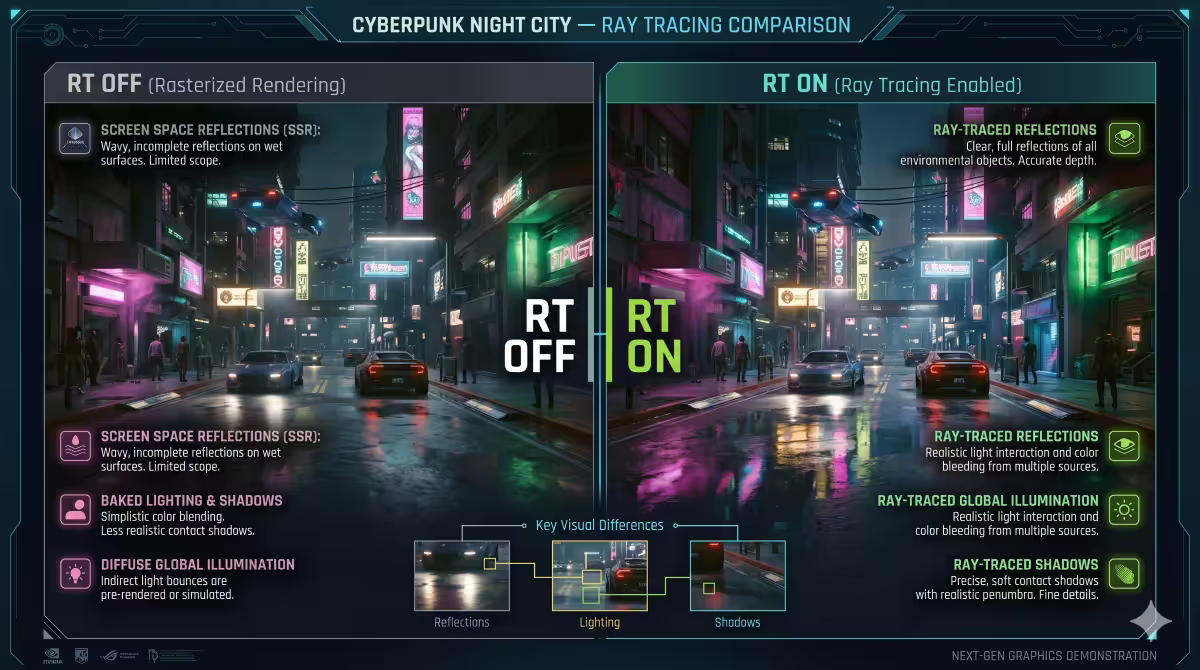
- RT Reflections. Glass, water, polished floors and mirrors reflect what's actually in the scene — not pre-baked cubemaps. A character standing in front of a window sees themselves; a puddle on the street reflects the neon sign overhead.
- RT Shadows. Accurate soft shadows that change shape with the light source. Distant lights cast soft penumbrae; nearby lights cast hard sharp shadows; multiple light sources produce realistic shadow blending.
- RT Ambient Occlusion (RTAO). The subtle darkening in corners, under furniture and in tight spaces — physically accurate rather than approximated by screen-space techniques (SSAO).
- RT Global Illumination. Indirect light bouncing off surfaces and illuminating other surfaces. A red wall lit by sunlight casts a faint red light onto the floor opposite. This is the biggest visual upgrade and the most expensive.
Modern AAA games typically apply RT to some subset of these — reflections + shadows is a common pairing. Full RT global illumination is the expensive one and is reserved for path-traced renderers.
Rasterisation vs ray tracing — what's the difference
Traditional rasterisation renders a scene by drawing triangles to the screen one at a time, then layering on pre-computed textures and tricks (screen-space reflections, baked lightmaps, shadow maps, ambient occlusion approximations) to fake the look of light behaviour. It's been the dominant rendering technique for 25+ years and is extraordinarily fast.
Rasterisation's compromises:
- Reflections often show only what's already on-screen (screen-space reflections) — turn around and a reflective surface "loses" the world behind you.
- Shadows are pre-baked or use shadow maps — sharp, often pixelated at edges, fail at long distances.
- Light from off-screen sources doesn't illuminate scenes naturally.
- Glass, water and polished surfaces show approximations rather than real reflections.
- Static lighting is baked at build-time and can't change dynamically with the day/night cycle.
Ray tracing fixes all of these — at the cost of computational complexity. Where rasterisation might draw a frame in 5ms, the same frame with RT might take 12-15ms. That's the FPS cost.
RT-supported versus RT-required games
Through 2018-2023, ray tracing was an optional toggle in games that otherwise had a complete rasterised renderer. Turn RT off, the game still looks great; turn it on, you trade FPS for visual fidelity.
From 2024 onwards, a new category emerged: RT-required games that ship without a rasterised fallback. The renderer is designed around ray tracing from the ground up and won't run without RT-capable hardware.
- Indiana Jones and the Great Circle (2024) — full RT renderer, no raster fallback.
- Avatar: Frontiers of Pandora — RT global illumination as the only lighting model.
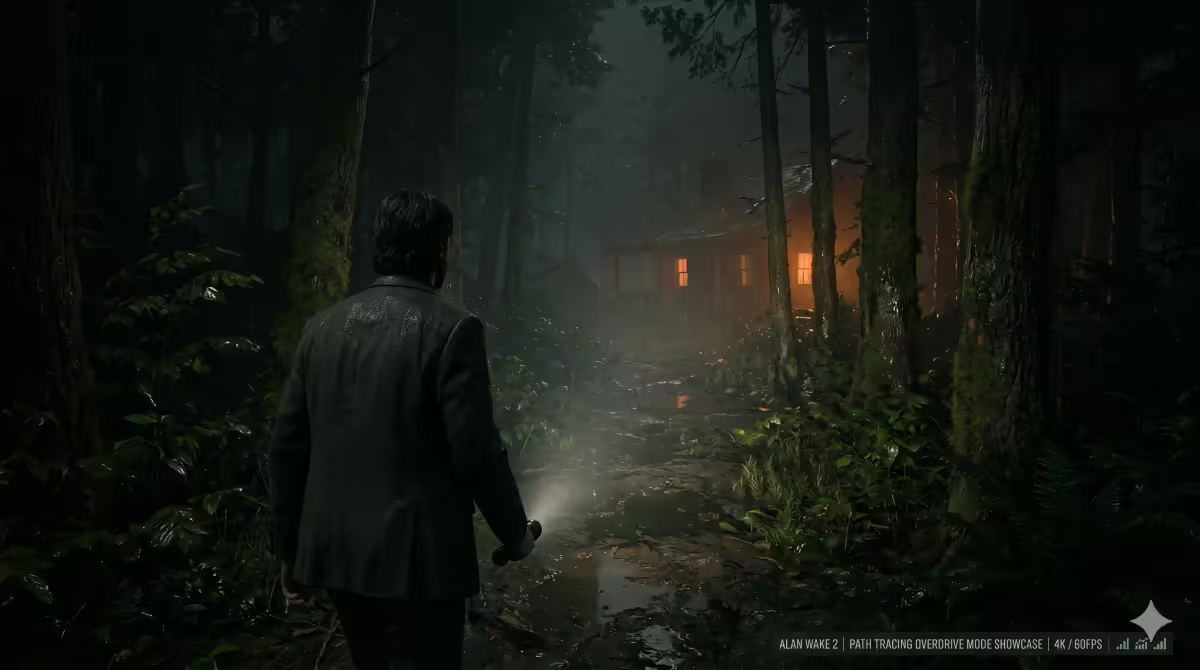
- Alan Wake 2 (RT mode) — optional but the game is designed to be experienced with RT.
- Star Wars Outlaws — RT global illumination embedded in the engine.
- Doom: The Dark Ages — id Tech 8 with mandatory RT.
This shift matters for GPU buying. Five years ago, RT support was a "nice to have"; in 2026, AAA-game buyers without an RT-capable GPU will encounter games that simply won't run.
Path tracing — the real ray tracing
"Ray tracing" as marketed in games has historically meant selective ray-traced effects bolted onto a rasterised renderer. RT reflections + raster geometry + raster shadows = "RT On" toggle. The result is better than full raster but isn't really ray tracing in the technical sense.
Path tracing is the full version. The entire rendering pipeline is ray-traced — including global illumination, soft shadows, ambient occlusion, reflections, refractions, and the light bouncing between surfaces multiple times before reaching the camera. It's what offline rendering (Pixar, Disney, Blender Cycles) has used for decades. In games, it has only become viable in the past 2-3 years.
The path-tracing showcase games (2024-2026):
- Cyberpunk 2077 RT Overdrive — the title that put path tracing on the gaming map. Night City lit entirely by path-traced light is a generational visual leap.
- Alan Wake 2 Path Tracing mode — atmospheric horror lit with path-traced volumetric light. The most cinematic-looking game on PC right now.
- Black Myth: Wukong — selective path tracing in cinematic scenes.
- Portal RTX — Valve's puzzle classic remade with full path tracing. Showcase quality.
- Half-Life 2 RTX — community-driven path tracing remaster.
The performance cost is brutal — 70-85% FPS reduction from rasterised baseline. Without DLSS or FSR upscaling, path tracing at 4K is impossible on any consumer GPU. With DLSS 4 Performance and Frame Generation, an RTX 5080 holds a stable 80-100 FPS at 4K in Cyberpunk RT Overdrive. An RTX 5090 does it at native or with light upscaling.
Performance cost — by RT level
FPS impact varies dramatically with the RT level and the GPU tier. The pattern is consistent across most modern titles.
| RT level | FPS cost vs raster | Visual gain |
|---|---|---|
| RT Off (raster only) | 0% (baseline) | Modern rasterised baseline |
| RT Low (reflections only) | 15-25% | Subtle — visible on glass/water |
| RT Medium (refl. + shadows) | 25-40% | Clear improvement in interiors |
| RT High (refl. + shadows + AO) | 35-50% | Strong upgrade in mixed scenes |
| RT Ultra (everything on) | 45-65% | Best traditional-RT experience |
| Path Tracing | 70-85% | Generational visual leap |
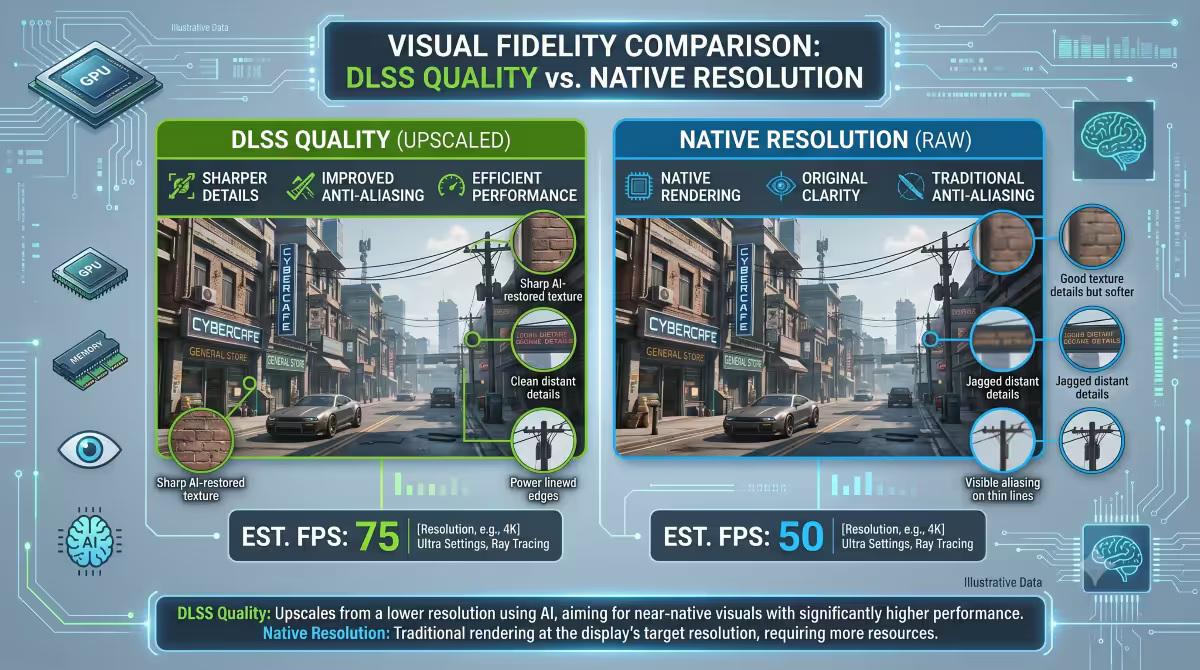
Critically, these costs are before DLSS or FSR. With upscaling active, you recover most of the FPS — typically getting back 30-50% by enabling DLSS Quality or FSR Quality. Frame Generation (DLSS 3/4 FG, FSR 3 FG) doubles displayed FPS on top of that, at the cost of a small latency penalty.
DLSS, FSR and XeSS — the upscaling enabler
If RT is the visual feature, upscaling is what makes it usable on real hardware. The three competing systems in 2026:
- NVIDIA DLSS 4 — the gold standard. Best image quality at all levels, frame generation matured, runs on RTX 40 and 50 series hardware. Quality preset typically indistinguishable from native; Performance preset gets you to native-looking image at 60-70% lower internal render cost.
- AMD FSR 4 — closing the gap fast. Now ML-based on RDNA 4 (RX 9000 series) rather than hand-tuned heuristics. Quality at FSR 4 Quality is approaching DLSS Quality, especially in motion. Older RDNA 3 hardware uses FSR 3 which is good but not as clean.
- Intel XeSS 2 — Arc B-series exclusive features, runs in compatibility mode on AMD and NVIDIA hardware. Image quality between DLSS and FSR. Frame Gen is now mature.
The practical rule: if your monitor is 1440p or 4K and you want RT on, enable DLSS/FSR Quality (75% internal render) as a default. Performance preset (50% internal) for path tracing or if you need more FPS. Frame Generation on if your base frame rate is 60+ already — it feels janky below that.
When ray tracing genuinely improves visuals
RT is most visible in environments with complex light interactions:
- Wet streets and puddles reflecting neon signs and city lights (Cyberpunk Night City, the standout example).
- Glass, mirrors and polished surfaces showing real reflections rather than fake cubemaps.
- Dark interiors with multiple light sources — torches, computer screens, a window — casting realistic overlapping shadows.
- Water — pools, fountains, rain effects with accurate reflection and refraction.
- Night-time scenes generally, where artificial light sources dominate.
- Hogwarts interiors — candlelit corridors with stained glass.
- Atmospheric horror (Alan Wake 2, Resident Evil 4 Remake interiors) where lighting carries the dread.
When ray tracing is barely visible
RT is least visible in environments where rasterised tricks already do a good job:
- Bright outdoor daylight scenes with diffuse natural lighting (Forza Horizon countryside, Assassin's Creed open fields).
- Stylised art-direction games (Borderlands, cel-shaded titles) where photo-realism isn't the goal.
- Competitive shooters where you're moving fast and looking at enemy outlines, not reflections.
- Top-down strategy and RTS games where the camera distance makes RT detail invisible.
- Older games with RT mods bolted on — sometimes the RT effect is subtle and the FPS hit is large.
In these contexts, the FPS spent on RT is better spent on higher refresh rates or higher resolution.
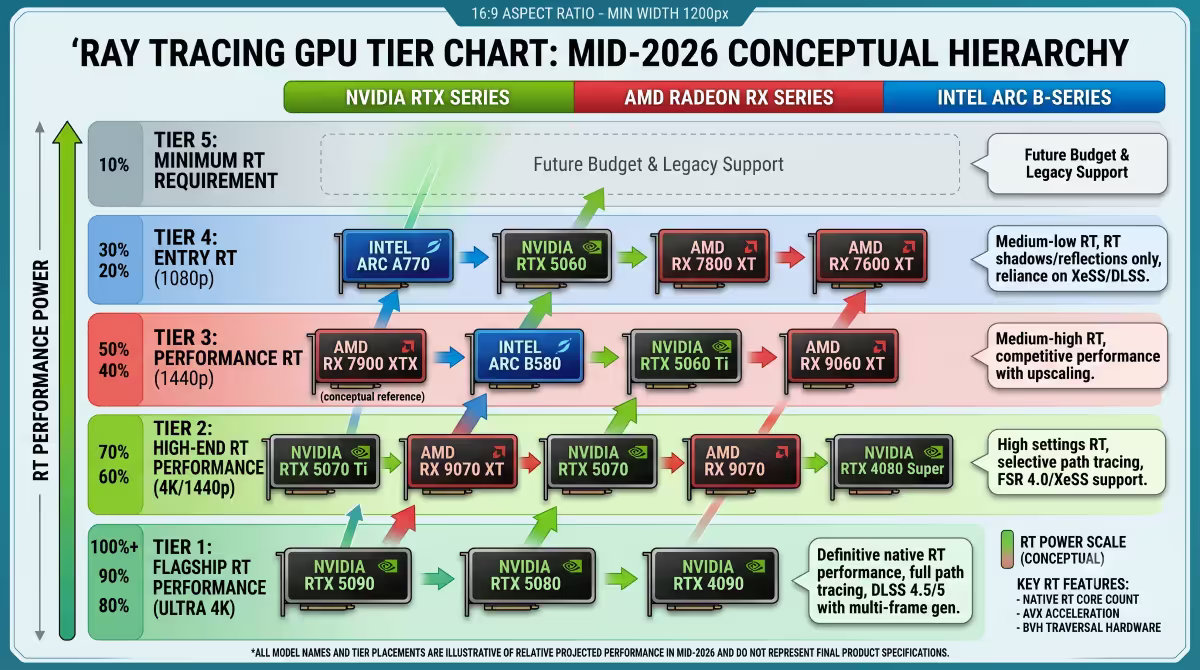
GPU tier required for each RT level
| RT target | NVIDIA | AMD |
|---|---|---|
| Entry-level RT @ 1080p | RTX 4060 / 5060 | RX 7600 / 9060 |
| Honest RT @ 1440p | RTX 4070 / 5070 | RX 7800 XT / 9070 |
| RT High @ 1440p | RTX 4070 Ti / 5070 Ti | RX 7900 XT / 9070 XT |
| RT @ 4K with DLSS Quality | RTX 4080 / 5080 | RX 7900 XTX / 9070 XT |
| Path Tracing @ 1440p with DLSS | RTX 4080+ / 5080+ | Limited (PT weak point for AMD) |
| Path Tracing @ 4K native | RTX 5090 only | Not viable |
The honest summary: any RTX 4070/5070 or RX 9070 is a solid RT card for 1440p with DLSS/FSR. Below that, RT is a feature you'll toggle off after the honeymoon. Above that, you start getting into 4K RT and path-tracing territory.
Per-game verdict — where RT is genuinely worth it
| Game | RT verdict | Recommended GPU |
|---|---|---|
| Cyberpunk 2077 | Path Trace — yes if hardware allows | RTX 4080+ / 5080+ |
| Alan Wake 2 | Path Trace — generational leap | RTX 4070 Ti+ / 5070 Ti+ |
| Indiana Jones (Great Circle) | RT required — runs well | RTX 4070+ / RX 9070+ |
| Avatar: Pandora | RTGI required — beautiful | RTX 4070+ / RX 9070+ |
| Black Myth: Wukong | RT cinematic scenes — subtle | RTX 4070+ / RX 9070+ |
| Hogwarts Legacy | RT in interiors — yes | RTX 4060+ / RX 9060+ |
| Forza Horizon 5 | RT marginal — skip | Any RT card; turn RT off |
| Call of Duty / Warzone | RT off — competitive | FPS over visuals |
| Valorant / CS2 / Apex | No RT — competitive | Refresh rate first |
Common misconceptions about ray tracing
"RT On means the game looks better in every scene." Not really. In outdoor daylight, the difference is often imperceptible. RT shines in specific lighting conditions — accept it as scene-dependent.
"AMD GPUs can't do ray tracing." Outdated. RDNA 3 (RX 7000) was competitive at standard RT, RDNA 4 (RX 9000) closes the gap on most workloads. Path tracing remains an NVIDIA strength because of the dedicated RT cores and DLSS 4 quality.
"DLSS is just upscaling." DLSS 4 includes Ray Reconstruction (improves RT denoising), Frame Generation (interpolates frames), and Quality, Balanced, Performance and Ultra Performance modes. It's a full rendering toolkit, not a single upscaler.
"Path tracing is the same as ray tracing." No. Path tracing is full ray-traced rendering of the entire pipeline. "Ray tracing" in most games means selective RT effects on top of rasterisation. The visual gap between them is significant.
"RT is only worth it on 4K." Wrong way around. RT cost is proportional to pixel count, so 4K RT is more expensive than 1440p RT. 1440p with RT and DLSS Quality is the sweet spot for current hardware.
Key takeaways
- Ray tracing simulates real light behaviour — accurate reflections, shadows, ambient occlusion and global illumination.
- Performance cost: 30-50% for standard RT, 70-85% for path tracing. DLSS or FSR Quality recovers most of it.
- Path tracing (Cyberpunk RT Overdrive, Alan Wake 2 PT) is the real visual leap — and wants RTX 4080+ to do well.
- RTX 4070 / RX 9070 is the entry-tier for honest RT at 1440p with upscaling. Below that, RT gets disabled.
- Turn RT off for competitive shooters. RT is a single-player AAA enhancement, not a competitive one.
Frequently asked questions
What is ray tracing in simple terms?
A rendering technique that simulates how light actually travels — accurate reflections, refractions, shadows and ambient occlusion. Traditional rasterisation fakes these with pre-baked textures and screen-space tricks.What is the performance cost of ray tracing?
30-50% FPS reduction on RT-capable GPUs at standard RT settings, 70-85% for path tracing. DLSS or FSR Quality recovers most of that.What is the difference between ray tracing and path tracing?
Ray tracing usually means selective RT effects (reflections, shadows) bolted on a raster renderer. Path tracing is full ray-traced rendering of the entire pipeline including global illumination — the real visual leap.Do I need DLSS or FSR to use ray tracing?
In 2026, effectively yes for 1440p and above. Without upscaling, RT is impractical on all but the very top GPUs. Path tracing essentially requires DLSS or FSR.Which GPU do I need for ray tracing in 2026?
RTX 4060/RX 9060 for entry RT at 1080p. RTX 4070/RX 9070 for honest 1440p RT. RTX 4080+/RX 9070 XT for 4K RT. RTX 4080+ or 5080+ for path tracing.In which games does ray tracing actually look great?
Cyberpunk 2077 (especially PT), Alan Wake 2, Indiana Jones, Avatar Pandora, Black Myth Wukong, Hogwarts Legacy interiors. Anything with reflective surfaces, glass, water and complex lighting.Should I turn ray tracing off for competitive gaming?
Yes. For Valorant, CS2, Warzone, Apex, Fortnite competitive — refresh rate beats reflections. RT is a single-player AAA enhancement.Is ray tracing the future of gaming?
Yes. RT-required games (Indiana Jones, Avatar Pandora, Doom Dark Ages) are the new default. Within 3-5 years RT will be the standard rendering path on AAA titles. Path tracing is the longer-term destination.
Get the Evetech app
Exclusive app-only prices, daily flash sales, and free delivery on orders over R4,000 — download the app and start saving.