Peripheral Guide · Sizing
Best mouse for small hands.
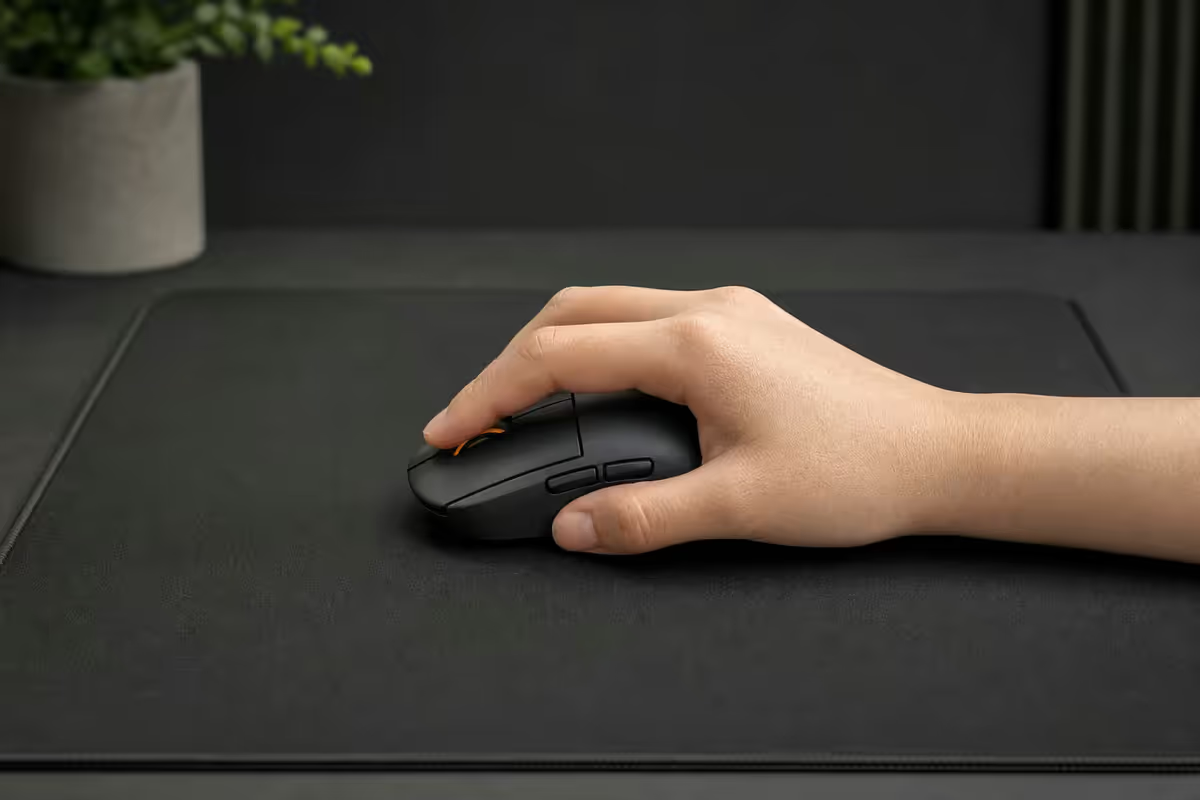
Most “best gaming mouse” lists are written for 19-cm palms. If yours is under 17 cm — a junior esports player, school-aged gamer, or simply a smaller-handed adult — those picks fight you. Six mice in 2026 are genuinely designed for small hands. Here’s how to pick the right one.
- small palm
- < 17 cm
- ideal weight
- < 65 g
- ideal length
- 115-122 mm
Measure your hand — the only number that matters
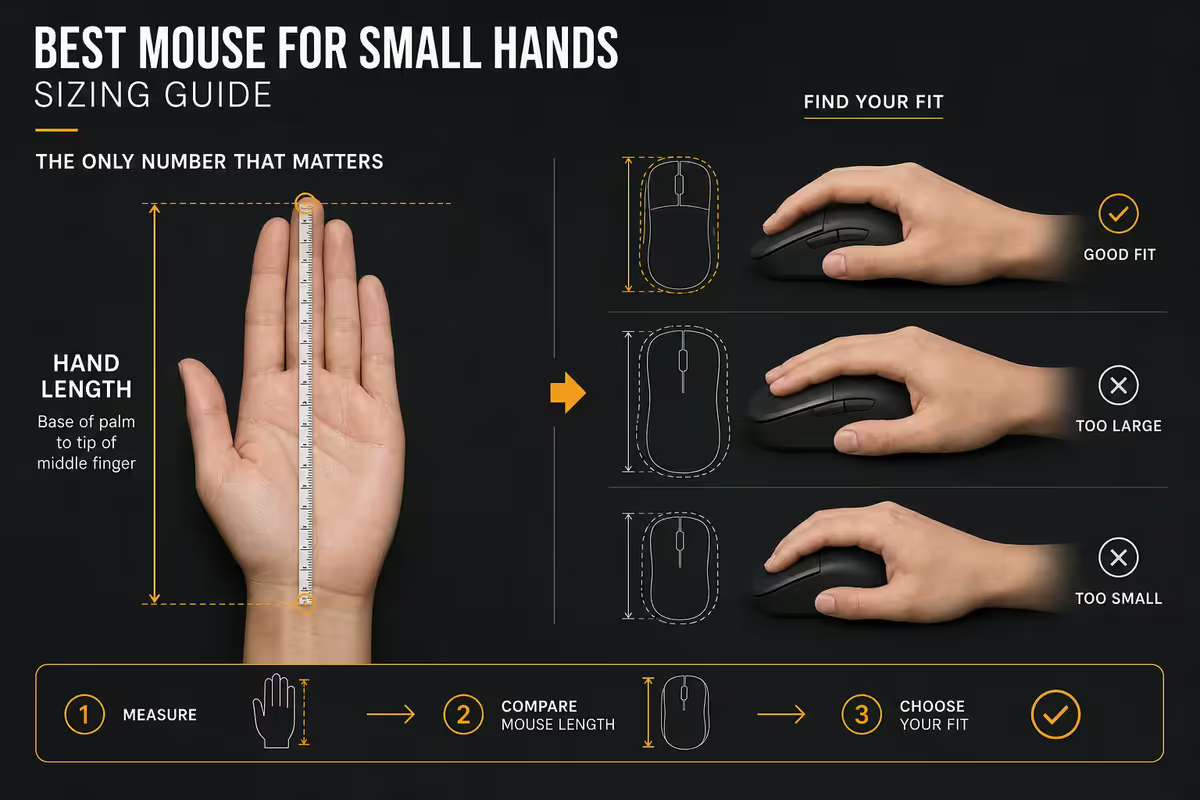
Before any picks, measure. Hand size is the single biggest determinant of mouse fit, and people are often wrong about their own. “Small hands” is a loose label — the actual metric is two numbers.
Palm length: the distance from the crease at your wrist (the line where your hand meets your forearm) to the base of your middle finger — where the finger meets the palm. Measure with a flexible tape or ruler, hand flat on a surface.
Palm width: across the widest part of your palm, just below where the fingers meet the hand. This is usually the line across your knuckles when you make a loose fist.
Size categories (industry common):
- Extra small: palm length < 16 cm, width < 8 cm — children, junior esports, very small adults.
- Small: palm length 16-17 cm, width 8-9 cm — this is where most “small-hand” advice applies.
- Medium: palm length 17-19 cm, width 9-10 cm — the default target for most gaming mice.
- Large: palm length 19+ cm, width 10+ cm — needs full-size or ergonomic ergos.
For reference, the global adult average sits around 18 cm palm length. If you’re under 17 cm, your hands are smaller than what mainstream gaming mice are designed for.
Grip style fit — palm, claw, fingertip
Three grip styles. Your grip determines what shape and weight work for your hand.
Palm grip: entire palm rests on the mouse back, fingers lie relatively flat on the buttons. Maximum stability, slower flicks. Needs a longer mouse that fills the palm (typically 0.75-0.85 × palm length).
Claw grip: palm rests on the back but fingers arch over the buttons rather than lying flat. The most common grip in modern competitive FPS — combines stability with quick clicks. Works with shorter mice (0.65-0.75 × palm length).
Fingertip grip: only the fingertips touch the mouse, palm doesn’t rest. Maximum agility for quick flicks but less stable for tracking. Works with the shortest, lightest mice — shape matters less.
For small hands specifically: claw and fingertip grips tend to work better than palm grip with mainstream mice. A 16 cm palm trying to use palm grip on a 125 mm mouse will fight the shape; the same hand in claw grip on a 115 mm mouse feels natural.
| Grip | Best small-hand pick | Why |
|---|---|---|
| Palm | Logitech G Pro X Superlight 2 (borderline) | Slightly larger, fills the palm better |
| Claw | Endgame Gear OP1 8K, Pulsar X2 Mini | Hump shape suits arched fingers |
| Fingertip | Endgame Gear OP1 8K, Razer Orochi V2 | Ultralight, short — maximum agility |
Why weight matters more than brand
A small hand has less leverage to swing a heavy mouse through long flicks. Over a 2-hour competitive session, weight fatigue accumulates as wrist tension, micro-tremor and reduced precision. Choosing a 75-gram mouse over a 110-gram mouse has more impact for small-handed players than choosing brand A over brand B.
Target weight: under 65 g ideal, under 75 g maximum. Anything heavier and small hands will fatigue noticeably during long sessions.
The 2026 ultralight tier (Endgame Gear OP1 8K at 53 g, Pulsar X2 Mini at 55 g) hits weights that would have been considered impossible five years ago. Modern manufacturing techniques — honeycomb shells, optimized PCB layout, smaller batteries in wireless designs — have made sub-60-gram wireless mice the new flagship standard.
The trade-off: some ultralight mice feel “hollow” or “creaky” in build quality. The Endgame Gear OP1 and Pulsar X2 Mini are notably solid for their weight; the Razer Viper V3 HyperSpeed leans slightly more “plasticky” but is still well-built.
The six top picks for small hands (2026)
- Endgame Gear OP1 8K — 115 mm · 53 g · ambidextrous · wired. The current king for small hands. Short, ultralight, ambidextrous shape that suits claw and fingertip grip beautifully. 8000Hz polling for the lowest measured input latency. Wired-only is the trade-off. SA price: R2,400-R2,900.
- Logitech G Pro X Superlight 2 — 125 mm · 60 g · ambidextrous · wireless. Borderline for small hands at 125 mm — but the build quality, wireless reliability and Logitech’s HERO 2 sensor make it the all-time best ambidextrous gaming mouse. Palms 16-17 cm work fine in claw grip. Below 16 cm, look elsewhere. SA price: R3,400-R4,200.
- Razer Viper V3 HyperSpeed — 127 mm · 82 g · ambidextrous · wireless (AA battery). Budget wireless pick. Slightly heavier than ideal at 82 g but the AA-battery design means no charging downtime and very long battery life (90+ hours). Good for school players or budget-conscious adults. SA price: R1,200-R1,500.
- Pulsar X2 Mini — 115 mm · 55 g · ambidextrous · wireless. The OP1’s direct wireless competitor. Same target market: short, ultralight, ambidextrous. Pulsar’s PCB layout puts more weight at the back which suits claw grip particularly well. Cheaper than the OP1 if you want a wireless ultralight under R3,000. SA price: R2,200-R2,700.
- Razer Orochi V2 — 108 mm · 60 g · ambidextrous · wireless (AA/AAA). Smallest premium gaming mouse currently available. Originally designed for travel/laptop use but excellent for very small adult hands and junior players. Uses a single AA or AAA battery for 425/950 hour life. SA price: R1,100-R1,500.
- ZOWIE EC2-C — 120 mm · 73 g · ergonomic right-handed · wired. The only ergonomic right-handed pick on this list. ZOWIE’s EC2-C ergo shape suits right-handed claw grip on small hands well. Wired and at 73 g it’s the heaviest on this list, but the shape is brilliant for players who prefer ergo over ambidextrous. SA price: R1,800-R2,200.
Ambidextrous vs ergonomic — which shape
Ambidextrous mice are symmetrical left-to-right. They work for either hand and suit any grip style. The downside: no thumb shelf, which can feel “loose” for some palm-grip players.
Ergonomic mice are sculpted for the right hand (left-handed ergos exist but are rare). They typically include a thumb rest/shelf, asymmetric back hump and shaped sides. The upside: feels “locked in” once you find the right one. Downside: limited to right-handed users and a specific palm/claw grip style.
For small hands specifically, ambidextrous mice dominate the recommended list because:
- Symmetrical shapes are usually shorter than equivalent ergos.
- Ambi mice support claw and fingertip grip better — which fit small hands better than palm grip.
- The “thumb rest” on ergo mice is sized for medium hands and often sits awkwardly under a smaller thumb.
The ZOWIE EC2-C is the exception that proves the rule — a right-handed ergo small enough at 120 mm to work for small-handed claw-grip players. Outside that one model, ambi is the better default for small hands.
“Female gaming mice” — the honest take
The “gear for women” marketing category has existed for decades. It’s worth being direct about what it actually offers.
What “female-marketed” gaming gear usually delivers: different colour variants (pink, white, pastel), sometimes smaller sizes on keyboards and headsets, occasionally “wellness” features (softer cushions, lighter weight). The underlying technology is identical to non-pink equivalents.
What it doesn’t deliver: a fundamentally different ergonomic design. There is no “female hand anatomy” that requires different shapes — hand size and grip style are the actual variables, and those vary as much between two women as between a woman and a man.
The right approach: buy on hand size and grip style, not gender marketing. The Endgame Gear OP1 8K and Razer Orochi V2 are excellent for any small-handed player. A pink Logitech G Pro X Superlight 2 is the same mouse as the white one — buy the colour you like, but don’t expect different ergonomics.
The exception: peripherals that are size-coded explicitly (some Razer “Mini” models, Cooler Master “60% Pink” keyboards). When the marketing names the actual dimensional difference, the size benefit is real.
Junior esports and school player picks
For school-aged players (11-15 years old with developing hand size), three picks consistently work:
- Endgame Gear OP1 8K (R2,400-R2,900). The “real deal” for serious junior competitive play. Same mouse pros use, sized correctly. Worth the price if competitive ranked is the goal.
- Razer Orochi V2 (R1,100-R1,500). Smallest premium gaming mouse. Excellent for ages 11-13 and very small 14-15 year olds. AA battery convenience.
- Razer DeathAdder V3 Mini or ZOWIE U2 (R900-R1,300). Budget tier — good build, sized for small hands, no compromises that hurt entry-level competitive play.
For very young players (8-11 years old), the Razer Orochi V2 at 108 mm is the smallest premium option. Below that, look at office-style “compact” mice like the Logitech M280 — not competitive-grade but appropriately sized.
A practical note for parents: kids grow. Buying a R3,500 mouse for an 11-year-old who’ll likely need a different shape at 14 is questionable. The Razer Viper V3 HyperSpeed and Orochi V2 give 80% of the OP1 experience at a third of the price, with room to upgrade later.
What to avoid for small hands
Mice consistently mis-recommended to small-handed players:
- Logitech G502 X Plus (130 mm, 114 g). Classic “best gaming mouse” recommendation. Too long and far too heavy for small hands. Causes wrist fatigue.
- Razer Basilisk V3 Pro (130 mm, 112 g). Same problem. Excellent mouse for medium-large hands; punishing for small hands.
- Corsair M65 RGB Ultra (118 mm but 97 g). Short enough in length, but the metal frame pushes weight up to a fatigue-inducing 97 g.
- Razer DeathAdder V3 / V3 Pro (128 mm, 63 g — wired version). The wireless V3 Pro is fine — light, well-built. The wired V3 is too long for small palms in palm grip.
- Anything described as “MMO mouse” with 12-side-button grid. Always heavier, always larger.
Key takeaways
- Measure palm length and width before buying. Under 17 cm length = small.
- Target 115-122 mm length and under 65 g weight for ideal small-hand fit.
- Claw and fingertip grips suit small hands better than palm grip.
- Endgame Gear OP1 8K is the current all-rounder champion. Orochi V2 for very small or junior players.
- “Female-marketed” mice are mostly colour variants — buy on hand size, not gender.
Frequently asked questions
How do I measure my hand for a gaming mouse?
Measure palm length (wrist crease to base of middle finger) and palm width (across the widest part). Small hands are under 17 cm length and under 9 cm width. Mice that fit small hands typically measure 115-122 mm long and weigh under 65 g.What’s the best gaming mouse for small hands in 2026?
Endgame Gear OP1 8K (115 mm, 53 g) is the current top all-rounder. Pulsar X2 Mini is the wireless equivalent. Razer Orochi V2 for very small hands. Logitech G Pro X Superlight 2 borderline at 125 mm but excellent.What is claw grip and which mouse fits it for small hands?
Claw grip: palm on the back of the mouse, fingers arched over the buttons. For small hands: 115-122 mm mice with humped backs. Top picks: Pulsar X2 Mini, Endgame Gear OP1 8K, Razer Orochi V2, ZOWIE EC2-C.What is fingertip grip and which mouse fits it for small hands?
Fingertip grip: only fingertips touch the mouse, palm doesn’t rest. Weight matters most. Under 60 g, under 120 mm long. Top picks: Endgame Gear OP1 8K (53 g), Pulsar X2 Mini (55 g), Razer Orochi V2 (60 g).Is the Logitech G Pro X Superlight 2 too big for small hands?
Borderline at 125 mm. Palms 16-17 cm can usually claw-grip it comfortably. Below 16 cm palm, look at Endgame Gear OP1 8K or Pulsar X2 Mini instead.Are mice marketed for ‘female gamers’ actually better for small hands?
Not specifically — that label is usually colour variants, not different ergonomics. Buy on hand size. Endgame Gear, Pulsar and Razer Orochi V2 are the right small-hand picks regardless of gender marketing.What weight should a gaming mouse be for small hands?
Under 65 g ideal, under 75 g maximum. Small hands have less leverage — heavier mice fatigue faster. Avoid traditional 100+ g mice like the Logitech G502 for serious competitive play with small hands.What’s the best mouse for a junior esports / school player with small hands?
Endgame Gear OP1 8K (115 mm, 53 g) for serious competitive juniors. Razer Orochi V2 (108 mm, 60 g) for very young players or budget. Razer DeathAdder V3 Mini and ZOWIE U2 at R900-R1,500 budget tier.
Get the Evetech app
Exclusive app-only prices, daily flash sales, and free delivery on orders over R4,000 — download the app and start saving.