RAM Upgrade Decision
DDR5 vs DDR4 in 2026. — It's not a RAM upgrade. It's a platform.
DDR5 prices have normalised. The kits themselves are nearly the same price as DDR4 now. But you can't drop DDR5 into a DDR4 motherboard — and that's where the real cost lives. Here's when the math works.
- AM5 sweet spot
- DDR5-6000
- platform-swap cost
- ~R8k+
- FPS gain on X3D
- 8-15%
The 2026 price reality update
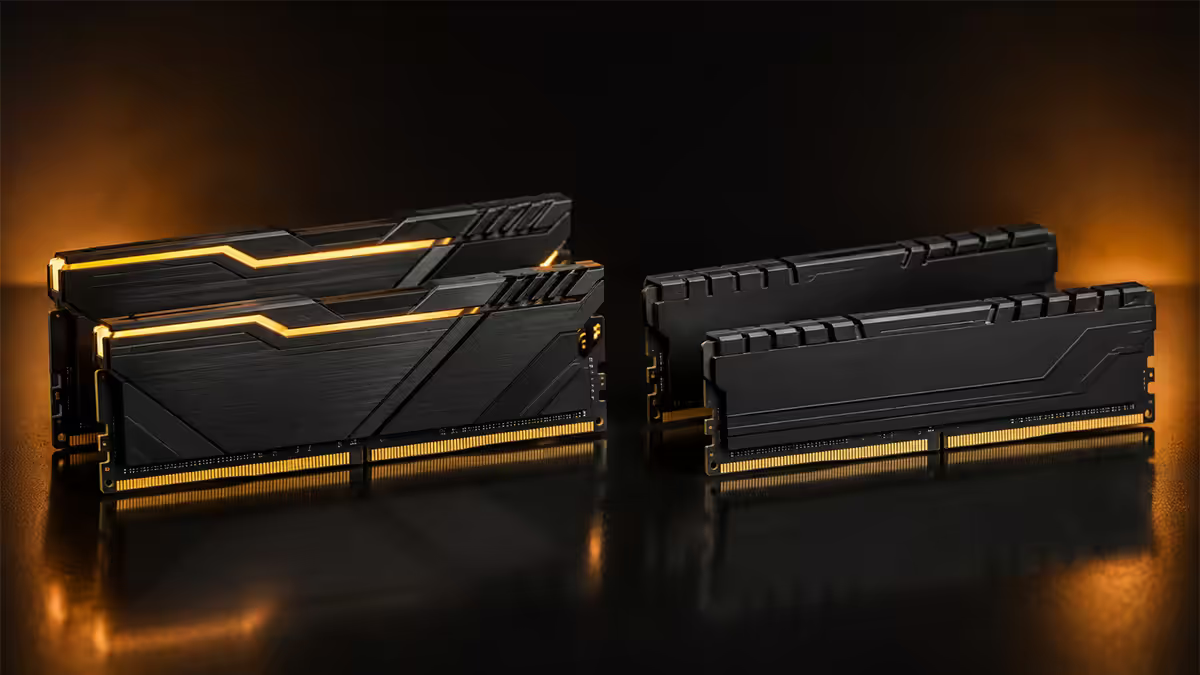
Two years ago this would have been a different article. In 2023, DDR5-5200 32GB kits commanded a 60-80% premium over equivalent DDR4-3600 32GB kits. The case for staying on DDR4 was largely about RAM pricing. That argument no longer holds.
By mid-2026, the price gap on the kits themselves has effectively closed. A typical 2x16GB Corsair Vengeance DDR5-6000 CL30 EXPO kit lands at R2,800-R3,200 in SA. The equivalent DDR4-3600 CL18 kit costs R2,400-R2,800. The R300-R400 gap on the RAM itself is no longer the deciding factor.
| Component | DDR4 kit price (SA) | DDR5 kit price (SA) |
|---|---|---|
| 16GB (2x8GB) | R1,200-R1,500 | R1,600-R2,000 |
| 32GB (2x16GB) value | R2,200-R2,600 | R2,600-R3,100 |
| 32GB (2x16GB) tuned | R2,600-R3,000 | R2,800-R3,400 |
| 64GB (2x32GB) | R4,400-R5,200 | R4,800-R5,800 |
The real cost lives elsewhere. You cannot put DDR5 in a DDR4 motherboard. The key-notch is in a different physical position on the bottom of the stick, the voltage is different (1.1V vs 1.2V), the on-stick PMIC of DDR5 changes the electrical interface entirely. To get DDR5 you need an AM5 (Ryzen 7000+ socket) or LGA1700/1851 (Intel 12th-15th gen) motherboard, and in most upgrade scenarios that means a new CPU too.
The platform-swap math
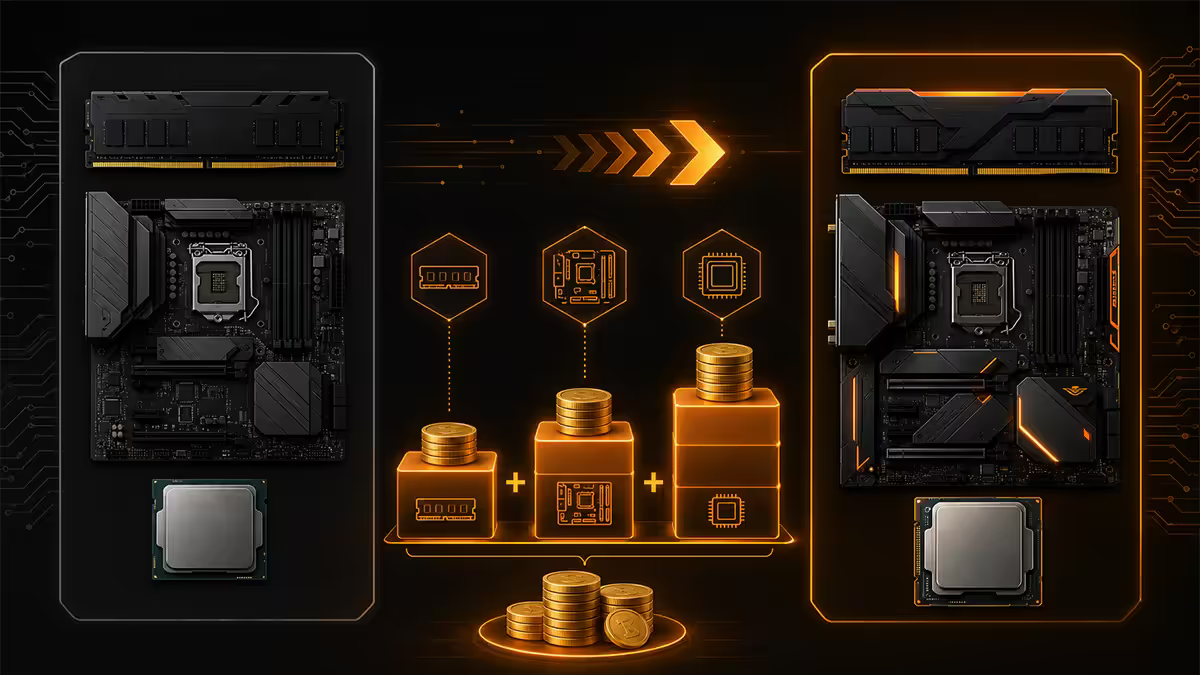
Here's the honest spreadsheet for someone moving from DDR4 to DDR5 in SA in 2026:
| Line item | Old (DDR4) | New (DDR5) |
|---|---|---|
| Motherboard | B550 / B660 — keep | B650 / B850 — R3,500-R5,500 new |
| CPU | Ryzen 5 5600 / i5-12400 — keep | Ryzen 7 7700 / i5-14600K — R5,000-R8,500 |
| RAM kit | DDR4-3600 32GB — keep / R2,400 | DDR5-6000 CL30 32GB — R2,800-R3,400 |
| Cooler | Existing cooler usually mounts | May need new mounting kit (R150-R250) |
| Windows licence | Migrates with motherboard change (digital licence) | Usually re-activates within 7 days |
| Total transition cost | R0 (keep current) | R8,000-R12,000 |
R8,000-R12,000 is real money. The question isn't whether DDR5 is faster than DDR4 — it is — but whether the speed difference is worth R8,000 spent now vs the same R8,000 spent on a better GPU when Witcher 4 lands, a 4K monitor, or a longer holiday.
When DDR4 is still the smart Rand in 2026
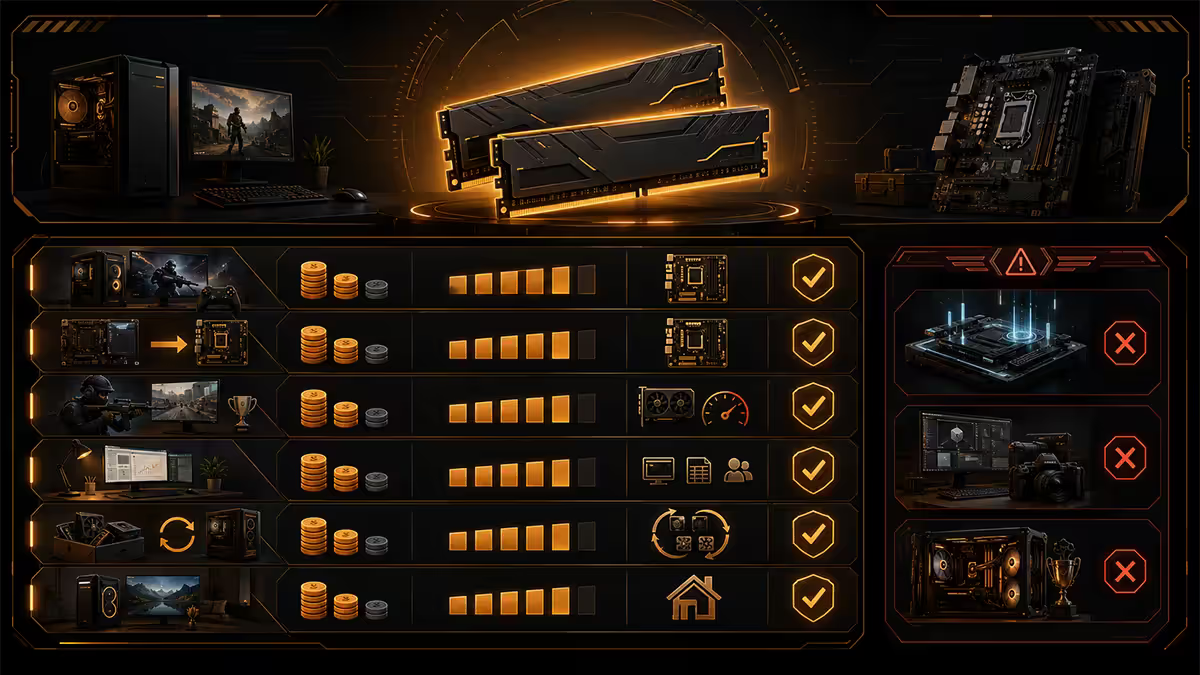
DDR4 platforms remain genuinely competitive at the budget end. Three scenarios where staying on DDR4 is the correct decision:
Building under R14,000 total
A complete AM4 build — Ryzen 5 5600, B550 motherboard, 16GB DDR4-3200, RTX 4060 or RX 7600, 1TB NVMe, 650W PSU, basic case — comes in around R12,500-R14,000. The equivalent AM5 / DDR5 build with similar CPU performance (Ryzen 5 7600) is R15,500-R17,500. For the R3,000-R3,500 difference you can get a full GPU class upgrade instead — RTX 4060 to RTX 4070, the gain in actual gaming performance is far bigger than DDR5's contribution.
Upgrading an existing AM4 system in-place
AM4 hit a remarkable extended lifespan. The Ryzen 5 5600 ($165 launch price, R3,200 in SA today) remains a fully competent CPU for 1080p and 1440p gaming. The Ryzen 7 5800X3D was one of the best gaming CPUs ever shipped and still benchmarks within 12-18% of the Ryzen 7 7800X3D in real workloads. If you're on AM4 with any 5000-series CPU and 32GB DDR4-3600, the value upgrade is a GPU, not the entire platform.
Office / productivity / casual gaming builds
For non-gaming and non-creative work — office, browser, light Steam catalog — DDR5's advantages don't surface. Both DDR4 and DDR5 are vastly faster than the storage and the network. A R10,000 office build on AM4 with DDR4 is identical in real use to a R13,500 build on AM5 with DDR5. Save the difference for a quality monitor, keyboard, or chair.
| Use case | DDR4 or DDR5? | Reasoning |
|---|---|---|
| Sub-R14k gaming build new | DDR4 (AM4) | R3k saved buys better GPU |
| Already on AM4 5800X3D | Keep DDR4 | Platform isn't the bottleneck |
| Already on Core i7-12700K | Keep DDR4 | Same — GPU upgrade wins |
| New build R20k+ for X3D gaming | DDR5 (AM5) | X3D + DDR5-6000 is meaningful |
| New 4K gaming build | DDR5 (AM5 or LGA1851) | Latest GPU deserves modern platform |
| Video editing / Blender | DDR5 64GB | Real RAM bandwidth wins |
| AI / ML local inference | DDR5 64-96GB | VRAM offload to system RAM |
The DDR5-6000 CL30 sweet spot
If you're going DDR5, the kit choice is almost binary. DDR5-6000 CL30 with EXPO on AM5, or DDR5-6400 CL32 with XMP on Intel LGA1700/1851. Don't overthink it.
The reason DDR5-6000 is the AMD sweet spot is the Infinity Fabric clock. On Ryzen 7000 and 9000-series CPUs, the memory controller runs Infinity Fabric (FCLK) at half the memory speed by default — 3000 MHz when RAM is at 6000 MT/s. Run RAM at 6400 MT/s and FCLK drops out of 1:1 sync, hurting latency. DDR5-6000 CL30 perfectly matches AM5's preferred memory:FCLK ratio and delivers the lowest practical latency.
EXPO is AMD's version of XMP — pre-validated overclocking profiles stored on the RAM stick itself. Enable EXPO in BIOS, the RAM trains at advertised speed and timings, done. Some boards label this as "XMP" anyway since the underlying mechanism is the same SPD profile.
For Intel LGA1700 (12th-14th gen) and LGA1851 (15th gen Core Ultra 200-series), DDR5-6400 CL32 is the typical sweet spot. Intel doesn't have the FCLK 1:1 boundary AMD does, so slightly faster RAM works without latency penalty. Don't overpay for DDR5-7200+ kits unless you're a benchmark chaser — the diminishing returns are brutal.
X3D is when DDR5 unlocks meaningful FPS
The biggest gaming gain from moving to DDR5 isn't the DDR5 itself — it's that on AM5 you can pair DDR5 with an X3D CPU. AMD's 3D V-Cache technology adds 64MB of additional L3 cache directly to the CPU die, dramatically improving performance in games that thrash the cache.
The numbers are real:
- Ryzen 7 5800X3D (AM4, DDR4) vs Ryzen 7 7800X3D (AM5, DDR5): 7800X3D is roughly 18-25% faster in 1080p gaming on average, with bigger wins (30%+) in cache-sensitive titles like Microsoft Flight Sim 2024, Stellaris, Factorio.
- Ryzen 7 7800X3D vs Ryzen 7 9800X3D: 9800X3D adds another 8-12% on top of 7800X3D's lead. Both are paired with DDR5-6000 CL30 EXPO.
- Same X3D chip, DDR5-6000 vs DDR5-6400: 6400 actually performs worse due to FCLK desync. 6000 CL30 is the genuine peak for X3D.
If you're building specifically for high-refresh-rate 1080p / 1440p gaming and you're going X3D, DDR5 is the right call. The combination of X3D's huge cache and DDR5's bandwidth produces step-function improvements in 1% low frame times — exactly what you feel in shooters and racing games at 144Hz+.
The upgrade ladder — Ryzen 5 5600 / Core i5-12400 in 2026
This is the question we get most. Someone on a 2-3 year-old DDR4 build (Ryzen 5 5600 or Core i5-12400 with RTX 3060/4060 and 16GB DDR4) asking what to upgrade. Here's the rational ladder:
- 1
Add 16GB more DDR4 (R1,000-R1,300)
If you're still on 16GB and you've been hitting 14-15GB usage in modern games, just adding another 16GB stick (or replacing 2x8 with 2x16) gets you to 32GB and removes any RAM ceiling for the next 18-24 months. Stay on the same AM4 / LGA1700 platform. This is the highest-Rand-per-FPS upgrade for the cheap end. - 2
Upgrade the GPU (R10,000-R15,000)
RTX 4070 / RTX 5060 Ti / RX 9060 in the same DDR4 system. The Ryzen 5 5600 won't fully feed a 4070 in every CPU-bound scenario but you'll see meaningful FPS gains at 1440p and almost no gain at 4K is GPU-bound. This is where most people should stop. - 3
Upgrade the AM4 CPU only (R3,500-R4,500)
If you're CPU-bound at 1080p high-refresh, drop in a Ryzen 7 5800X3D into the existing AM4 board. It's still one of the best gaming chips available, and the upgrade is a 10-minute drop-in with no new RAM or motherboard. Massive 1% low FPS improvement in cache-heavy games. This single upgrade can postpone the platform jump by 2-3 years. - 4
The full platform jump (R8,000-R12,000)
Only when steps 1-3 no longer move the needle. By then you're typically buying a Ryzen 7 7800X3D / 9800X3D, AM5 motherboard, and DDR5-6000 CL30 32GB kit as a package. Expect this to land in 2027-2028 for current AM4 owners.
SA picks per tier
| Tier & standard | Best SA pick | Price |
|---|---|---|
| DDR4-3200 16GB budget | Kingston Fury Beast / Corsair Vengeance LPX | R900-R1,200 |
| DDR4-3600 32GB tuned | G.Skill Ripjaws V / Corsair Vengeance LPX CL18 | R2,400-R2,800 |
| DDR5-6000 CL30 32GB EXPO (AM5) | G.Skill Trident Z5 Neo / Corsair Vengeance DDR5 | R2,800-R3,400 |
| DDR5-6000 CL30 64GB EXPO (AM5) | G.Skill Trident Z5 Neo 2x32GB | R5,000-R5,800 |
| DDR5-6400 CL32 32GB XMP (Intel) | G.Skill Trident Z5 RGB / Kingston Fury Renegade | R3,000-R3,800 |
| DDR5-7200+ enthusiast | G.Skill Trident Z5 RGB / Corsair Dominator Titanium | R4,500-R6,500 |
| CUDIMM DDR5-8400+ (LGA1851) | G.Skill Trident Z5 CK / Corsair Dominator Titanium CK | R6,500-R9,500 |
Key takeaways
- In 2026, DDR5 kits themselves cost only R300-R400 more than equivalent DDR4. The kits aren't the problem.
- You can't put DDR5 in a DDR4 motherboard. The platform-swap cost is R8,000-R12,000 total.
- DDR4 + AM4 (Ryzen 5 5600 / 7 5800X3D) remains the right answer under R14,000.
- DDR5-6000 CL30 EXPO is the AM5 sweet spot — matches Infinity Fabric for lowest latency.
- X3D + DDR5 is where the meaningful FPS uplift lives. Non-X3D upgrades show smaller wins.
Frequently asked questions
Can I put DDR5 in a DDR4 motherboard?
No. Different key-notch position and incompatible electrical interface. DDR5 requires AM5 (AMD) or LGA1700/1851 (Intel) motherboards.Is DDR4 still worth buying in 2026?
Yes for budget builds under R14,000. AM4 platform with Ryzen 5 5600 or LGA1700 with i5-12400 are still genuinely strong on DDR4.What's the DDR5 sweet spot for AM5?
DDR5-6000 CL30 EXPO. Matches Infinity Fabric 1:1 ratio. Going faster than 6400 hurts latency on AMD.Does DDR5 actually give better gaming FPS than DDR4?
With X3D — 8-15% higher minimum FPS at 1080p over DDR4. At 1440p the gap closes to 3-6%. At 4K it's irrelevant.What does upgrading from DDR4 to DDR5 actually cost?
R8,000-R12,000 total — new motherboard (R3,500-R5,500), new CPU (R3,500-R8,000) and DDR5 kit (R2,800-R3,400). Complete platform swap.Is DDR5 finally cheap enough in 2026?
Effectively yes — DDR5-6000 kits are within R300-R400 of equivalent DDR4-3600 kits. The cost issue is the board and CPU.What about CL30 vs CL36 vs CL40 — does timing matter?
Yes — CL30 vs CL36 at the same speed is roughly 5-8% better latency, 1-3% FPS at 1080p. Pay the small extra for CL30.Should I get 32GB or 64GB DDR5?
32GB (2x16GB) for gaming and most use. 64GB (2x32GB) for video editing, Blender, AI, VMs. Never 4 sticks on AM5 — drops speed to 3600-4000.
Get the Evetech app
Exclusive app-only prices, daily flash sales, and free delivery on orders over R4,000 — download the app and start saving.