Hardware Explainer · Memory
DDR5 vs DDR4. — Is the platform swap worth it?
DDR5 is faster on paper, slower in CAS Latency, more expensive in rand, and only works on certain motherboards. The real question isn't which is better — it's whether the gap justifies replacing your CPU and motherboard to get there.
- paper bandwidth gain
- ~50%
- real-world FPS gain
- 5-15%
- platform swap cost
- R8k+
What's actually new about DDR5
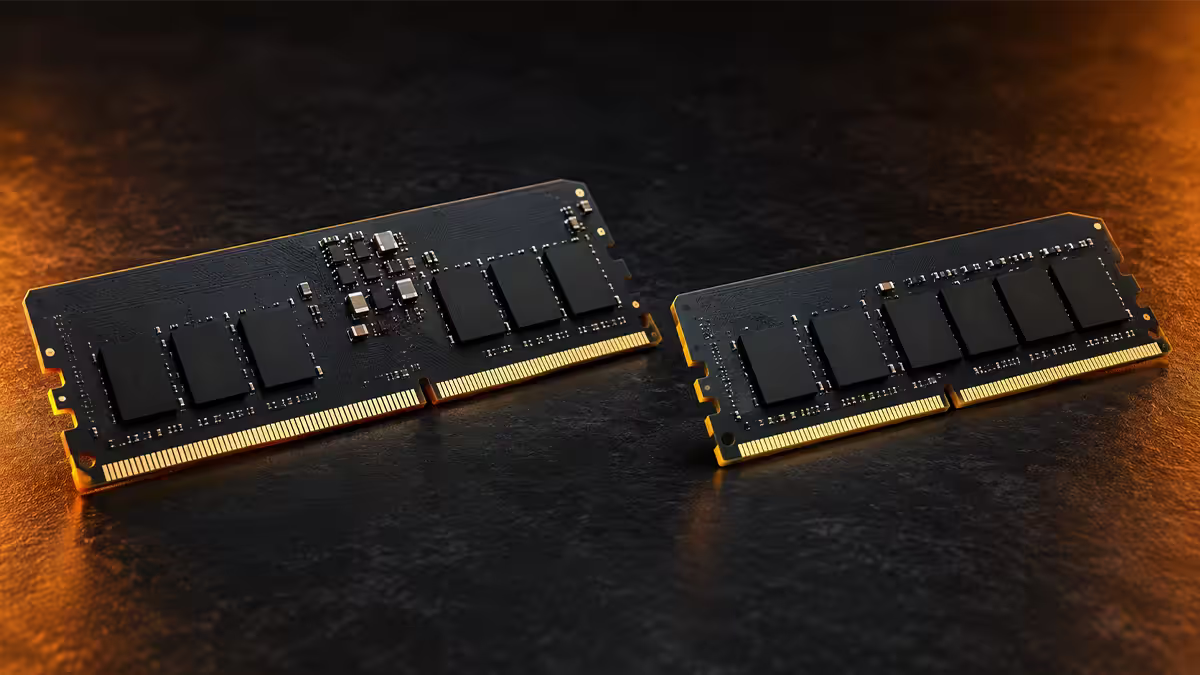
DDR5 isn't just "DDR4 but faster". It's a structural rework of how memory talks to your CPU. Three changes matter for builders:
Dual-channel within the stick. Each DDR5 module is split into two independent 32-bit sub-channels. A "dual-channel kit" of two DDR5 sticks is really running four parallel channels — that's where most of the bandwidth gain comes from, not just higher clock rates.
On-stick PMIC. The Power Management IC moved from the motherboard onto the DIMM itself. That's why DDR5 runs at 1.1V instead of 1.2V — cleaner voltage delivery — and it's also why the heatspreader bulges over the centre of the stick on premium kits.
On-die ECC. Every DDR5 module has internal error correction across the memory array. This isn't the same as server-grade ECC (which checks data on the bus), but it does mean DDR5 is genuinely more reliable per-cell than DDR4, especially as density scales.
DDR5 isn't faster RAM. It's a different memory subsystem that happens to be backwards-named.
Why a "DDR5 upgrade" means a platform upgrade
Bandwidth vs latency — the part most people get wrong
The DDR5 vs DDR4 internet discourse usually fixates on CAS Latency (CL) — and that's misleading. DDR5-6000 CL30 has a higher CL number than DDR4-3200 CL16, so people assume DDR5 is "slower". The reality is more nuanced.
True latency in nanoseconds = (CL ÷ MT/s) × 2000. Run the maths:
- DDR4-3200 CL16: (16 ÷ 3200) × 2000 = 10 ns
- DDR4-3600 CL16: (16 ÷ 3600) × 2000 = 8.9 ns
- DDR5-6000 CL30: (30 ÷ 6000) × 2000 = 10 ns
- DDR5-7200 CL34: (34 ÷ 7200) × 2000 = 9.4 ns
In nanoseconds — what your CPU actually waits for — DDR5 is roughly the same as good DDR4. But DDR5 moves twice the bandwidth in those same nanoseconds. That's the entire game.
| Spec | DDR4 (typical) | DDR5 (typical) |
|---|---|---|
| Headline speed (2026 retail) | 3200-3600 MT/s | 6000-8000 MT/s |
| Per-stick bandwidth | 25.6 GB/s | 48-64 GB/s |
| True latency (ns) | ~9-10 ns | ~9-10 ns |
| Voltage | 1.2V | 1.1V (cooler) |
| Power management | Motherboard | On-stick PMIC |
| On-die ECC | No | Yes |
| Max practical capacity / stick | 32 GB | 64 GB |
| XMP / EXPO profile | XMP 2.0 | XMP 3.0 / EXPO |
Real-game FPS — what the benchmarks actually show
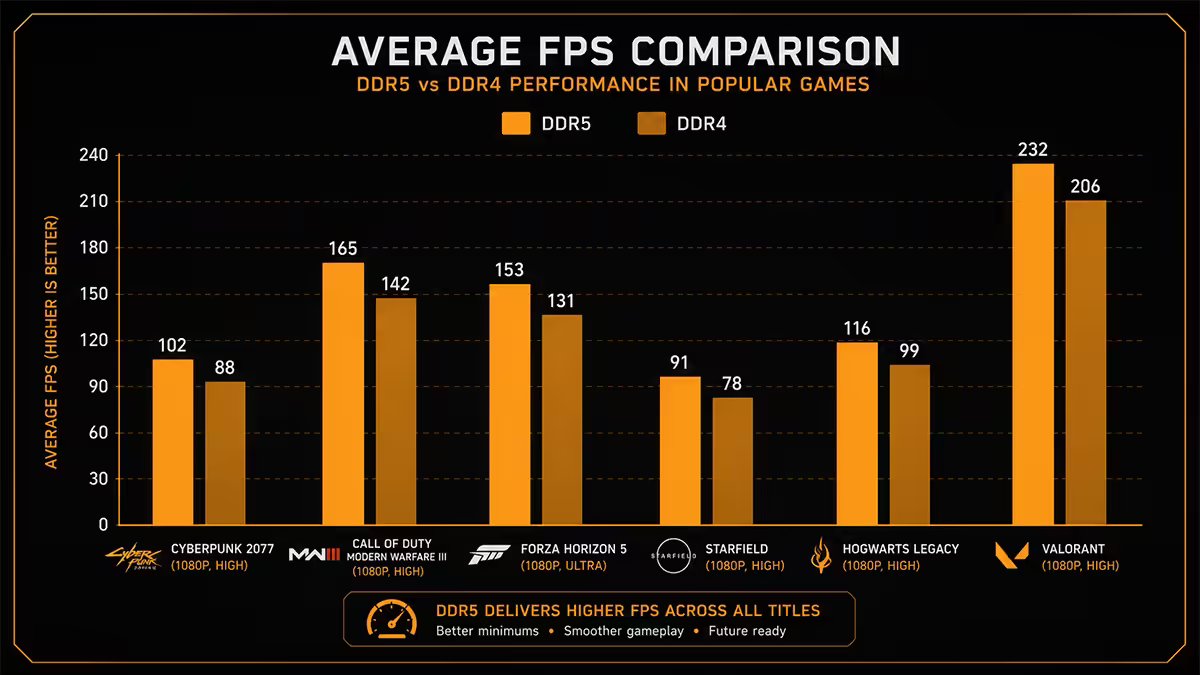
Synthetic memory benchmarks (AIDA64, MemTest) make DDR5 look like a generational leap. Real games are more measured. Here's what we see in 2026 testing across CPU-bound modern titles:
The pattern: CPU-bound scenarios (1080p, esports, simulation games like Factorio, MMO city hubs) benefit the most — 10-20% FPS gain is common. GPU-bound scenarios (1440p and 4K with high settings) barely move — 3-7% if you're lucky.
For productivity, the deltas are bigger. Premiere Pro 4K timeline exports run 15-25% faster on DDR5. Blender renders 5-15% faster. Compiling large codebases sees 10-20%. Anything memory-bandwidth-bound (which is most "real work") benefits.
Platform requirements — the part that breaks budgets
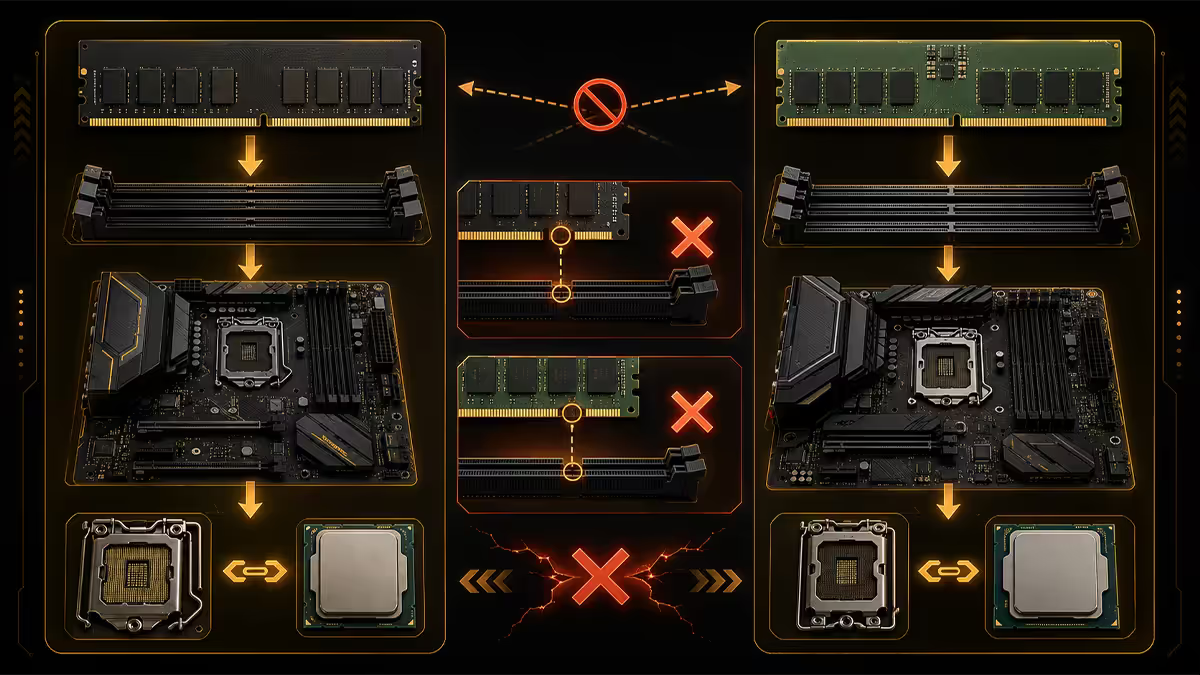
You cannot just buy DDR5 sticks and slot them into a DDR4 motherboard. The key notch position is different. The voltage delivery is different. The memory controller in the CPU is different. The chipset is different.
Upgrading to DDR5 means upgrading three things together:
- CPU — must have a DDR5 memory controller.
- Motherboard — must have DDR5 DIMM slots and matching chipset.
- RAM — DDR5 kit.
| Platform | Memory support | Status |
|---|---|---|
| AMD AM4 (Ryzen 1000-5000) | DDR4 only | End-of-life but still good value |
| AMD AM5 (Ryzen 7000/8000/9000) | DDR5 only | Current AMD platform |
| Intel LGA1200 (10th/11th gen) | DDR4 only | End-of-life |
| Intel LGA1700 (12th-14th gen) | DDR4 or DDR5 (board decides) | Transitional platform |
| Intel LGA1851 (Core Ultra 200S) | DDR5 only | Current Intel platform |
Intel's LGA1700 socket is the interesting middle ground — Z690/Z790/B760 boards exist in both DDR4 and DDR5 flavours. If you're upgrading from an 11th-gen Intel chip, you could keep DDR4 and just swap the CPU + board for a DDR4 LGA1700 board. That's the cheapest "modern" upgrade path. AMD users had no such option — moving past Ryzen 5000 means DDR5.
DDR5 vs DDR4 — what it costs in SA right now
DDR5 was 2-3x DDR4 prices at launch in late 2022. By mid-2026 it's gotten reasonable. Here's what we see on the SA market today:
| Kit | SA price (May 2026) | Best for |
|---|---|---|
| DDR4-3200 CL16 16GB (2x8) | R750-R900 | Budget AM4 / LGA1200 builds |
| DDR4-3600 CL16 32GB (2x16) | R1,400-R1,750 | Sweet spot AM4 / B760-DDR4 builds |
| DDR5-5600 CL36 16GB (2x8) | R1,200-R1,500 | Entry DDR5 |
| DDR5-6000 CL30 32GB (2x16) AMD EXPO | R2,200-R2,800 | AM5 gaming sweet spot |
| DDR5-7200 CL34 32GB (2x16) Intel XMP | R2,900-R3,500 | LGA1851 high-end |
| DDR5-8000 CL38 32GB (2x16) | R3,800-R4,500 | Diminishing returns |
| DDR5-6000 CL30 64GB (2x32) EXPO | R4,200-R5,500 | Creator workstation |
The honest gap in 2026 is roughly 30-60% more rand for DDR5 at equivalent capacity. Combined with the new CPU + motherboard cost, a complete platform jump from DDR4 to DDR5 lands at R8,000-R14,000+ for a mid-range build.
When DDR5 is the right call
- You're building new in 2026. DDR5 is the default. Don't go DDR4 unless budget is genuinely tight — the platform will be supported for years longer.
- You're upgrading from Intel 11th gen or older. You're changing CPU + board anyway. DDR5 (or DDR4 on LGA1700) makes sense as part of that.
- You're upgrading from AMD Ryzen 5000. AM4 is end-of-life. AM5 means DDR5. Bite the bullet.
- You run memory-bandwidth workloads. Video editing, 3D rendering, local AI inference, large code compiles — DDR5 delivers material gains here, not just FPS bragging rights.
- You want capacity beyond 64GB. Single 48GB and 64GB DDR5 sticks are now available — 128GB-192GB DDR5 builds are practical. DDR4 capped out at 128GB and is no longer in production at the high end.
When DDR4 still wins
- You already have a solid DDR4 platform. If you're on AM4 with a Ryzen 5700X3D or 5800X3D, you have one of the best gaming CPUs of the era. Don't throw that away for a 10% FPS bump.
- You're building under R12,000. A complete AM4 + DDR4 build (Ryzen 5 5600 + B550 board + 32GB DDR4-3600) lands well under R8,000 for the platform. The same money on AM5 forces compromises elsewhere.
- You're upgrading specifically the GPU. A faster GPU on an old DDR4 system delivers 80-100% of the gain a full platform swap would.
- You only need 16-32GB and won't upgrade for 3 years. DDR4 prices are stable, kits are abundant on secondary markets, and the platform works fine.
Key takeaways
- DDR5 brings ~50% paper bandwidth, 5-15% real FPS gain, similar true latency to good DDR4.
- You cannot mix DDR4 and DDR5 — different keys, different voltage, different memory controllers.
- AM5 and LGA1851 are DDR5-only. AM4 is DDR4-only. LGA1700 supports both.
- DDR5-6000 CL30 (AMD EXPO) or DDR5-7200 CL34 (Intel XMP) is the sweet spot — faster gives diminishing returns.
- Enable XMP/EXPO in BIOS — DDR5 ships at 4800-5600 base speed until you turn the profile on.
Frequently asked questions
Is DDR5 worth upgrading from DDR4?
Only if you're already changing CPU + motherboard. The real-world FPS gain (5-15%) doesn't justify the R8,000-R14,000 platform swap if your DDR4 system is otherwise healthy.What's the actual speed difference between DDR4 and DDR5?
DDR5 delivers roughly 50% more bandwidth on paper. In real games, that translates to 5-15% more FPS at 1080p, less at 1440p+, and 10-25% in memory-bound productivity tasks.Can I use DDR4 RAM in a DDR5 motherboard?
No — different key-notch position, different voltage, different memory controller. The slots are physically incompatible.What CPUs require DDR5?
AMD AM5 (Ryzen 7000/8000/9000) is DDR5-only. Intel LGA1851 (Core Ultra 200S) is DDR5-only. Intel LGA1700 (12th-14th gen) supports either depending on the motherboard.DDR5 latency is higher — does that hurt performance?
CAS Latency numbers are higher but true latency in nanoseconds is roughly equal. The bandwidth gain wins overall.What's the best DDR5 speed for gaming in 2026?
DDR5-6000 CL30 EXPO on AMD AM5 (matches infinity fabric in 1:1 mode). DDR5-7200 CL34 to DDR5-8000 CL38 on Intel LGA1851. Faster than that = diminishing returns for serious money.How much DDR5 do I need?
32GB (2x16GB) is the sweet spot for gaming and creator work. 16GB still works for esports. 64GB only for video editing, 3D and local AI workloads.Can I mix DDR5 modules with different speeds?
Technically yes, but the kit runs at the slowest module's speed and XMP/EXPO may not boot. Always buy a matched dual-channel kit (2x16 or 2x32).
Get the Evetech app
Exclusive app-only prices, daily flash sales, and free delivery on orders over R4,000 — download the app and start saving.