Future Tech · Memory Standard
Should you wait for DDR6, or buy DDR5 now?
DDR6's JEDEC spec was finalised in late 2025. The first consumer modules are still 18 months away. DDR5-6000 is cheap, mature and finally living up to its promise. Here's what that means for your 2026 build.
- DDR6 base spec
- 12.8 Gbps
- consumer launch
- ~Q4 2027
- 32GB DDR5-6000
- R3500
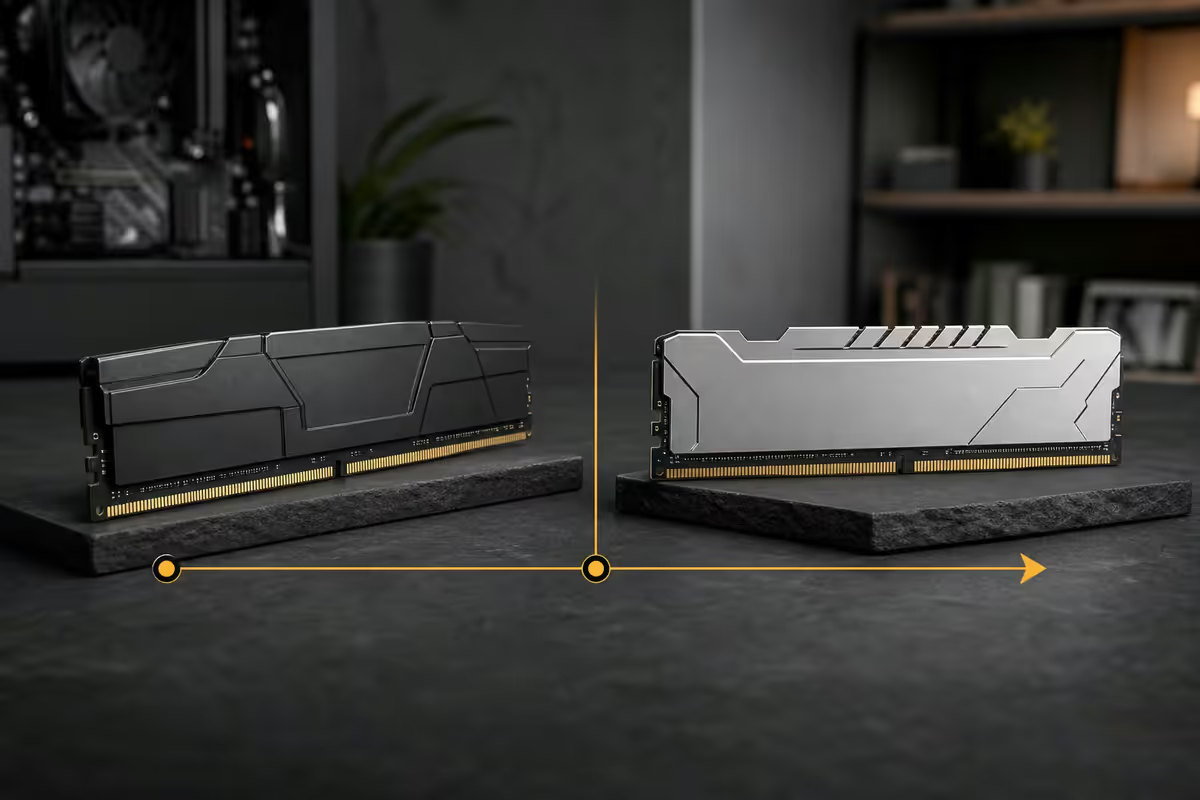
DDR5 vs DDR6 at a glance
The headline numbers make DDR6 look like an obvious win — until you factor in launch pricing, platform requirements, and the fact that most real workloads are nowhere near DDR5's ceiling yet.
| Spec | DDR5 (today) | DDR6 (2027) |
|---|---|---|
| JEDEC base speed | 4800 MT/s | 12800 MT/s |
| Sweet-spot kit (2026/2028) | DDR5-6000 CL30 | DDR6-14400 est. |
| Voltage | 1.1V | ~1.0V |
| Channels per DIMM | 2 × 32-bit subchannels | 4 × 24-bit subchannels |
| Max launch capacity | 2 × 24GB / 48GB | 2 × 32GB / 64GB est. |
| SA 32GB kit price (mid-2026) | R3000-R3800 | R6000+ est. at launch |
| Platform support | AM5, LGA1851, AM4 DDR5 boards | AM6 / LGA1954 (new) |
| Realistic SA retail | In stock everywhere | Q1-Q2 2028 |
The 2.6x bandwidth uplift sounds enormous, but the gaming reality is more modest. DDR6's biggest wins are in workloads DDR5 actually struggles with — large-language-model inference, 8K video editing, integrated graphics performance, and chiplet-based CPUs starved for bandwidth. For 1440p gaming on a discrete GPU, the difference between DDR5-6000 and DDR6-12800 in 2028 will likely be 5-12%, not the 2x marketing fantasy.
DDR6 spec leaks — what we actually know
JEDEC finalised the DDR6 specification in late 2025. The official documents aren't public yet, but Samsung, SK Hynix and Micron have published roadmaps that give us a clear picture.
Confirmed DDR6 specifications:
- Base speed: 12.8 Gbps per pin (DDR5 base is 4.8 Gbps) — a 2.6x bandwidth uplift before XMP/EXPO overclocks.
- Voltage: ~1.0V (down from DDR5's 1.1V) for better power efficiency at higher speeds.
- Channel architecture: 4 subchannels of 24-bit per DIMM (DDR5 uses 2 × 32-bit subchannels) — more parallelism for modern multi-thread workloads.
- On-die ECC: Enhanced ECC remains for reliability at higher speeds.
- Capacity: 32GB single-stick modules at launch, 64GB dual-stick kits as the mainstream sweet spot.
The launch timeline: Samsung has stated production samples in Q2 2026 and mass production in late 2026. Consumer modules ship alongside Intel's Nova Lake and AMD's Zen 6 platforms in late 2027. In SA, expect retail availability in Q1-Q2 2028, with early modules carrying a 40-60% premium for the first 12 months — exactly like DDR5 did in 2022.
DDR5 in 2026 — finally living up to the promise
When DDR5 launched in 2022, the first kits were expensive, unstable, and barely outpaced DDR4-3600. Four years later, the picture is completely different.
What changed for DDR5 by 2026:
- DDR5-6000 CL30 is the mainstream — was the enthusiast tier 18 months ago. R3000-R3500 for 32GB at Evetech.
- EXPO and XMP profiles work first try — early DDR5 needed BIOS gymnastics to hit advertised speeds. AM5 and LGA1851 now boot to rated speeds out of the box.
- Memory controller maturity — Ryzen 9000 (Zen 5) and Intel Core Ultra 200 (Arrow Lake) handle DDR5-6000 to DDR5-7200 reliably. Bus speed isn't the limiter anymore.
- Capacity options grew — 24GB and 48GB sticks shipped in 2024, opening up 48GB and 96GB total configurations for AI and creative workloads without breaking the bank.
The honest framing: DDR5 in 2026 is in the same place DDR4 was in 2019 — mature, affordable, with widespread platform support and proven reliability. It will remain the mainstream RAM standard until at least 2030 because LGA1851 and AM5 platforms can't physically use DDR6.
The platform refresh tax — what nobody tells you
Here's the part of the DDR6 conversation that vanishes from most YouTube videos. DDR6 isn't just new memory — it's a complete platform change.
What you'll actually buy in 2027 to move to DDR6:
| Component | Why it changes | Estimated SA cost |
|---|---|---|
| Motherboard | New socket (AM6 / LGA1954) and new DDR6 keying | R4000-R8000 |
| CPU | New memory controller in Zen 6 / Nova Lake | R6000-R15000 |
| DDR6 32GB kit | Launch premium (40-60% over DDR5 ZAR) | R6000-R9000 |
| CPU cooler (often) | New socket mount kits required | R0-R1500 |
| Total platform refresh | Minimum spend to access DDR6 | R16000-R33500 |
Compare that to buying DDR5 today: a 32GB DDR5-6000 CL30 kit at R3500. That's the entire RAM decision. Your existing AM5 or LGA1851 motherboard already supports it. Your CPU runs it natively. You can be done in an afternoon.
The platform refresh tax is the single biggest reason "just wait for DDR6" advice is misleading. The RAM itself was never the expensive part of the upgrade.
When waiting actually makes sense
Waiting for DDR6 is the right call in a narrow set of scenarios. Be honest about which one you're in.
You should wait if:
- You're already on AM4 or LGA1700 with DDR4 and your current performance is acceptable. Skipping AM5/LGA1851 means you land on DDR6 in 2027 instead of buying two platforms in three years.
- You don't need a new PC right now. No broken parts, no productivity bottleneck, no game you can't play. Waiting costs you nothing.
- Your budget for the next 18 months is R25000+ and you've earmarked it for a complete platform refresh in 2028 anyway.
- Your workload is genuinely bandwidth-starved — large-language-model fine-tuning, 8K editing, scientific simulation. The DDR6 jump will materially improve your work.
When buying DDR5 now is the right call
For most people reading this guide, buying DDR5 today is genuinely the better answer. Here's when the maths is clear-cut.
Buy DDR5 now if:
- You're building from scratch or replacing a broken PC. You need a working machine. R3500 of DDR5-6000 gets you there today.
- You're on DDR4 and feeling the bandwidth ceiling. Modern games, 1440p+ gaming, content creation and AI workflows benefit immediately from DDR5-6000.
- You're upgrading from 16GB to 32GB. The capacity jump matters more than the DDR generation. Don't run modern Windows + Chrome + Discord + a game on 16GB any longer.
- You're price-conscious. DDR5-6000 has never been cheaper in SA. Waiting two years to spend 3x as much on DDR6 launch pricing is a bad trade.
- Your AM5 or LGA1851 build will stay in service through 2028-2030. Even when DDR6 launches, your DDR5 platform stays useful for the full lifespan you originally planned for.
The DDR5 platform isn't going anywhere. AM5 has confirmed support through 2027+. LGA1851 will see at least one more CPU generation. Both stay on DDR5. A DDR5 build today will receive years of CPU upgrades on the same memory.
SA build pricing reality — what you'll actually pay
SA RAM pricing has stabilised in 2026 after the volatility of 2022-2024. The big retailers (Evetech, Wootware, Rebel Tech, Computer Mania) all carry DDR5-6000 in 32GB kits as their default stock. The variance between them is usually under 8%.
| Kit | Best for | SA price (June 2026) |
|---|---|---|
| Kingston Fury Beast DDR5-6000 CL30 32GB | Best value Ryzen / Intel | R3000-R3300 |
| G.Skill Flare X5 DDR5-6000 CL30 32GB | Ryzen sweet spot | R3200-R3600 |
| Corsair Vengeance DDR5-6000 CL30 32GB | Intel-friendly | R3300-R3800 |
| G.Skill Trident Z5 RGB DDR5-6400 CL32 32GB | Intel Core Ultra premium | R3800-R4500 |
| G.Skill Trident Z5 DDR5-7200 CL34 32GB | Intel high-refresh enthusiast | R4500-R5500 |
| Corsair Dominator DDR5-7200 CL36 32GB | Showcase build | R5500-R7000 |
| G.Skill Flare X5 DDR5-6000 CL30 48GB (2x24) | Creative / AI workload | R4800-R5500 |
| G.Skill Flare X5 DDR5-6000 CL30 96GB (2x48) | Local LLM / heavy video | R8500-R10000 |
Common mistakes builders are making in 2026
Paying premium for DDR5-8000+ on Ryzen. The Ryzen memory controller can't run faster than ~DDR5-6200 in 1:1 mode with the Infinity Fabric. Buying a DDR5-8000 kit and forcing the system to drop to 2:1 mode gives you worse real-world latency than DDR5-6000 CL30 at half the price.
Waiting forever for the next generation. DDR6 in 2027, DDR7 in 2030, DDR8 in 2033. There's always a next generation. The hardware that's ready when you need it is the right hardware.
Buying DDR4 in 2026. Unless you're rescuing a working AM4 / LGA1700 DDR4 build with broken RAM, don't buy new DDR4. The platform is end-of-life, DDR4 prices have plateaued and DDR5 is now cheaper per GB at the 32GB tier.
Skimping on RAM to chase a faster CPU. 16GB on a Ryzen 9 9950X is a waste of the CPU. Spend the extra R1500 on 32GB DDR5-6000 and let the CPU breathe. The performance returns are far better than chasing the next CPU SKU up.
Believing the "DDR5 will crash when DDR6 launches" myth. DDR4 didn't crash when DDR5 arrived in 2021. It dropped about 20% over 18 months, then plateaued. DDR5 will follow the same curve — useful price relief, not a fire sale.
Mixing kits from different purchases. Two 16GB kits bought 12 months apart will likely not run at full rated speed together, even with identical part numbers. Always buy a matched 2-stick kit, never two 1-stick purchases.
Key takeaways
- DDR6 ships late 2027 globally. SA retail availability realistically lands Q1-Q2 2028, at a 40-60% launch premium.
- DDR6 isn't just new RAM — it's a new socket, chipset and CPU. The platform refresh tax is R16000-R33500, not the R6000 of RAM alone.
- DDR5-6000 CL30 at R3000-R3500 is the sweet spot for both Ryzen 7000/9000 and Intel Core Ultra in 2026.
- Buy DDR5 now if you need a working PC, are on DDR4 feeling the ceiling, or upgrading from 16GB. Your AM5/LGA1851 platform stays useful through 2028-2030.
- Wait for DDR6 only if you're already content on AM4/LGA1700 and would rather skip a generation. Don't wait just because the next thing is coming — something is always coming.
- Don't pay premium for DDR5-8000+ on Ryzen. The memory controller can't run faster than ~DDR5-6200 in 1:1 mode, so you pay extra for worse real-world latency.
Frequently asked questions
When will DDR6 actually be available in South Africa?
DDR6 ships globally in late 2027 alongside Intel Nova Lake and AMD Zen 6. SA retail typically follows global launch by 2-4 months, so Q1-Q2 2028. Expect a 40-60% premium for the first 12 months, mirroring the DDR5 launch curve in 2022-2023.What's the actual performance jump from DDR5 to DDR6?
DDR6 starts at 12.8 Gbps per pin vs DDR5's 4.8 Gbps — a 2.6x paper uplift. Real-world gaming gains will be 5-12% at 1080p and less at 1440p/4K. Bigger wins for content creation, AI and integrated graphics.What is the platform refresh tax?
Moving to DDR6 in 2027 means new motherboard (R4000-R8000), new CPU (R6000-R15000) and new DDR6 RAM (R6000+ at launch) — R16000-R29000 minimum, on top of any DDR5 build you'd own.Should I buy DDR5 in 2026 or wait?
Buy now if you need a working PC, are building from scratch, or upgrading from DDR4. Your AM5 or LGA1851 platform stays useful 4+ years. Wait only if you're on AM4/LGA1700 and content with current performance.What's the DDR5 sweet spot for Ryzen and Intel in 2026?
Ryzen 7000/9000: DDR5-6000 CL30 (matches Infinity Fabric for best latency). Intel Core Ultra LGA1851: DDR5-6400 to DDR5-7200 CL32. Don't pay premium for DDR5-8000+ on Ryzen — the platform can't run it in 1:1 mode.How much does 32GB DDR5 cost in South Africa in 2026?
A 32GB DDR5-6000 CL30 kit lands R3000-R3800 at Evetech, Wootware and Rebel Tech mid-2026. G.Skill Flare X5, Kingston Fury Beast and Corsair Vengeance are the common SKUs. Premium DDR5-7200 RGB runs R4500-R6000.Will DDR5 prices crash when DDR6 launches?
No. DDR4 didn't crash when DDR5 launched in 2021 — it dropped about 20% over 18 months and plateaued. DDR5 will follow the same pattern. It will remain the mainstream standard until at least 2030.Can I upgrade my existing AM5 board to DDR6 later?
No. DDR6 requires a new motherboard with new memory controllers and new physical keying. AM5 and LGA1851 are DDR5-only by design. The transition is always a full platform change — there is no in-place DDR6 upgrade.
Get the Evetech app
Exclusive app-only prices, daily flash sales, and free delivery on orders over R4,000 — download the app and start saving.