Cooling Comparison
Air vs AIO vs Custom Loop. The honest comparison.
The cooling debate is rigged by influencers selling RGB. The truth: most builds belong on premium air. AIOs win above 225W. Custom loops are a hobby disguised as a cooling solution. Here's the math.
- air cooler ceiling
- 225W
- AIO pump life
- 5-7 yrs
- custom loop entry
- R15k+
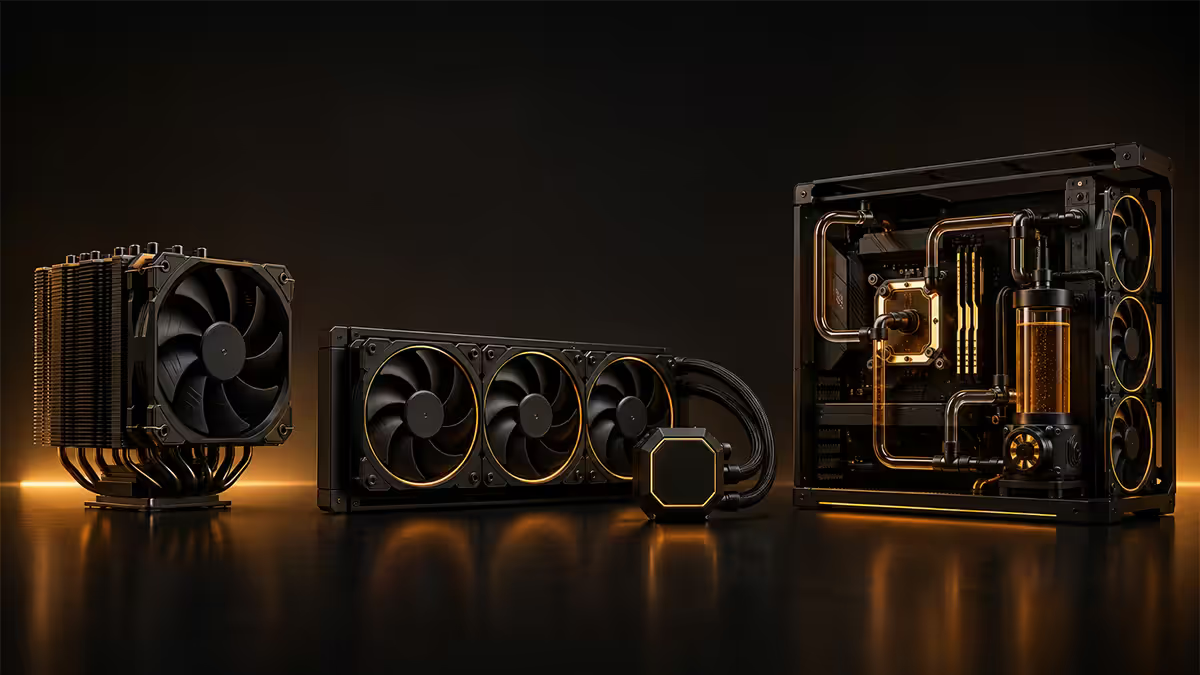
Thermal ceilings — what each system can actually handle
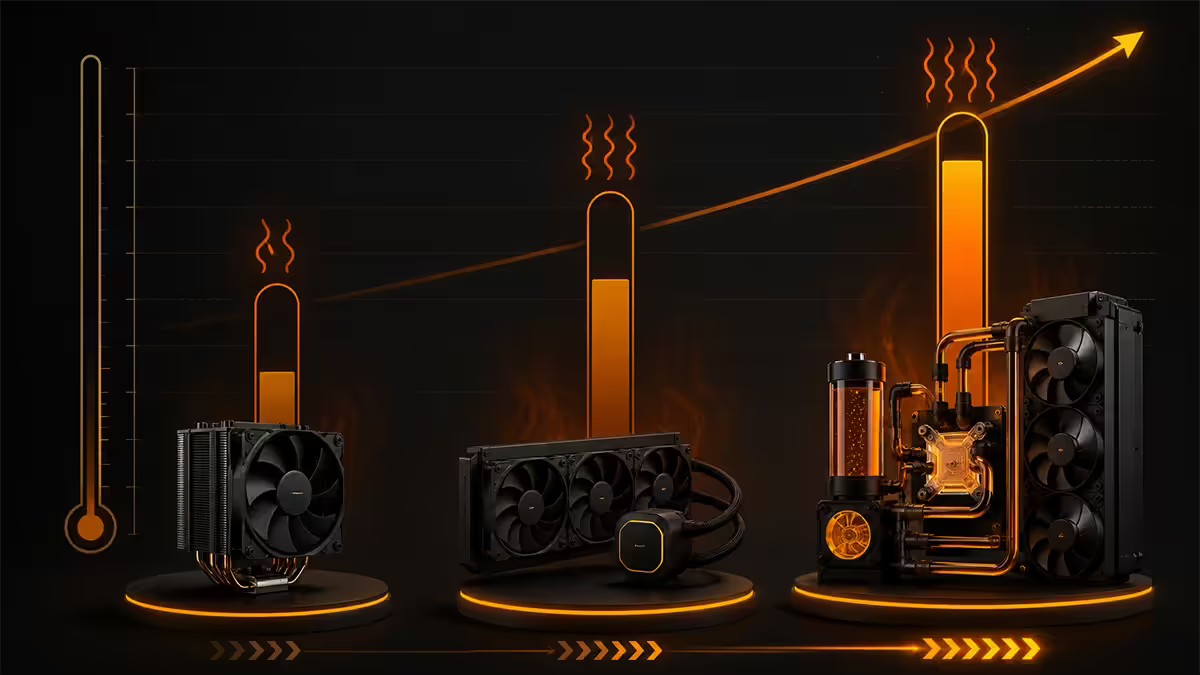
The honest performance line nobody wants to draw: at the same fan speeds, in the same case, on the same chip, the thermal differences between top-tier air and a 360mm AIO are smaller than the YouTube thumbnails suggest. The gap only opens at extreme loads.
| CPU load | Premium air | 360mm AIO | Custom loop |
|---|---|---|---|
| Up to 125W (Ryzen 7 7700X, Core i5-14600K) | Excellent — sub-65°C | Excellent — same range | Excellent — wasted potential |
| 125-200W (Ryzen 9 7900X, Core i7-14700K) | Very good — 75°C peak | Very good — 70°C peak | Excellent — 60-65°C peak |
| 200-250W (Ryzen 9 7950X, Core i9-14900K) | Borderline — 85-90°C, throttles in some all-core loads | Good — 78-82°C | Excellent — 68-72°C |
| 250W+ sustained (delidded, overclocked, Threadripper) | Inadequate | Marginal | Best option |
The 225W ceiling for premium air isn't arbitrary — it's roughly where a dual-tower air cooler with two 140mm fans can no longer dissipate heat fast enough to keep a high-TDP chip below thermal throttling thresholds in extended all-core loads. Below 225W, the radiator surface area of a Noctua NH-D15 or Phantom Spirit 120 SE actually rivals a 240mm AIO and approaches a 360mm AIO.
Above 225W — Ryzen 9 7950X / 9950X, Core i9-14900K/KS, Core Ultra 9 285K under sustained Cinebench R23 or Blender render — the heat density exceeds what any 165mm-tall tower can shed. The 360mm AIO has roughly 3-4x the effective radiator surface area, and that ratio shows up as a 5-10°C gap.
The noise reality nobody wants to print
Marketing has a story: liquid cooling is quiet, air cooling is loud. The truth is more uncomfortable.
At idle — meaning desktop work, browsing, video calls — a top-tier air cooler with PWM fans below 40% duty cycle is functionally silent. The only audible component in a quiet case is the GPU fan above 50%. An AIO at idle has a pump running 2000-3000 RPM that produces a constant low-frequency hum. It's not loud, but it's there. Sensitive listeners notice immediately.
At load — gaming, rendering, compile sessions — both systems need to move heat to the air outside the case. The radiator on an AIO is thin (27-30mm typically), which means the fans need to push more static pressure to force air through it. Three 120mm fans at 1400-1800 RPM on a thin radiator are louder than two 140mm fans at 900-1100 RPM on a deep air tower. Modern push-pull AIO configurations are even louder.
The pump factor. AIO pumps are rated for "near-silent" operation, but reality varies: Arctic Liquid Freezer III is one of the quietest, Lian Li Galahad is moderate, older Corsair iCUE pumps are notably whiny. Custom loop D5 pumps in decoupled mounting are the quietest of any liquid solution, but only at the cost of significant build effort and money.
The honest summary: premium air is quieter at idle, AIO is quieter at load if you pay for a 360mm and don't run it at full RPM. The "AIO is just quieter" claim collapses if you actually compare same-tier products.
AIO pump lifespan — the dirty secret
AIOs are not lifetime products. The pump is a wear part with a finite lifetime, and most manufacturers won't print expected hours in the box copy.
| AIO tier | Examples | Realistic lifespan |
|---|---|---|
| Premium (Asetek Gen 7+, custom-spec) | Arctic Liquid Freezer III, Lian Li Galahad II, Corsair iCUE H150i Elite LCD | 6-8 years |
| Mid-range (Asetek Gen 6, common OEM) | Deepcool LS720, NZXT Kraken X63, Corsair H115i | 5-7 years |
| Budget (CoolerMaster, generic OEM) | MasterLiquid 240L, ARGB budget AIOs < R1,500 | 2-4 years |
| Custom loop D5 pump | EK D5 PWM, Aquacomputer D5 Next | 50,000+ hours (~6-10 yrs daily use) |
Symptoms of an aging AIO pump: increased noise (whine or gurgling), occasional bubbles audible when the system tilts, slow temperature creep where the CPU runs 3-5°C hotter than 18 months ago at the same workload, and in late stages, audible coolant flow gaps. When you start hearing these, the cooler is on borrowed time.
The hidden cost: when an AIO pump dies, the whole unit is replaced. There's no field-serviceable pump. The radiator, tubing and coolant are bonded into a sealed loop. Compare to an air cooler where the fan is replaceable for R200 and the heatsink itself lasts indefinitely.
Custom loop cost in South Africa
If you've ever wondered why custom loops aren't more common, the answer is on the invoice. SA custom-loop pricing is brutal — components are largely imported, and the "starter loop" that gets posted to Reddit doesn't reflect what landed cost actually looks like in rands.
| Component | SA price range | Notes |
|---|---|---|
| CPU water block (EK Velocity 2, Bitspower Summit) | R2,500-R4,500 | Socket-specific (AM5, LGA1851) |
| 360mm radiator (EK CoolStream, HardWare Labs Black Ice) | R3,500-R6,500 | 30-45mm thick options |
| D5 pump + reservoir combo | R3,500-R5,500 | Decoupled mount adds cost |
| Fittings (10-14 needed for a CPU loop) | R150-R350 each | R1,800-R4,000 total |
| Soft tubing + clamps | R400-R800 | Or R2,500+ for hard tubing |
| Coolant (1-2 litres) | R350-R700 | EK CryoFuel, Mayhems X1 |
| Distro plate (optional, premium loops) | R3,500-R8,000 | Case-specific |
| Total CPU-only starter | R12,000-R18,000 | Realistic SA pricing |
| CPU + GPU loop | R18,000-R30,000+ | GPU water block adds R3,500-R7,000 |
For context: a Noctua NH-D15 G2 (the current best air cooler available) is R2,400 in SA. A premium 360mm AIO (Arctic Liquid Freezer III, Lian Li Galahad III) runs R3,500-R5,500. A custom loop's fittings alone can cost more than a premium AIO. You're not buying cooling — you're buying a hobby.
Maintenance burden — the hours nobody mentions
| System | Per-year time | What's involved |
|---|---|---|
| Air cooler | ~30 min/year | Dust fans & fins twice a year. Compressed air or soft brush. That's it. |
| AIO | ~30 min/year | Dust radiator fins quarterly. No coolant maintenance — sealed loop. |
| Custom loop — soft tubing | ~6 hours/year | Annual coolant change (drain, flush, refill). Quarterly inspections. Bleed bubbles. |
| Custom loop — hard tubing | ~8-12 hours/year | As above plus tubing cleaning. Full disassembly every 2-3 years for deep clean. |
| Custom loop — coloured coolant | ~12-18 hours/year | As above plus pigment fading, biological growth, monthly visual checks. |
The custom loop maintenance numbers are conservative. They assume nothing goes wrong. A pump bearing whining at the 4-year mark is another 3-6 hours. A leak that requires draining, partial disassembly and refilling is half a day. The honest maintenance load over a 6-year custom loop ownership window is closer to 50-80 total hours.
Who each system actually suits
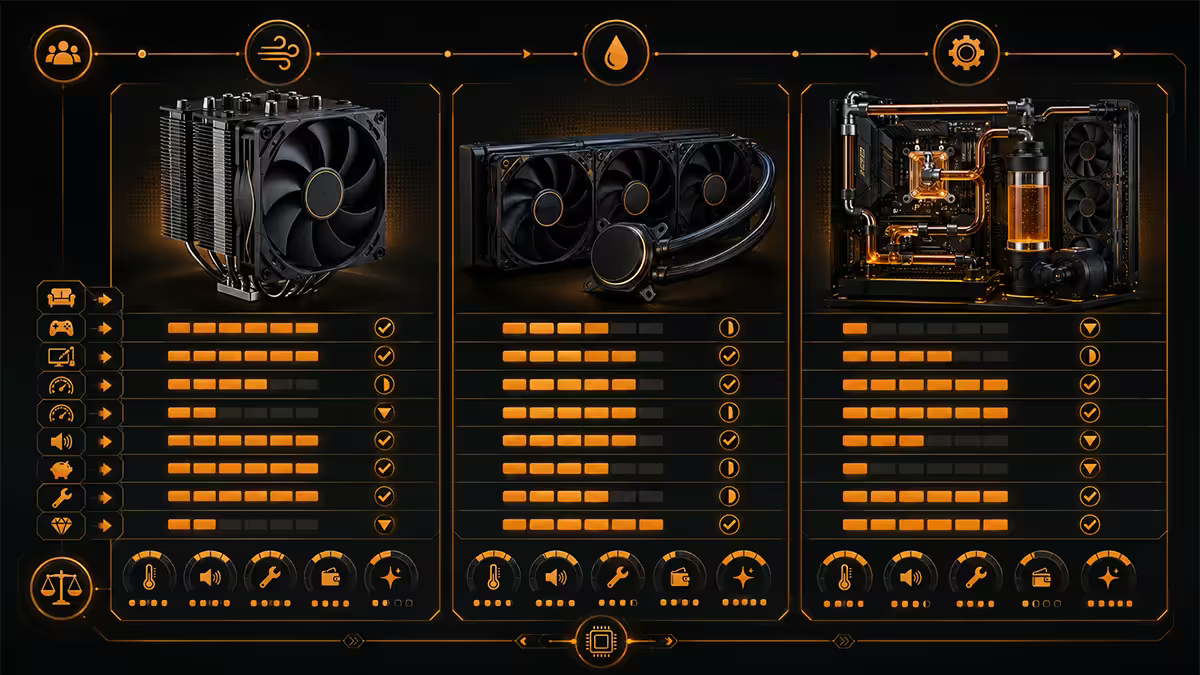
Premium air cooler
Right for: most builds. Up to Ryzen 9 7900X / 9900X, Core i7-14700K, Core Ultra 7 265K. Anyone who values reliability over thermal headroom. Anyone in load-shedding country. Anyone who wants to not think about their cooler for a decade.
Skip if: running a top-bin Ryzen 9 7950X3D / 9950X under sustained all-core loads. Running a Core i9 KS variant with manual overclocks. Building in a case with no vertical clearance for a 165mm tower.
360mm AIO
Right for: High-TDP chip owners (Ryzen 9, Core i9). Builders who want a cleaner aesthetic with no tower obscuring the motherboard. Builders prioritising peak boost clocks. Anyone whose case doesn't fit a deep air tower but does fit a 360mm radiator.
Skip if: running CPUs under 125W TDP (overkill, the AIO will be loud at idle for no thermal benefit). Hoping for silent idle — the pump will hum. Buying budget tier — sub-R1,500 AIOs have notoriously short pump lives.
Custom loop
Right for: Enthusiasts willing to make cooling a hobby. Threadripper or HEDT users where AIOs can't keep up. Show builds where the loop is part of the aesthetic. Anyone who genuinely enjoys the maintenance ritual.
Skip if: the budget is "make it work and forget about it". You travel often (a loop needs eyes on it). You don't already have experience with at least one AIO. You're convinced the loop is "more reliable" — it's the opposite.
The South African load-shedding factor
SA conditions add one variable the global cooling discussion ignores: frequent, often unplanned full power loss. Even with a UPS for the desktop, sustained outages mean systems sit cold for hours and restart abruptly. This affects each cooler type differently.
- Air coolers are unaffected. They have no liquid, no pump, no priming concerns. Restart from cold to load is identical to a first-boot scenario every time.
- AIOs handle power loss without damage, but the pump priming after long sit periods can introduce micro-bubbles that cause occasional gurgling. Modern AIOs (Arctic Liquid Freezer III, Lian Li Galahad III) handle this well; older sealed designs are more susceptible. Always reorient the AIO so the pump sits below the radiator's highest point — air pockets collect at the top of the loop, away from the pump impeller.
- Custom loops are unaffected if properly built with adequate reservoir height. The pump primes from the reservoir on restart. The wear concern is pump inrush current at restart — if your PSU comes back hard after a load shed, the pump motor sees a startup spike that gradually accelerates bearing wear over hundreds of restart cycles. A UPS for the PC desk smooths this out.
For pure resilience to load shedding without any consideration, the air cooler wins. For a properly built custom loop with a UPS, the practical reliability is similar but with a high upfront investment.
Key takeaways
- Up to 225W, premium air ties or beats mid-range AIOs. Above 225W, AIO wins by 5-10°C.
- AIO pumps are wear parts — 5-7 years on quality units, 2-4 on budget. Plan for it.
- Custom loops start at R12,000-R18,000 in SA. They're a hobby, not just cooling.
- Air at idle is silent. AIO at idle has audible pump hum. Marketing won't tell you this.
- Custom loops cost 6-12 hours of maintenance per year. Air costs 30 minutes.
- For load-shedding SA, air is most resilient. AIO works with a UPS. Custom loops need both.
Frequently asked questions
Is a high-end air cooler as good as an AIO?
For CPUs up to ~225W package power, yes — a top-tier dual-tower air cooler (Noctua NH-D15, Be Quiet Dark Rock Pro 5, Thermalright Phantom Spirit) is within 2-4°C of a 360mm AIO on the same chip, sometimes wins, and lasts 10+ years with no maintenance. Above 225W (Ryzen 9 7950X3D, Core i9-14900KS, Core Ultra 9 285K at full load), AIOs pull ahead by 5-10°C because the radiator surface area exceeds what any tower fits in a case.How long does an AIO last?
Most quality AIOs (Arctic Liquid Freezer III, Lian Li Galahad, Corsair iCUE H150i, Be Quiet Pure Loop) last 5-7 years before the pump shows signs of weakening — louder operation, occasional gurgling, slight temperature creep. Cheap AIOs (sub-R1500 units) often fail at 2-4 years. The pump is the wear part; the radiator and tubing typically outlast the pump.How much does a custom loop cost in South Africa?
A starter CPU-only custom loop (single 360mm radiator, CPU block, pump/reservoir combo, fittings, soft tubing, coolant) starts around R12,000-R15,000 in SA. Adding GPU water blocks adds R3,500-R7,000 depending on card. Hard-tubing with quality fittings (Bitspower, Barrow Premium) easily pushes a full CPU+GPU loop to R25,000-R40,000. Custom loops are a hobby, not just a cooling solution.Are AIOs actually quieter than air coolers?
This is the lie most builders fall for. A 360mm AIO at idle has a pump running at 2000-3000 RPM that produces a low-frequency hum air coolers don't make. At idle, a passive top-tier air cooler is silent; even the quietest AIO has audible pump noise. At load, AIO fans need to spin faster than people admit to dump 250W of heat through a thin radiator. The 'AIO is quieter' claim only holds if you compare a premium AIO against a budget air cooler.What's the maintenance burden of a custom loop?
Custom loops need annual coolant changes (drain, flush, refill — 2-3 hours), quarterly visual inspections for tubing yellowing and pump noise (10 minutes), and full disassembly cleaning every 2-3 years to clear micro-deposits (4-6 hours). Realistically that's 6-12 hours of maintenance per year. AIOs need almost zero maintenance — the loop is sealed and the only failure mode is the pump aging out. Air coolers need fan dust cleaning twice a year, max 15 minutes.Which cooler is best for load shedding in SA?
Air. Power-loss restart cycles are kindest to coolers with no moving liquid. Air coolers don't care about thermal shock from sudden power-down at full load. AIOs are designed to handle it but the pump priming after sustained power-off can occasionally introduce micro-bubbles that cause gurgling. Custom loops are unaffected if properly built but the inrush current at restart strains the pump if the PSU comes back hard. For load-shedding country, dual-tower air remains the most resilient choice.Does case airflow matter more than cooler choice?
Often, yes. A premium R3,500 AIO in a case with poor airflow can underperform a mid-range R1,500 air cooler in a case with three 140mm intakes and two exhaust fans. The thermal limiter for any cooling solution is heat removal from the case interior. Spend on intake fans, dust filters and a case with mesh fronts before upgrading the cooler itself. The case is the cooling system; the cooler is one component of it.Should I get a 240mm or 360mm AIO?
360mm if your case supports it. The cost delta between 240mm and 360mm AIOs is usually under R500, and the extra radiator surface area gives you 5-8°C more headroom or significantly quieter fans at the same load. The only reason to choose 240mm is case constraint (mITX or compact mATX cases without 360mm clearance). For mid-tower ATX builds with high-TDP CPUs, 360mm is the default.
Related reads
Get the Evetech app
Exclusive app-only prices, daily flash sales, and free delivery on orders over R4,000 — download the app and start saving.