CPU Cooling Comparison
Water cooling vs air cooling. — Which one actually wins on your CPU?
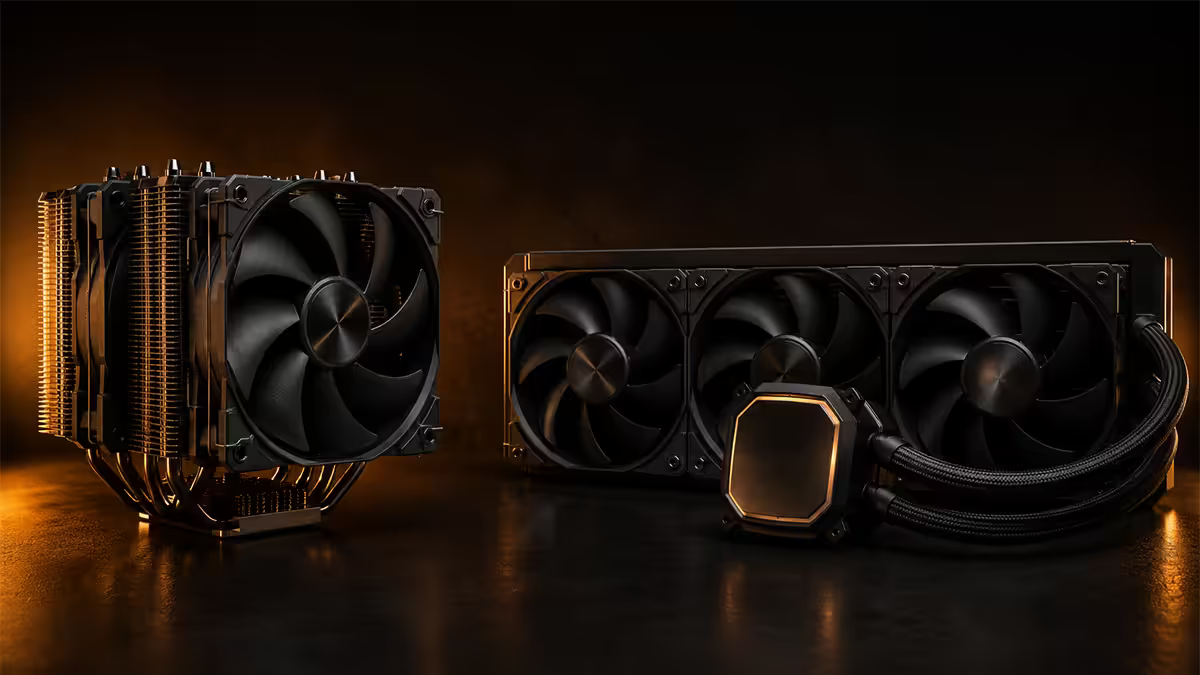
The marketing makes AIOs sound essential and air coolers sound antique. The benchmarks tell a different story — one where a R900 Noctua-tier tower matches a R3,000 AIO on most workloads, and the right answer depends entirely on which CPU you're cooling.
- AIO lifespan
- 5-7 yrs
- air cooler lifespan
- 10-15 yrs
- price range
- R650-R6,500
How each cooling style actually works
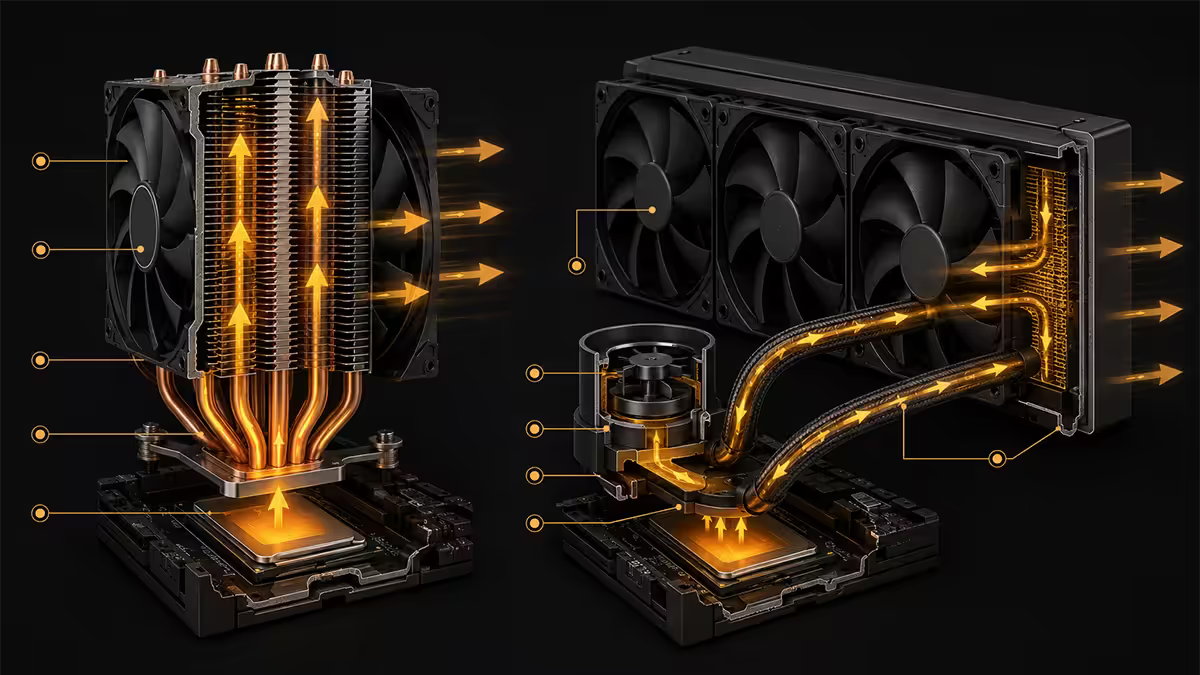
Both air coolers and AIO water coolers do the same job in two stages: move heat off the CPU surface, then transfer that heat into the air leaving your case. They differ entirely in how they accomplish stage one.
An air tower cooler uses copper heat pipes that pull heat from a baseplate sitting on the CPU heat spreader. Liquid inside the heat pipes (usually distilled water or a low-pressure refrigerant) vaporises at the hot end, rises by convection, condenses at the cool end, and flows back down. The pipes feed into a stack of thin aluminium fins. Fans push air through those fins, carrying the heat into the case airflow. No moving parts touch the heat — just the fans, which are easy to replace if they fail.
An AIO water cooler uses a pump-driven liquid loop. A pump unit sits on the CPU, pulling heat into the coolant. The coolant flows through flexible tubes to a radiator (usually mounted to the top or front of the case), where a separate set of fans dissipates the heat into the case airflow. The coolant returns to the pump via a second tube, cooled and ready for another pass. The pump is the moving part that defines AIO lifespan — when it fails, the unit is essentially scrap.
Both systems ultimately dump heat into the same case airflow. The cooler's job isn't to reduce heat — it's to move heat off the CPU faster than the CPU produces it. If your case airflow is bad, neither system performs well. If your case airflow is good, the difference between the two narrows dramatically.
Performance compared on real CPUs
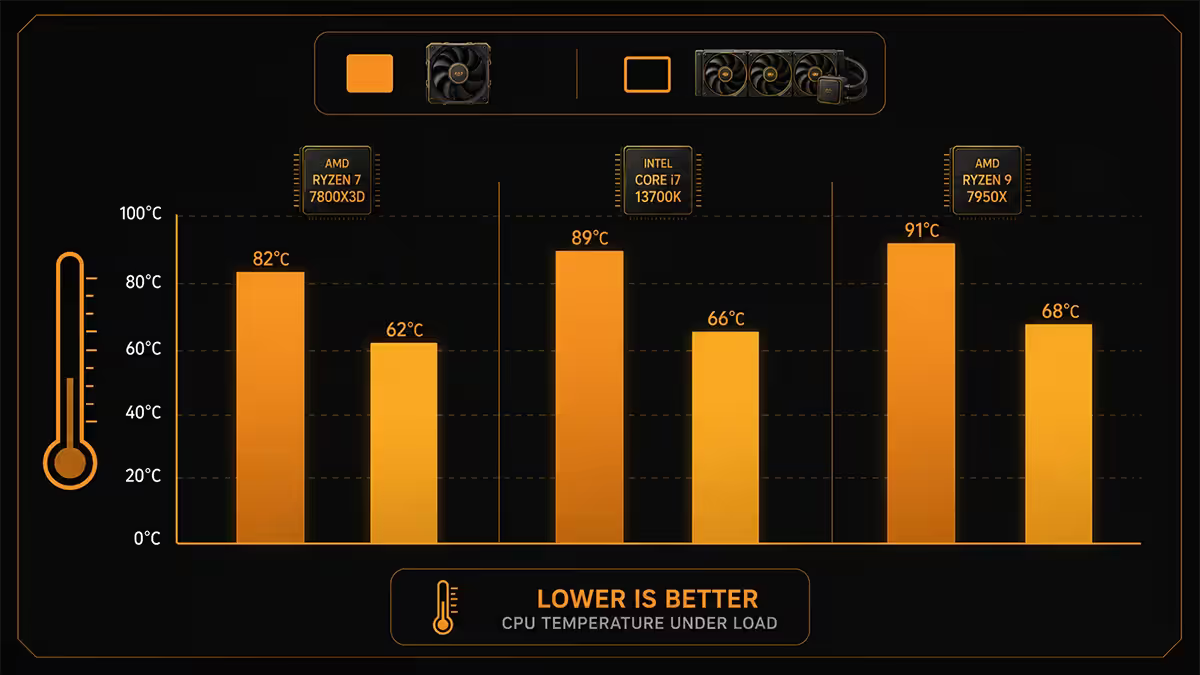
Here's what years of testing on the workshop bench shows, normalised to 22°C ambient, mid-tower case with good airflow:
| CPU class | Best air cooler | 240mm AIO | 360mm AIO |
|---|---|---|---|
| Ryzen 5 7600X / Core Ultra 5 | 62-68°C (NH-D15) | 61-67°C | 58-63°C |
| Ryzen 7 7700X / Core Ultra 7 | 72-78°C (NH-D15) | 71-77°C | 66-72°C |
| Ryzen 9 7950X / Core Ultra 9 | 85-92°C (NH-D15 G2) | 84-90°C | 78-84°C |
| Core i9-14900K (sustained) | 96°C+ throttling | 91-95°C | 85-90°C |
The pattern is clear: on lower-TDP CPUs, the difference between a great air cooler and a great AIO is 1-3°C. On high-TDP chips (Ryzen 9, Core Ultra 9, i9-14900K), the AIO advantage grows to 5-10°C — meaningful when you're approaching the throttle point.
The right cooler isn't the one with the biggest radiator or the loudest marketing — it's the one matched to your CPU's sustained heat output. Most builders overspend on cooling because they're afraid of throttling that wouldn't have happened anyway.
An RTX 4090 build with a Ryzen 7 7800X3D doesn't need a 360mm AIO. The 7800X3D maxes out around 70-75°C with a R900 Deepcool AK620 air tower. Spending R3,500 on a Lian Li Galahad 360 buys you 4°C of headroom you'll never use, RGB you'll either love or quietly hate, and a 5-7 year service window before pump replacement.
When AIOs genuinely outperform
- Sustained 100% workloads — video rendering, compilation, scientific simulation. AIOs have far more thermal mass in the coolant, so they delay throttling on long-duration peaks.
- Compact cases with poor air clearance — large air towers (NH-D15 is 165mm tall) don't fit in some mid-towers or any small form factor case. AIO radiators sit at the case edges and free up internal volume.
- Ryzen 9 7950X / 9950X, Core i9, Core Ultra 9 — these chips dump 230-280W under sustained load. Even the best air coolers approach their thermal ceiling. A 360mm AIO has the headroom.
When air coolers win outright
- Mid-range CPUs (Ryzen 5/7, Core Ultra 5/7) — air handles the heat with margin to spare.
- 10+ year build horizons — air coolers outlive AIOs by a factor of two on average.
- Quiet idle — no pump whine. Ever.
- Sub-R1,200 budgets — the cost gap between a great air cooler and a "just okay" AIO is 2-3x.
- Hot SA environments without aircon — air coolers actually handle ambient temp spikes better since they don't depend on a pump pushing heat against gravity into a radiator that's also at higher ambient.
Noise — the unexpected outcome
Most builders assume AIOs are quieter because "no spinning fan visible". The reality is more nuanced. Air coolers are quieter at idle. AIOs always have a running pump (15-22 dBA depending on the unit and quality), plus radiator fans that spin at low RPM even with no load. The Noctua NH-D15 G2 with its NF-A12 fans at idle (~400 RPM) is genuinely inaudible at 60cm.
AIOs become quieter under sustained heavy load. When a CPU climbs from 60°C to 80°C, an air cooler's fans have to ramp from 700 RPM to 1,400 RPM to keep up. An AIO's radiator fans ramp far less because the coolant absorbs heat first, buffering the response curve. Under a 30-minute render or 4-hour gaming session, AIOs are noticeably quieter than equivalent-tier air coolers.
For typical mixed-use (browsing, gaming, occasional productivity), perceived noise between a quality AIO and a quality air cooler is similar. For pure silence at idle, the Noctua NH-D15 is unbeatable. For minimum noise under sustained load, a 360mm AIO with good fans (Corsair iCUE Elite, NZXT Kraken Elite, Lian Li Galahad II) wins.
Longevity — the long game
Air coolers are functionally permanent. Replace the fan every 5-7 years (R200-R400 for a quality 120mm) and the cooler outlasts every other component in the system. The Noctua NH-D15 we shipped on a customer's i7-4790K build in 2014 is still cooling that exact CPU twelve years later — same fan, same paste interval.
AIOs degrade. The pump bearings wear, the coolant slowly evaporates through micro-permeable tubing, and the dye in coloured coolants can settle and clog narrow micro-channels in the cold plate. Expected lifespan:
- Cheap AIO (sub-R1,500) — 3-5 years before pump issues.
- Mid-tier AIO (R1,500-R3,500) — 5-7 years typical.
- Premium AIO with Asetek Gen 8 pump (R3,500+) — 7-10 years with care.
- Air cooler — 10-15 years with periodic fan replacement.
If your build philosophy is "buy once, run for a decade", air cooling is the correct answer. If you upgrade your CPU every 3-5 years anyway (and replace the cooler along with it), AIO longevity matters less.
Maintenance reality check
Air coolers: blow dust off the fins with compressed air every 6-12 months. Replace thermal paste when you move the cooler (every 3-5 years). Replace the fan if it gets noisy (every 5-10 years). That's it.
AIOs (sealed): clean radiator dust every 6-12 months. Watch for unusual pump noise. Replace if the pump dies or coolant level drops noticeably (visible through the inspection window on some models). No coolant top-up — most consumer AIOs are sealed and not designed for refilling.
Custom loops (separate pump, reservoir, hard tubing): coolant change every 12-24 months, leak inspection monthly, tubing replacement every 3-5 years, dye degradation monitoring. Custom loops are an enthusiast hobby with real maintenance demands — they're stunning and provide best-in-class cooling, but they're not "set and forget".
Recommended picks (SA availability)
Air coolers
| Tier | Pick | SA price |
|---|---|---|
| Budget | Thermalright Peerless Assassin 120 SE | R650-R900 |
| Mid-range | Deepcool AK620 (or AK620 Digital) | R900-R1,200 |
| High-end | be quiet! Dark Rock Pro 5 | R1,900-R2,300 |
| Flagship | Noctua NH-D15 G2 (LBC / HBC variants) | R2,200-R2,600 |
| Compact (low profile) | Noctua NH-L12S or be quiet! Pure Rock LP | R900-R1,300 |
AIO water coolers
| Tier | Pick | SA price |
|---|---|---|
| Budget 240mm | DeepCool LE520 or Cooler Master ML240L Core | R1,400-R1,900 |
| Mid-range 240/280mm | Lian Li Galahad II Trinity 240 or Corsair H100i Elite | R2,300-R3,000 |
| Mid-range 360mm | DeepCool LS720 or Lian Li Galahad II Trinity 360 | R2,800-R4,500 |
| High-end 360mm | NZXT Kraken Elite 360 RGB or Corsair iCUE H170i Elite LCD | R5,500-R6,800 |
| Workstation 420mm | Corsair iCUE H170i Elite Capellix XT | R6,500-R7,500 |
South African considerations
Load shedding. Both cooling styles handle sudden power loss the same way — gracefully. An AIO pump that stops mid-load lets the CPU cool by passive convection through the coolant and radiator. No damage, no risk. Use a UPS for data integrity (graceful Windows shutdown saves your work), not for cooling concerns.
Ambient temperatures. Johannesburg summers can push case ambients to 28-32°C without aircon. Air coolers handle this slightly better than AIOs because they don't depend on a pump moving heat against gravity through a radiator that's also at higher ambient. For non-aircon environments, slight bias toward air or larger AIO radiators (360mm minimum).
Dust. SA construction sites and Highveld dust storms add to maintenance overhead. Air cooler fins clog faster than AIO radiator fins because they're denser. Both styles benefit from positive-pressure case airflow (more intake fans than exhaust) with dust filters on the intakes.
Spare parts. Noctua, be quiet!, Corsair and NZXT all have local SA warranty and replacement support through their importers. Lian Li, DeepCool and Thermalright go through resellers — replacement parts (fans, mounting brackets) can take 2-4 weeks. Cooler Master and Cooler Master parts are fastest to source locally.
Key takeaways
- Match the cooler to the CPU. Ryzen 5/7 and Core Ultra 5/7 don't need an AIO. Ryzen 9 and Core Ultra 9 do.
- Air coolers are quieter at idle. AIOs are quieter under sustained heavy load. Both can be near-silent done right.
- Air coolers last 10-15 years. AIOs last 5-7 years on average, 8-10 for premium pumps.
- Load shedding is irrelevant — both styles handle sudden power loss without damage.
- Top SA picks: Noctua NH-D15 G2, Thermalright Peerless Assassin (air); Lian Li Galahad II, NZXT Kraken Elite (AIO).
Frequently asked questions
Is water cooling better than air cooling?
Only for high-TDP CPUs (Ryzen 9, Core Ultra 9, i9). A 240mm AIO matches a flagship air tower on most workloads. For mid-range chips, air is quieter at idle and lasts longer.How long do AIO water coolers last?
Quality AIOs last 5-7 years. Premium Asetek Gen 8 pumps stretch to 8-10. Air coolers run 10-15 years with periodic fan replacement.Are AIOs louder or quieter than air coolers?
Air is quieter at idle (no pump). AIOs are quieter under sustained heavy load (coolant mass buffers the heat curve). For pure silence at idle, Noctua NH-D15 G2 is unbeatable.Do AIOs need maintenance?
Sealed AIOs are near-zero maintenance — dust the radiator every 6-12 months. Custom loops need coolant changes every 12-24 months.What size AIO radiator do I need?
240mm for Ryzen 5/Core 5. 280mm for Ryzen 7/Core Ultra 7. 360mm minimum for Ryzen 9/Core Ultra 9. Verify case compatibility before buying.Does load shedding damage AIO water coolers?
No. AIOs handle sudden power loss identically to air. Pump stops, coolant cools by convection. No risk. Use a UPS for data integrity, not for cooling.What are the best air coolers available in SA?
Noctua NH-D15 G2 (top), be quiet! Dark Rock Pro 5, Deepcool AK620, Thermalright Peerless Assassin 120 SE (value), Cooler Master Hyper 212 Halo (budget).What are the best AIO water coolers available in SA?
Corsair iCUE H170i Elite LCD and NZXT Kraken Elite 360 (top), Lian Li Galahad II 360 and DeepCool LS720 (mid), Cooler Master ML240L Core and DeepCool LE520 (budget).
Get the Evetech app
Exclusive app-only prices, daily flash sales, and free delivery on orders over R4,000 — download the app and start saving.