Keyboard Troubleshooting
How to fix keyboard ghosting. — NKRO isn’t a setting. It’s hardware.
You hold W, A, Shift and Space to strafe-jump — and one input dies. That’s ghosting. No driver tweak in Windows or Razer Synapse will fix it. The board is the problem.
- key rollover
- 6 vs N
- to diagnose
- 60 sec
- NKRO entry
- R600+
What keyboard ghosting actually is
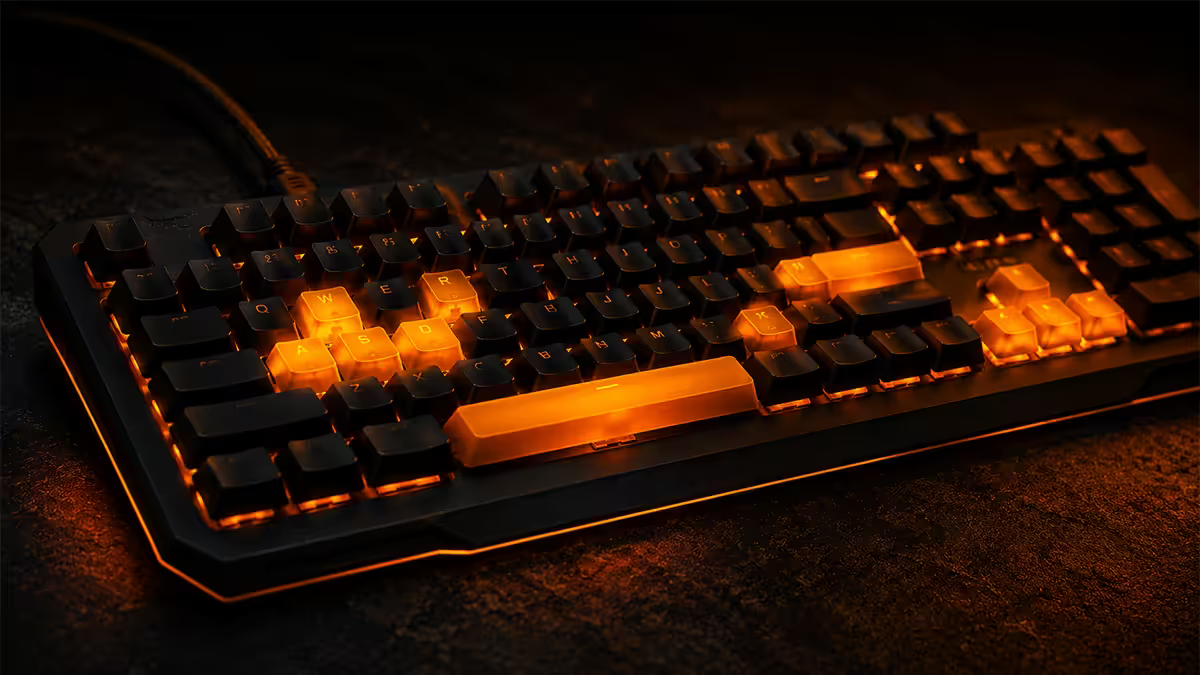
Ghosting is when you hold several keys at once and one — or more — fails to register. You’re sprinting forward and strafing (W + A + Shift), you tap E to interact, and nothing happens. Or worse: a phantom key fires that you never pressed. That’s the “ghost” in the name.
It happens because of the way most keyboards are wired. Underneath the keys is a grid called a scan matrix: rows and columns of conductive traces. When you press a key, you close a contact at the intersection. The controller scans the grid hundreds of times a second and reports which intersections are closed.
The trouble starts when several keys on the same row and column form a closed rectangle. The controller can’t tell which corner you actually pressed — it sees the same electrical pattern whether you pressed two, three or four corners. To stay safe it either drops one of the inputs or invents a phantom press. That’s ghosting in one sentence.
NKRO vs 6-key rollover vs anti-ghosting
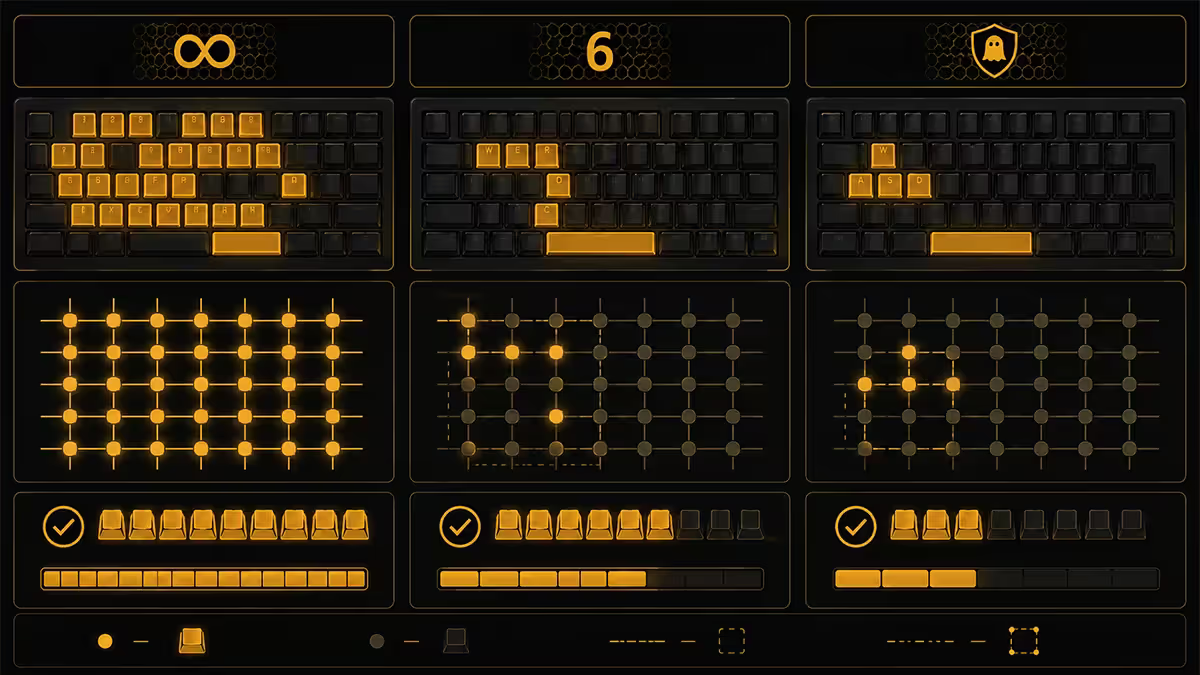
Three terms appear on every keyboard box and the marketing is messy. Here’s what each actually means.
| Spec | What it means | Real-world impact |
|---|---|---|
| 6KRO (6-key rollover) | USB HID standard limit — 6 normal keys + 4 modifiers reported at once | Fine for typing, dies in fighting games & MMOs |
| NKRO (N-key rollover) | Every key reports independently, no upper limit | The only spec that ends ghosting for good |
| “Anti-ghosting” (12-key, 26-key) | Marketing term — usually means only a cluster of keys (often WASD area) is NKRO | Fine for FPS, fails outside the cluster |
“Anti-ghosting” without a specific NKRO claim is the spec to be suspicious of. It often means the keyboard has been wired so the WASD area handles unlimited simultaneous inputs but the rest of the board is still 6KRO. Fine if you only ever play FPS. Painful if you use heavy keybinds in League, Dota, WoW or any rhythm game.
Why cheap membrane keyboards ghost (and mechanicals almost never do)
Membrane keyboards use three layers of plastic film with conductive traces printed on them. When you press a key, the top film flexes down and bridges a circuit on the bottom film. It’s cheap, quiet, and easy to manufacture at scale. It’s also why your R250 office board ships from the factory with 6KRO at best — adding diodes to a film matrix would push the cost up by maybe 30% and nobody’s paying R325 for a membrane keyboard.
Mechanical keyboards use individual switches soldered directly to a PCB. Adding a diode next to each switch is a 10-cent operation per board at scale. Almost every modern mechanical — Cherry, Gateron, Kailh, Outemu, Razer Green, Logitech GX — ships NKRO over USB by default. The exceptions are no-name budget mechanicals from AliExpress that drop the diodes to chase the cheapest possible price.
There’s a third category you’ll see in 2026: magnetic / Hall-effect keyboards (Wooting, Keychron Q1 HE, Razer Huntsman V3 Pro). These use magnets and Hall sensors instead of physical contacts, which gives them perfect NKRO and adjustable actuation points. The cheapest entry into Hall-effect in SA is still R2k+, so it’s not the budget fix — but it’s where the high end is going.
Polling rate & USB hubs — the red herrings
Two things get blamed for ghosting all the time but rarely cause it.
Polling rate. This is how often the keyboard reports its state to the PC — typically 125Hz, 500Hz or 1000Hz. Higher polling reduces input latency by a few milliseconds. It does not change which keys the controller detects. If the matrix dropped your E press at 125Hz, polling at 8000Hz reports the same dropped E eight thousand times a second.
USB hubs. A cheap unpowered USB hub sharing bandwidth with a webcam, headset, external HDD and phone-charging cable can cause delayed or partially-dropped reports that look like ghosting. The fix is simple: plug the keyboard directly into a rear motherboard USB 2.0 port. USB 2.0 is the spec keyboards are designed for and rear ports go straight to the chipset without hub trickery.
How to test for ghosting in 60 seconds
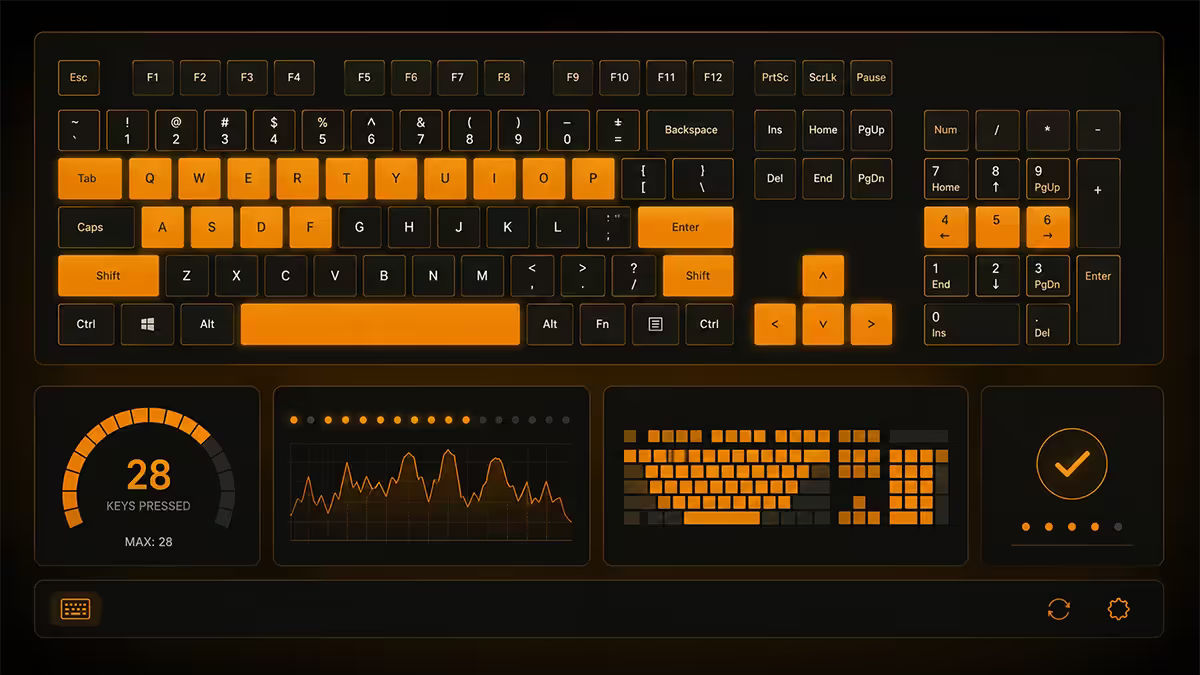
You don’t need to buy anything. Two free browser tools tell you everything.
Aqua’s KeyTest (en.key-test.ru) is the standard. It shows every key on a virtual keyboard and lights up the ones currently held. Press W + A + Shift + Space. Add E. Add R. Add Ctrl. Add 1-2-3 across the number row. Note any key on the virtual board that doesn’t light up — that’s the one ghosting.
MechanicalKeyboards.com NKRO checker is the alternative if KeyTest is down. Same idea, slightly cleaner UI.
A useful sequence for gamers:
- WASD + Shift + Space + Ctrl (movement + crouch + sprint + jump)
- WASD + Shift + 1-2-3-4-5 (weapon switching while moving)
- QWER + WASD (MOBA keybinds)
- F1-F5 + Ctrl + Shift (raid macros)
- Numpad 4 + 5 + 6 + 8 + Enter (number-pad NKRO check — often overlooked)
If every key in those sequences lights up, your board is genuinely NKRO and ghosting is not your problem. If something drops, you’ve found your bottleneck.
Is it the keyboard, or is it the game capping inputs?
Some games — almost always older ones — cap simultaneous inputs at the engine level. Quake III’s input handler famously stopped processing after 4 keys. Several DOS-era emulators do the same. A handful of fighting games on PC cap inputs to mimic arcade-stick behaviour.
The test is simple. If your keyboard tests fully NKRO in the browser but drops inputs only in a specific game, it’s the game. No keyboard upgrade in the world will fix it. Check the game’s forums for “input cap” or “simultaneous keys” — there’s often a config-file tweak or no fix at all.
Modern AAA games (Valorant, CS2, Apex, Fortnite, Helldivers 2, every MOBA) do not cap inputs at the engine level. If you’re dropping keys in those, the keyboard is the problem.
NKRO mechanical keyboards under R1k in SA
| Pick | Why it fixes the problem | SA price |
|---|---|---|
| Redragon K552 Kumara | TKL, Outemu Blue, full NKRO, indestructible — the bench-test favourite | R550-R650 |
| MSI Vigor GK30 | Mechanical feel, 6-zone RGB, NKRO, water-resistant | R700-R850 |
| Logitech G413 SE | Tactile mechanical, aluminium top plate, full NKRO, brand reliability | R850-R999 |
| Redragon K617 Fizz | 60% form factor for desk space, NKRO, hot-swappable | R500-R600 |
| HyperX Alloy Origins Core | TKL, HyperX Red linear switches, NKRO, aircraft-grade aluminium | R900-R1,100 |
| Asus ROG Strix Scope | Cherry MX Red, NKRO with full anti-ghost, dedicated stealth key | R950-R1,100 |
Common ghosting mistakes
Tweaking polling rate or DPI in driver software. Doesn’t help. Polling controls how often the controller reports state, not what state it can detect.
Reinstalling drivers or buying a “gaming USB cable”. Keyboards are USB HID class — they use the generic Windows driver, not the brand’s RGB suite. Razer Synapse, Logitech G HUB, Corsair iCUE handle lighting and macros, not key detection.
Buying a budget mechanical without checking the NKRO spec. A handful of sub-R500 mechanicals from AliExpress brands ship at 6KRO to save BOM cost. Always check the listing — “N-key rollover” or “Full NKRO over USB” must be explicitly stated.
Blaming the game when it’s the keyboard. Always run the browser test first. 90% of “this game has bad input handling” complaints are actually the keyboard.
Pairing a wireless keyboard for competitive FPS. Wireless keyboards over 2.4GHz dongles are mostly NKRO-capable, but Bluetooth keyboards are typically capped at 6KRO due to HID profile limits. If you’re playing competitive shooters wirelessly, run on the dongle, not Bluetooth.
Key takeaways
- Ghosting is a hardware limit — missing per-key diodes mean the matrix can’t tell which keys you pressed.
- No driver, polling-rate change or Windows tweak fixes ghosting. The fix is replacing the keyboard.
- Test in 60 seconds with Aqua’s KeyTest or the MechanicalKeyboards.com checker.
- “Anti-ghosting” is marketing — only “NKRO” or “N-key rollover” guarantees ghosting is gone.
- Under R1k in SA: Redragon K552, MSI Vigor GK30, Logitech G413 SE. All real NKRO, all in stock.
Frequently asked questions
What is keyboard ghosting?
Ghosting is when one or more key presses are dropped, or a wrong key registers, when several keys are held at the same time. It’s a circuit-matrix limit, not a software bug. Mechanical keyboards with NKRO are immune.What does NKRO mean?
N-key rollover. The keyboard reports every pressed key independently, no matter how many you hold. The opposite of 6KRO (6-key rollover), the old USB HID default.How do I test for keyboard ghosting?
Open Aqua’s KeyTest (en.key-test.ru) or the MechanicalKeyboards.com NKRO checker. Hold combinations you actually use — WASD + shift + space + adjacent letters. Any key that doesn’t light up is ghosting.Can I fix ghosting with a driver update?
No. Ghosting is a hardware limit at the circuit level. No driver, firmware or Windows tweak can add NKRO to a board that wasn’t designed for it. Only solution is a different keyboard.Is every mechanical keyboard NKRO?
Almost all are. A handful of no-name budget mechanicals skip the per-key diodes to chase the lowest price and ship with 6KRO. Always confirm the listing says “NKRO” or “N-key rollover”.Does USB polling rate affect ghosting?
No. Polling rate affects input latency, not detection. If the matrix dropped a key at 125Hz, it’ll drop the same key at 8000Hz.Is it ghosting or is the game capping inputs?
If your keyboard passes the browser NKRO test but drops keys only in a specific game, the game has an input cap. Common in older titles and emulators. Modern AAA games don’t cap inputs.Can a USB hub cause ghosting symptoms?
Indirectly. Unpowered hubs sharing bandwidth can cause dropped reports that look like ghosting. Plug the keyboard into a rear motherboard USB 2.0 port to rule this out.
Get the Evetech app
Exclusive app-only prices, daily flash sales, and free delivery on orders over R4,000 — download the app and start saving.