Glossary · Form Factor
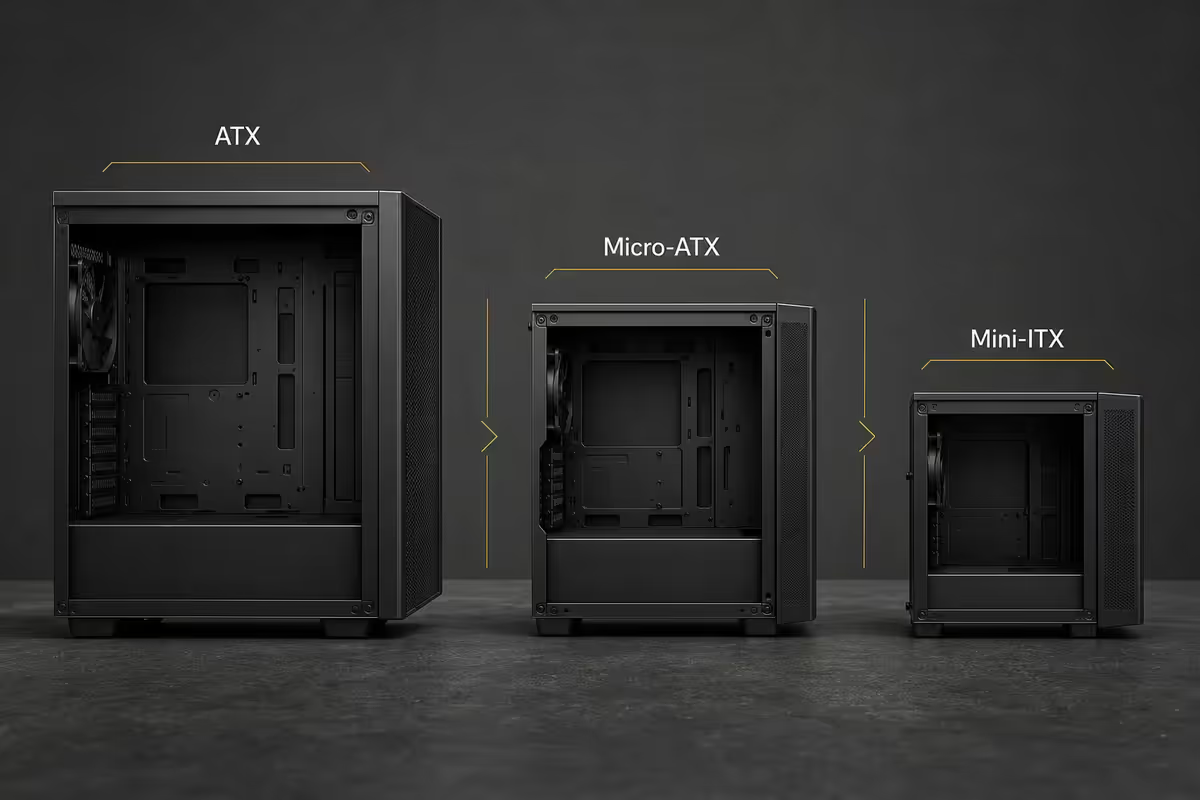
What is a form factor? — PC sizes, drawn to scale.
Five standardised motherboard sizes account for virtually every desktop PC sold in 2026. Pick the right one and every part fits the next part. Pick wrong and you'll fight your case for the lifetime of the build.
- ATX mm
- 305×244
- Mini ITX mm
- 170×170
- cover 99%
- 5 sizes
What "form factor" actually means
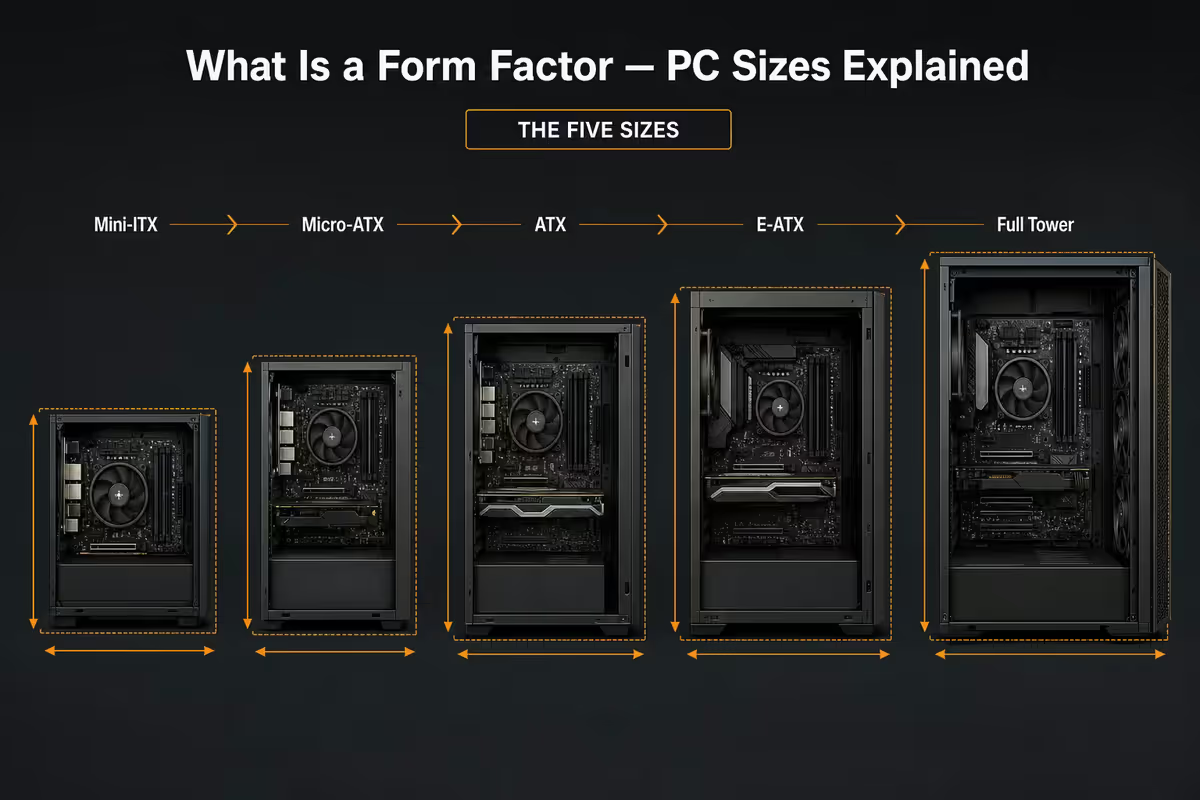
A motherboard form factor is a published specification — first standardised by Intel in 1995 as ATX (Advanced Technology Extended) — that defines four things: the physical dimensions of the PCB, the mounting hole pattern for screwing it to a case, the I/O panel cut-out at the back, and the power-connector layout for the PSU.
The standard exists for one purpose: interoperability. An ATX motherboard from ASUS bought in 2026 mounts into an ATX case from Phanteks bought in 2018 using mounting holes specified in a 1995 document. The cooler fits because the AM5 or LGA1851 socket sits at the standardised position. Your PSU connects because the 24-pin and CPU EPS connectors are where every PSU expects them.
The five mainstream sizes
| Form factor | Dimensions (W × D) | Where it's used |
|---|---|---|
| E-ATX | 305 × 330 mm | HEDT, Threadripper, content workstations |
| SSI-EEB | 305 × 330 mm | Dual-socket Xeon, EPYC server boards |
| ATX | 305 × 244 mm | Standard gaming, mainstream desktops |
| Micro ATX (mATX) | 244 × 244 mm | Compact mainstream, office, budget gaming |
| Mini ITX (ITX) | 170 × 170 mm | SFF builds, lounge HTPCs, LAN portables |
E-ATX and SSI-EEB look identical on paper but are not interchangeable in every case — the mounting hole spacing differs and SSI-EEB boards typically have an extra row of mount points. Always check the case spec sheet calls out the specific size you're buying.
Case-size dependency — bigger fits smaller
A case is rated for the largest motherboard it accepts. Larger cases accept smaller boards without modification — the smaller board uses the matching subset of mount points.
| Case class | Accepts | Typical example |
|---|---|---|
| Full tower | E-ATX, ATX, mATX, ITX | Phanteks Enthoo Pro 2, Lian Li PC-O11D XL |
| Mid tower | ATX, mATX, ITX | Corsair 4000D, NZXT H7, Fractal North |
| Micro tower | mATX, ITX | Cooler Master MasterBox NR400 |
| Mini tower / ITX case | ITX only | NZXT H1, Fractal Terra, Lian Li A4-H2O |
| HTPC / console-style | ITX only (usually) | Fractal Ridge, Cooler Master NR200P |
Expansion slots — what each size gives you
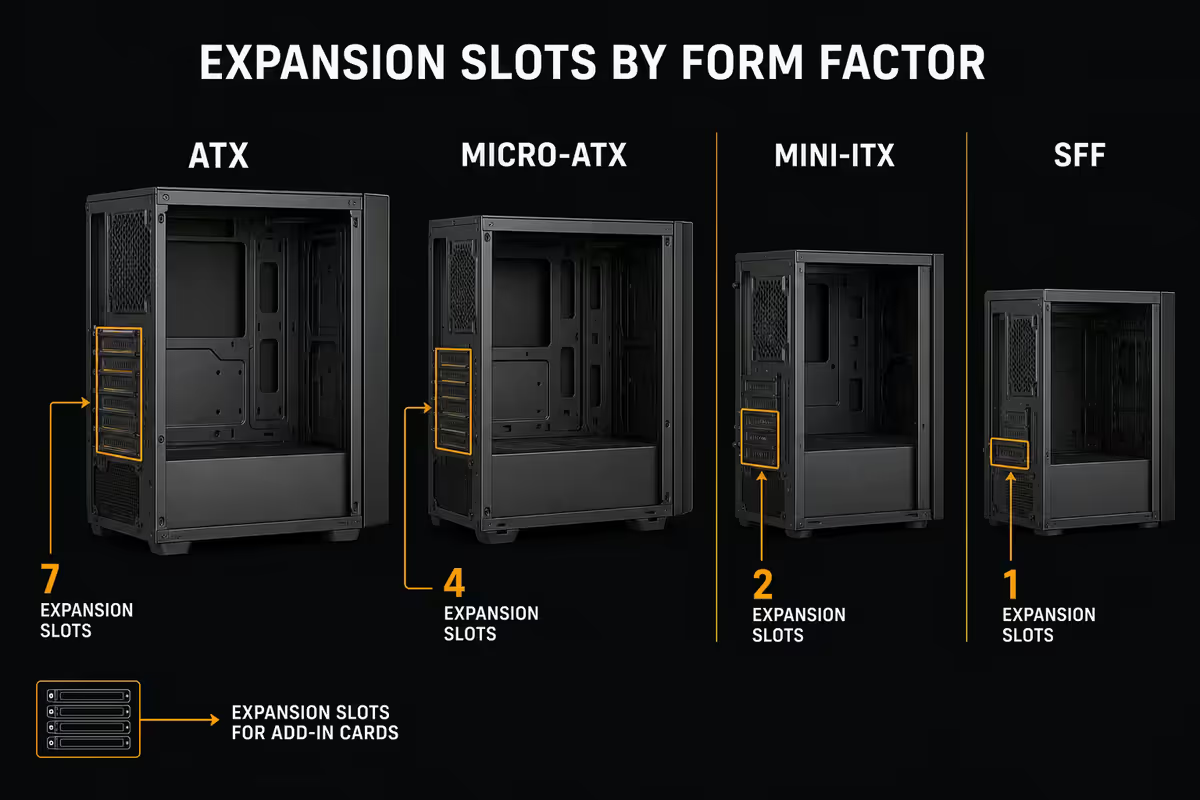
Smaller boards mean fewer PCIe slots. For most modern builds (single GPU + maybe a sound card or capture card), this matters less than it did 15 years ago. But if you're planning multi-GPU AI workloads, 10G networking PCIe cards, or expansion storage controllers — slot count is decisive.
| Form factor | PCIe slots | DIMM slots |
|---|---|---|
| E-ATX | 7 (often 4 full-length) | 4 or 8 |
| SSI-EEB | 7 (server-spec spacing) | 8 or 16 |
| ATX | 7 (3-4 full-length usually) | 4 |
| Micro ATX | 4 (2-3 full-length) | 4 (occasionally 2) |
| Mini ITX | 1 (full-length only) | 2 |
PSU form factors — ATX vs SFX vs SFX-L
PSUs have their own form factor spec, which must match what the case supports. Three sizes cover almost everything:
| PSU type | Dimensions (W × H × D) | Where it fits |
|---|---|---|
| ATX (standard) | 150 × 86 × 140 mm | Every full / mid / micro tower |
| ATX (long) | 150 × 86 × 180 mm | 1000W+ high-end units |
| SFX | 125 × 63.5 × 100 mm | Mini ITX cases, some mATX SFF |
| SFX-L | 125 × 63.5 × 130 mm | ITX cases with longer PSU bay, quieter fan |
| TFX | 175 × 65 × 85 mm | Slim OEM cases (rare in retail) |
| Flex ATX | 81.5 × 40.5 × 150 mm | Very narrow SFF cases (rare) |
SFX-L is the SFF sweet spot in 2026 — only marginally larger than SFX but with a 120mm fan that runs noticeably quieter than the 92mm fan on standard SFX units. Corsair SF750L, Cooler Master V750 SFX-L and Silverstone SX1000R-PL all retail in SA.
Why Mini ITX builds cost more in SA
An ITX equivalent of a R30,000 mid-range ATX gaming build typically lands R34,000-R37,000. Three reasons:
- Motherboard premium. ITX boards use denser PCB layouts (more layers, finer trace routing) and ship at lower production volumes. A B650 ATX board lands ~R3,800; a B650 ITX equivalent runs R5,400-R6,500.
- PSU premium. SFX 750W gold lands R2,800-R3,500; equivalent ATX runs R1,900-R2,500. SFX-L is even more.
- Cooling premium. Low-profile NH-L9, NH-L12, AsRock NSP, Cryorig C7 and slim 120mm AIOs all carry a small-volume premium. A standard 240mm AIO runs R2,200; a 240mm AIO designed for ITX with short tubes can be R3,000-R3,400.
The case itself isn't necessarily more expensive — but it constrains everything inside it.
Which form factor suits you
| You are… | Pick | Why |
|---|---|---|
| Standard gaming build R20-50k | ATX | Best value, widest case selection, easiest cooling |
| Budget gaming under R20k | Micro ATX | Saves R500-R1000 vs ATX, fits smaller desk |
| Office workstation | Micro ATX | 4 DIMMs, single GPU slot — everything you need |
| LAN-party portable | Mini ITX | Pack it in a backpack, plug in anywhere |
| Aesthetic showcase build | Mini ITX | Lian Li A4 / Fractal Terra wow factor |
| HTPC / lounge PC | Mini ITX | Fits AV cabinet, looks like a console |
| Content creator / 3D / video | E-ATX | Threadripper, more PCIe lanes, more DIMMs |
| Dorm / student desk | Micro ATX | Compact, affordable, dual-monitor ready |
| Multi-GPU AI / Render | E-ATX or SSI-EEB | Multiple full-length slots with spacing |
The evolution — how we got here
Form factor stability is the unsung hero of PC building. The same ATX spec that Intel published in 1995 still governs the case you're considering today. Brief timeline:
- 1984 — IBM PC AT (12 × 13 inches), the ATX predecessor. Big, beige, terrible airflow.
- 1995 — Intel publishes ATX spec. Moves CPU and RAM next to PSU for better cooling.
- 1997 — Micro ATX published, drops two expansion slots for smaller footprint.
- 2001 — VIA publishes Mini ITX spec, originally for embedded and industrial.
- 2003 — BTX spec released by Intel, attempts to displace ATX. Fails by 2006.
- 2010-2015 — Mini ITX goes mainstream as gaming SFF cases reach maturity.
- 2024-2026 — ATX 12V O.2 (12VHPWR / 12V-2x6) connector standardised for high-wattage GPUs. PSU shape unchanged.
The form factor hasn't changed because every attempt to change it has failed. BTX, DTX and proprietary OEM specs (looking at you, Dell and HP "desktop minitower") all lost to ATX. The reason: ATX is good enough, and the ecosystem of cases, coolers, PSUs and boards built around it represents thirty years of compounding interoperability.
Key takeaways
- Form factor = standardised motherboard dimensions, mount holes and connector positions.
- Five mainstream sizes: E-ATX, SSI-EEB, ATX, Micro ATX, Mini ITX — cover virtually every build.
- Bigger cases fit smaller boards — always check the case spec for "Motherboard support".
- PSU form factor matters too: ATX standard, SFX/SFX-L for ITX builds.
- ATX for most buyers — Mini ITX runs 15-20% more in SA due to denser parts.
Frequently asked questions
What is a PC form factor?
Standardised specification defining motherboard dimensions, mounting holes, I/O cut-out and power connector layout. Lets you mix and match cases, PSUs and boards across brands.What are the main motherboard form factors?
E-ATX (305×330 mm), ATX (305×244), Micro ATX (244×244), Mini ITX (170×170), SSI-EEB (server dual-socket).Does my case need to match my motherboard size?
Case must support your board size or larger. ITX boards fit any ATX or mATX case. Check case spec sheet before ordering.What is an ATX power supply versus SFX?
ATX (150×86×140 mm) fits standard cases. SFX (125×63.5×100 mm) for ITX SFF. SFX-L slightly bigger with quieter fan.Why do Mini ITX builds cost more in South Africa?
Denser PCB motherboards, SFX PSU premium, low-profile cooling premium. Typical 15-20% surcharge versus equivalent ATX build.Which form factor is right for me?
ATX for most builds. mATX for compact mainstream. Mini ITX for portability or aesthetic. E-ATX for Threadripper / Xeon-W workstations.What is the most popular form factor in SA?
ATX is the clear majority of the custom builds we ship. Micro ATX is a solid second, Mini ITX a growing minority, and E-ATX / SSI-EEB a tiny tail.How has the form factor landscape evolved?
ATX has dominated since 1995. BTX and DTX failed to displace it. Trend since 2010: miniaturisation, ITX going mainstream. 2026: ATX still the centre.
Get the Evetech app
Exclusive app-only prices, daily flash sales, and free delivery on orders over R4,000 — download the app and start saving.