Comparison · PSU Tier
Gold vs Platinum PSU. Worth it?
The Platinum sticker promises lower bills, longer life and quieter operation. The Rand math is harder than the marketing suggests — and the answer depends entirely on whether your rig runs 4 hours a day or 24.
- efficiency delta
- 2-4%
- Eskom save / yr
- R30-R180
- warranty bump
- +3 yrs
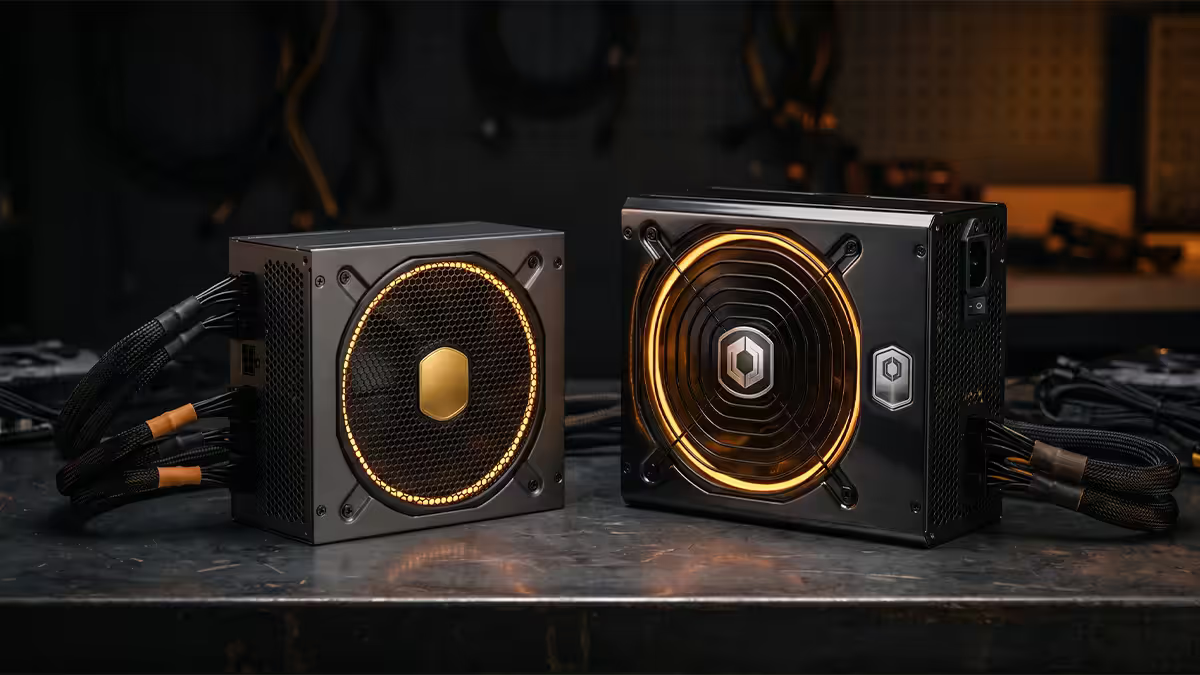
The efficiency delta — what 2-4% actually looks like
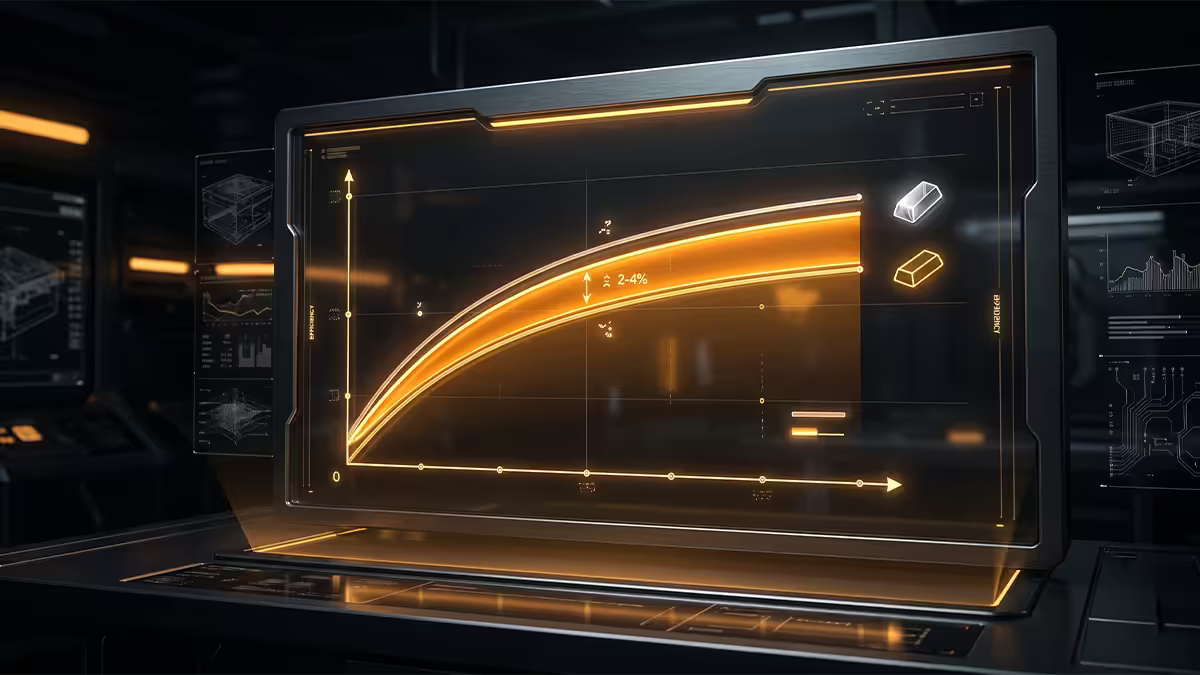
80 Plus certification measures one thing: how much of the AC power coming from the wall actually reaches your components as DC. The rest is lost as heat. Gold and Platinum certification both require >87% efficiency, but at different points on the load curve they pull apart.
| Load % | 80 Plus Gold | 80 Plus Platinum | Delta |
|---|---|---|---|
| 20% load | 87% | 90% | +3 pts |
| 50% load | 90% | 92% | +2 pts |
| 100% load | 87% | 89% | +2 pts |
Real-world translation: at a 400 W DC load (typical gaming session — CPU 100 W, GPU 250 W, the rest), a Gold PSU draws roughly 444 W from the wall. A Platinum PSU draws 435 W. That's a 9 W difference. Multiply across a year of 4 hour/day sessions and the delta is small but real.
The shape of the curve matters too. Both tiers are most efficient at 50% load. This is why "size the PSU to peak at 50-60% of capacity" is one of the most-repeated rules of thumb in PC building: at 50% load you're sitting on the peak of the curve. A 750 W Gold unit feeding a 400 W rig is running at ~85% efficiency; the same unit feeding a 550 W rig is closer to 90%.
The Eskom Rand math — gaming vs sustained load
In 2026, the average Eskom domestic tariff sits around R3.50/kWh for tier-2 consumption (varies by municipality and incline-block bracket). That's the price tag on the wattage delta.
Scenario A · Gaming, 4 hours/day
Assume 400 W average load (mix of full-load play and idle desktop). Wattage delta Gold → Platinum: 9 W.
- Energy delta per day: 9 W × 4 hours = 36 Wh = 0.036 kWh
- Per year: 13.1 kWh
- Per year in Rands: R46
- 10-year saving: R460
Scenario B · Sustained productivity / workstation, 10 hours/day
300 W average load (CPU-heavy workload, GPU idle most of the time). Wattage delta: 7 W.
- Energy delta per year: 7 W × 10 hours × 365 days = 25.5 kWh
- Per year in Rands: R90
- 10-year saving: R900
Scenario C · Home server / mining / 24/7 high load
600 W sustained load (the actual use case Platinum was designed for).
- Wattage delta: 13 W
- Per year: 13 W × 24 hours × 365 days = 113.9 kWh
- Per year in Rands: R398
- 10-year saving: R3,985
Capacitor quality — the silent reliability story
80 Plus certification doesn't measure capacitor quality directly. But hitting Platinum efficiency targets is impossible with cheap capacitors — they bleed too much energy as heat. So Platinum certification implicitly forces the use of Japanese-brand 105°C-rated electrolytic capacitors throughout the design (typically Nichicon, Rubycon, Nippon Chemi-Con).
Tier-A Gold units already use these capacitors — Seasonic, Corsair RMx/HX, Be Quiet Straight Power, EVGA SuperNOVA. Budget Gold units (sub-R1,200 for 750 W) often use Taiwanese capacitors (Teapo, CapXon) rated 85°C. They pass the efficiency test, but field life is shorter.
| Component | Tier-A Gold | Budget Gold | Platinum |
|---|---|---|---|
| Primary capacitor | Japanese 105°C | Taiwanese 85°C | Japanese 105°C |
| Secondary capacitors | Mostly Japanese | Mixed Taiwanese | All Japanese |
| MOSFETs | Premium-tier | Mid-tier | Premium-tier |
| Voltage regulation | ±2-3% | ±3-5% | ±1-2% |
| Ripple (12V) | 40-60 mV | 60-90 mV | 20-40 mV |
The takeaway: a tier-A Gold PSU and a Platinum PSU are remarkably close in build quality. The real divide is tier-A Gold versus budget Gold — that's where reliability falls off a cliff, not at Gold vs Platinum.
Warranty tier — three years of confidence
Manufacturers price their warranty terms based on expected field failure rates. The pattern is consistent across brands:
- Budget Gold (no-name OEMs): 3-5 year warranty
- Tier-A Gold (Corsair RMx, Seasonic Focus GX, Be Quiet Straight Power 12): 7-10 year warranty
- Platinum tier (Corsair AX, Seasonic Prime PX, Cooler Master V Platinum): 10-12 year warranty
- Titanium tier (Seasonic Prime TX, Corsair AX1600i): 12 year warranty
A PSU is unique in PC hardware — a quality unit will physically outlast 2-3 GPU generations and at least one CPU socket change. A 10 year warranty isn't theoretical; we still service 2018 Corsair RMx units under warranty in our Centurion workshop in 2026. Platinum's longer warranty is the most concrete real-world advantage outside of pure efficiency.
Noise and heat — a quieter case under sustained load
Every watt lost to inefficiency becomes heat inside the PSU. Higher efficiency = less internal heat = lower fan RPM = quieter operation = lower exhaust temperature into the case.
At gaming-typical 50% load, the noise difference is negligible. Both tier-A Gold and Platinum units in 2026 ship with semi-passive fan modes (fan off below 30-50% load). At sustained 80%+ load — workstation rendering, encoding, server tasks — the Platinum unit's fan stays at a lower RPM and runs quieter.
Heat-wise, the same arithmetic. A 750 W Gold unit feeding a 600 W load produces ~70 W of internal heat. A Platinum unit at the same load produces ~50 W. Across 6 hours of sustained rendering, that's a measurable difference in case ambient and adjacent component temperatures — particularly the M.2 drive often mounted directly above the PSU shroud.
The break-even — at what wattage does Platinum pay off?
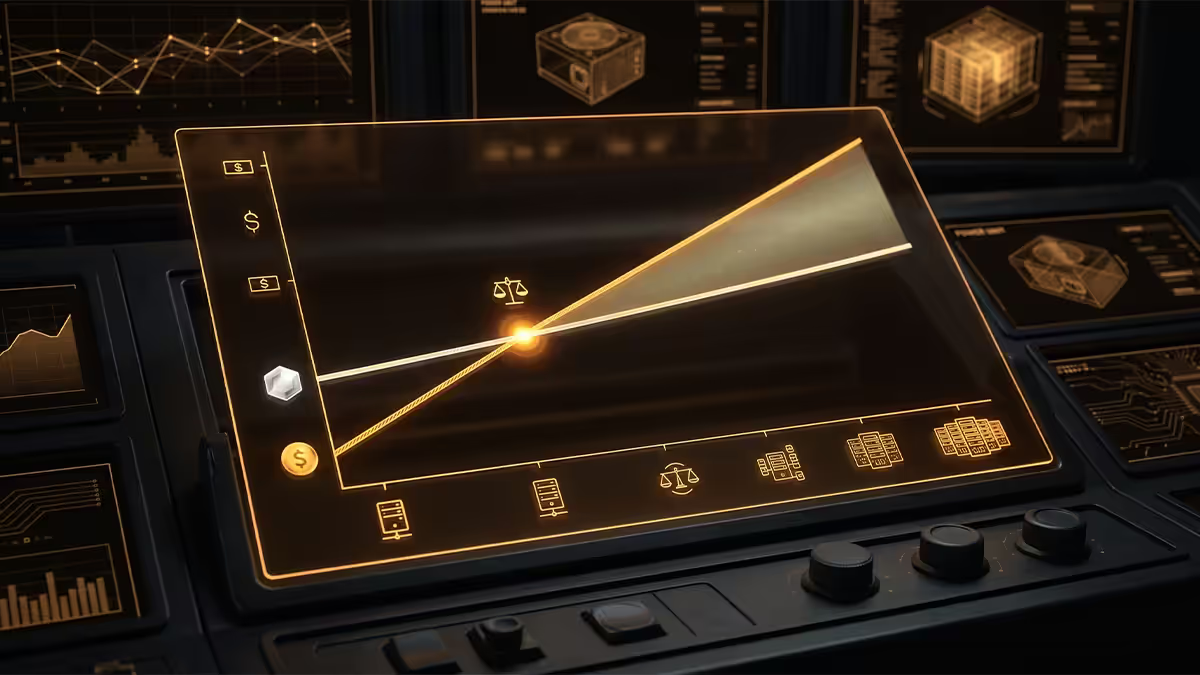
Translating the math into a single rule of thumb:
| Use pattern | Avg load | Break-even (R1,000 premium) |
|---|---|---|
| Casual gaming (3 hr/day) | 300 W | 22+ years |
| Heavy gaming (6 hr/day) | 450 W | 15 years |
| Productivity (10 hr/day) | 350 W | 11 years |
| Sustained workstation (12 hr/day) | 500 W | 6 years |
| Mining / server (24 hr/day) | 600 W | 2.5 years |
For gaming alone, Platinum almost never pays back in Rands. You pay the premium for warranty length, build quality assurance, and quieter sustained operation. For 24/7 high-watt use, Platinum is genuinely cheaper inside 3 years.
Recommended PSUs at every tier (SA pricing)
| Tier | Recommended unit | SA price (1000 W) |
|---|---|---|
| Budget Gold (RTX 5070 build) | MSI MAG A850GL PCIE5 | R1,800-R2,000 |
| Tier-A Gold (gaming sweet spot) | Corsair RM1000x · Seasonic Focus GX 1000 | R2,400-R2,800 |
| Tier-A Gold (silence focus) | Be Quiet Straight Power 12 1000W | R2,800-R3,200 |
| Platinum (workstation) | Seasonic Prime PX 1000W · Cooler Master V Platinum 1000 | R3,600-R4,200 |
| Platinum / Titanium (flagship) | Corsair AX1600i · Seasonic Prime TX 1000 | R5,500-R8,500 |
| Sustained 24/7 (server / mining) | Super Flower Leadex VII Platinum 1000W | R3,400-R3,800 |
Key takeaways
- Gold vs Platinum efficiency delta is 2-4 percentage points — real but modest at typical gaming loads.
- Eskom Rand savings: R30-R50/year for gaming, R300-R400/year for 24/7 high-load use.
- Platinum's real wins: Japanese capacitors, +2-3 yr warranty, quieter sustained load, tighter regulation.
- Tier-A Gold (Corsair RMx, Seasonic Focus GX, Be Quiet Straight Power 12) is the smart-Rand sweet spot.
- Platinum pays off financially only above 500-600 W sustained 24/7 load — server, mining, render farm.
Frequently asked questions
What is the efficiency difference between Gold and Platinum?
2 percentage points at 50% load (90% vs 92%), 3-4 points at 20% and 100% load. Roughly 9-13 W less wall draw at typical gaming load.How much can I save on electricity with a Platinum PSU?
R30-R50/year for typical gaming, R100-R180/year for sustained workstation use, R300-R400/year for 24/7 high-load. Break-even ranges from 2.5 years (mining) to 22 years (casual gaming).Is 80 Plus Platinum more reliable than Gold?
Indirectly, yes. Platinum certification forces Japanese-tier capacitors. Tier-A Gold (Seasonic, Corsair RMx) already uses them and overlaps closely with Platinum reliability.At what wattage does Platinum pay off versus Gold?
Roughly 500-600 W sustained load at 24/7 use breaks even inside 5 years. Gaming-only use rarely pays back inside the warranty period.What is the warranty difference?
Tier-A Gold: 7-10 years. Platinum: 10-12 years. Titanium: 12 years. The longer warranty is often the most concrete reason to upgrade.Does a Platinum PSU run quieter?
Slightly, on average — lower internal heat means lower fan RPM. Negligible at gaming loads, noticeable at sustained 80%+ load.Can a Gold PSU power an RTX 5090 build?
Absolutely. 850-1000 W tier-A Gold (Corsair RM1000x, Seasonic Focus GX 1000) with the ATX 3.1 12V-2x6 connector handles 5090 spikes comfortably.Are there bad Gold-certified PSUs to avoid?
Yes — budget Gold from no-name OEMs uses cheaper capacitors. Stick to Seasonic, Corsair RMx/HX, Be Quiet Straight Power, EVGA SuperNOVA, Cooler Master V Series, MSI MAG/MEG.
Get the Evetech app
Exclusive app-only prices, daily flash sales, and free delivery on orders over R4,000 — download the app and start saving.