PSU Standard Comparison
ATX 3.1 vs ATX 2.0 PSU
ATX 3.1 isn't just a connector swap. It's a transient spike spec that's been doubled, a recessed-pin redesign that fixes melting, and tighter low-load efficiency. But your old PSU isn't always the problem.
- transient spike spec
- 2x
- recessed sense pins
- 1.5mm
- SA upgrade cost
- R2.5k-R5k
What actually changed in ATX 3.1
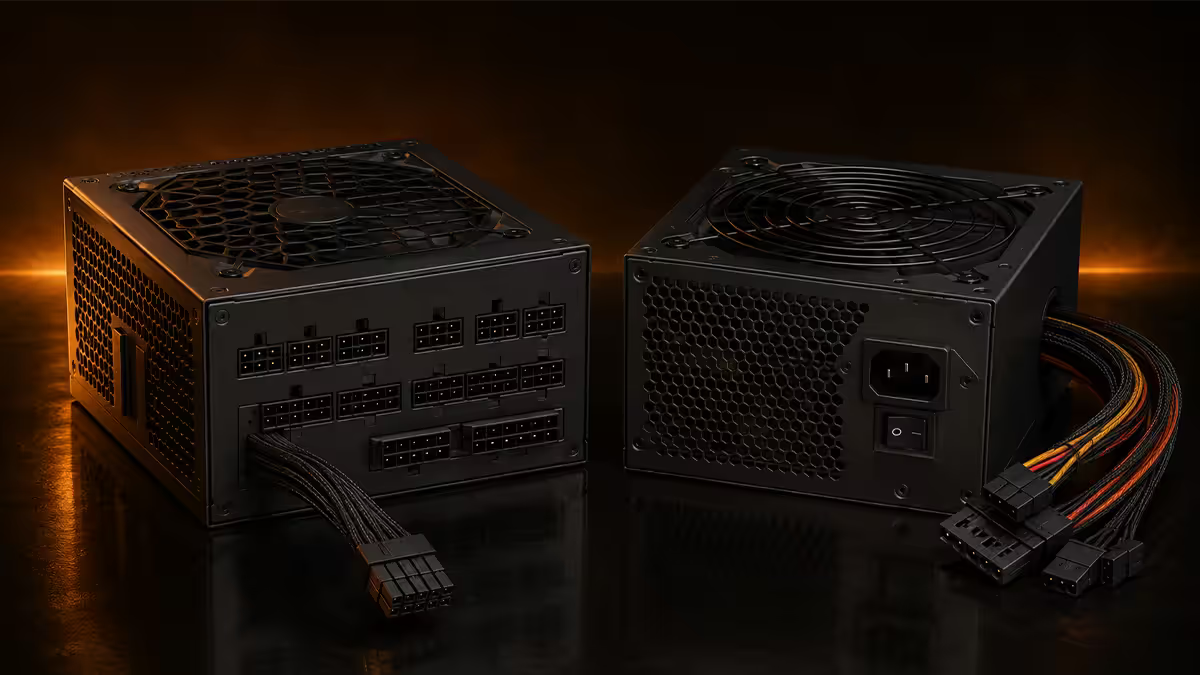
ATX 3.1 (finalised 2024) wasn't a marketing refresh of ATX 3.0 — it was a quiet repair job after the RTX 4090 melting saga. Three things changed simultaneously.
| Specification | ATX 2.0 (2003-2022) | ATX 3.1 (2024+) |
|---|---|---|
| GPU power connector | 6/8-pin PCIe (150W each) | 12V-2x6 (600W single) |
| Transient spike (excursion) | 1.5x rated, 100µs | 2x rated, 100µs |
| Power-good signal timing | 100-500ms | ≤16ms tighter window |
| Sense-pin design | n/a | Recessed 1.5mm |
| Low-load efficiency (10W) | Not specified | Required threshold |
The connector change gets the headlines, but the transient spike spec is what matters most for modern high-end GPUs. An RTX 5090 rated at 575W can momentarily pull 1150W+ for 100 microseconds during a power state transition. An ATX 2.0 PSU sees that as a fault and may shut down.
12V-2x6 vs 12VHPWR — the safety fix
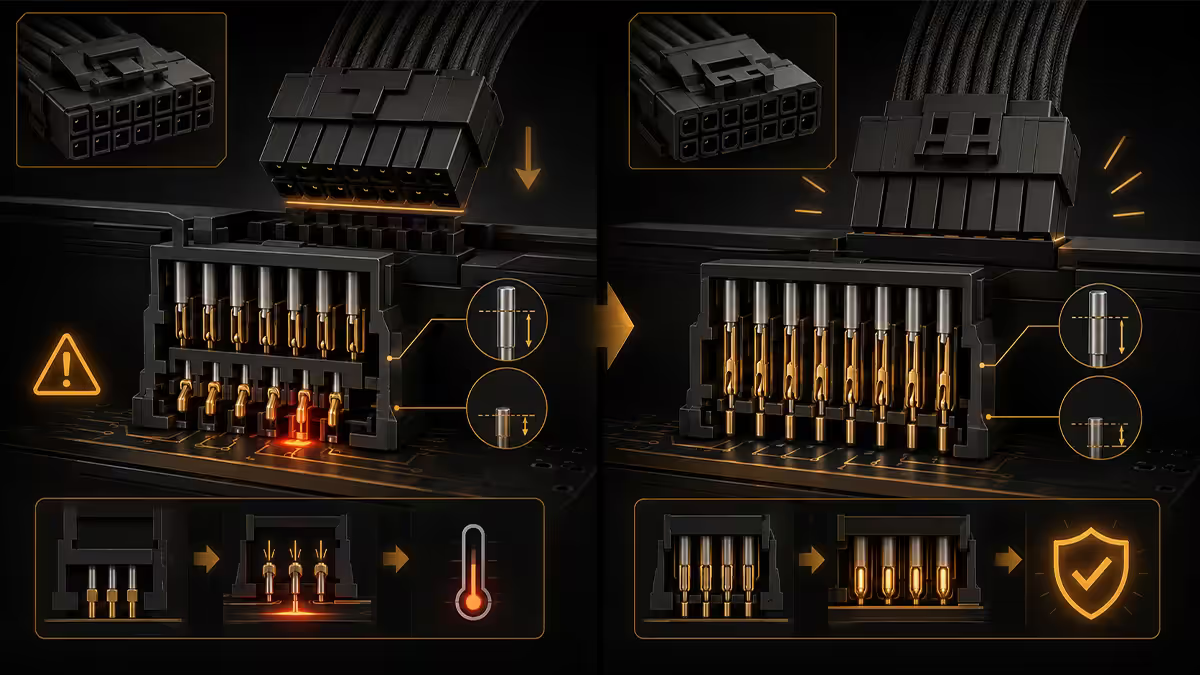
The original 12VHPWR connector (introduced with RTX 4090 in 2022) became infamous for melting in user installations. The root cause wasn't bad pins — it was partial seating. Users would push the connector in until it looked seated, but the click hadn't engaged. Under 450W+ load, the partially seated contact arced and the plastic shell melted.
The 12V-2x6 redesign keeps the same plug shape so it's backwards compatible. The difference is invisible from outside:
- Male power pins recessed 1.5mm — if the housing isn't fully home, the live 12V pins don't make contact at all.
- Sense pins shortened 1.5mm — the GPU's "I'm properly connected" detection trips before the power pins energise. A loose connection drops the card into a 150W safe mode instead of arcing.
- Latch reinforced — physical click is more decisive, less ambiguous.
The transient spike spec doubled — why it matters
Modern GPUs don't draw power smoothly. They pulse. A clock transition, a new scene rendering, or a boost-state change can spike power draw to 2x the steady-state rating for tens to hundreds of microseconds.
For an RTX 4090 (450W rated), peak spikes hit 900W+. For an RTX 5090 (575W rated), spikes can exceed 1150W. The PSU has to hold the 12V rail steady during these spikes — if voltage dips below 11.4V, the GPU sees brownout and the system locks or crashes.
ATX 2.0 specification required PSUs to handle 1.5x rated power for 100µs. ATX 3.0/3.1 doubled that to 2x. The practical effect: an ATX 3.1 850W PSU can briefly source 1700W without dipping. An ATX 2.0 850W PSU may handle only 1275W before OCP (over-current protection) trips.
When an ATX 2.0 PSU is still fine
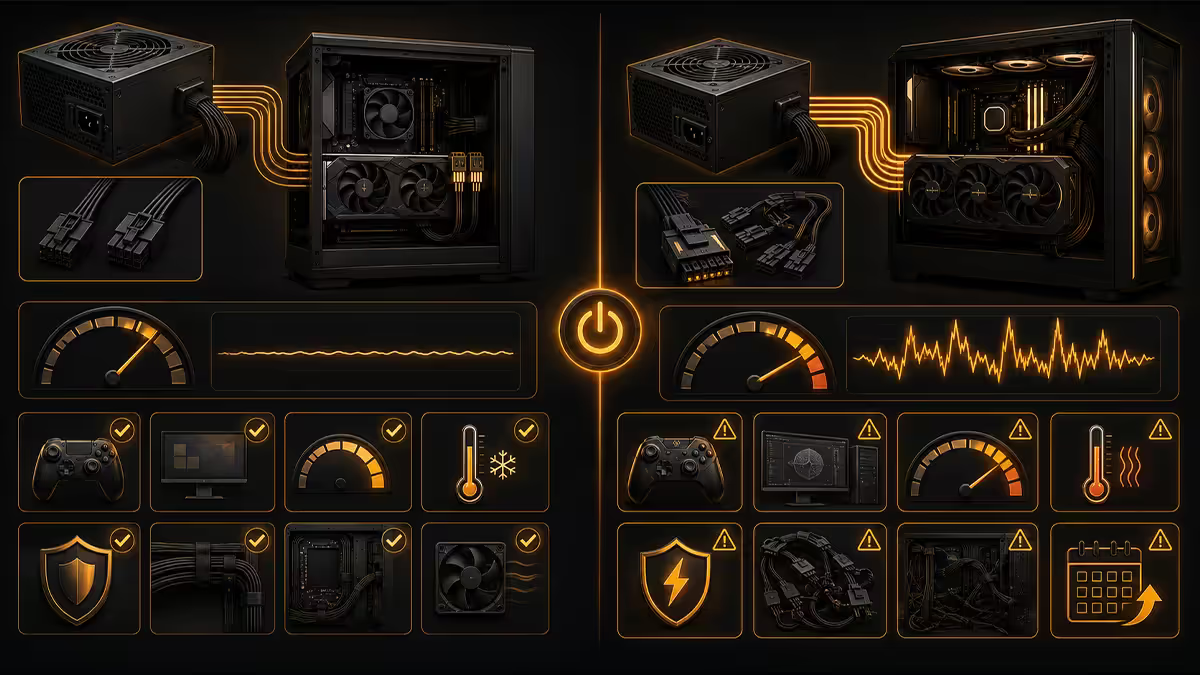
Plenty of builds don't need ATX 3.1. The standard exists for one reason — 600W single-cable GPUs. If your build doesn't have one, your old PSU is probably fine.
Keep your ATX 2.0 PSU if:
- You're running RTX 5070 / RTX 5070 Ti / RX 9070 XT or below (peaks under 350W, well within 1.5x transient on quality units).
- Your PSU is a Tier-A or Tier-B unit on cultists.network — Corsair RMx, Seasonic Focus GX, EVGA SuperNOVA G+, be quiet Straight Power.
- It's a quality 850W or 1000W unit less than 5 years old with good capacitors.
- You're running a single-GPU build with sensible ambient temps (under 35°C case intake).
Replace your ATX 2.0 PSU if:
- It's a budget no-name unit (Aerocool, generic OEM PSU from pre-built).
- It's older than 7-8 years (capacitor degradation is real).
- Wattage is too tight for the new GPU (less than recommended).
- You're getting random reboots, shutdowns under load, or coil whine that's gotten worse.
When to upgrade for RTX 5090
RTX 5090 is the line in the sand. Its sustained draw (575W) and transient peaks (1150W+) push the ATX 2.0 transient spec past breaking point on most PSUs. NVIDIA officially recommends an ATX 3.1 1000W unit.
Minimum recommended ATX 3.1 wattage by GPU:
| GPU | Recommended ATX 3.1 wattage | ATX 2.0 OK? |
|---|---|---|
| RTX 5090 | 1000W (1200W ideal) | No — replace |
| RTX 5080 | 850W | Yes if quality 850W |
| RTX 5070 Ti | 750W | Yes if quality 750W+ |
| RTX 5070 | 650W | Yes if quality 650W+ |
| RX 9070 XT | 750W | Yes if quality 750W+ |
| RX 9070 | 650W | Yes if quality 650W+ |
For 5090 builds specifically, the choice between 1000W and 1200W comes down to whether you want headroom. At 1000W with a 7950X3D + RTX 5090, you're running 85-90% load under stress — fans ramp, efficiency dips off 80+ peak. At 1200W you're at 70-75% load — quieter, cooler, longer-lived caps.
Native cable vs adapter — does it matter?
If you bought RTX 4080/4090/5070 Ti and kept an ATX 2.0 PSU, the GPU shipped with a 12VHPWR-to-3x-8-pin adapter. Is using the adapter as safe as a native 12V-2x6 cable from an ATX 3.1 PSU?
Short answer: not quite, but it's acceptable if you do it right.
- Native cable = one continuous run, one connector at each end, no junctions.
- Adapter = three 8-pin plugs into PSU, junction box, 12VHPWR plug into GPU. More connection points = more contact resistance, more failure modes.
- Third-party adapters (CableMod, EZDIY-FAB Spliced) have a worse safety record than first-party adapters. Stick with the one that came in the GPU box.
- Ensure all three 8-pin halves are fully seated in the PSU — partial seating on the PSU side is just as risky as on the GPU side.
Of the RTX 5090 systems we've shipped from Centurion in 2026, zero connector failures on builds using native ATX 3.1 12V-2x6 cables. Three out of the first 200 builds using adapters from older PSUs reported coil whine or under-load reboots — all traced to either undersized wattage (a 750W unit pushing a 5090) or partial 8-pin seating on the PSU side. The fix in each case was either upgrading to a 1000W ATX 3.1 unit or reseating all three 8-pin connectors. Adapter use isn't unsafe. Adapter use plus undersized PSU plus partial seating is.
Behind the Build · Evetech service bench
Recommended ATX 3.1 PSUs in SA
| Use case | Pick | SA price |
|---|---|---|
| RTX 5090 / sustained workstation | Corsair RM1200x SHIFT ATX 3.1 | R5,000-R5,800 |
| RTX 5090 budget-conscious | MSI MAG A1000GL PCIE5 1000W | R3,400-R3,900 |
| RTX 5080 enthusiast | Seasonic Focus GX-ATX 3.1 850W | R2,900-R3,400 |
| RTX 5080 value | Cooler Master MWE Gold 850 V2 ATX 3.1 | R2,300-R2,700 |
| RTX 5070 Ti | be quiet Pure Power 12 M 750W ATX 3.1 | R2,000-R2,400 |
| RTX 5070 / 9070 mid-range | XPG Pylon 650W ATX 3.1 | R1,500-R1,900 |
| Silent enthusiast | Corsair RM850e ATX 3.1 fanless mode | R3,000-R3,500 |
Common upgrade mistakes
Buying a 1000W ATX 3.1 for an RTX 5070 build. Wattage overkill. A quality 650W or 750W ATX 3.1 unit handles a 5070 with ease, runs at higher efficiency at typical load, and costs R1,500-R2,000 less.
Trusting the box wattage on cheap units. A R1,500 "1000W" PSU from a generic brand often delivers 700W actual sustained. Real ATX 3.1 compliance comes from Seasonic, Corsair, MSI, Cooler Master, be quiet, EVGA, FSP and ASUS.
Skipping the cable lock. The 12V-2x6 has a latch tab on top. After plugging in, verify the latch has clicked over the GPU housing detent. If the latch is floating, the connector isn't fully seated.
Mixing native and adapter cables. Don't plug a CableMod custom 12V-2x6 into a stock PSU and a stock GPU adapter into the other end. Use one continuous chain — either fully native ATX 3.1 cable or the original GPU adapter, not Frankenstein assemblies.
Reusing the 12VHPWR cable from an old ATX 3.0 PSU. ATX 3.0 cables don't have the recessed sense pin geometry. Even if it fits, you've lost the safety improvement. ATX 3.1 PSUs ship with new cables for a reason.
Key takeaways
- ATX 3.1 = 12V-2x6 connector + 2x transient spike spec + recessed sense pins. Three improvements, not one.
- RTX 5090 requires ATX 3.1 1000W minimum. Older PSUs trip OCP on 1200W transient spikes.
- RTX 5080 and below can run on a quality ATX 2.0 PSU with the bundled adapter.
- The 12V-2x6 melting fix only works if both ends use 12V-2x6 spec — not mixed with 12VHPWR.
- Native cable beats adapter. If you're using an adapter, seat both halves until both clicks engage.
Frequently asked questions
What is the difference between ATX 3.1 and ATX 2.0 PSU?
ATX 3.1 mandates the 12V-2x6 connector, doubles the transient spike spec (from 1.5x to 2x rated), and tightens light-load efficiency. ATX 2.0 uses 8-pin PCIe connectors with a lower transient spec.Is the 12V-2x6 connector safer than 12VHPWR?
Yes. Power pins are recessed 1.5mm and sense pins shortened so that partial seating drops the GPU to safe mode instead of arcing the live 12V pins. Same shape, different internal geometry.Will my ATX 2.0 PSU work with an RTX 5090?
Electrically yes with an adapter, but transient spikes (up to 1200W) may trip OCP on older PSUs. NVIDIA and Corsair recommend ATX 3.1 1000W for any RTX 50-series build.Should I upgrade my PSU for an RTX 5090 or 5080?
RTX 5090 — yes, ATX 3.1 1000W or 1200W. RTX 5080 — quality 850W ATX 2.0 works with adapter, ATX 3.1 850W is cleaner. RTX 5070 and below — keep your existing quality PSU.Is a native 12V-2x6 cable safer than an adapter?
Yes. Native = one continuous cable, fewer junctions, less contact resistance. Adapters add a junction box and three 8-pin PSU connections. Use the official GPU-bundled adapter, not third-party.What wattage ATX 3.1 PSU do I need for RTX 5090?
1000W minimum, 1200W for transient headroom and quieter fan behaviour. RTX 5080 needs 850W, RTX 5070 Ti needs 750W.Can I use ATX 3.1 PSU with an older RTX 30-series or 40-series card?
Yes, fully backwards compatible. ATX 3.1 PSUs ship with both 12V-2x6 and traditional 8-pin PCIe cables.How long will ATX 3.1 PSU standards remain current?
Expected through 2028-2029 minimum. Transient spec is sized for 600W single-cable GPUs, covering current and next-gen flagships.
Get the Evetech app
Exclusive app-only prices, daily flash sales, and free delivery on orders over R4,000 — download the app and start saving.