PSU Buying Guide
How to choose a power supply. — Where buying premium actually pays off.
The PSU is the one place in your build where the cheap option is a serious mistake. A bad PSU can quietly degrade your components for years, or kill them in a single power event.
- RTX 5070 sweet spot
- 750 W
- minimum tier
- 80+ Gold
- expected lifespan
- 7-10 yrs
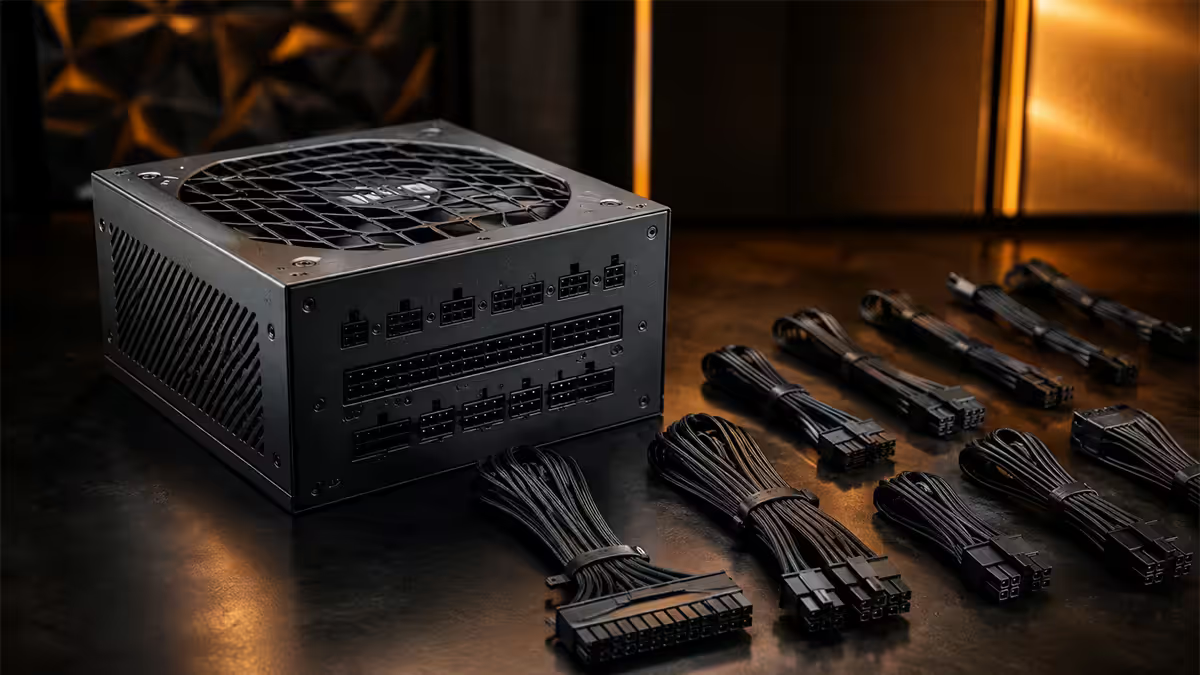
Why the PSU matters more than people think
Every other component in your build runs on the power the PSU delivers. A bad PSU doesn't just fail — it fails dirty, often taking the GPU, CPU or motherboard with it. We've seen R900 PSUs kill R25,000 worth of components during a load shedding cycle. The maths is brutal: saving R500-R1,000 here can cost you a full rebuild.
A good PSU also affects everyday quality — quieter fan curves, cleaner voltage regulation (which means less coil whine), and stable performance under sudden load spikes. The PSU is invisible when it's working and very visible when it isn't.
How to size wattage
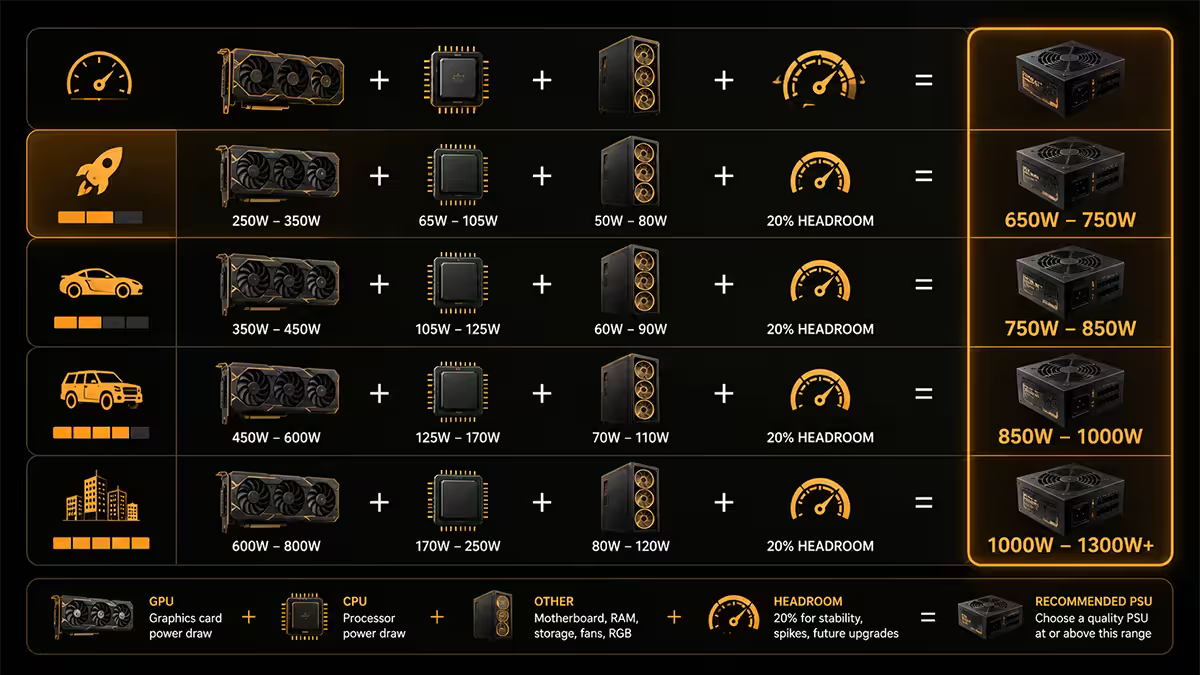
The rule: add up your GPU's recommended PSU + 30-50% headroom. The GPU is by far the biggest power draw in a modern build; everything else (CPU, RAM, drives, fans) is a rounding error in comparison.
| GPU | Recommended PSU | Comfortable size |
|---|---|---|
| RTX 5060 | 550 W | 650 W Gold |
| RTX 5060 Ti | 600 W | 650-750 W Gold |
| RX 9060 XT | 600 W | 650-750 W Gold |
| RTX 5070 | 700 W | 750 W Gold |
| RX 9070 | 700 W | 750 W Gold |
| RTX 5070 Ti | 750 W | 850 W Gold |
| RX 9070 XT | 750 W | 850 W Gold |
| RTX 5080 | 800 W | 850-1000 W Gold |
| RTX 5090 | 1000 W | 1200 W Gold/Platinum |
Why the headroom matters: PSUs are most efficient at 30-60% load. A 750 W PSU running a 400 W build sits in its sweet spot, runs cooler, the fan stays quiet, and the PSU itself lasts longer. Running a 600 W PSU at near-full capacity wears it out faster.
80 Plus efficiency tiers
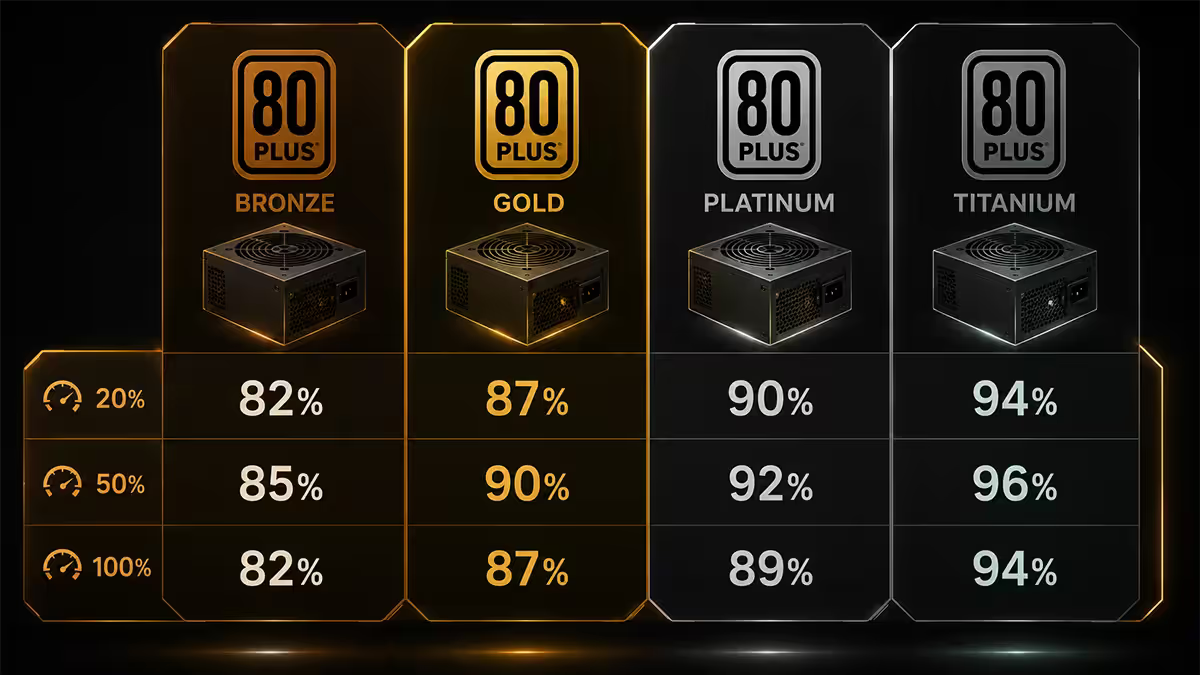
80 Plus is a certification that grades how efficient a PSU is — how much of the power it draws from the wall actually reaches your components, versus how much is wasted as heat.
| Tier | Efficiency | Verdict |
|---|---|---|
| 80 Plus Bronze | 82-85% efficient | Entry-level. Avoid in 2026 for gaming builds. |
| 80 Plus Gold | 87-90% efficient | The 2026 sweet spot. Where most builds should land. |
| 80 Plus Platinum | 89-92% efficient | Premium. Usually 30-40% more expensive than Gold for marginal efficiency. |
| 80 Plus Titanium | 91-94% efficient | Server-grade. Only worth it if you run heavy 24/7 workloads. |
Practical translation: The efficiency difference between Gold and Platinum saves you maybe R150-R300 a year in electricity on a typical gaming PC. The price difference between Gold and Platinum PSUs is often R1,000-R2,000. Stay Gold unless you have a specific reason to go higher.
Modular, semi-modular or non-modular
Modular refers to whether the cables detach from the PSU body.
- Fully modular — every cable detaches. Best for cable management and airflow. You only plug in what your build needs. Premium tier, R200-R600 more than non-modular.
- Semi-modular — the essential cables (24-pin ATX, EPS) are permanently attached; everything else detaches. Good compromise, R200-R400 cheaper than fully modular.
- Non-modular — all cables permanently attached. Cheapest tier but unused cables clutter the case and hurt airflow. Fine for budget builds in larger cases.
The recommendation: Go fully modular if your build is R20,000+. The cable management benefit alone is worth it, and replacement cables for upgrades cost less than buying a new PSU. Semi-modular is the sensible budget compromise.
ATX 3.1 and the 12V-2x6 connector
ATX 3.1 is the current PSU specification. The defining feature for gaming builders: the 12V-2x6 connector (also called 12VHPWR refresh). This is the single high-power cable that feeds modern flagship GPUs — RTX 50-series cards use it natively.
If you're running an RTX 5070 or higher, you want a PSU that ships with this connector directly — not as an adapter from older 8-pin PCIe cables. Adapters work, but they're a known failure point in 2023-2024 RTX 40-series builds, and they look messy.
ATX 3.1 also defines how PSUs handle transient power spikes. Modern GPUs spike to 2-3× their rated TDP for milliseconds during scene transitions; ATX 3.1 PSUs are designed to deliver these spikes without triggering protection shutdowns. Older ATX 2.x PSUs sometimes shut down under RTX 50-series transient loads even when nominally rated for the wattage.
Brands you can actually trust in South Africa
PSU quality varies wildly between brands and even between models within a brand. The benchmark for SA-available units in 2026:
Tier A — buy with confidence
- Corsair RM / HX / AX series — Corsair's premium lines, 10-year warranty on RMx and HXi
- Seasonic Focus / Prime / Vertex — Seasonic makes PSUs for many other brands. Their own-brand units are excellent
- be quiet! Pure Power / Straight Power / Dark Power — German engineering, near-silent operation, premium tier
- ASUS ROG Strix / ROG Loki / ROG Thor — premium ASUS units, often paired with their motherboards
- MSI MAG / MEG series — solid mid-to-premium tier
Tier B — fine for most builds
- Corsair CX / CV series (budget Corsair)
- Cooler Master MWE Gold / V Gold
- Thermaltake Toughpower GF series
- NZXT C-series
Avoid in 2026
- Unbranded or no-name PSUs (especially anything shipped with a R900-R1,500 "gaming case + PSU" bundle)
- Older 80 Plus Bronze units, even from good brands
- Anything more than 5 years old (capacitors degrade)
Recommended PSUs by build tier
| Build tier | PSU pick | SA price |
|---|---|---|
| RTX 5060 entry build (650 W) | Corsair RM650e or MSI MAG A650GL | R1,800-R2,400 |
| RTX 5070 mid-range (750 W) | Corsair RM750e or Seasonic Focus GX-750 | R2,200-R3,000 |
| RTX 5070 Ti / 5080 (850 W) | Corsair RM850x or be quiet! Pure Power 12 M 850W | R2,800-R3,800 |
| RTX 5090 enthusiast (1200 W) | Corsair HX1200i or ASUS ROG Thor 1200W Platinum | R5,500-R8,500 |
| Workstation / dual-PSU build | Corsair AX1600i or Seasonic Prime TX-1300 | R8,500-R13,000 |
Common PSU mistakes
Underspeccing wattage. Buying a 650 W PSU for an RTX 5080 build because "550 W minimum is on the box". The recommended is a minimum; sustained load + transients need 30-50% headroom.
Reusing a 7+ year old PSU in a new build. Capacitors degrade. Even a high-quality PSU from 2018 might have lost 10-20% of its rated capacity by now. Replace it.
Buying the bundled PSU in a "gaming case kit". Cases that ship with a "free" PSU are almost always pairing a R1,500 case with a R500 unbranded PSU. The PSU will fail. Buy them separately.
Using a 12V-2x6 adapter on a non-ATX-3.1 PSU. Works, but adds a failure point and a messier cable run. If you're building with an RTX 50-series card, just buy an ATX 3.1 PSU.
Not registering for warranty. Tier-A PSUs typically offer 7-10 year warranties — but many require online registration within 30-90 days of purchase. The R3,000 PSU you didn't register is a R3,000 PSU you can't claim on in year five.
Key takeaways
- Size PSU wattage from the GPU + 30-50% headroom. 750 W is the 2026 mainstream sweet spot for RTX 5070 / RX 9070 builds.
- 80 Plus Gold is the 2026 minimum. Platinum and Titanium rarely justify their price premium.
- Go fully modular if your build is R20,000+. The cable management benefit alone is worth the R300-R500 premium.
- For RTX 50-series, buy an ATX 3.1 PSU with native 12V-2x6 — not an adapter cable from older units.
- Stay in Tier A brands (Corsair, Seasonic, be quiet!, ASUS ROG, MSI MAG/MEG). The PSU is the wrong place to save R500.
Frequently asked questions
What wattage PSU do I need for a gaming PC in 2026?
Add up your GPU's recommended PSU plus 30-50% headroom. RTX 5070 builds want 750 W. RTX 5080 wants 850 W. RTX 5090 needs 1000-1200 W. Always size up, not down.What does 80 Plus Gold mean?
80 Plus is an efficiency certification. Gold guarantees the PSU runs at least 87-90% efficient — only 10-13% of the power drawn from the wall is wasted as heat. Higher tiers are more efficient but rarely worth the price uplift.Modular vs non-modular PSU — which should I buy?
Fully modular is best — every cable detaches. Semi-modular is the compromise (essential cables attached, others detachable). Non-modular has all cables permanently attached — fine for budget builds.What is ATX 3.1 and the 12V-2x6 connector?
ATX 3.1 is the current PSU standard. The 12V-2x6 connector is the single cable that powers modern high-end GPUs — RTX 50-series cards use it. ATX 3.1 PSUs handle the surge spikes these GPUs draw during fast scene transitions.How long does a PSU last?
A good 80 Plus Gold PSU from a reputable brand should last 7-10 years of normal use. Premium units often come with 10-12 year warranties. Cheap unbranded PSUs can fail in 2-3 years.What PSU brands can I trust in South Africa?
Tier A: Corsair (RM and HX), Seasonic (Focus and Prime), be quiet! (Pure Power and Straight Power), MSI (MAG and MEG), ASUS ROG and TUF Gaming. Avoid generic/unbranded units.Is a bigger PSU more expensive to run?
No. A PSU only draws the power your components need, regardless of capacity. A 1000 W PSU running a 400 W load is actually slightly more efficient than a 600 W PSU running the same load.Can I reuse my old PSU in a new build?
If your old PSU is 80 Plus Gold or better, under 5 years old, from a trusted brand, and rated for your new GPU plus 30% headroom — yes. If any of those are off, replace it.
Get the Evetech app
Exclusive app-only prices, daily flash sales, and free delivery on orders over R4,000 — download the app and start saving.