Hardware Explainer
80 Plus, decoded. Bronze, Gold, Platinum. — What each badge really saves you.
That badge on the PSU box isn’t marketing fluff — it’s a measured efficiency curve. The catch: only Gold and above start paying back their premium in a typical SA gaming PC. Here are the actual Rands per year.
- white to titanium
- 6 tiers
- efficiency band
- 80% → 94%
- SA grid rate ’26
- R3.50/kWh
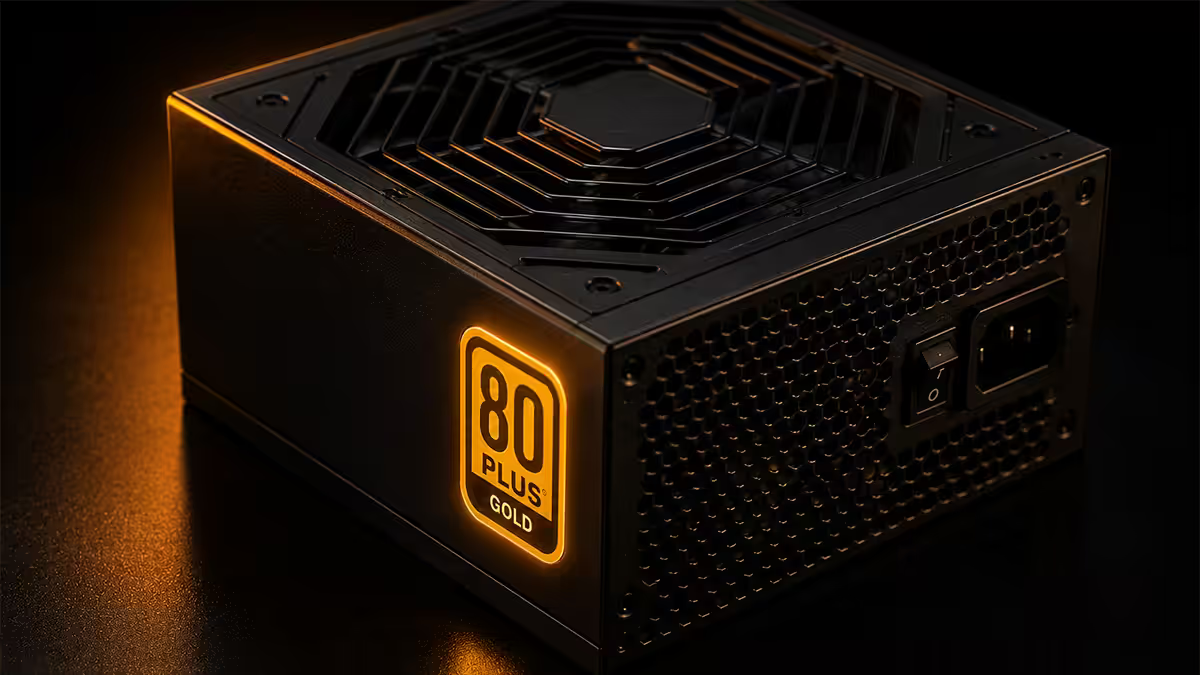
What 80 Plus actually measures
80 Plus is a voluntary efficiency certification programme run by CLEAResult. The premise is simple: a power supply takes incoming AC power from your wall and converts it to the DC voltages your PC components actually use. That conversion is never 100% efficient — some energy is always lost as heat inside the PSU itself.
An 80 Plus certification confirms a PSU achieves at least 80% efficiency at three measurement points: 20%, 50% and 100% of its rated load. Above 80 Plus White (the entry tier), higher badges raise the bar at each point. By the time you reach Titanium, you’re looking at 94% efficiency at 50% load and 90% at 100% load.
Why does this matter beyond the electricity bill? Because energy lost in conversion becomes heat inside your PSU. Less heat means quieter fans, longer capacitor life and lower system temperatures overall. A Gold or Platinum unit will often run its fan in zero-RPM mode (silent) under typical gaming loads. A Bronze unit might be audibly spinning the whole time.
Six tiers from White to Titanium
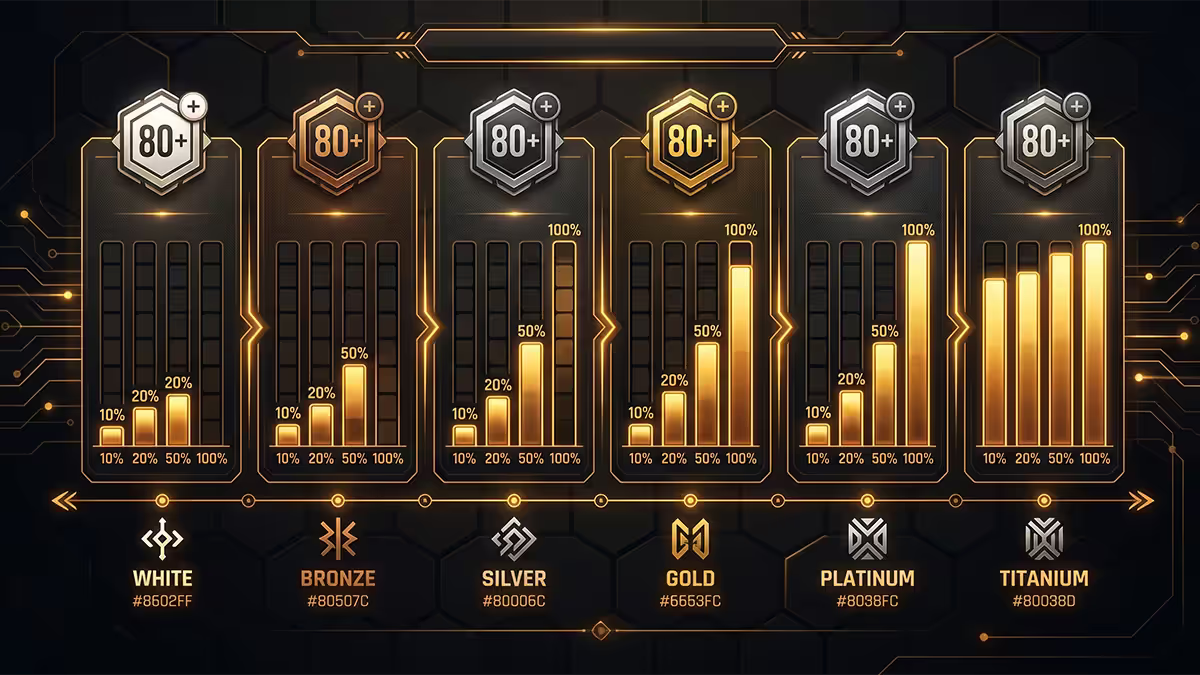
The 80 Plus ladder has six tiers, but only four matter in practice for SA retail buyers in 2026. Silver is rarely produced anymore (it sits awkwardly between Bronze and Gold pricing), and White is increasingly relegated to OEM bulk units.
| Tier | Efficiency @ 50% load (230V) | Typical SA retail price (650W-850W) |
|---|---|---|
| 80 Plus White | 82% | R900-R1,400 (rare retail) |
| 80 Plus Bronze | 85% | R1,400-R2,400 |
| 80 Plus Silver | 88% | R1,800-R2,800 (rare) |
| 80 Plus Gold | 90% | R2,500-R4,800 |
| 80 Plus Platinum | 92% | R4,500-R8,000 |
| 80 Plus Titanium | 94% | R7,000-R14,000 |
The numbers shown are 80 Plus’ updated 230V internal test points (the original 115V ratings are slightly different). The ladder steepens at the top — moving from Gold to Platinum is a 2% efficiency gain at a 50-80% price jump. Titanium is largely for content creators or 24/7 silent-PC enthusiasts where every watt counts.
Why efficiency depends on load
The headline number you see on the box (“90% efficient”) is almost always the peak — measured at 50% load. PSU efficiency is not flat. It rises from a lower point at 20% load, peaks around 40-60% load, then drops again past 80% load.
This is why oversizing a PSU helps both efficiency and longevity. A 1,000W PSU running a 250W gaming load is operating at 25% — toward the lower edge of its efficiency curve. A 650W PSU running the same 250W load is operating at 38% — almost at peak efficiency.
The rule of thumb: target your typical gaming/working load to land around 40-60% of the PSU’s rated wattage. That puts you on the efficiency peak and leaves headroom for GPU transient spikes (which modern Nvidia 50-series cards demand).
- A 250W typical-draw build wants a 550W to 650W PSU — not a 1,200W “future-proof” monster.
- A 400W typical-draw build (RTX 5080 + Ryzen 9) wants 850W to 1,000W.
- A 600W+ workstation (RTX 5090 + Threadripper / dual GPU) wants 1,200W-1,500W.
Cybenetics — the overlay that matters in SA
Here’s something the 80 Plus badge doesn’t tell you: it’s tested at 115V (US grid voltage). SA’s grid runs at 220-240V, where PSU efficiency is genuinely different (usually 1-2% higher than the 115V ratings published).
Cybenetics is the alternative European certification body that tests at 230V across a much finer load granularity. It produces two ratings: ETA (efficiency) and Lambda (acoustic noise). Both are useful overlays for SA buyers.
| Cybenetics rating | Roughly equivalent to 80 Plus | Noise (Lambda) |
|---|---|---|
| ETA Standard | ~Bronze | — |
| ETA-B | ~Silver / low Gold | — |
| ETA-A | ~Gold | Lambda A: very quiet |
| ETA-A+ | ~Platinum | Lambda A+: silent at typical load |
| ETA-A++ | ~Titanium | Lambda A++: dead silent |
When you’re shopping a Corsair RM, Seasonic Focus or MSI MAG in SA, look for both badges. A unit rated 80 Plus Gold + Cybenetics ETA-A is a genuinely high-quality buy. A unit rated 80 Plus Gold but no Cybenetics certification is more questionable — it may be coasting on the older 80 Plus test methodology.
SA Rand math — what the rating saves you
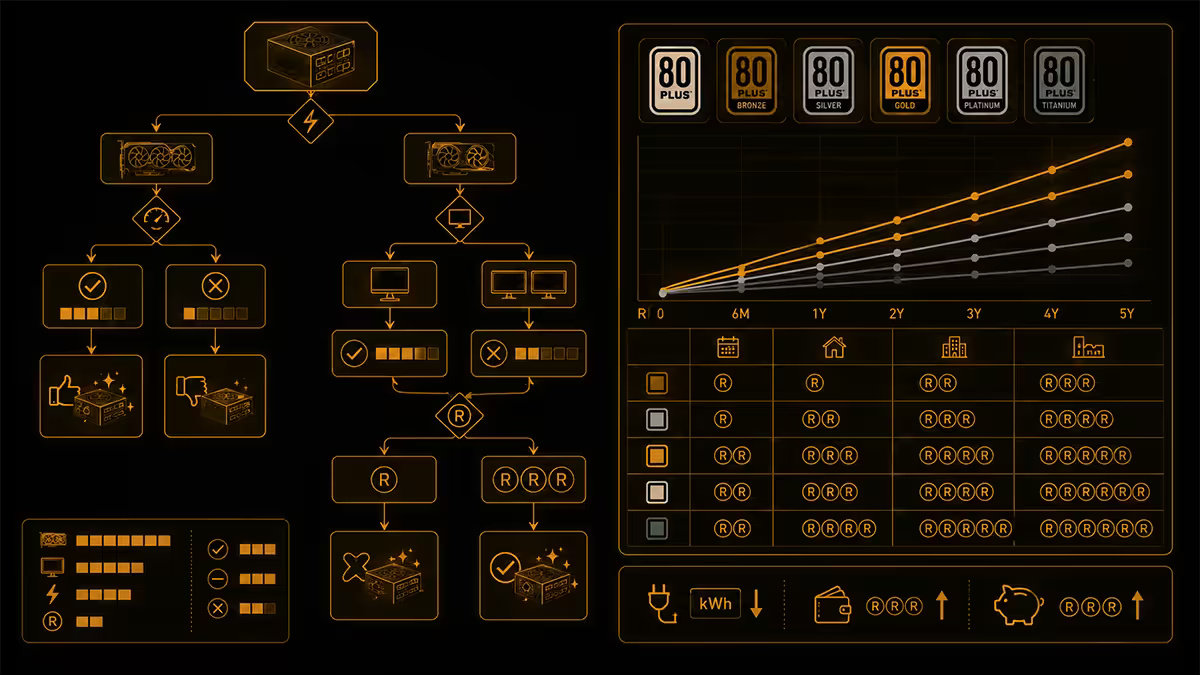
Let’s do the actual maths for a typical SA gaming PC: 250W average load, 6 hours of gaming per day, R3.50 per kWh (Eskom city tariff in 2026 after inflation).
Annual wall-power consumption at 250W typical load:
- 250W ÷ 0.82 efficiency (80 Plus White) = 305W from wall × 6h × 365 days = 668 kWh × R3.50 = R2,338/year
- 250W ÷ 0.85 efficiency (Bronze) = 294W from wall × 6h × 365 days = 644 kWh × R3.50 = R2,254/year
- 250W ÷ 0.90 efficiency (Gold) = 278W from wall × 6h × 365 days = 609 kWh × R3.50 = R2,131/year
- 250W ÷ 0.92 efficiency (Platinum) = 272W from wall × 6h × 365 days = 596 kWh × R3.50 = R2,085/year
Annual savings vs Bronze: Gold saves R123/year, Platinum saves R169/year, Titanium saves R210/year. Multiply by a 5-7 year PSU lifespan and Gold’s payback against Bronze (typically R600-R1,200 price premium) becomes very real. Platinum’s payback over Gold takes longer than the PSU’s likely service life — only worth it if you also value the quieter operation.
Sweet-spot wattage and the ATX 3.1 reality
In late 2024, the industry transitioned from ATX 3.0 to ATX 3.1, mostly to address the 12VHPWR connector issues that plagued early Nvidia 40-series cards. The new 12V-2x6 connector has a shorter sense pin and tighter manufacturing tolerances — meaning your new ATX 3.1 PSU is safer with high-draw GPUs than older ATX 2.x units.
For 2026 builds: insist on ATX 3.1 compliance, not just an old 80 Plus badge. Many older “80 Plus Gold” units don’t meet the ATX 3.1 transient spec required by RTX 50-series and Radeon RX 9000-series GPUs.
Recommended PSUs by build tier
| Build type | Recommended PSU | SA price |
|---|---|---|
| Entry gaming (RX 7600 / RTX 5060) | Corsair CV650 80+ Bronze 650W or MSI MAG A650BN | R1,400-R2,000 |
| Mid-range (RTX 5070 / RX 9070) | Cooler Master MWE 750 Gold V2 or MSI MAG A750GL | R2,500-R3,400 |
| High-end (RTX 5080 / RX 9070 XT) | Corsair RM850e Gold or Seasonic Focus GX-850 | R3,500-R4,800 |
| Flagship gaming (RTX 5090) | Corsair RM1000x Shift or Seasonic Vertex GX-1200 | R5,500-R8,500 |
| Workstation / 24/7 silent | Seasonic Prime TX-1000 Titanium or Corsair AX1500i | R10,000-R14,500 |
| Compact ITX gaming | Corsair SF750 Platinum SFX | R4,800-R6,200 |
| Budget / office build | Cooler Master MWE 550 Bronze V2 | R1,200-R1,500 |
Common 80 Plus shopping mistakes
Buying the highest tier “for future-proofing.” A Titanium PSU on a 250W gaming build wastes money and runs further from its efficiency peak. Match the rating tier to your actual load and the unit’s wattage to your real consumption.
Trusting an old 80 Plus badge. Pre-2024 Gold-rated PSUs don’t always meet ATX 3.1 transient spec. New Nvidia and AMD GPUs demand rapid power swings. Verify the unit is ATX 3.1-compliant with a 12V-2x6 connector if you’re using a 40-series or newer GPU.
Massively oversizing the wattage. A 1,200W Platinum running a 250W build operates at 20% load — below the peak efficiency point. Counter-intuitively, a 750W Gold at the same workload is more efficient because it sits closer to its sweet spot.
Ignoring the brand altogether. A no-name Platinum-badged unit can be wildly worse than a Corsair Bronze. The badge only certifies efficiency under controlled testing — not capacitor quality, voltage regulation or hold-up time. Tier-list reputable brands first, then optimise within them.
Treating Cybenetics as marketing fluff. Cybenetics is genuinely more rigorous than 80 Plus at SA grid voltage. When two units are equivalent on 80 Plus tier, prefer the one with the Cybenetics ETA-A or ETA-A+ rating.
Key takeaways
- 80 Plus measures efficiency at 20%, 50% and 100% load. Each tier raises the bar at each point.
- Gold is the sweet spot for SA gaming PCs — 90% peak efficiency, ~R120/year cheaper than Bronze, 2-3 year payback.
- Target 40-60% PSU load for peak efficiency. Don’t oversize wildly — a 1,200W on a 250W build wastes money.
- Cybenetics ETA at 230V is more meaningful for SA than 80 Plus alone. Look for both badges.
- For RTX 50-series or RX 9000-series, demand ATX 3.1 compliance and the 12V-2x6 connector — not just any old Gold badge.
Frequently asked questions
What does 80 Plus actually mean?
A voluntary certification confirming the PSU converts at least 80% of AC wall power to usable DC at the 20%, 50% and 100% load points. Higher tiers (Gold, Platinum, Titanium) raise the bar at each point.Is 80 Plus Gold worth the premium over Bronze in SA?
For a 250W average-draw gaming PC running 6 hours daily at R3.50/kWh, Gold saves ~R120-R150/year vs Bronze. Gold premium is R600-R1,200. Payback is 2-3 years. Worth it for new builds.What’s the difference between 80 Plus and Cybenetics?
80 Plus tests at 115V US grid. Cybenetics tests at 230V (close to SA’s 220-240V) with finer granularity, plus rates acoustic noise (Lambda). Cybenetics ETA-A is a more meaningful overlay for SA buyers.Why is 80 Plus White still relevant in 2026?
It barely is. Most retail PSUs now start at Bronze or Gold. White-rated units are limited to budget OEM builds and the cheapest retail offerings — avoid for new builds.Does a higher 80 Plus rating mean better quality?
It correlates but doesn’t guarantee. Voltage regulation, ripple, transient response and capacitor quality matter equally. A Corsair Gold beats a no-name Platinum every time.What 80 Plus tier should I buy for a gaming PC in 2026?
Gold is the sweet spot for almost every modern gaming build. Bronze for entry. Platinum/Titanium for silent or 24/7 workstation use.How does PSU efficiency affect my electricity bill?
At 250W typical gaming load, Bronze = ~R760/yr, Gold = ~R710/yr, Platinum = ~R695/yr — a R65/yr Bronze-to-Platinum gap. Larger savings appear with higher-load workstations (400W+).What is 80 Plus 2026 and why did standards change?
Updated 2025-2026 standards add stricter ripple, hold-up time and standby efficiency rules to match ATX 3.1. For RTX 50-series GPUs, demand ATX 3.1-compliant PSUs with the 12V-2x6 connector.
Get the Evetech app
Exclusive app-only prices, daily flash sales, and free delivery on orders over R4,000 — download the app and start saving.