GPU Naming Decoded
GPU naming decoded.
— Generation, tier, Ti, SUPER, XT, XTX. Read any GPU in 30 seconds.
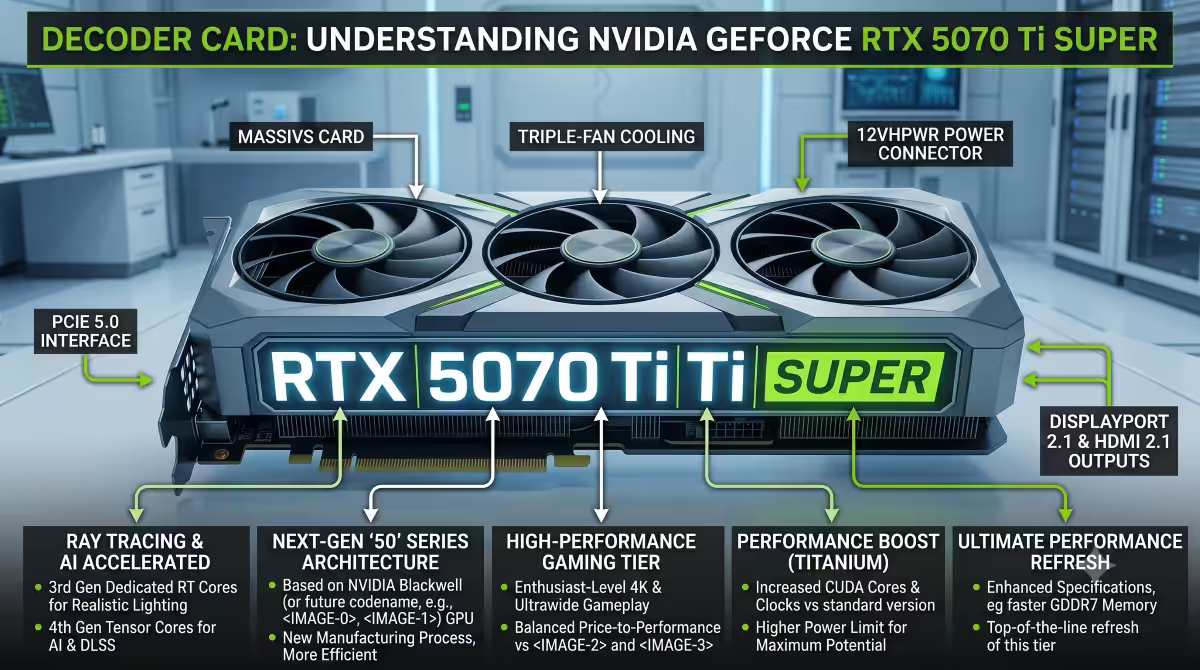
“RTX 5070 Ti SUPER” looks like marketing soup until you know what each part means. It's not. The naming system is a structured code — once decoded, you can read any GPU spec sheet without guessing, compare generations sanely, and stop falling for “Ti SUPER” upsells you didn't need.
RTX, GTX, TITAN — the prefix decoded
NVIDIA's prefix tells you which capability class the card belongs to. There are three to know, only one of which is current:
- RTX (Ray Tracing eXtreme) — every consumer NVIDIA GPU since the RTX 20 series in 2018. Has dedicated RT cores for ray tracing and tensor cores for DLSS / AI workloads. This is what you're buying today.
- GTX (Giga Texel Shader eXtreme) — the legacy non-ray-tracing line. The GTX 16 series (1660, 1650) was the last entry. Still appears in budget pre-built systems, but no current desktop GTX is in production.
- TITAN — legacy prosumer/halo line. The last consumer TITAN was the TITAN RTX in 2018. That role is now filled by the RTX 90-tier (5090, 4090, 3090, 3090 Ti).
Practical takeaway: if you're buying new today, you're buying RTX. GTX exists only in old inventory or budget OEM laptops. TITAN is dead as a consumer brand.
NVIDIA generation digit — the first number
The first digit of the model number is the generation. It corresponds to the GPU architecture:
| Generation | Architecture | Year |
|---|---|---|
| RTX 20-series (2080, 2070, etc.) | Turing | 2018 |
| RTX 30-series (3090, 3080, 3070, 3060) | Ampere | 2020 |
| RTX 40-series (4090, 4080, 4070, 4060) | Ada Lovelace | 2022 |
| RTX 50-series (5090, 5080, 5070, 5060) | Blackwell | 2024-2025 |
| RTX 60-series (expected 6090, 6080…) | Rubin | 2027 (expected) |
A newer generation card at the same tier (e.g. RTX 5070 vs RTX 4070) is typically 20-35% faster at the same price tier, more efficient per watt, and gets new features (DLSS 4 frame generation only works on RTX 40/50, for instance).
The “skip a generation” trap: upgrading from a 3080 to a 4080 was historically a marginal jump for the cost. Most builders should hold for 2 generations between GPU upgrades.
NVIDIA tier digit — what 50/60/70/80/90 means
The second and third digits indicate the performance tier within a generation. This is where the actual price-to-performance decisions get made.
| Tier | Target use | SA price (current gen) |
|---|---|---|
| x50 (RTX 5050) | Entry / esports 1080p | R5,500-R7,000 |
| x60 (RTX 5060) | Mainstream 1080p | R8,500-R12,000 |
| x70 (RTX 5070) | Upper mid 1440p | R14,500-R17,500 |
| x70 Ti (RTX 5070 Ti) | Entry 4K / high-refresh 1440p | R19,500-R23,000 |
| x80 (RTX 5080) | 4K gaming, creator workstations | R28,500-R34,000 |
| x90 (RTX 5090) | Flagship / pro/AI workloads | R45,000-R58,000 |
The tier gaps in real performance terms (approximations, vary by title):
- x60 → x70: typically +45-60% faster
- x70 → x70 Ti: +15-25% faster
- x70 Ti → x80: +15-25% faster
- x80 → x90: +30-50% faster (and much more expensive — the price/performance curve breaks here)
The Ti suffix — step-up variant
Ti stands for Titanium and marks a step-up variant within a tier. An RTX 5070 Ti sits between the regular 5070 and the 5080. The Ti version uses either:
- A higher-binned chip from the next tier up (a 5080 die with some cores disabled), or
- More cores enabled from the same die family (e.g. a fully-enabled GB203 vs a cut-down GB203 in the base 5070)
In either case, expect 15-25% more performance than the base tier card, often with faster memory and slightly higher TDP.
Launch timing: Ti variants typically launch 6-12 months after the base tier. NVIDIA uses the gap to bin yields and build inventory. If you can wait that 6-12 months, the Ti is usually the better buy at a small premium over the original tier.
The SUPER suffix — mid-generation refresh
SUPER appeared with the RTX 20 series in 2019 as NVIDIA's mid-generation refresh badge. A SUPER card is a beefed-up version of the base tier — more CUDA cores, faster GDDR memory — launched roughly halfway through a generation's lifespan.
Common pattern: Generation launches → 6-9 months later Ti variants appear → 12-18 months later SUPER variants launch as a refresh. A SUPER card replaces the base tier at the same MSRP but with meaningfully better performance.
Examples:
- RTX 2070 → RTX 2070 SUPER → +10-15% performance
- RTX 4070 → RTX 4070 SUPER → +15-18% performance (one of the best refreshes ever)
- RTX 4080 → RTX 4080 SUPER → +5-8% performance + price cut (mostly a price-positioning move)
Ti + SUPER together: when a card carries both badges (e.g. RTX 4070 Ti SUPER) it's a step-up variant of the mid-gen refresh. Effectively the second step up from the base — between SUPER and the next tier above.
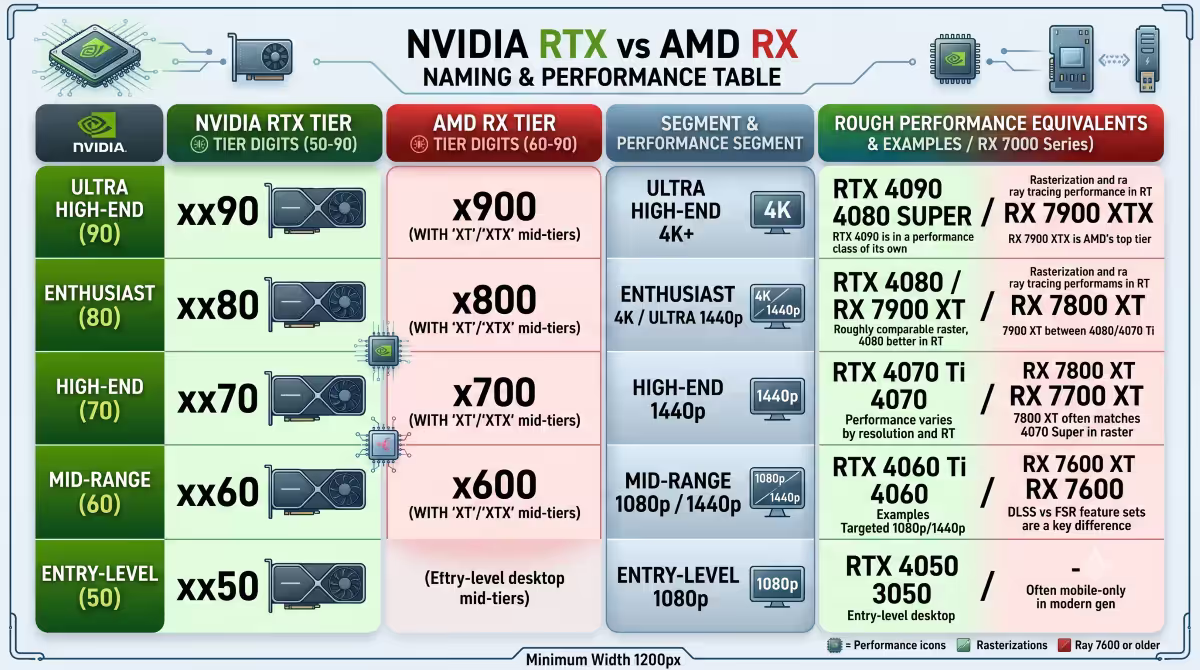
AMD RX naming — Radeon decoded
AMD's consumer Radeon line uses the RX prefix universally:
- RX = Radeon consumer / gaming line
- Radeon Pro = workstation line (for CAD, video editing)
- Radeon W = workstation refresh (last seen on Pro W7900)
- Radeon Instinct / MI = data centre and AI compute
Within RX, the model number follows a similar pattern to NVIDIA:
| Series | Architecture | Year |
|---|---|---|
| RX 6000 (6900, 6800, 6700, 6600) | RDNA 2 | 2020 |
| RX 7000 (7900, 7800, 7700, 7600) | RDNA 3 | 2022 |
| RX 9000 (9070, 9060) | RDNA 4 | 2025 |
Note: AMD skipped the “RX 8000” name for desktop consumer cards. RDNA 4 launched as RX 9000 to align with NVIDIA's tier-90 naming context and signal the architecture jump. This sort of naming gap happens occasionally — Intel did the same skipping Core i7 series numbers historically.
The second and third digits behave like NVIDIA's tier digit — 60/70/80/90 indicate increasing performance class within the generation.
XT and XTX — AMD's step-up suffixes
XT is AMD's equivalent of NVIDIA's Ti. The step-up variant within a tier:
- RX 9070 vs RX 9070 XT — the XT is 15-20% faster
- RX 7800 XT — there's no non-XT 7800 in many regions; the XT is the base
- RX 6700 XT vs RX 6700 — XT is the better-known and more widely stocked variant
XTX is the top-binned premium variant, used sparingly and only on flagship cards:
- RX 7900 XTX — AMD's RDNA 3 flagship
- RX 6900 XT generation — no XTX existed (just XT)
XTX appears only on the highest tier in a generation. It's AMD's “best silicon from the wafer” badge — analogous to NVIDIA's TITAN positioning historically (and the 90-tier today).
Laptop GPU naming — same name, different chip
Laptop GPUs are not the same as desktop GPUs with the same model number. This is the single most confusing aspect of GPU naming and the source of the most common buyer regret.
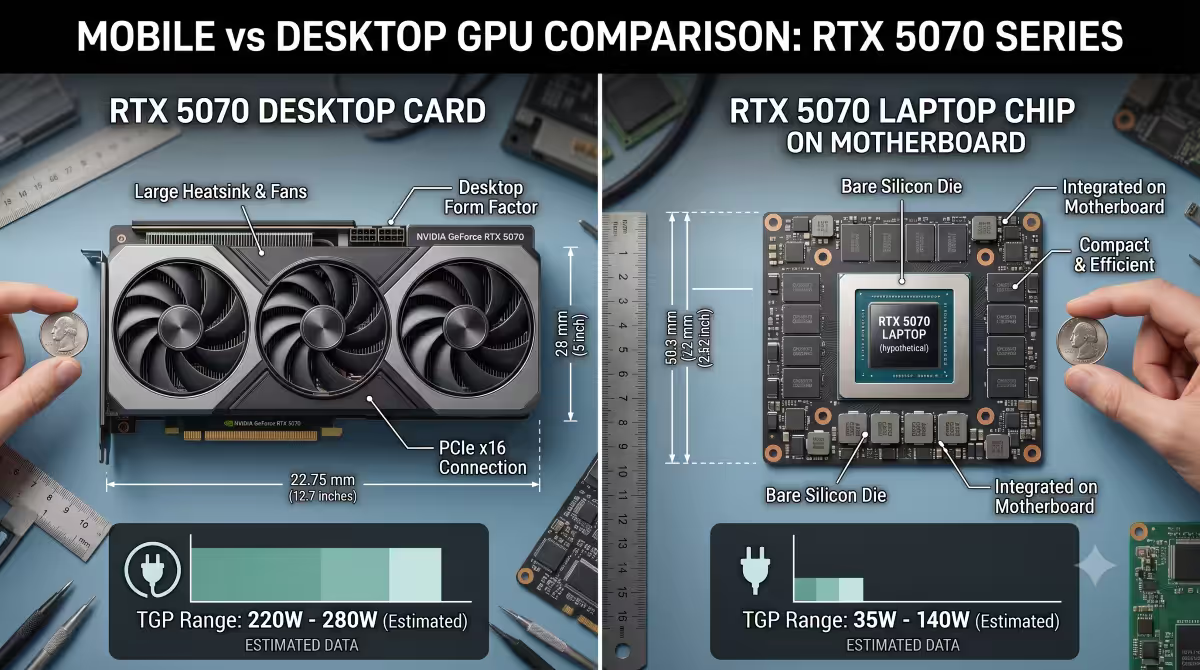
An “RTX 5070 Mobile” or “RTX 5070 Laptop GPU” is a different silicon configuration than the desktop RTX 5070. Typically:
- Mobile silicon is from one tier below — an “RTX 5070 Mobile” often uses the same chip as a desktop RTX 5060 Ti
- Power-limited far below desktop — desktop 5070 = 220W, mobile 5070 = 80-150W (depending on laptop design)
- VRAM may differ — laptop versions often have less VRAM than desktop counterparts
- Memory bus narrower — common cost-saving on mobile
Always check the TGP (Total Graphics Power) rating on a gaming laptop spec sheet, not just the GPU name. An “RTX 5070 Laptop GPU at 150W” performs very differently to an “RTX 5070 Laptop GPU at 90W” — the chip is the same but the power envelope is half.
Rough rule of thumb: a top-tier mobile GPU performs like two desktop tiers below it. A mobile RTX 5080 at 150W TGP is roughly equivalent to a desktop RTX 5060 Ti or 5070. Don't expect desktop-tier performance from a laptop named after it.
Founders Edition vs AIB partners
NVIDIA sells GPUs in two forms:
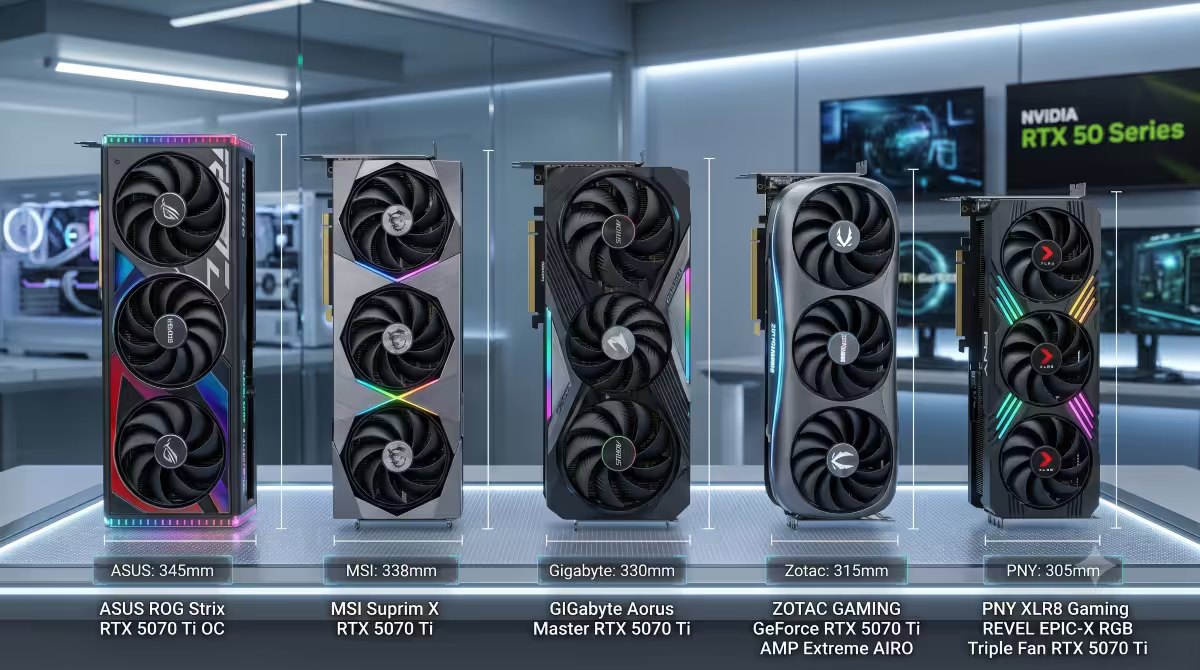
- Founders Edition (FE) — NVIDIA's own-branded reference design. Sleek dual-fan or triple-fan cooler designed in-house, sold direct or via select partners. Reference clocks, reference TDP, premium build quality.
- AIB (Add-in Board) partners — Asus (ROG Strix, TUF), MSI (Suprim X, Gaming X), Gigabyte (Aorus, Gaming OC), Zotac, Palit, Inno3D, PNY, ASRock and historically EVGA. Use NVIDIA's chips but their own coolers, PCBs, power delivery and BIOS.
AIB cards typically:
- Run factory overclocks 3-8% above reference
- Have bigger coolers (often triple-fan, longer length)
- Cost 5-15% more than FE for the high-end variants
- Offer multiple variants per chip (Strix vs TUF vs Prime from Asus, for example)
AMD's equivalent: “reference” cards directly from AMD (rare in SA retail), and “AIB” cards from Sapphire (the closest-to-reference partner), XFX, ASRock, PowerColor, Gigabyte. Sapphire's Nitro+ and PowerColor's Red Devil are the AMD premium lines.
For SA buyers: Founders Edition cards are rarely stocked locally — AIB partner cards dominate the market. Look at Asus, MSI, Gigabyte and Sapphire for the most consistently available premium options at Evetech, Wootware and Rebel Tech.
Historical naming context — why “Ti” and “SUPER”
A bit of useful context for spotting marketing tricks:
“Ti” dates back to the GeForce 2 Ti (2001) — used continuously since then on step-up variants. The name is purely heritage marketing; it stands for Titanium but means nothing technical.
“SUPER” is much newer (2019) — NVIDIA introduced it to compete with AMD's mid-cycle refreshes during the RDNA 2 era. The branding is “super” as in “improved”, not the cape.
Why no GTX 5000: after GTX 16, NVIDIA dropped GTX entirely. There's no GTX 20, 30, 40, 50 — everything from RTX 20 onwards is RTX. GTX 16 was the last GTX line.
Why AMD skipped RX 8000: internal naming alignment with NVIDIA's 90-tier flagship positioning, plus a clear delineation between RDNA 3 (RX 7000) and RDNA 4 (RX 9000) generations. AMD's Hawaii (R9 290) era had similar gaps.
How to read any GPU name in 30 seconds
The fast-read flow when you see any GPU name:
- Brand prefix (RTX / GTX / RX) → ray tracing yes/no, brand
- Generation digit → architecture, age, feature set
- Tier digit(s) → 50/60/70/80/90 = entry/mainstream/upper-mid/high-end/flagship
- Suffix → Ti/SUPER (NVIDIA), XT/XTX (AMD): step-up or refresh variant
- “Laptop” / “Mobile” in the name → completely different chip; check TGP
Test it on:
- RTX 4070 Ti SUPER → ray tracing capable, Ada gen, tier 70 upper-mid, step-up + mid-gen refresh = between 4070 SUPER and 4080
- RX 9070 XT → AMD consumer, RDNA 4 gen, tier 70 upper-mid, step-up variant = AMD's mid-2025 mainstream-enthusiast pick
- RTX 5080 Mobile at 175W → ray tracing, Blackwell gen, tier 80 high-end nameplate, but mobile chip equivalent to desktop 5070/5070 Ti
- GTX 1660 Ti → no ray tracing, GTX 16-series legacy, tier 60 mainstream, step-up — likely budget laptop only at this point
Common GPU naming mistakes
Assuming mobile = desktop. “RTX 5070 Laptop GPU” performs roughly like a desktop RTX 5060 Ti, not a desktop 5070. Always check TGP before judging laptop performance.
Buying “Ti” thinking it's a new generation. RTX 4070 Ti is the same Ada generation as the regular 4070, just a step-up variant. The first digit is the generation; the Ti is the variant.
Mixing up x60 Ti and x70. RTX 4060 Ti and RTX 4070 are not the same performance class. 4060 Ti is a step-up of the 4060 tier; 4070 is one tier higher entirely. The 4070 is meaningfully faster.
Comparing across generations by tier alone. “RTX 5060 vs RTX 4070” is a fair comparison because of the generational uplift. But “RTX 5070 vs RTX 4070” is unfair — the 5070 wins on both generation and tier name match.
Trusting Founders Edition stock claims in SA. FE cards are NVIDIA-direct and rarely warehoused in SA. If a local retailer advertises an FE card at MSRP, verify before paying — most “FE” listings in SA history have actually been AIB cards in plain packaging.
Ignoring the AIB sub-brand. “MSI RTX 5080 Gaming X Trio” and “MSI RTX 5080 Ventus 2X” use the same chip but very different coolers and BIOS. The Gaming X Trio runs cooler, quieter and at higher sustained clocks. Check the AIB model name, not just the chip name.
Key takeaways
- NVIDIA: prefix (RTX/GTX) + generation digit + tier digits + optional Ti / SUPER. AMD: RX + generation + tier + optional XT/XTX.
- Tier matters more than suffix. RTX 5070 → 5080 is much bigger than RTX 5070 → 5070 Ti.
- The x70 Ti tier is consistently the price/performance sweet spot each generation.
- Mobile/laptop GPUs are different chips. Same name, ~2 desktop tiers lower performance. Always check TGP.
- AIB partner sub-brand matters — Asus ROG Strix vs Asus Dual is the same chip but very different cooler, noise and clocks.
Frequently asked questions
What does RTX vs GTX vs TITAN mean?
RTX = ray tracing + tensor cores (2018+, current). GTX = legacy non-RT (last on GTX 16 series). TITAN = legacy prosumer halo line, role now filled by the 90-tier.What does the first digit in an RTX model number mean?
It's the generation. RTX 30 = Ampere (2020), RTX 40 = Ada Lovelace (2022), RTX 50 = Blackwell (2024-2025). Newer generation = newer architecture and features.What does the second/third digit (tier) mean?
Performance class within a generation. 50 = entry, 60 = mainstream, 70 = upper mid, 80 = high-end, 90 = flagship.What is the Ti suffix?
A step-up variant within a tier. Typically 15-25% faster than the base, launched 6-12 months after the base tier.What is the SUPER suffix?
NVIDIA's mid-generation refresh badge (introduced 2019). A SUPER card replaces the base tier at similar price with 10-18% more performance.What's the difference between AMD's XT and XTX suffixes?
XT = step-up variant within a tier (equivalent to NVIDIA's Ti). XTX = top-binned premium variant, only on flagship cards (e.g. RX 7900 XTX).Why do laptop GPUs have lower performance than desktop versions with the same name?
Different chip configuration, lower power envelope. A mobile “RTX 5070” is roughly a desktop 5060 Ti running at 80-150W. Always check TGP rating, not just the name.What does Founders Edition (FE) mean vs AIB partners?
FE = NVIDIA's own-branded reference design. AIB = partner cards (Asus, MSI, Gigabyte, etc.) using NVIDIA chips with custom coolers and modest factory overclocks. AIB dominates the SA market.
Get the Evetech app
Exclusive app-only prices, daily flash sales, and free delivery on orders over R4,000 — download the app and start saving.