GPU Comparison
RTX 5070 vs RTX 5080. — The R11,500 question, answered by your monitor.
Same Blackwell architecture, same DLSS 4, same Frame Generation. What separates them is 4GB of VRAM and an entire resolution tier. Here's which one your build actually needs.
- GB VRAM
- 12 vs 16
- Native target
- 1440p / 4K
- Price gap (SA)
- ~R11,500
Spec comparison at a glance
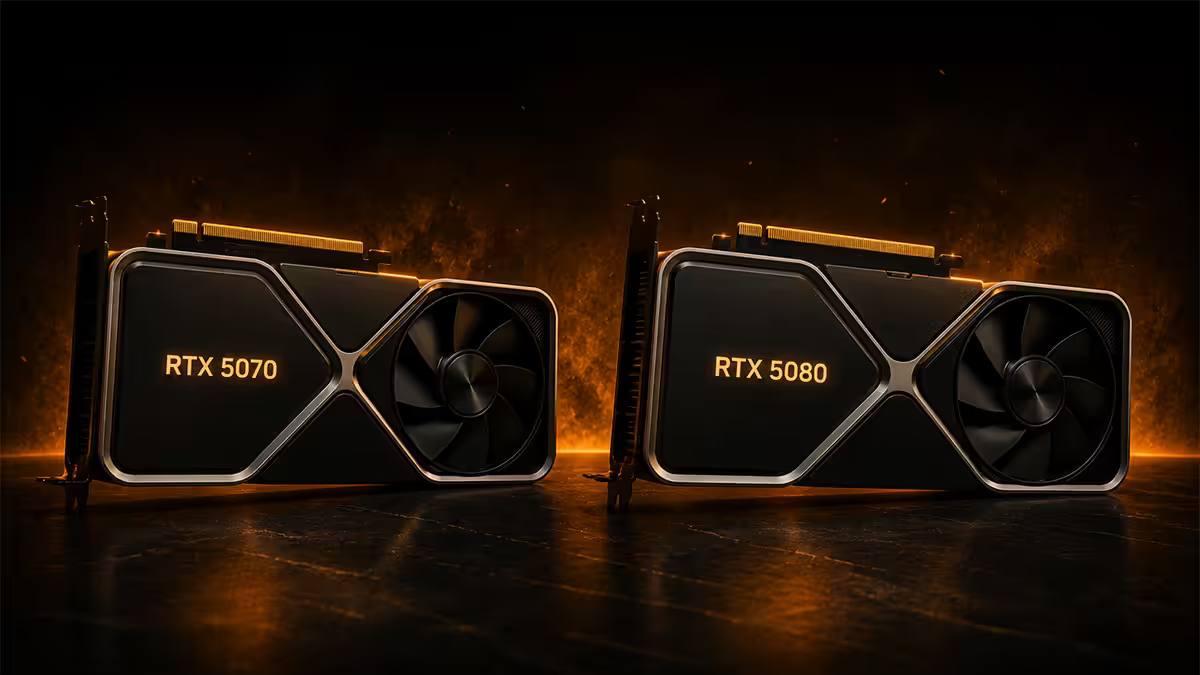
Same Blackwell silicon, different tiers of the GB203 die. Both support DLSS 4 Multi Frame Generation, both use the 12V-2x6 power connector, both will fit in any modern ATX case provided the card length clears your front intake. Where they diverge:
| Spec | RTX 5070 | RTX 5080 |
|---|---|---|
| CUDA cores | 6,144 | 10,752 |
| VRAM | 12 GB GDDR7 | 16 GB GDDR7 |
| Memory bus | 192-bit | 256-bit |
| Memory bandwidth | 672 GB/s | 960 GB/s |
| TGP (power) | 250 W | 360 W |
| PSU recommendation | 750 W | 850-1000 W |
| Card length (FE) | ~305 mm | ~340 mm |
| SA price (May 2026) | R10,000 | R21,500 |
The headline numbers — 10,752 vs 6,144 CUDA cores, 16GB vs 12GB VRAM — set the expectation: this is a tier and a half gap, not a sibling refresh. NVIDIA priced the 5080 firmly above the 5070 Ti rather than just above the 5070, which is part of why the value calculation tilts so heavily on monitor choice.
1440p performance — where the 5070 shines
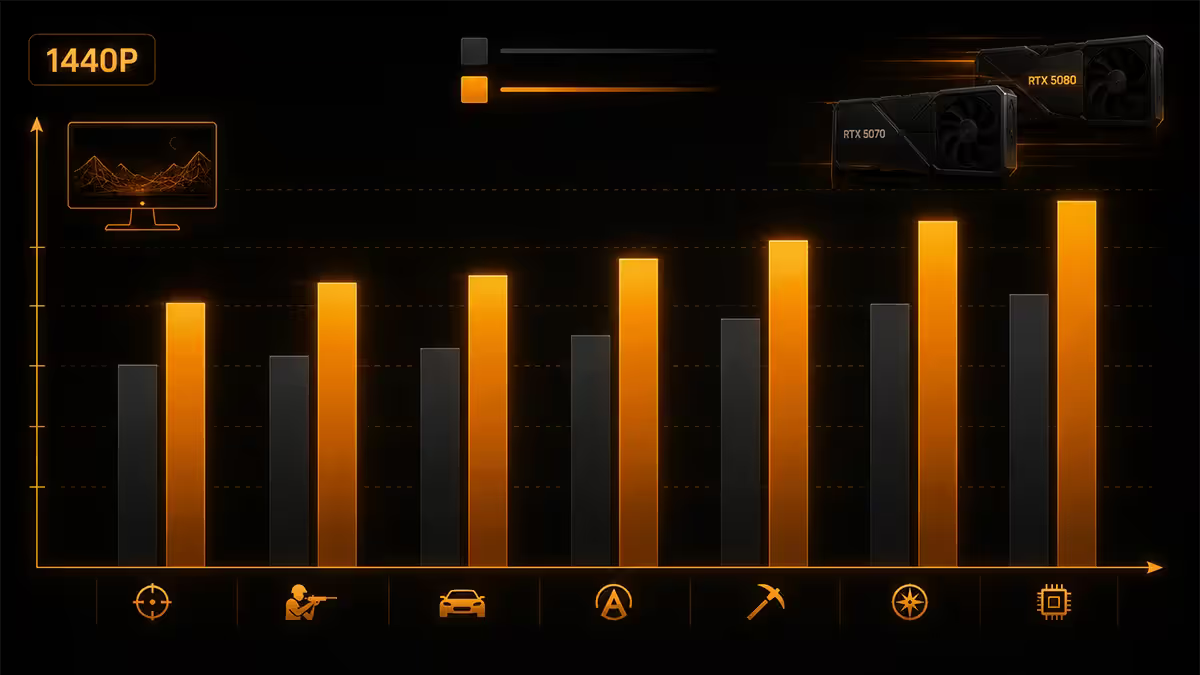
At 1440p, both cards are excellent. The RTX 5070 hits comfortable high-refresh numbers in nearly every modern title; the RTX 5080 hits them with more headroom and lets you crank settings without thinking. The gap is real but not decisive.
Typical native 1440p results, high-ultra settings:
| Title | RTX 5070 (FPS) | RTX 5080 (FPS) |
|---|---|---|
| Cyberpunk 2077 (ultra, no RT) | 108 | 142 |
| Alan Wake 2 (high) | 92 | 128 |
| Hogwarts Legacy (ultra) | 118 | 152 |
| Counter-Strike 2 (max) | 360+ | 450+ |
| Black Myth: Wukong (high) | 96 | 138 |
| The Witcher 4 (ultra) | 88 | 122 |
The RTX 5070 is a native 1440p high-refresh GPU. With DLSS 4 Quality enabled where supported, it pushes well past 144 FPS in almost every title we tested. The 5080 is over-spec for 1440p in the sense that you're paying for headroom you can't see on a 165Hz panel — past 165 FPS the extra frames are buffered and discarded unless you have a 240Hz monitor.
4K performance — where the 5080 earns its premium
At native 4K, the gap widens dramatically. The RTX 5080 enjoys both raw shader throughput and the VRAM headroom to actually use it. The RTX 5070 starts to lean on DLSS upscaling — not because it can't render, but because it can't render fast enough or with enough VRAM to maintain native textures.
Typical native 4K results, high-ultra settings:
| Title | RTX 5070 (FPS) | RTX 5080 (FPS) |
|---|---|---|
| Cyberpunk 2077 (high, no RT) | 52 | 78 |
| Alan Wake 2 (high) | 44 | 68 |
| Hogwarts Legacy (ultra) | 58 | 86 |
| Black Myth: Wukong (high) | 42 | 66 |
| The Witcher 4 (ultra) | 38 | 62 |
At 4K the RTX 5070 needs DLSS Quality or DLSS Performance in most modern titles to hit a stable 60 FPS. DLSS Quality at 4K is excellent and we recommend it — image quality is nearly indistinguishable from native, and the FPS uplift is substantial. DLSS Performance starts to introduce visible artefacts on UI elements and thin geometry.
The RTX 5080 holds native 4K high settings in the 60-90 FPS range across the catalogue, and can use DLSS Quality as a comfort upgrade rather than a necessity. That distinction — DLSS as comfort vs DLSS as crutch — is the real reason to spend the R11,500.
VRAM headroom — the 4GB that matters
12GB vs 16GB of VRAM looks like a small numeric gap until you start playing modern titles at 4K with maxed textures and ray tracing. Several 2025-2026 releases (Indiana Jones and the Great Circle, Hogwarts Legacy with HD textures, Cyberpunk Phantom Liberty at 4K + RT) exceed 12GB and force texture pool reduction on the 5070.
What happens when a GPU runs out of VRAM:
- Textures stream in slowly (visible "popping" as low-res placeholders swap to high-res).
- Stuttering on geometry-heavy scenes as the driver swaps assets through the PCIe bus.
- Forced settings downgrade — the game silently drops to "high" textures when you set "ultra".
- In rare cases, a hard crash if the VRAM exhaustion is severe.
For 2026 titles at 1440p, 12GB is comfortable. For 2026 titles at 4K, 12GB is tight on the most demanding releases. For 2028 titles, the 16GB on the 5080 will age noticeably better at 4K — this is where the "future-proof" argument has actual weight, not the usual marketing spin.
Ray tracing — where the gap really shows
Ray tracing scales with everything: shaders, ray-traced cores, memory bandwidth and VRAM. The RTX 5080 wins on all four counts. The result is a ray-tracing experience that crosses a quality threshold the RTX 5070 can approach but rarely match.
Path tracing at 4K with DLSS Quality + Frame Generation:
- RTX 5080: Cyberpunk path-traced runs 55-65 FPS. Alan Wake 2 path-traced runs 50-58 FPS. Genuinely playable.
- RTX 5070: Cyberpunk path-traced needs DLSS Performance + Frame Generation to hit 50-55 FPS. Image quality degrades noticeably. Playable, not pretty.
For ray-traced gaming as a primary focus, the RTX 5080 is the right card. For ray-traced gaming as an occasional treat (you turn it on for screenshots and showcase scenes, but mostly play at high-no-RT), the RTX 5070 is fine.
CPU and monitor pairing
The right CPU and monitor matter as much as the GPU choice itself. Mismatch either and you're paying for performance you can't see.
CPU pairing
- RTX 5070 sweet spot: Ryzen 7 9700X (R6,800) or Ryzen 7 9800X3D (R10,500). Intel Core Ultra 7 265K (R9,500) is equivalent. Don't pair with anything older than Ryzen 5000-series or 13th-gen Intel — you'll bottleneck at 1440p.
- RTX 5080 sweet spot: Ryzen 7 9800X3D (R10,500) or Ryzen 9 9900X3D (R12,500) for hybrid gaming/productivity. Core Ultra 9 285K (R14,500) for pure productivity emphasis. The 5080 deserves a top-tier CPU; pairing it with a Ryzen 5 7600 wastes a meaningful chunk of its 1440p/4K potential.
Monitor pairing
- RTX 5070: 1440p 165Hz IPS or OLED is the ideal match. Best-fit panels under R10,000 include the LG 27GP850 (1440p 180Hz), MSI MAG 274QRF QD (1440p 170Hz), and several 1440p OLEDs from Samsung and LG in the R13,000-R17,000 bracket.
- RTX 5080: Either a 4K 144Hz IPS/OLED, or a 1440p 240Hz QD-OLED if you prioritise smoothness over resolution. The 5080 has the throughput to make 4K 144Hz native a real experience rather than a marketing target.
The verdict — which card is right for you
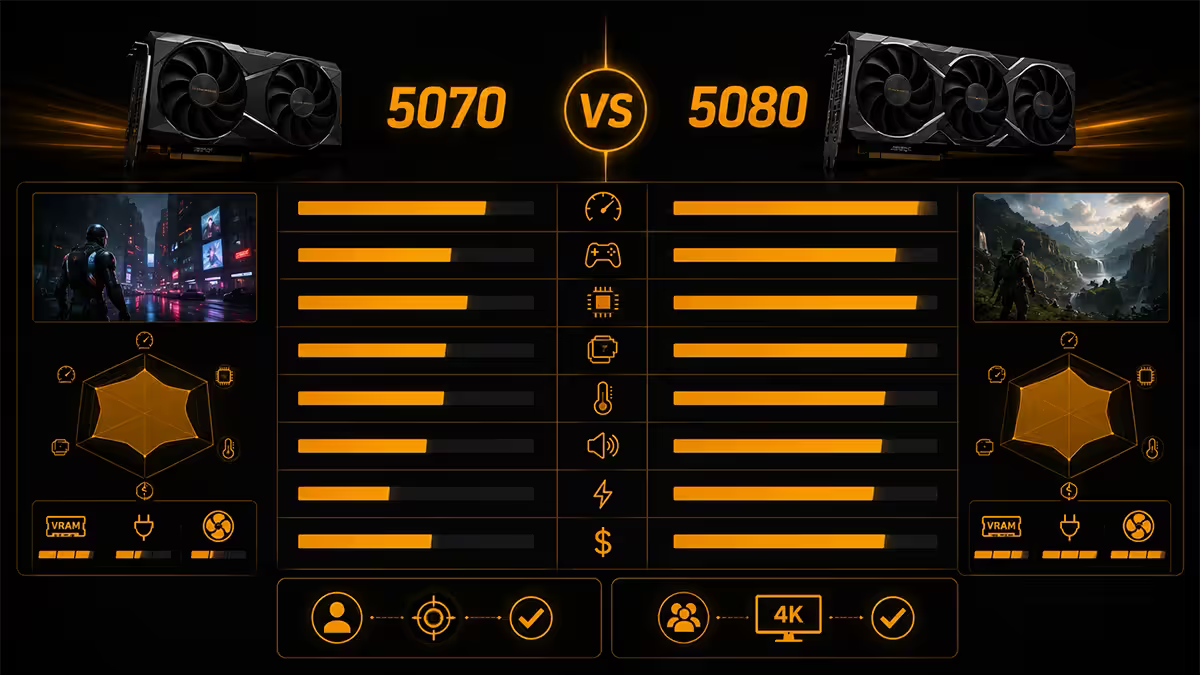
If we had to compress the decision into a 30-second answer, it would be this:
Choose the RTX 5070 (R10,000) when:
- Your monitor is 1440p — current or planned within 18 months.
- You want a high-refresh 1440p gaming experience at high-ultra settings without DLSS dependency.
- You'd rather spend the R11,500 saving on a faster CPU, better monitor, or more storage.
- Ray tracing is "nice to have" rather than a primary purchase criterion.
Choose the RTX 5080 (R21,500) when:
- Your monitor is 4K — current or planned within 18 months.
- You play AAA titles with ray tracing or path tracing as a regular gameplay setting.
- You do 3D rendering, video editing or local AI work that benefits from 16GB VRAM.
- You want to skip an upgrade cycle — the 5080 will be capable at 4K for 4-5 years.
Key takeaways
- The RTX 5070 (R10,000) is a 1440p high-refresh card — comfortable 12GB VRAM, 144+ FPS in most modern AAA titles.
- The RTX 5080 (R21,500) is a 4K-native card with 16GB VRAM and the ray-tracing throughput to keep up.
- Average 4K gap is 38-48% in favour of the 5080. At 1440p it shrinks to 22-28% — measurable but less decisive.
- Pair the RTX 5070 with a Ryzen 7 9800X3D and 1440p 165Hz monitor. Pair the RTX 5080 with the same CPU and a 4K 144Hz panel.
- The R11,500 premium buys VRAM comfort and the freedom to ignore upscaling — not raw FPS alone.
Frequently asked questions
Is the RTX 5080 worth R11,500 more than the RTX 5070?
Only if you game at 4K or plan to. At native 4K the 5080 is 38-48% faster; at 1440p the gap is 22-28%. If your monitor is 1440p with no 4K upgrade planned, the 5070 is the better value.Is 12GB VRAM enough for the RTX 5070?
For 1440p yes, comfortably. For 4K with maxed textures and RT, it's tight in 2026 titles and will get tighter over the next 2-3 years. 16GB on the 5080 has more headroom.What PSU do I need for RTX 5070 vs RTX 5080?
RTX 5070 250W TGP — 750W PSU minimum. RTX 5080 360W TGP — 850-1000W PSU. Both use 12V-2x6; ATX 3.1 PSU avoids the adapter.Can the RTX 5070 do ray tracing at 4K?
Only with DLSS Performance plus Frame Generation, and visible artefacts appear. RT at 4K is the 5080's territory; the 5070 is best at RT-on for 1440p.Will the RTX 5070 bottleneck a Ryzen 7 9800X3D?
No — it's a near-ideal pairing at 1440p, perfectly balanced at 4K. The 5080 also pairs well with the 9800X3D.DLSS 4 Frame Generation — does it close the gap between the cards?
Frame Gen multiplies frames but cannot create VRAM. At 4K the 5070 hits VRAM limits before MFG can help. The 5080 doesn't need MFG to stay smooth.Which is better for productivity — Blender, video editing, AI?
The 5080 is meaningfully ahead — 16GB matters for 4K video timelines, larger Blender scenes and local AI models. For hobbyist creator work, the 5070's 12GB is fine.Should I wait for the RTX 5070 Ti instead?
The 5070 Ti (16GB, ~R16,500) is the sensible middle ground if 4K with DLSS Quality is your target but R21,500 is too much. 18-22% faster than the 5070, 18-22% slower than the 5080.
Get the Evetech app
Exclusive app-only prices, daily flash sales, and free delivery on orders over R4,000 — download the app and start saving.