GPU Comparison Guide
RTX 5060 Ti vs RTX 5070. — Is the Ti enough?
The Ti has more VRAM than the card above it. The 5070 has more raw power. A R1,800 gap separates them, and the answer flips depending on what you actually play.
- VRAM (Ti larger)
- 16GB vs 12GB
- 5070 FPS uplift
- +20% raw
- price gap
- R1,800
The counter-intuitive VRAM situation
Normally you'd expect a higher-tier card to have more of everything — more shaders, more RT cores, more memory. NVIDIA's 50-series breaks that pattern between the 5060 Ti and 5070:
- RTX 5060 Ti — 16GB GDDR7 on a 128-bit memory bus (eight 16Gb chips)
- RTX 5070 — 12GB GDDR7 on a 192-bit memory bus (six 16Gb chips)
Why this happens: at current GDDR7 chip density (16Gb per chip), the 5060 Ti's 128-bit bus naturally lands at 16GB (8 chips × 2GB) and the 5070's 192-bit bus naturally lands at 12GB (6 chips × 2GB). The 5070 has higher bandwidth (192-bit × faster clock) but less total capacity. NVIDIA could ship the 5070 with 24GB by using two chips per channel (“clamshell mode”), but they don't — it would cost more and overlap with the 5070 Ti / 5080.
The practical result: the lower-tier 5060 Ti has more total VRAM than the higher-tier 5070. For most games this doesn't matter — but for the edge cases where it does, the 5060 Ti has a real advantage.
Pure compute comparison
| Spec | RTX 5060 Ti | RTX 5070 |
|---|---|---|
| Architecture | Blackwell | Blackwell |
| CUDA cores (shaders) | 4,608 | 5,888 (+28%) |
| RT cores | 22 | 28 (+27%) |
| Tensor cores | 144 | 184 (+28%) |
| Base / boost clock | 2,572 / 2,572 MHz | 2,325 / 2,512 MHz |
| VRAM | 16 GB GDDR7 | 12 GB GDDR7 |
| Memory bus | 128-bit | 192-bit |
| Memory bandwidth | 448 GB/s | 672 GB/s (+50%) |
| TGP | 180W | 250W |
| Recommended PSU | 650W | 750W |
The 5070 leads on every core metric except VRAM capacity. The ~28% more shader/RT/Tensor cores plus the +50% memory bandwidth combine to give the 5070 roughly 18-22% higher gaming performance in compute-bound scenarios.
Real-world per-game FPS (1440p high)
All benchmarks at 1440p, native resolution, high settings (not maxed), without DLSS upscaling. CPU pairing: Ryzen 7 9800X3D + 32GB DDR5-6000.
| Game | 5060 Ti 16GB | 5070 12GB | Δ |
|---|---|---|---|
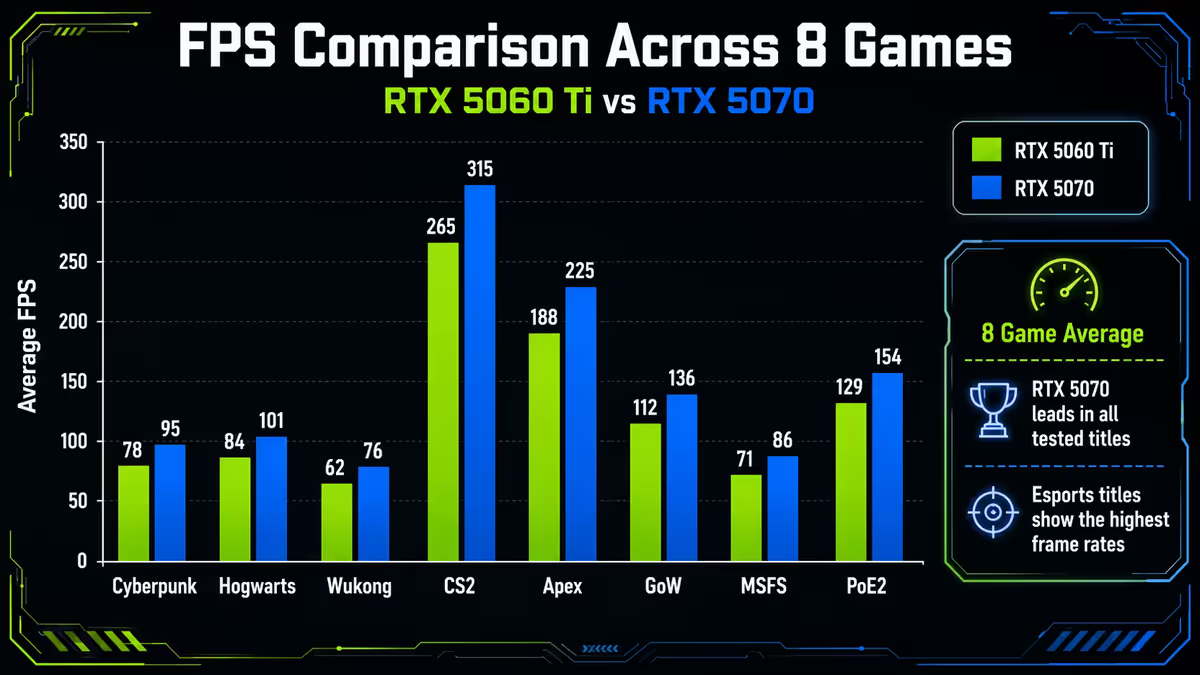
| Cyberpunk 2077 (1440p High) | 78 FPS | 92 FPS | +18% |
| Hogwarts Legacy (1440p High) | 95 FPS | 110 FPS | +16% |
| Black Myth Wukong (1440p High) | 68 FPS | 82 FPS | +21% |
| Counter-Strike 2 (1440p Comp) | 385 FPS | 448 FPS | +16% |
| Apex Legends (1440p High) | 198 FPS | 235 FPS | +19% |
| God of War Ragnarök (1440p High) | 102 FPS | 122 FPS | +20% |
| Microsoft Flight Sim 2024 (1440p) | 62 FPS | 74 FPS | +19% |
| Path of Exile 2 (1440p High) | 120 FPS | 148 FPS | +23% |
Across the board, the 5070 holds a 16-23% lead at 1440p — consistent with the spec difference. Both cards comfortably exceed 60 FPS at 1440p in current AAA; the 5070 hits more aggressive 100-144 FPS targets in more titles.
Memory bandwidth — the 5070's underrated edge
VRAM capacity gets the headlines, but memory bandwidth is the metric that matters most for gaming frame rates. The 5070's 192-bit bus delivers 672 GB/s vs the 5060 Ti's 448 GB/s — a 50% advantage.
This bandwidth difference shows up most in:
- High-resolution rendering — more pixels = more bandwidth needed
- Ray tracing — RT generates enormous random memory accesses
- DLSS Frame Generation — motion vectors and frame buffers consume bandwidth
- High texture quality — bigger textures need to stream through the bus
The 5060 Ti's 16GB VRAM is excellent for storing assets, but the 128-bit bus becomes a bottleneck pumping them to the GPU cores at high frame rates. Bandwidth is why the 5070 wins in most scenarios despite having less total VRAM.
Ray tracing performance
Ray tracing widens the 5070's lead — the +28% RT cores plus the bandwidth advantage compound:
| Game (RT enabled, 1440p) | 5060 Ti | 5070 | Δ |
|---|---|---|---|
| Cyberpunk 2077 RT Ultra (DLSS Quality) | 52 FPS | 68 FPS | +31% |
| Alan Wake 2 RT High (DLSS Balanced) | 58 FPS | 74 FPS | +28% |
| Black Myth Wukong RT Very High | 42 FPS | 54 FPS | +29% |
| Hogwarts Legacy RT Ultra | 62 FPS | 78 FPS | +26% |
| Cyberpunk Path Tracing (DLSS Performance + FG) | 68 FPS | 92 FPS | +35% |
DLSS 4 Frame Generation closes the absolute FPS gap somewhat — both cards can hit playable RT frame rates with FG enabled. But the relative performance gap remains 25-35% in favour of the 5070 across ray-traced workloads.
When 16GB VRAM actually matters
The 5060 Ti's VRAM advantage isn't theoretical — there are specific scenarios where 12GB starts choking the 5070:
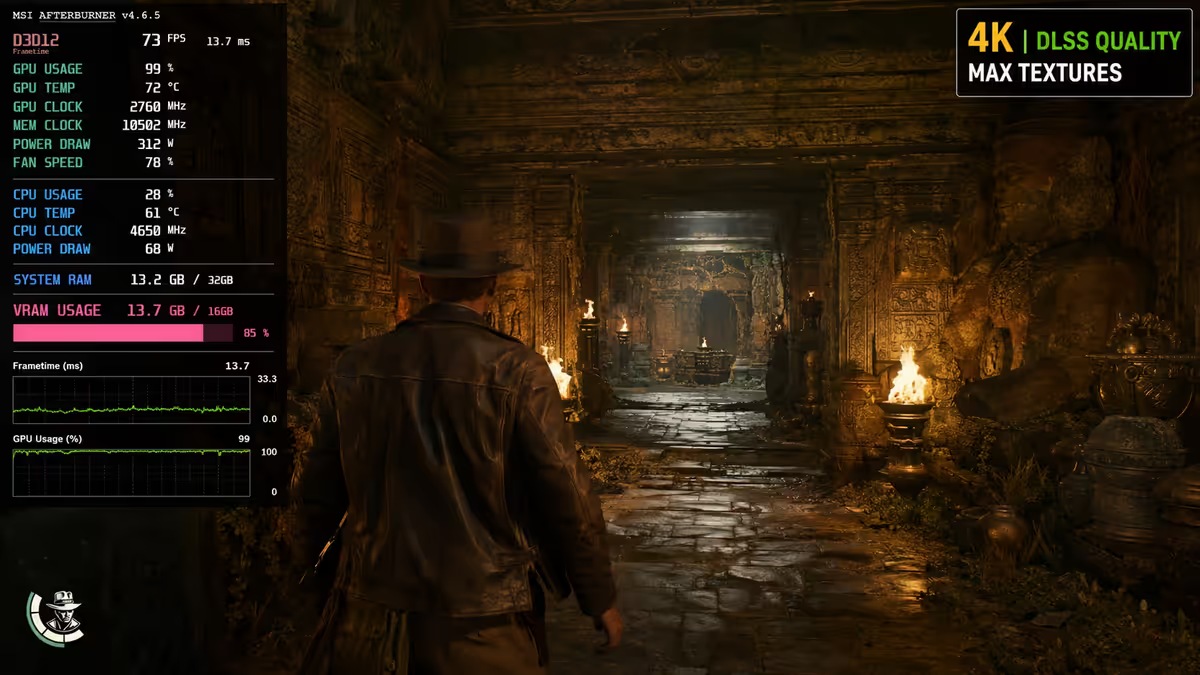
- 4K + DLSS + maxed textures. Recent AAA titles (Indiana Jones and the Great Circle, The Last of Us Part II PC, Alan Wake 2) consume 13-14GB at 4K-with-DLSS at maxed textures. The 5070's 12GB hits its ceiling; the 5060 Ti's 16GB has headroom.
- Modded games. Skyrim VR, Cyberpunk overhaul mods, Fallout 4 high-res texture packs frequently push past 12GB.
- Productivity workloads with GPU acceleration. DaVinci Resolve, Blender, Stable Diffusion large-model inference — VRAM-capacity-bound. 16GB lets you load larger AI models locally.
- Future-proofing 2027-2028 titles. The 4060 Ti vs 4070 12GB debate from 2024 has played out: by 2026, 12GB is showing tightness in some new AAA at maxed textures. The pattern is likely to repeat with 5070 12GB by 2028.
When the 5070's raw power wins
Most of the time, the 5070 wins:
- 1440p high-refresh gaming — 100-144 FPS targets where every extra frame matters
- Competitive esports — CS2, Valorant, Apex at high refresh rates
- Ray tracing at any resolution — 25-35% faster in RT workloads
- Path tracing with DLSS Frame Generation — the bandwidth + tensor advantage matters
- 1080p gaming where you'd rather just have raw FPS — VRAM never the bottleneck at 1080p
- Production workloads like real-time 3D rendering, Blender viewport — compute-bound
For pure 2026 gaming performance, the 5070 is straightforwardly the better card. The 5060 Ti is a strategic VRAM bet, not a performance bet.
Power consumption and PSU requirements
The 5060 Ti is significantly cheaper to run and easier to cool:
| Metric | RTX 5060 Ti | RTX 5070 |
|---|---|---|
| TGP (total graphics power) | 180W | 250W (+39%) |
| Peak transients | ~210W | ~290W |
| Idle | ~12W | ~14W |
| Recommended PSU (system) | 650W 80+ Gold | 750W 80+ Gold |
| Power connector | 1× 8-pin or 12V-2x6 | 1× 12V-2x6 (16-pin) |
| Cooler size | 2-slot dual-fan | 2-2.5 slot dual/triple-fan |
| Case fit | SFF/mid-tower friendly | Mid/full tower |
For small form factor (SFF) builds, the 5060 Ti is meaningfully easier to live with — shorter cards, lower power draw, less heat to dump out of a small case. The 5070 fits SFF too but is closer to the edge of what compact cases handle gracefully.
SA pricing — May 2026
| Card / variant | SA price band | Notes |
|---|---|---|
| RTX 5060 Ti 16GB (base AIB) | R8,300-R8,700 | Gigabyte Eagle, MSI Ventus, Inno3D Twin X2 |
| RTX 5060 Ti 16GB (premium AIB) | R8,800-R9,500 | ASUS TUF, MSI Gaming Trio, Gigabyte Gaming OC |
| RTX 5070 (base AIB) | R10,200-R10,800 | Gigabyte Eagle, MSI Ventus, PNY VERTO |
| RTX 5070 (premium AIB) | R10,800-R11,800 | ASUS TUF, MSI Gaming Trio, Gigabyte Aero |
| RTX 5070 (flagship AIB) | R12,000-R13,500 | ASUS ROG Strix, MSI Suprim X, Gigabyte AORUS Master |
| Price gap (base to base) | ~R1,800-R2,000 | — |
The buying decision flow
A pragmatic walk-through for the typical SA buyer:
Pick the RTX 5070 if:
- 1440p high-refresh gaming is your primary goal (144Hz+ targets)
- You play ray-tracing-heavy AAA at maxed settings
- You want the most FPS you can get for the budget — pure performance question
- Your case can handle 250W heat dump comfortably
- You're upgrading from a 3060/3060 Ti generation
Pick the RTX 5060 Ti 16GB if:
- VRAM headroom matters more than raw FPS — modded games, 4K-with-DLSS, future-proofing
- You build SFF or value low power draw
- You do GPU-accelerated productivity (Blender, DaVinci, Stable Diffusion local inference)
- You're targeting 1440p high settings (not chasing ultra)
- The R1,800 saved goes to a better CPU, SSD, monitor or other system upgrade
Skip both and stretch budget if:
- You're targeting 4K native — both cards are 1440p tier, neither is genuine 4K
- You want path-traced gaming at high frame rates — the 5070 Ti or 5080 is the next step
- You're a content creator who wants 4K timeline scrubbing in Resolve — 5070 Ti minimum
Common mistakes
Buying RTX 5060 Ti 8GB and thinking it's the same card. The 8GB variant exists, is cheaper, and is genuinely a much worse buy. Always confirm the “16GB” badge.
Picking the 5060 Ti for 4K because of the 16GB. 16GB doesn't help if the GPU compute is too slow for 4K to begin with. Both cards are 1440p tier; for 4K, go 5070 Ti minimum.
Underspeccing the PSU. The 5070 draws 250W TGP with 290W peak transients. A 550W PSU paired with an X3D Ryzen will trip during gaming spikes. 750W minimum, 850W comfortable.
Buying flagship-tier custom AIB variants of either card. The R12,500+ ASUS ROG Strix or MSI Suprim X 5070 add maybe 3% performance over a base R10,500 model. Save the R2,000 for a better monitor or storage.
Pairing 5070 with a CPU bottleneck. Don't pair a 5070 with a Ryzen 5 5500 — you'll lose 30% of the 5070's FPS to CPU bottleneck. Minimum CPU pairing: Ryzen 5 7600 / Core Ultra 5 235K.
Key takeaways
- The 5060 Ti has MORE VRAM (16GB) than the 5070 (12GB) — NVIDIA segmentation quirk.
- 5070 is ~20% faster at 1440p, ~25-35% faster in ray tracing. Memory bandwidth +50%.
- 5060 Ti's 16GB matters for modded games, 4K-with-DLSS maxed textures, future-proofing.
- SA pricing: 5060 Ti R8,500 vs 5070 R10,500 — R1,800 gap, smaller than 5060→5070.
- Default pick is 5070. Pick 5060 Ti only if VRAM headroom is your specific concern.
Frequently asked questions
Why does the RTX 5060 Ti have more VRAM than the 5070?
Bus-width / chip-density math: 5060 Ti's 128-bit bus lands at 16GB (8×2GB), 5070's 192-bit bus lands at 12GB (6×2GB). 5070 has more bandwidth, less capacity.Which is faster — RTX 5060 Ti or RTX 5070?
RTX 5070 — about 18-22% faster at 1440p in GPU-bound scenarios, 25-35% faster in ray tracing.When does the 5060 Ti's 16GB VRAM actually matter?
4K-with-DLSS and maxed textures, ray-tracing scenes, modded games, future-proofing for 2027-2028 AAA titles.What's the price difference between RTX 5060 Ti and RTX 5070 in SA?
R1,800-R2,200 in May 2026. 5060 Ti ~R8,500, 5070 ~R10,500. Premium AIBs push higher.Should I get the 5060 Ti or 5070 for 1440p gaming?
5070 by default for 1440p high-refresh gaming. 5060 Ti only if VRAM headroom is your specific concern.Can the RTX 5060 Ti handle 4K gaming?
Marginal at 4K with DLSS — playable Medium-High but not native 4K. Both cards are really 1440p tier.What PSU do I need for RTX 5060 Ti vs RTX 5070?
5060 Ti — 650W 80+ Gold. 5070 — 750W 80+ Gold. Overspec slightly (750W and 850W) for X3D Ryzen pairings.How does ray tracing performance compare?
5070 leads by 25-35% in ray-traced scenarios — more RT cores plus higher bandwidth. Both benefit from DLSS 4 Frame Generation.
Get the Evetech app
Exclusive app-only prices, daily flash sales, and free delivery on orders over R4,000 — download the app and start saving.