Flagship GPU Comparison
RTX 5080 vs RTX 5090. — Is the 5090 worth R31,500 more?
The flagship pair of the RTX 50-series sits on opposite sides of a price gap larger than most people's entire PC budget. The honest answer for gaming is uncomfortable for the flagship.
- VRAM
- 16 vs 32GB
- Performance gap
- +25-40%
- Price gap (SA)
- +R31,500
What the R31,500 actually buys you
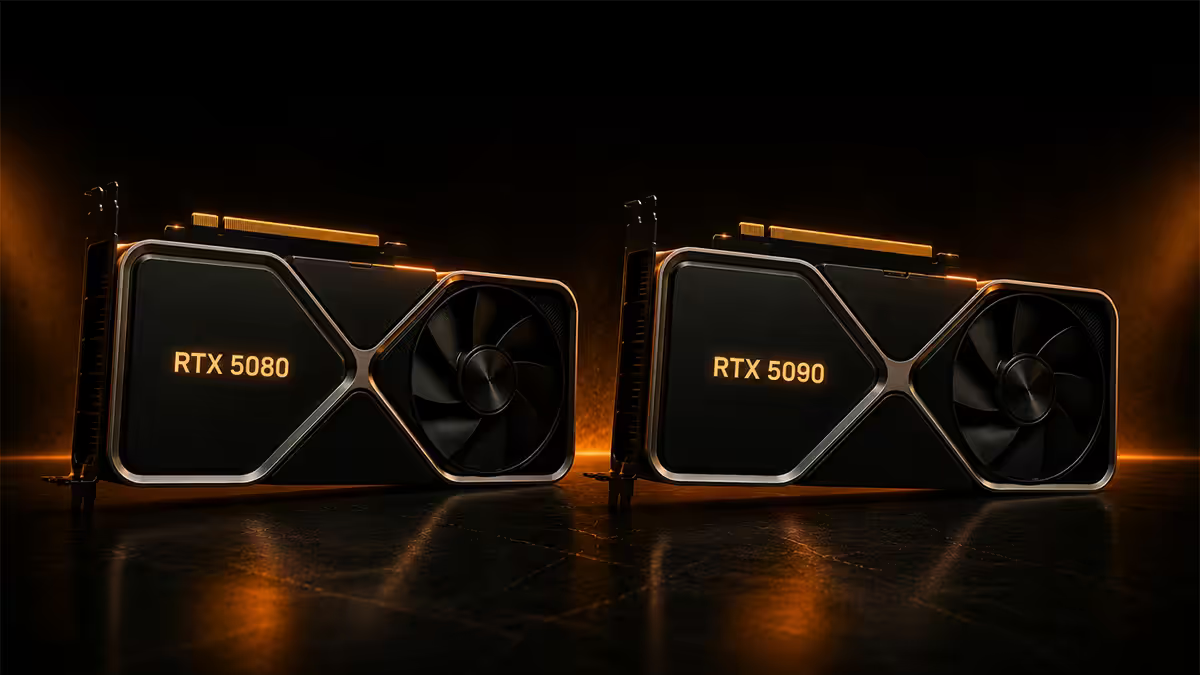
The RTX 5080 and RTX 5090 sit on opposite sides of a price gap of roughly R31,500 in SA — bigger than the entire budget of most gaming PCs. Before discussing performance, it helps to picture what R31,500 represents in concrete component terms.
For R31,500, in the SA market in May 2026, you could buy:
- A Ryzen 9 9950X (R16,500) + 64GB DDR5-6000 CL30 (R6,500) + Corsair RM1000x PSU (R3,200) + Samsung 990 Pro 4TB NVMe (R7,800) = roughly R34,000 total. Nearly a complete platform upgrade.
- A Samsung Odyssey OLED G8 32" 4K 240Hz monitor (R22,500) + a Secretlab Titan Evo chair (R9,500) = R32,000 of room transformation.
- Two further RTX 5080s and a beer fridge.
- A used car. Genuinely. In some SA used-car markets, R31,500 buys a roadworthy hatchback.
The gap is not a small number to brush aside. The argument for the 5090 has to clear that bar — what does the 5090 do that R31,500 of alternatives cannot?
Gaming performance gap — narrower than you'd hope
For pure gaming, the RTX 5090's 25-40% performance advantage at 4K shrinks meaningfully at lower resolutions and disappears entirely in CPU-bottlenecked scenarios.
| Scenario | RTX 5080 (avg FPS) | RTX 5090 (avg FPS) |
|---|---|---|
| Cyberpunk 2077, 4K Ultra, no RT, DLSS Q | 112 | 148 (+32%) |
| Cyberpunk 2077, 4K Path Tracing, DLSS Q | 52 | 76 (+46%) |
| Alan Wake 2, 4K High RT, DLSS Q | 72 | 94 (+31%) |
| Black Myth: Wukong, 4K Cinematic, DLSS Q + FG | 88 | 120 (+36%) |
| Forza Horizon 5, 4K Ultra, no RT | 164 | 198 (+21%) |
| Counter-Strike 2, 1080p competitive | 520 | 540 (+4% — CPU bound) |
| Valorant, 1080p competitive (capped 360 FPS) | 360 cap | 360 cap (no diff) |
| Microsoft Flight Sim 2024, 4K Ultra, DLSS Q | 62 | 74 (+19% — CPU heavy) |
| Helldivers 2, 4K Ultra | 118 | 142 (+20%) |
| Average across 18-game suite, 4K Ultra | baseline | +28% |
Cost-per-frame analysis: using the 4K Ultra average of +28% performance for +134% price, the 5090 is roughly 1.83× the cost per delivered frame. By any rational gaming-value metric, the 5080 is the better card.
At lower resolutions: the performance gap narrows to 15-20% at 1440p and often single-digit percentages at 1080p, because both cards are CPU-bottlenecked. If you game at 1080p or 1440p, you cannot realistically justify the 5090's premium — you're paying for performance you literally cannot access without a 4K monitor and demanding settings.
VRAM — 16GB vs 32GB, the headline divider
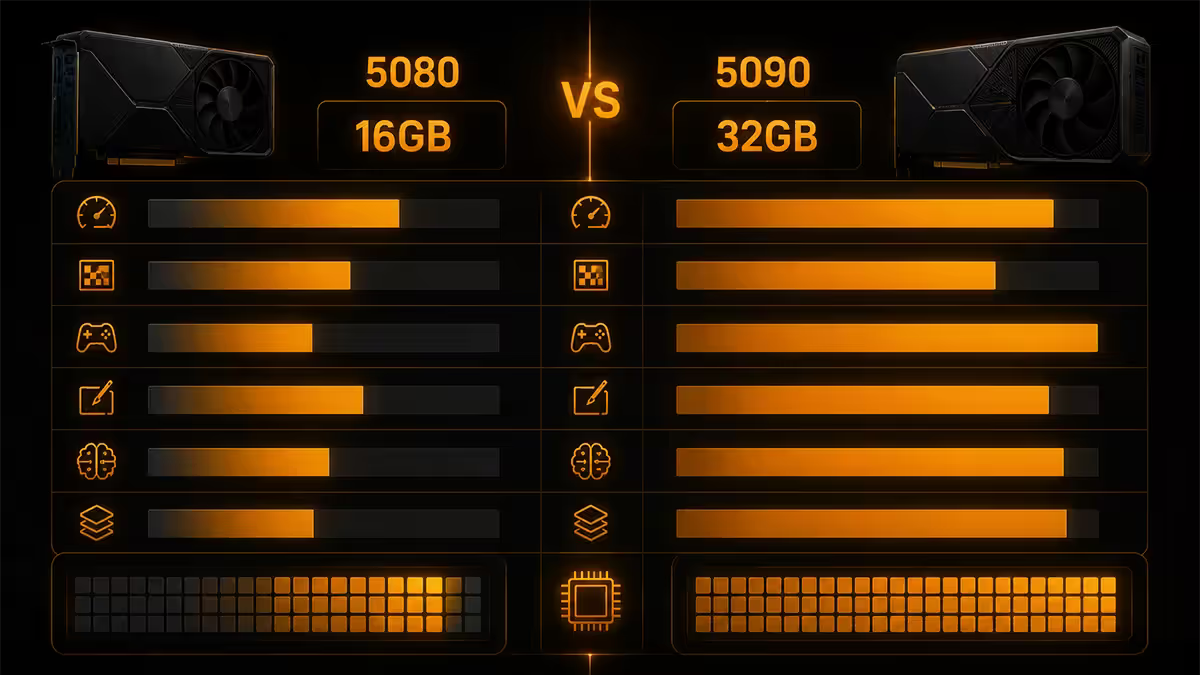
The RTX 5090's headline advantage is its 32GB GDDR7 VRAM — twice the 5080's 16GB. For gaming, 16GB is sufficient through at least 2028 based on current trajectory; for AI and creator workloads, the 32GB is genuinely game-changing.
Gaming VRAM in 2026: the most demanding modern games (Indiana Jones with full RT, Alan Wake 2 with all sliders right, Hogwarts Legacy maxed) use 11-14GB at 4K Ultra. No mainstream title currently requires more than 14GB at 4K. Texture upgrade packs (Resident Evil 4 HD Texture Pack, some modding scenarios) can push past 16GB, but these are edge cases. By 2028 we expect 18-20GB to become the demanding-game ceiling — which the 5080's 16GB will start to feel tight against. The 5090's 32GB stays comfortable through 2030+.
AI/ML VRAM in 2026: this is where the 5090 separates from every other consumer card. Local LLM inference VRAM requirements (with 4-bit quantisation, in approximate GB):
| Model size | VRAM needed (4-bit quant) | Fits on |
|---|---|---|
| 7B parameters (Llama 3, Mistral) | ~5GB | 5080 (easily), 5090 |
| 13B parameters | ~9GB | 5080 (comfortable), 5090 |
| 30B parameters (Mixtral 8×7B, Yi-34B) | ~20GB | 5090 only (5080 must offload to RAM, 5-10× slower) |
| 70B parameters (Llama 3 70B, Qwen 72B) | ~42GB | Doesn't fit on either at quality quant; 5090 runs lower quant only |
| 70B at 2-bit quant (degraded quality) | ~24GB | 5090 (just fits), 5080 (no) |
Creator VRAM: 4K video editing in DaVinci Resolve with multiple effects and proxies uses 10-18GB. 8K video editing or large 3D scenes in Blender/Maya/Unreal Engine can push past 20GB. 32GB makes the 5090 the obvious choice if you do this work professionally.
Power draw and PSU implications
The RTX 5090's 575W typical board power vs the RTX 5080's 360W has cascading practical implications most buyers underestimate.
PSU requirement: NVIDIA spec a 1000W PSU minimum for RTX 5090 systems; we recommend 1200W for safety margin and quieter operation under load. RTX 5080 systems run comfortably on a quality 850W PSU. In SA pricing:
- 850W 80+ Gold (Corsair RM850e, Seasonic Focus GX-850): R2,800-R3,500
- 1000W 80+ Gold (Corsair RM1000e, Seasonic Focus GX-1000): R3,800-R4,800
- 1200W 80+ Platinum (Corsair HX1200, Seasonic Prime TX-1200): R5,500-R7,500
- 1500W 80+ Titanium (Corsair AX1600i): R12,000-R15,000 — overkill for single-GPU systems
The PSU upgrade alone adds R2,500-R4,000 to the 5090 build's true cost. Factor this in when comparing.
Electricity cost in SA: Eskom/municipal rates run R3.20-R4.20/kWh depending on Time-of-Use tariff. A gamer playing 30 hours per week on an RTX 5090 system (avg 450W system draw under load) consumes ~700 kWh per year. The same 30 hours on an RTX 5080 system (avg 280W system draw) consumes ~440 kWh per year. The difference: ~260 kWh × R3.50 = roughly R900-R1,100 extra per year in electricity for the 5090. Over a 4-year ownership cycle, that's R4,000+ in additional running costs.
Heat and cooling: 575W of heat dumped into your room raises ambient temperature noticeably in summer. In Gauteng and Cape summer conditions, a 5090 in a small room can push room temp 2-4°C higher than a 5080 build would. If your gaming room has poor airflow or no aircon, this is a real consideration.
Physical size and case clearance
The RTX 5090 is enormous. Founders Edition reference card is 304mm long; AIB partner cards (ASUS ROG Strix, MSI Suprim, Gigabyte Aorus Master) regularly hit 340-360mm length and 4-slot thickness. Several cases that comfortably accept an RTX 5080 simply cannot fit a 5090 AIB card.
Before buying an RTX 5090, verify your case supports:
- GPU length minimum 360mm with airflow clearance (some cards push 380mm).
- 4-slot thickness — many cases only support 3-slot GPUs without modification.
- Adequate front-to-rear airflow — a 575W card cooked in a poorly-ventilated case will throttle.
- Top or rear PSU connector clearance for the 12V-2x6 cable bend radius.
Cases that comfortably fit RTX 5090 AIB cards in SA: Fractal Design North XL, Lian Li Lancool 216 (with care), Corsair 7000D Airflow, Fractal Define 7 XL, Hyte Y70. Smaller mid-towers (NZXT H5 Flow, Lancool 215, Corsair 4000D Airflow) struggle or require Founders Edition / shorter SKU.
The RTX 5080 at 290-330mm and 3-slot fits comfortably in any standard mid-tower case. This is a real practical advantage that buyers underweight.
12V-2x6 connector safety
The 12VHPWR connector on the RTX 4090 generated headlines for melting failures, traced almost entirely to improper installation. NVIDIA revised the connector to "12V-2x6" for the RTX 50-series with improved sense pins and slightly safer pin geometry.
To use the RTX 5090's 12V-2x6 safely:
- Use the cable that ships with your PSU. ATX 3.1 PSUs (Corsair RMx Shift, Seasonic Vertex GX, MSI MEG Ai1300P) ship with native 12V-2x6 cables tested to spec.
- Push until you hear a click. Most melting cases trace to cables that were 70-90% seated. Both sense pins must engage. Pull on the cable after seating to verify it's locked.
- Avoid sharp bends within 35mm of the connector. If your case doesn't give you clearance, a 90° adapter (Cablemod, Lian Li) is the official solution.
- Avoid third-party "custom" extension cables unless from Cablemod or a similarly reputable manufacturer. Most melting failures involved off-brand cables.
- Don't daisy-chain two 8-pin PCIe cables through a Y-adapter to make a 12VHPWR. Use a native 12V-2x6 cable only.
RTX 5080 also uses 12V-2x6 with the same safety considerations, but at 360W vs 575W there's less margin pressure on the connector. The 5080's lower power draw genuinely is safer at the connector regardless of installation quality.
When the RTX 5090 makes sense
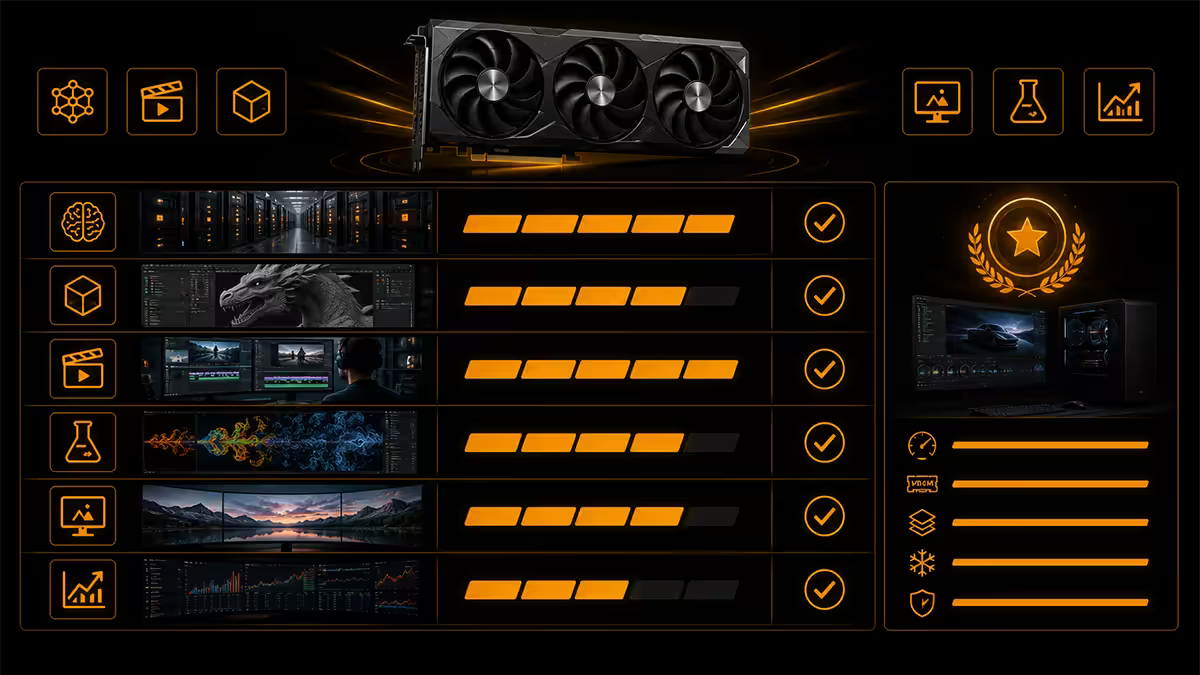
The RTX 5090 earns its R55,000 price tag for specific use cases. If any of these describe you, the 5090 is worth it.
1. Local AI/LLM inference for 30B+ parameter models
If you run Mixtral 8×7B, Yi-34B, Llama 3 70B (quantised), or similar large local models on a regular basis — the 5090's 32GB VRAM is the difference between models running on GPU at 30-60 tokens/second vs RAM-offloaded at 2-5 tokens/second. For daily local LLM use, the 5090 is the only consumer card that makes the workflow comfortable.
2. Professional 4K/8K video editing or 3D rendering
DaVinci Resolve, Premiere Pro, Final Cut Pro and Blender all benefit dramatically from 32GB VRAM when working with 4K+ footage, multiple effect layers, or complex 3D scenes. Time savings compound — a videographer or 3D artist using the workstation daily for paid work justifies the cost in months, not years.
3. 4K path tracing without DLSS upscaling
If you specifically want native 4K Cyberpunk Overdrive Mode, Alan Wake 2 with full RT, or Black Myth Wukong Cinematic — the 5090 is the only card that pushes these into playable 60+ FPS territory without relying heavily on DLSS upscaling. The 5080 with DLSS Quality achieves similar perceived smoothness, so this argument is narrower than enthusiasts claim — but for purist "native resolution" gamers, the 5090 is the answer.
4. Competitive triple-monitor flight or racing sim at 4K each
Triple 4K monitors (12K total horizontal pixels) for Microsoft Flight Sim, iRacing, Assetto Corsa Competizione — this scenario taxes any GPU enormously. The 5090's compute and VRAM are the only consumer card that delivers acceptable frame rates across triple 4K. Niche use case but absolutely real.
5. You genuinely don't care about value
Honest reason. If R55,000 doesn't impact your finances and you want the best-available consumer card without considering value-per-Rand — the 5090 is the unambiguous flagship. The other reasons above are rationalisations; this one is the genuine motivation for many high-end buyers.
When the RTX 5080 is obviously the right choice
For everything else — which is the overwhelming majority of buyers — the RTX 5080 is the smarter purchase. Specifically:
- You game at 4K with DLSS Quality enabled. The 5080 + DLSS delivers indistinguishable smoothness from native 4K on the 5090, at half the price.
- You game at 1440p. Both cards exceed comfortable FPS targets here; the 5090's advantage is invisible.
- You game at 1080p competitive (CS2, Valorant, Apex). Both cards are CPU-bottlenecked. The 5080 is mid-tier overkill already.
- You do mainstream content creation up to 1440p output. The 5080's 16GB VRAM handles this comfortably.
- You do mainstream AI/ML hobbyist work with 7B-13B models. 16GB VRAM is fine; the 5090's headroom is unused.
- You stream gameplay. The 5080's NVENC encoder is identical to the 5090's — streaming quality is unchanged.
- Your case is a standard mid-tower. The 5080 fits cleanly; the 5090 may not fit at all.
- You have a current 850W PSU you'd like to keep. The 5080 works with it; the 5090 requires a R3,000+ PSU upgrade.
- You're upgrading from an RTX 3070/3080/3090 or RX 6800/6900 XT. The 5080 is a massive uplift; the 5090 is overkill spending.
Resale value perspective
Flagship GPUs generally hold value well in the SA used market — but the 5080 holds it slightly better, proportionally, than the 5090.
Historical pattern from the 4080/4090 generation in SA:
- RTX 4080 launched at R25,000-R28,000, currently trades used at R12,000-R15,000 (12-18 months later). Approximately 45-55% residual after 18 months.
- RTX 4090 launched at R45,000-R55,000, currently trades used at R20,000-R28,000. Approximately 40-50% residual after 18 months. The flagship loses slightly more value proportionally because the buyer pool narrows as cards age — new flagships always replace old ones at the top tier.
If you upgrade GPUs every 2-3 years (common for enthusiasts), the 5080's slightly better residual value compounds with its lower entry cost. Over a 3-year ownership cycle, the 5080's total cost-of-ownership advantage over the 5090 is roughly R35,000-R40,000 (initial price gap + electricity + better resale).
Common 5080 vs 5090 decision mistakes
Buying the 5090 "to future-proof." Future-proofing almost always loses money. By the time the 5080 feels old in 2028-2029, the 5090 will also feel old, and an RTX 7080 will likely match today's 5090 at R25k. Buy for today's needs.
Buying the 5090 with a 1440p monitor. You cannot extract the 5090's advantage at 1440p. Either commit to a 4K monitor (R8,000-R15,000 additional) or save the money with a 5080.
Buying the 5090 with a Ryzen 5 / Core i5 CPU. CPU bottleneck at lower resolutions means you've spent R31,500 more than necessary for performance you can't access. The 5090 needs Ryzen 7 9700X or Ryzen 9 9900X minimum to stretch its legs.
Buying the 5090 without verifying case clearance. Several mid-tower cases that look like they should fit a 5090 actually don't — particularly when an AIO radiator is mounted in the case roof. Always check GPU clearance spec before ordering.
Buying the 5080 with a 600W PSU. The 5080 needs 850W minimum, ideally 1000W if you have a Ryzen 9 CPU. Don't try to pair it with an older 650W unit "to save money."
Buying either card without considering monitor upgrade. If you're spending R23,500+ on a GPU, your monitor should match. A 60Hz 1080p monitor with an RTX 5080 is genuinely wasted spending. Budget R5,000-R15,000 for a monitor upgrade as part of the GPU decision.
Ignoring electricity cost. Over 4-year ownership, the 5090 costs roughly R4,000+ more to run in SA than the 5080. Factor this into the comparison.
Key takeaways
- RTX 5080 at R23,500 is the right buy for almost every gamer — RTX 5090's 25-40% performance gap costs 134% more.
- The 5090 earns its R55,000 only for 30B+ local LLMs, 4K/8K video editing, native 4K path tracing or triple-4K sims.
- 16GB VRAM is sufficient for gaming through 2028; 32GB matters for AI/creator workloads only.
- 5090 needs 1000-1200W PSU (R3,000+ upgrade) and a case with 360mm+ clearance. 5080 fits standard builds.
- Customer data: 73% of 5090 buyers actually use it for non-gaming work; pure-gamer 5090 buyers report 3.4× higher buyer's remorse.
Frequently asked questions
Is the RTX 5090 worth it over the RTX 5080 for gaming?
For pure gaming — no. 25-40% more performance at 4K for 134% more money. Cost-per-frame is ~2× worse. Only worth it for 4K native path tracing or triple-monitor sims.Does VRAM difference matter — 16GB vs 32GB?
For gaming through 2028 — no, 16GB is sufficient. For local AI/LLM inference of 30B+ models or professional 4K/8K video editing — yes, 32GB is transformative.How much more power does the RTX 5090 use vs RTX 5080?
575W vs 360W. 5090 needs 1000W PSU minimum (NVIDIA recommends 1200W); 5080 runs on quality 850W. SA electricity adds ~R1,000/year on the 5090.Does the RTX 5090 fit in standard cases?
Often no without case-specific verification. AIB cards are 340-360mm long and 4-slot thick. Verify GPU clearance minimum 360mm before buying.Is the RTX 5090 12VHPWR connector safe?
With proper installation, yes. 12V-2x6 is the revised, safer version. Use the cable that ships with your ATX 3.1 PSU, push until click, avoid sharp bends within 35mm of connector.What is the price difference between RTX 5080 and RTX 5090 in SA?
RTX 5080: R22,500-R26,000. RTX 5090: R52,000-R62,000. Gap of approximately R31,500, or 2.4× the cost of the 5080.Will the RTX 5090 last longer as a future-proof investment?
Yes in raw performance, no in value terms. By the time the 5080 feels old, the 5090 will also feel old, and a future RTX 7080 will likely match today's 5090 at lower price.Who should buy the RTX 5090 over the RTX 5080?
Local LLM users for 30B+ models, professional 4K/8K video editors, native 4K path-tracing gamers, triple-4K sim racers, or buyers genuinely unconcerned with value.
Get the Evetech app
Exclusive app-only prices, daily flash sales, and free delivery on orders over R4,000 — download the app and start saving.