GPU Comparison · AMD RDNA 4
RX 9070 vs RX 9070 XT. — Is the XT worth R2,500 more in 2026?
Same die, same VRAM capacity, +15% raster, +75W power, +R2,500-R3,500 at SA retail. The decision tracks resolution targets and ray-tracing ambition — and it's straightforward once you know which side of the line you're on.
- VRAM (both)
- 16GB
- XT raster gain
- +15%
- SA price gap
- R2.5-3.5k
What's actually different between the two
Both the RX 9070 and the RX 9070 XT are built on the same Navi 48 die with the same 16GB GDDR6 VRAM capacity. The XT is the fully-enabled variant — more shader units active, higher clocks, faster effective memory bandwidth. The standard 9070 is the binned-down variant with some shader units disabled, lower power target and tighter clocks.
| Spec | RX 9070 | RX 9070 XT |
|---|---|---|
| GPU die | Navi 48 (RDNA 4) | Navi 48 (RDNA 4) |
| Shader units | 3,584 | 4,096 |
| Boost clock | ~2,520 MHz | ~2,970 MHz |
| VRAM | 16 GB GDDR6 | 16 GB GDDR6 (faster) |
| Memory bus | 256-bit | 256-bit |
| Memory bandwidth | ~640 GB/s | ~672 GB/s |
| TBP (board power) | 220 W | 295 W |
| Power connectors | 2x 8-pin PCIe | 2x 8-pin PCIe |
| Recommended PSU | 650W | 750W |
| SA retail (May 2026) | ~R12,000 | ~R14,500 |
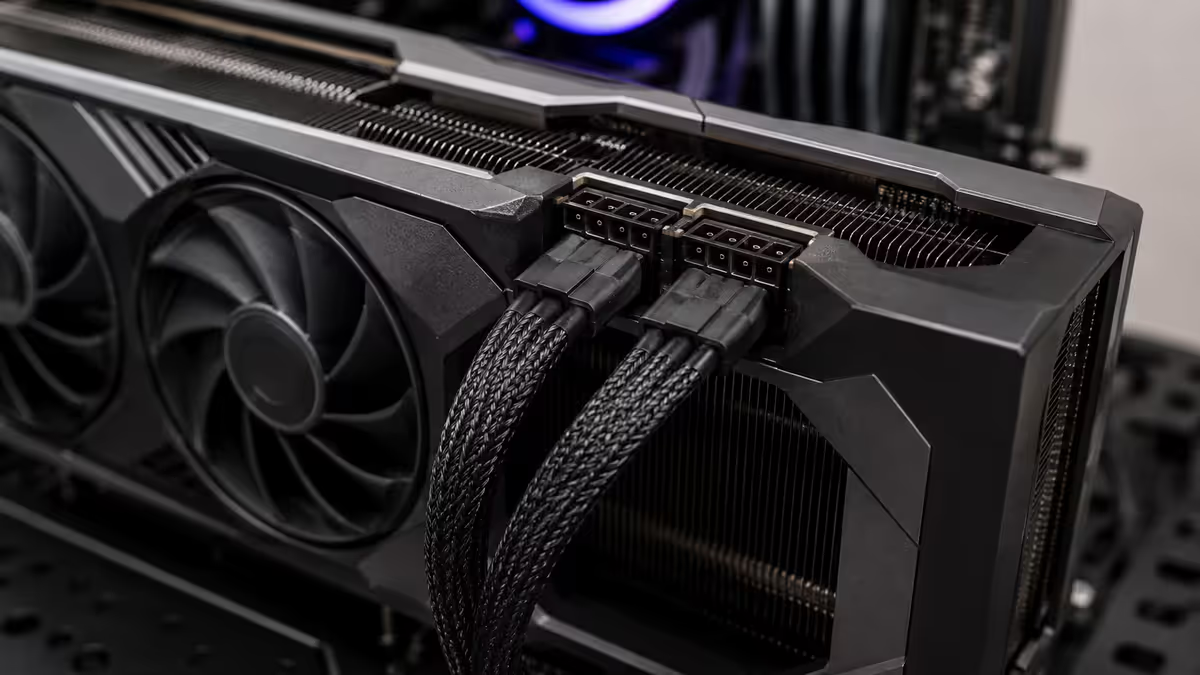
Critically, both cards use the standard 2x 8-pin PCIe power connectors — no 12VHPWR adapter drama, no melted-cable horror stories, works with any decent PSU you already own.
Performance head-to-head — 1440p
1440p is the resolution sweet spot where this comparison matters most. The XT delivers roughly 15% more FPS at 1440p Ultra raster settings, more in the heaviest titles, less in CPU-bound or lightly-threaded games.
| Game (1440p Ultra) | RX 9070 | RX 9070 XT |
|---|---|---|
| Cyberpunk 2077 (no RT) | 96 fps | 112 fps (+17%) |
| Alan Wake 2 (no RT) | 78 fps | 90 fps (+15%) |
| Black Myth: Wukong | 72 fps | 83 fps (+15%) |
| Hogwarts Legacy | 105 fps | 119 fps (+13%) |
| Forza Horizon 5 | 148 fps | 166 fps (+12%) |
| Call of Duty Warzone | 164 fps | 182 fps (+11%) |
| Counter-Strike 2 (high) | 320 fps | 340 fps (+6%) |
| Valorant (max) | 440 fps | 458 fps (+4%) |
The pattern is consistent: heaviest AAA titles show the biggest gap (15-17%); competitive e-sports show the smallest (4-6%) because those titles are CPU-bound at high frame rates and the GPU isn't the limit.
Performance head-to-head — 4K
At 4K the gap narrows slightly in some titles (VRAM and memory bandwidth become the limit before raw shader count does) but the XT remains the better 4K card. Both cards handle 4K High at 60+ FPS in most modern titles without ray tracing; the XT is the one that reliably crosses 75-80 FPS for VRR / G-Sync display sweet-spot territory.
| Game (4K High) | RX 9070 | RX 9070 XT |
|---|---|---|
| Cyberpunk 2077 (no RT) | 56 fps | 66 fps (+18%) |
| Alan Wake 2 (no RT) | 44 fps | 52 fps (+18%) |
| Black Myth: Wukong | 42 fps | 50 fps (+19%) |
| Hogwarts Legacy | 62 fps | 73 fps (+18%) |
| Forza Horizon 5 | 88 fps | 102 fps (+16%) |
| God of War Ragnarök | 72 fps | 84 fps (+17%) |
| Helldivers 2 | 61 fps | 71 fps (+16%) |
At 4K with FSR 4 Quality enabled, the standard 9070 also crosses 60 FPS comfortably — just with less headroom than the XT.
Ray tracing comparison
RDNA 4 closed AMD's traditional RT gap significantly — both 9070-tier cards are genuinely usable with ray tracing on at 1440p. The XT carries roughly 10-12% more RT performance than the standard 9070.
| Game (1440p RT High + FSR Q) | RX 9070 | RX 9070 XT |
|---|---|---|
| Cyberpunk 2077 RT Ultra | 62 fps | 70 fps (+13%) |
| Alan Wake 2 RT | 54 fps | 61 fps (+13%) |
| Hogwarts Legacy RT | 78 fps | 87 fps (+12%) |
| Indiana Jones (RT req.) | 72 fps | 82 fps (+14%) |
| Avatar Pandora RTGI | 58 fps | 65 fps (+12%) |
| Cyberpunk Path Tracing | 34 fps | 39 fps (+15%) |
Honest framing on path tracing: RDNA 4 path-tracing performance is workable but not great. If path tracing in Cyberpunk and Alan Wake 2 is your primary use case, NVIDIA's RTX 5070 Ti and 5080 are still the stronger choice. For standard RT (reflections + shadows), both 9070-tier cards perform well.
VRAM and memory bandwidth
Both cards ship with 16GB GDDR6 on a 256-bit bus. VRAM capacity is identical; the XT runs slightly faster memory clocks for ~5% higher bandwidth. In practical terms, both have the same VRAM headroom for 4K gaming, ray tracing and ultra textures.
Why 16GB matters in 2026:
- 4K ultra textures in titles like Hogwarts Legacy, Forspoken, The Last of Us Part 1 can consume 10-12GB on their own.
- Ray tracing at 4K ultra adds 2-3GB on top of base texture allocation.
- Path tracing at 4K maxed approaches 14GB in Cyberpunk RT Overdrive — 16GB is the appropriate headroom.
- Content creation (Blender, DaVinci Resolve, AI image generation) genuinely uses VRAM — 16GB is the entry tier for serious creative workloads.
By comparison, the RTX 5070 ships with 12GB which is becoming the noticeable shortfall in 2026 AAA titles at 4K. The 9070-tier cards' 16GB matches or beats every NVIDIA card below the RTX 5080.
Power consumption and PSU requirements
RX 9070 (220W TBP): AMD recommends 650W. A quality 650W 80+ Gold from Corsair, Seasonic, Cooler Master MWE Gold or Be Quiet System Power is comfortable. 750W if you have a high-power CPU like Ryzen 9 9950X or Core Ultra 9 285K.
RX 9070 XT (295W TBP): AMD recommends 750W. A quality 750W 80+ Gold is the minimum; 850W gives headroom and lets the PSU fan run quieter at typical loads. Same brand recommendations.
Power consumption in practical terms:
- RX 9070 at full gaming load: ~210-225W (matches TBP).
- RX 9070 XT at full gaming load: ~285-305W (matches TBP).
- Idle / desktop: both around 12-18W (low).
- Video playback: both around 25-40W (moderate).
The XT adds roughly 75W of sustained gaming-load draw versus the 9070. Over a year of typical gaming hours, that's modest but not invisible on the electricity bill — and noticeable as heat dumped into the room.
FSR 4 vs DLSS 4 in 2026
AMD's upscaling story changed substantially with FSR 4. RDNA 4 hardware introduced ML-accelerated upscaling — moving FSR from the hand-tuned heuristic approach of FSR 2 and 3 to a neural-network model closer to DLSS in architecture.
Where FSR 4 is competitive with DLSS 4:
- Quality preset image clarity in modern AAA titles.
- Motion handling on textured surfaces.
- Performance preset usability at 1440p and 4K.
- Frame Generation latency (FSR 3 FG now mature).
Where DLSS 4 still pulls ahead:
- Game support footprint — DLSS is in more titles, especially older releases.
- Fine-detail reconstruction — hair, fur, foliage at distance.
- Ray Reconstruction — DLSS 4's specialised RT denoiser that improves path-tracing quality.
- Ultra Performance preset at 4K — DLSS holds image quality better at extreme upscale ratios.
The practical 2026 verdict: for 90% of games at Quality / Balanced presets, FSR 4 on RDNA 4 is genuinely competitive. For the most demanding RT / PT showcases, DLSS 4 still has an edge. If you primarily play raster-focused titles or competitive e-sports, FSR's parity is enough. If you live in path-traced single-player AAA, DLSS is worth the NVIDIA premium.
AMD vs NVIDIA at this tier
| Card | Raster perf | Ray tracing | SA price |
|---|---|---|---|
| RX 9070 | ~RTX 5070 (slight edge) | ~RTX 5070 (slight loss) | ~R12,000 |
| RTX 5070 | ~RX 9070 (slight loss) | ~RX 9070 (slight edge) | ~R13,500 |
| RX 9070 XT | ~RTX 5070 Ti (matches) | ~RTX 5070 Ti (slight loss) | ~R14,500 |
| RTX 5070 Ti | ~RX 9070 XT (matches) | ~RX 9070 XT (slight edge) | ~R17,000 |
| RTX 5080 | Better than both AMD | Significantly better | ~R22,000 |
The AMD case in 2026: better raster performance per Rand, more VRAM at price tier, FSR 4 closes the upscaling gap, no 12VHPWR cable risk.
The NVIDIA case in 2026: stronger ray tracing and path tracing, DLSS 4 quality edge in edge cases, CUDA for content creation and AI workloads, broader software support across niche applications.
When the RX 9070 is enough
Go with the standard RX 9070 when:
- You're targeting 1440p high-refresh gaming (144Hz / 165Hz / 240Hz monitors) and not running ultra-heavy ray tracing.
- Your monitor is a 1440p VRR panel and you're happy with 90-140 FPS in modern AAA titles.
- You play primarily competitive / e-sport titles — Valorant, CS2, Apex, Warzone — where the gap closes at high refresh rates.
- Your budget is firm and the R2,500+ saved versus the XT is better spent on a 1440p OLED monitor, a better PSU or extra storage.
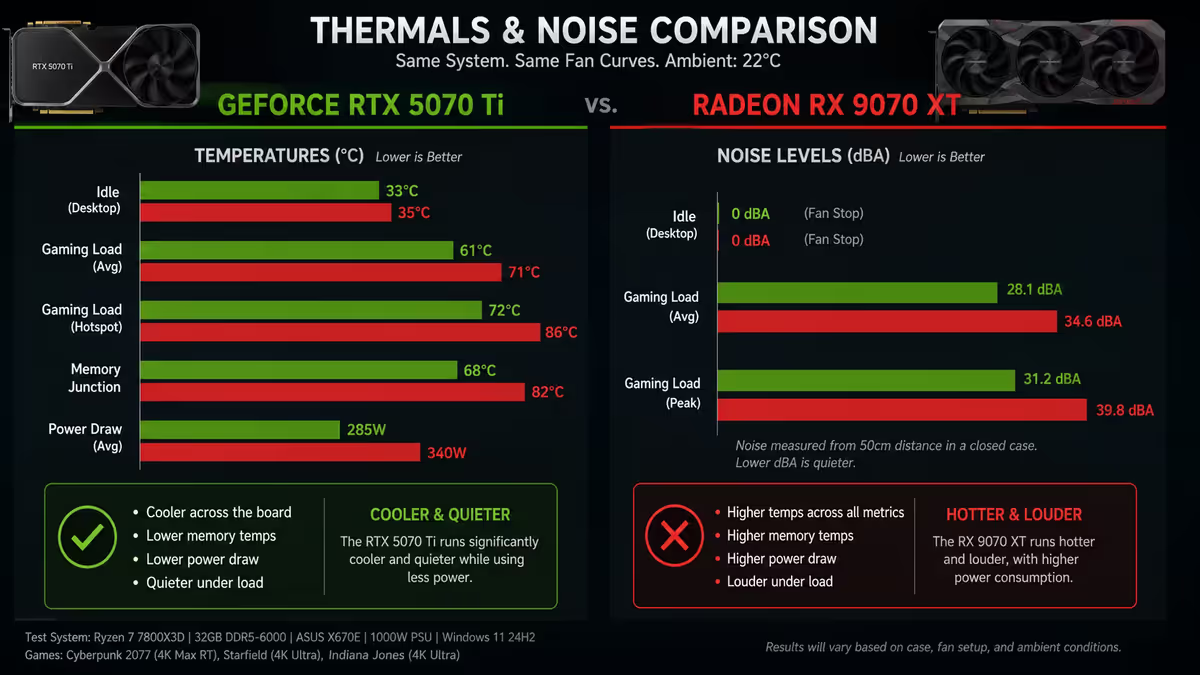
- Your case has limited airflow or you want lower noise — the 9070 runs ~10°C cooler and quieter than the XT in the same chassis.
- You have a 650W PSU and don't want to upgrade.
When the RX 9070 XT is worth +R2,500
Step up to the RX 9070 XT when:
- You're targeting 1440p ultra + ray tracing — the XT crosses 60+ FPS reliably in RT High where the 9070 hovers at 55-65.
- You're targeting 4K high gaming on a 60-120Hz 4K monitor — the XT's ~17% gain at 4K is the difference between consistent 60 FPS and dipping below.
- You want 2-3 generations of future-proofing — the XT's extra headroom delays the next upgrade by 12-18 months at typical AAA game demand growth.
- You're a content creator (Blender, DaVinci, AI image generation) where the XT's extra compute units genuinely speed up render times.
- You already have a 750W+ PSU and a case with good airflow — the cost of accommodating the XT is already paid.
- The XT happens to be on special / bundle deal that closes the gap to under R2,000 — at that delta the XT becomes the obvious pick.
Common decision mistakes
Picking the XT "because it's the better card". If you only game at 1440p high-refresh on a 144Hz monitor, the 9070 gets you within 10-15 FPS of the XT in every game — and you save R2,500. The XT isn't "better" if you can't use its extra performance.
Pairing either card with a weak PSU. Putting an XT on a 550W generic PSU is asking for transient-load failures. Either upgrade to 750W or step down to the 9070 with a quality 650W.
Ignoring case airflow. The XT runs 10°C hotter than the 9070 in the same chassis. If your case has poor front-intake airflow, the XT throttles or runs noisily. Either improve airflow (front fans, mesh panel) or pick the 9070.
Buying based on RT alone. RDNA 4 RT is competitive but not class-leading. If path tracing is genuinely critical to you, the RTX 5070 Ti is the better choice at the +R2,500 premium versus the 9070 XT. Don't buy AMD primarily for RT.
Underspeccing the rest of the build. A 9070 XT paired with 16GB DDR4 and a 256GB SSD is a balance error. The GPU class implies a build with 32GB DDR5, 1TB NVMe minimum, and a CPU that can keep up at your target resolution.
Key takeaways
- Same Navi 48 die, same 16GB VRAM, +15% raster and +12% RT on the XT, +75W power draw.
- SA pricing R12,000 vs R14,500 — R2,500-R3,500 gap, worth it for roughly half of buyers.
- RX 9070 wins for 1440p high-refresh and competitive gaming. RX 9070 XT wins for 1440p ultra RT or 4K high.
- Both use 2x 8-pin PCIe — no 12VHPWR drama. 9070 wants 650W PSU, XT wants 750W.
- FSR 4 is now competitive with DLSS 4 Quality in most games. NVIDIA still pulls ahead in heavy path tracing.
Frequently asked questions
What is the difference between the RX 9070 and RX 9070 XT?
Same Navi 48 die and 16GB GDDR6 VRAM. XT has more enabled shaders (4,096 vs 3,584), higher boost clocks, faster effective memory, 295W TBP vs 220W. ~15% more raster, ~12% more RT, R2,500-R3,500 SA price gap.Which is better value, the RX 9070 or RX 9070 XT?
9070 wins FPS-per-Rand at 1440p high-refresh. XT wins if you target 1440p ultra + RT or 4K high — its extra 15% moves you between resolution tiers in a way the price gap justifies.What PSU do I need for the RX 9070 vs RX 9070 XT?
9070: 650W 80+ Gold (Corsair / Seasonic / Be Quiet). XT: 750W 80+ Gold minimum, 850W for headroom. Both use standard 2x 8-pin PCIe — no 12VHPWR.How does FSR 4 compare to DLSS 4 in 2026?
FSR 4 on RDNA 4 is now ML-based and competitive with DLSS 4 Quality in most modern titles. DLSS still pulls ahead in fine-detail reconstruction, Ray Reconstruction for path tracing, and game-support footprint.Should I buy the RX 9070 XT or the RTX 5070 Ti?
9070 XT lands R1,500-R3,000 below RTX 5070 Ti at SA retail for similar raster performance. 5070 Ti pulls ahead in heavy RT and path tracing. Raster-heavy or e-sport buyers favour 9070 XT; path-tracing buyers favour 5070 Ti.Is 16GB VRAM enough for 2026?
Yes — comfortably for 1440p and 4K gaming through at least 2027-2028. Matches RTX 5080 capacity, beats RTX 5070 (12GB). Path tracing 4K maxed in Cyberpunk approaches 14GB, so 16GB has appropriate headroom.Will the RX 9070 XT bottleneck a Ryzen 5 7600?
At 1440p and 4K, no. At 1080p 240Hz+ competitive e-sports, slight CPU bottleneck possible. For 1440p targets, Ryzen 5 7600 / 7700 / 9700X all pair well with the XT.Does the RX 9070 XT run hot or loud compared to the 9070?
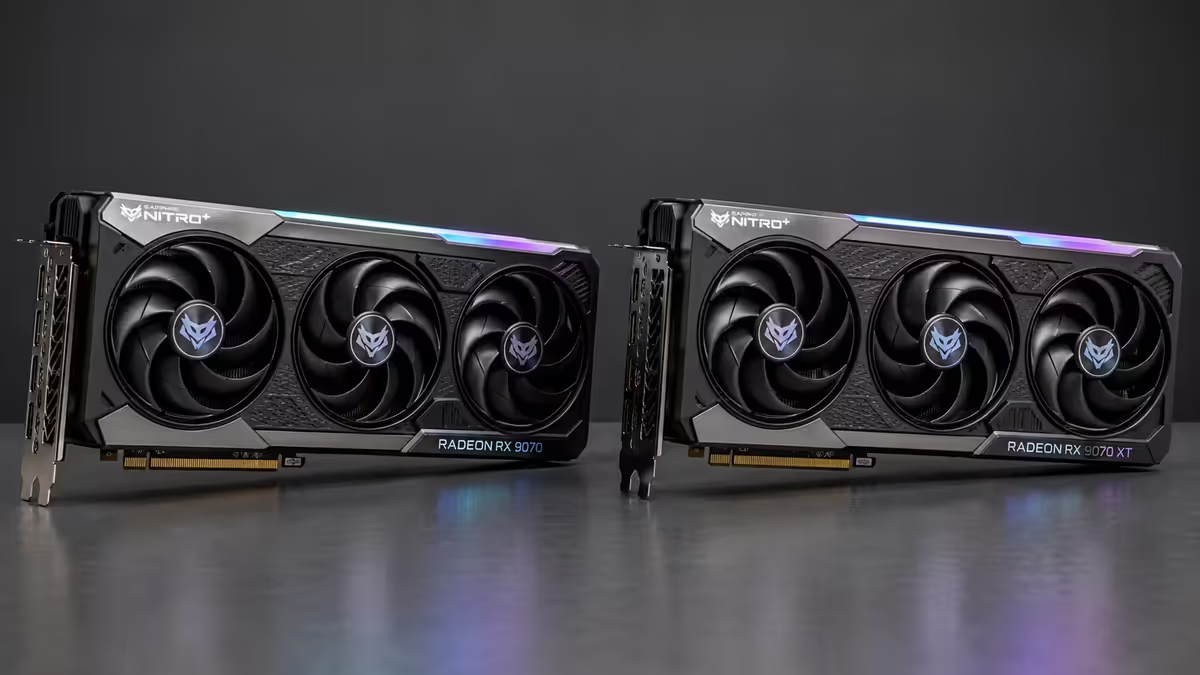
XT runs 75-82°C vs 65-72°C for the 9070 with similar cooler designs. AIB triple-fan partners (Sapphire Nitro+, ASUS TUF, PowerColor Hellhound) stay 38-42 dB. Plan for slightly more case airflow with the XT.
Get the Evetech app
Exclusive app-only prices, daily flash sales, and free delivery on orders over R4,000 — download the app and start saving.