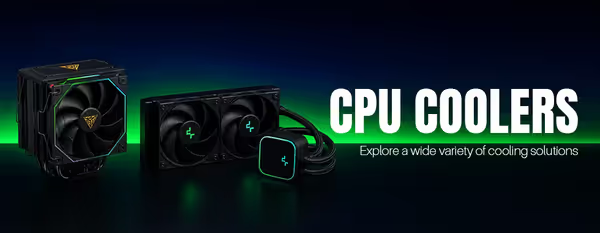
CPU Coolers ❄️
CPU Cooling — AIO & Tower Air (114)


How to Choose a CPU Cooler
The right cooler comes down to your CPU's heat output, your case's clearance, your socket and how quiet you want the PC to be. Air and AIO liquid coolers both perform well — what matters is matching cooling capacity to your processor and making sure it physically fits. The guide below covers the decisions that actually matter.
Air coolers are simpler, cheaper and very reliable — a large dual-tower air cooler can match a mid-size AIO. AIO liquid coolers (240mm, 280mm, 360mm radiators) move heat away from the socket, often look cleaner and suit high-power chips and compact cases where a tall air cooler won't fit. Both are good; pick on your CPU, case and budget.
This is the most common mistake. For air coolers, check the maximum cooler height your case allows. For AIOs, confirm your case supports the radiator size (240/280/360mm) in the top or front. And always confirm the cooler includes a bracket for your socket — current AMD AM5 or the current Intel socket — as not every cooler covers every socket out of the box.
Higher-power and overclocked CPUs run hotter and need more capacity — a large air tower or a 240mm-plus AIO. Lower-power chips are happy with a compact air cooler. Match the cooler's capacity to your processor's heat output; over-cooling a modest CPU wastes money, while under-cooling a hot one causes throttling and noise.
Noise depends on the fans and how hard they have to work. A larger cooler running its fans slowly is usually quieter than a small cooler running flat out, because it has more surface area to shed heat. Look for PWM fans so the motherboard can ramp them only when needed, and a larger heatsink or radiator if silence matters.
Most aftermarket coolers include thermal paste, either pre-applied or in a tube, so you usually don't need to buy it separately. Many modern CPUs no longer include a cooler at all, so an aftermarket one is required. Apply a thin, even layer; you only need to buy premium paste if you are chasing the last degree on an overclock.