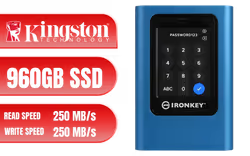
External hard drives provide high-capacity removable storage for backups, archives, media and transfers through a USB enclosure.
Compare capacity, portable or desktop power, interface, sustained workload, file system, dimensions, warranty and the backup strategy around the drive.
External Hard Drives for Backup and Portable Storage (7)
A single external disk is additional storage, not a complete backup when it holds the only copy.
Portable 2.5-inch drives commonly draw power from USB, while higher-capacity desktop units often use a mains adapter. Mobility, speed and capacity ranges differ.
USB link speed is only one limit; mechanical media, file size and drive cache determine transfers. Small-file copies are slower than large sequential operations.
exFAT supports large files across current Windows and macOS, while NTFS and APFS favour their native platforms. Reformatting erases existing data.
Keep important data in multiple independent copies, with at least one separated from the PC and routine threats. Test restoration rather than trusting a completed-job message alone.
Hard drives contain moving parts and should not be bumped during operation. Safely eject the volume and use stable power before disconnecting.