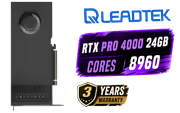
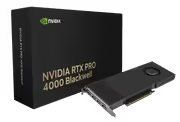

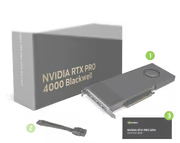
3 Years Local Warranty
Model No : LEADTEK 126X4000100
Price Inc. Vat
R 57,999
Save R 7,000
ListR 64,999
57999Free Delivery
Qty:
In Stock with Evetech
Price Inc. Vat
R 57,999
Save R 7,000
ListR 64,999
57999Free Delivery
Qty:
In Stock with Evetech
Trusted Partners
Please Note: Product images are for illustrative purposes only and may differ from the actual product.
Hand-pick every part with live stock, compatibility, and instant pricing.
Try the new builderHand-pick every part with live stock, compatibility, and instant pricing.
Try the new builderLEADTEK NVIDIA RTX PRO 4000 Blackwell 24GB GDDR7 Workstation
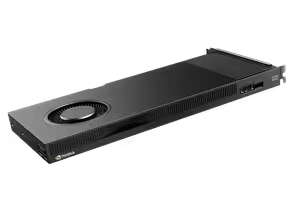
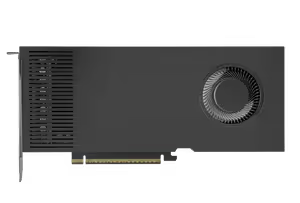
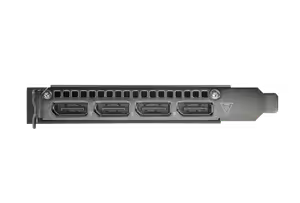
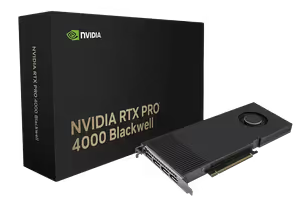
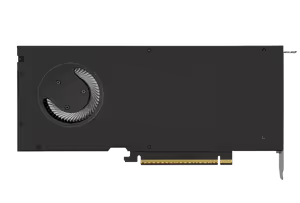
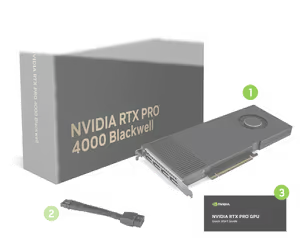
The NVIDIA RTX PRO™ 4000 Blackwell is engineered as a compact single-slot GPU that brings exceptional AI acceleration, neural rendering capabilities, and power efficiency to design, engineering, scientific, and creative fields. Built on the NVIDIA Blackwell architecture, it leverages 5th-generation Tensor Cores, 4th-generation RT Cores, and 24GB of high-speed memory to support generative AI tasks, photorealistic rendering, and real-time simulation workloads. Its streamlined form factor fits seamlessly into workstations, medical systems, and studio environments, allowing professionals to pursue advanced product design, simulate next-generation systems, and develop immersive virtual worlds with greater speed and intelligence.
The NVIDIA RTX PRO™ 4000 Blackwell is engineered as a compact single-slot GPU that brings exceptional AI acceleration, neural rendering capabilities, and power efficiency to design, engineering, scientific, and creative fields. Built on the NVIDIA Blackwell architecture, it leverages 5th-generation Tensor Cores, 4th-generation RT Cores, and 24GB of high-speed memory to support generative AI tasks, photorealistic rendering, and real-time simulation workloads. Its streamlined form factor fits seamlessly into workstations, medical systems, and studio environments, allowing professionals to pursue advanced product design, simulate next-generation systems, and develop immersive virtual worlds with greater speed and intelligence.
NVIDIA RTX PRO solutions are purpose-built for professionals who require stability, reliability, and long-term support across demanding workflows. Each GPU undergoes extensive validation for engineering, AI, and design applications and is continually optimized through enterprise drivers. Featuring broad ISV certifications and strong IT management tools, RTX PRO workstation GPUs provide dependable performance for mission-critical environments and large-scale enterprise deployments.
NVIDIA RTX PRO solutions are purpose-built for professionals who require stability, reliability, and long-term support across demanding workflows. Each GPU undergoes extensive validation for engineering, AI, and design applications and is continually optimized through enterprise drivers. Featuring broad ISV certifications and strong IT management tools, RTX PRO workstation GPUs provide dependable performance for mission-critical environments and large-scale enterprise deployments.
The NVIDIA Blackwell architecture fuses advanced AI computing, real-time ray tracing, and neural graphics technologies with major improvements in speed and memory capacity to drive cutting-edge creative, design, and engineering workflows. RTX PRO Blackwell GPUs deliver high-performance ray tracing, AI-accelerated computation, and professional visualization, enabling efficient collaboration and productivity from virtually any environment.
The NVIDIA Blackwell architecture fuses advanced AI computing, real-time ray tracing, and neural graphics technologies with major improvements in speed and memory capacity to drive cutting-edge creative, design, and engineering workflows. RTX PRO Blackwell GPUs deliver high-performance ray tracing, AI-accelerated computation, and professional visualization, enabling efficient collaboration and productivity from virtually any environment.
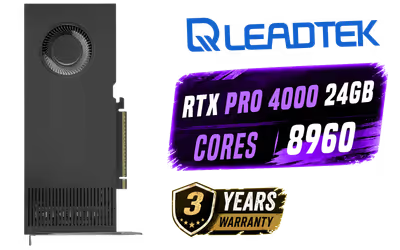
The Blackwell Streaming Multiprocessor (SM) integrates new CUDA cores and neural shader capabilities to significantly elevate AI-enhanced graphics and compute workloads. Offering up to 1.4X higher FP32 throughput compared to the previous generation and scaling to 8,960 CUDA cores per GPU, the SM architecture accelerates simulations, 3D modeling, and ray-traced rendering. With support for FP64, FP32, FP16, and BF16 precision, larger L2 cache, and increased clock speeds, it delivers powerful performance in neural networks, tensor operations, and photorealistic rendering across AECO, manufacturing, and media industries.
The Blackwell Streaming Multiprocessor (SM) integrates new CUDA cores and neural shader capabilities to significantly elevate AI-enhanced graphics and compute workloads. Offering up to 1.4X higher FP32 throughput compared to the previous generation and scaling to 8,960 CUDA cores per GPU, the SM architecture accelerates simulations, 3D modeling, and ray-traced rendering. With support for FP64, FP32, FP16, and BF16 precision, larger L2 cache, and increased clock speeds, it delivers powerful performance in neural networks, tensor operations, and photorealistic rendering across AECO, manufacturing, and media industries.
5th-generation Tensor Cores deliver substantial speedups for deep learning operations, offering up to 3X higher throughput with Fine-Grained Structured Sparsity enabled. These cores support a wide range of mixed-precision formats—including FP4, TF32, BF16, FP16, FP8, and FP6—enabling efficient model training and inference. With performance enhancements that benefit generative AI, DLSS 4 multi-frame generation, and large-scale model development, these Tensor Cores unlock faster prototyping and high-performance deployment for advanced AI workflows.
5th-generation Tensor Cores deliver substantial speedups for deep learning operations, offering up to 3X higher throughput with Fine-Grained Structured Sparsity enabled. These cores support a wide range of mixed-precision formats—including FP4, TF32, BF16, FP16, FP8, and FP6—enabling efficient model training and inference. With performance enhancements that benefit generative AI, DLSS 4 multi-frame generation, and large-scale model development, these Tensor Cores unlock faster prototyping and high-performance deployment for advanced AI workflows.
4th-generation RT Cores provide up to 2X the ray tracing performance of the previous generation, enabling lifelike rendering with accurate lighting, shadows, reflections, and refractions. They power neural graphics technologies such as RTX Mega Geometry, dramatically increasing ray-traced triangle counts for ultra-detailed scenes. Designed for industrial precision, these RT Cores accelerate visualization, immersive design workflows, and content creation, significantly reducing iteration time and boosting productivity.
4th-generation RT Cores provide up to 2X the ray tracing performance of the previous generation, enabling lifelike rendering with accurate lighting, shadows, reflections, and refractions. They power neural graphics technologies such as RTX Mega Geometry, dramatically increasing ray-traced triangle counts for ultra-detailed scenes. Designed for industrial precision, these RT Cores accelerate visualization, immersive design workflows, and content creation, significantly reducing iteration time and boosting productivity.
The Blackwell GPU architecture integrates hardware encoding and decoding for 4:2:2 chromasampled video, enabling faster processing and higher fidelity when working with demanding video pipelines. This added color precision benefits HDR projects and workflows involving detailed text, graphical overlays, or repeated color grading, allowing editors and colorists to work more efficiently with fewer proxies and better preserved visual detail.
The Blackwell GPU architecture integrates hardware encoding and decoding for 4:2:2 chromasampled video, enabling faster processing and higher fidelity when working with demanding video pipelines. This added color precision benefits HDR projects and workflows involving detailed text, graphical overlays, or repeated color grading, allowing editors and colorists to work more efficiently with fewer proxies and better preserved visual detail.
NVIDIA’s 9th-generation NVENC engines dramatically boost encoding performance for professional video workflows, now supporting 4:2:2 H.264 and HEVC formats along with improved AV1 and HEVC quality—up to a 5% BD-BR PSNR increase. A new AV1 Ultra High Quality mode offers an additional 5% quality improvement for premium results. Capable of handling resolutions up to 8K/60, these engines free up the CPU and graphics cores, enabling smooth multitasking and faster turnaround times.
NVIDIA’s 9th-generation NVENC engines dramatically boost encoding performance for professional video workflows, now supporting 4:2:2 H.264 and HEVC formats along with improved AV1 and HEVC quality—up to a 5% BD-BR PSNR increase. A new AV1 Ultra High Quality mode offers an additional 5% quality improvement for premium results. Capable of handling resolutions up to 8K/60, these engines free up the CPU and graphics cores, enabling smooth multitasking and faster turnaround times.
The 6th-generation NVIDIA NVDEC engines provide up to double the H.264 decoding throughput relative to earlier generations and introduce support for 4:2:2 H.264 and HEVC decoding. They enable smoother playback, faster ingestion, and enhanced AI-assisted editing. Supported codecs include MPEG-2, VC-1, H.264 (AVCHD), H.265 (HEVC), VP8, VP9, and AV1, making them ideal for modern, high-resolution video workflows.
The 6th-generation NVIDIA NVDEC engines provide up to double the H.264 decoding throughput relative to earlier generations and introduce support for 4:2:2 H.264 and HEVC decoding. They enable smoother playback, faster ingestion, and enhanced AI-assisted editing. Supported codecs include MPEG-2, VC-1, H.264 (AVCHD), H.265 (HEVC), VP8, VP9, and AV1, making them ideal for modern, high-resolution video workflows.
Next-generation GDDR7 memory delivers substantially increased bandwidth and capacity, allowing professionals to work with larger datasets, high-resolution assets, and complex 3D or AI workloads. With 24GB of GPU memory and up to 2X the memory bandwidth, the RTX PRO 4000 Blackwell Generation GPU accelerates ray tracing, rendering, and AI operations, supporting massive datasets and latency-sensitive professional applications with industry-leading efficiency.
Next-generation GDDR7 memory delivers substantially increased bandwidth and capacity, allowing professionals to work with larger datasets, high-resolution assets, and complex 3D or AI workloads. With 24GB of GPU memory and up to 2X the memory bandwidth, the RTX PRO 4000 Blackwell Generation GPU accelerates ray tracing, rendering, and AI operations, supporting massive datasets and latency-sensitive professional applications with industry-leading efficiency.
Integrated ECC support in GDDR7 memory improves data reliability through sideband ECC, which corrects single-bit errors and flags double-bit errors without reducing memory capacity or performance. This ensures the level of data integrity required for mission-critical professional workloads, allowing workstations to maintain accuracy and computational stability across intensive operations.
Integrated ECC support in GDDR7 memory improves data reliability through sideband ECC, which corrects single-bit errors and flags double-bit errors without reducing memory capacity or performance. This ensures the level of data integrity required for mission-critical professional workloads, allowing workstations to maintain accuracy and computational stability across intensive operations.
Blackwell Max-Q technologies optimize power efficiency and performance in compact or dense multi-GPU configurations. These enhancements enable workstations to maintain strong performance while reducing overall power consumption, making them ideal for complex, large-scale computational environments that prioritize efficiency and thermal balance.
Blackwell Max-Q technologies optimize power efficiency and performance in compact or dense multi-GPU configurations. These enhancements enable workstations to maintain strong performance while reducing overall power consumption, making them ideal for complex, large-scale computational environments that prioritize efficiency and thermal balance.
RTX PRO GPUs incorporate PCI Express Gen 5 support, offering up to 64 GB/sec in x16 configurations—twice the bandwidth of PCIe Gen 4. This accelerates data transfers from CPU memory for AI, data science, and video workflows. Faster PCIe speeds also enhance GPU Direct Memory Access operations and significantly improve throughput for GPUDirect Storage and video-enabled devices.
RTX PRO GPUs incorporate PCI Express Gen 5 support, offering up to 64 GB/sec in x16 configurations—twice the bandwidth of PCIe Gen 4. This accelerates data transfers from CPU memory for AI, data science, and video workflows. Faster PCIe speeds also enhance GPU Direct Memory Access operations and significantly improve throughput for GPUDirect Storage and video-enabled devices.
The dedicated AI Management Processor offloads GPU context scheduling tasks from the CPU, decreasing latency and freeing CPU resources for critical operations such as data processing and I/O management. This enhances responsiveness in demanding workflows, particularly in applications that combine real-time graphics with AI-driven tools like physics simulations or AI denoising.
The dedicated AI Management Processor offloads GPU context scheduling tasks from the CPU, decreasing latency and freeing CPU resources for critical operations such as data processing and I/O management. This enhances responsiveness in demanding workflows, particularly in applications that combine real-time graphics with AI-driven tools like physics simulations or AI denoising.
Pixel-level graphics preemption enables more detailed control over GPU resources, improving responsiveness in applications that rely on real-time precision such as VR motion tracking. This feature ensures smoother performance during time-sensitive operations where latency must be minimized.
Pixel-level graphics preemption enables more detailed control over GPU resources, improving responsiveness in applications that rely on real-time precision such as VR motion tracking. This feature ensures smoother performance during time-sensitive operations where latency must be minimized.
Compute preemption at the instruction level prevents long-running compute tasks from monopolizing GPU resources or causing timeout issues. This granular control ensures greater system stability and fairness across workloads, maintaining smooth performance in multi-application environments.
Compute preemption at the instruction level prevents long-running compute tasks from monopolizing GPU resources or causing timeout issues. This granular control ensures greater system stability and fairness across workloads, maintaining smooth performance in multi-application environments.
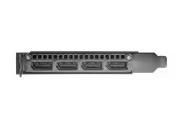
DisplayPort 2.1b enables professionals to drive extremely high-resolution displays, supporting up to 8K at 240Hz and 16K at 60Hz. With increased bandwidth and HDR capabilities, it ensures exceptional color accuracy for tasks such as video editing, 3D modeling, and live broadcast environments. Each GPU can support up to four 4K displays at 165Hz or two 8K displays at 100Hz with DSC using DP or HDMI, with maximum link rates requiring a DP80LL cable.
DisplayPort 2.1b enables professionals to drive extremely high-resolution displays, supporting up to 8K at 240Hz and 16K at 60Hz. With increased bandwidth and HDR capabilities, it ensures exceptional color accuracy for tasks such as video editing, 3D modeling, and live broadcast environments. Each GPU can support up to four 4K displays at 165Hz or two 8K displays at 100Hz with DSC using DP or HDMI, with maximum link rates requiring a DP80LL cable.
NVIDIA RTX Desktop Manager gives users extensive control over multi-display and large-display setups, improving productivity across complex workspace configurations. It enables customized layouts, window management, and enhanced usability in environments with ultra-wide or multi-monitor arrays.
NVIDIA RTX Desktop Manager gives users extensive control over multi-display and large-display setups, improving productivity across complex workspace configurations. It enables customized layouts, window management, and enhanced usability in environments with ultra-wide or multi-monitor arrays.
RTX PRO Sync technology allows synchronization of up to 32 displays from 8 GPUs in a single system with two Sync boards. It can also scale across multiple systems to synchronize hundreds of displays for large-scale visualization deployments. When paired with an RTX PRO 4000 Blackwell GPU, users benefit from Variable Refresh Rate up to 1000Hz, which enhances responsiveness in low-latency environments.
RTX PRO Sync technology allows synchronization of up to 32 displays from 8 GPUs in a single system with two Sync boards. It can also scale across multiple systems to synchronize hundreds of displays for large-scale visualization deployments. When paired with an RTX PRO 4000 Blackwell GPU, users benefit from Variable Refresh Rate up to 1000Hz, which enhances responsiveness in low-latency environments.
NVIDIA Mosaic technology enables scaling the desktop and applications across up to 4 GPUs and 16 displays within a single workstation, supporting resolutions up to 16K x 16K on Windows and 32K x 32K on Linux. Mosaic can be combined with RTX PRO Sync to synchronize displays in large-scale visualization configurations, ensuring consistent performance and visual fidelity.
NVIDIA Mosaic technology enables scaling the desktop and applications across up to 4 GPUs and 16 displays within a single workstation, supporting resolutions up to 16K x 16K on Windows and 32K x 32K on Linux. Mosaic can be combined with RTX PRO Sync to synchronize displays in large-scale visualization configurations, ensuring consistent performance and visual fidelity.
Each frame lock connector includes a self-locking retention system to secure its attachment to the frame lock cable. This ensures consistent and reliable connectivity, improving stability and productivity in environments that rely on synchronized multi-display configurations.
Each frame lock connector includes a self-locking retention system to secure its attachment to the frame lock cable. This ensures consistent and reliable connectivity, improving stability and productivity in environments that rely on synchronized multi-display configurations.
A dedicated 3D stereo synchronization connection allows direct coordination between stereo hardware and NVIDIA RTX PRO graphics cards. This provides accurate, robust control of stereo effects, supporting applications that require precise depth rendering and immersive visualization.
A dedicated 3D stereo synchronization connection allows direct coordination between stereo hardware and NVIDIA RTX PRO graphics cards. This provides accurate, robust control of stereo effects, supporting applications that require precise depth rendering and immersive visualization.
The NVIDIA App provides a suite of professional tools for workstation users, including desktop recording up to 8K, notifications for new NVIDIA RTX Enterprise driver updates, and access to gaming-related features. It streamlines productivity and system maintenance, and can be downloaded directly through NVIDIA’s official software portal.
The NVIDIA App provides a suite of professional tools for workstation users, including desktop recording up to 8K, notifications for new NVIDIA RTX Enterprise driver updates, and access to gaming-related features. It streamlines productivity and system maintenance, and can be downloaded directly through NVIDIA’s official software portal.
Deep learning frameworks such as TensorFlow, MXNet, Caffe2, CNTK, and others receive major performance boosts on NVIDIA RTX PRO GPUs. GPU-accelerated libraries including cuDNN, cuBLAS, and TensorRT enhance both deep learning inference and HPC tasks. NVIDIA AI Workbench enables quick setup of sample projects or custom environments, while NVIDIA AI Enterprise offers a large collection of pretrained models and enterprise-ready tools for scalable deployment.
Deep learning frameworks such as TensorFlow, MXNet, Caffe2, CNTK, and others receive major performance boosts on NVIDIA RTX PRO GPUs. GPU-accelerated libraries including cuDNN, cuBLAS, and TensorRT enhance both deep learning inference and HPC tasks. NVIDIA AI Workbench enables quick setup of sample projects or custom environments, while NVIDIA AI Enterprise offers a large collection of pretrained models and enterprise-ready tools for scalable deployment.
NVIDIA CUDA enables native execution of widely used programming languages such as C/C++ and Fortran, along with APIs like OpenCL, OpenACC, and Direct Compute. This platform accelerates complex tasks including ray tracing, video processing, image computation, and computational fluid dynamics, enabling significant performance gains across engineering and scientific workloads.
NVIDIA CUDA enables native execution of widely used programming languages such as C/C++ and Fortran, along with APIs like OpenCL, OpenACC, and Direct Compute. This platform accelerates complex tasks including ray tracing, video processing, image computation, and computational fluid dynamics, enabling significant performance gains across engineering and scientific workloads.
NVIDIA GPUDirect for Video reduces latency and improves efficiency by allowing video I/O devices to communicate directly with the GPU, bypassing unnecessary system memory copies. This minimizes CPU overhead and enhances performance for real-time video applications and professional editing pipelines.
NVIDIA GPUDirect for Video reduces latency and improves efficiency by allowing video I/O devices to communicate directly with the GPU, bypassing unnecessary system memory copies. This minimizes CPU overhead and enhances performance for real-time video applications and professional editing pipelines.
NVIDIA’s enterprise management tools help organizations maintain high system uptime while efficiently controlling wide-scale deployments. Administrators can remotely manage display and graphics settings, monitor system health, and streamline operational workflows across professional environments requiring robust and consistent performance.
NVIDIA’s enterprise management tools help organizations maintain high system uptime while efficiently controlling wide-scale deployments. Administrators can remotely manage display and graphics settings, monitor system health, and streamline operational workflows across professional environments requiring robust and consistent performance.