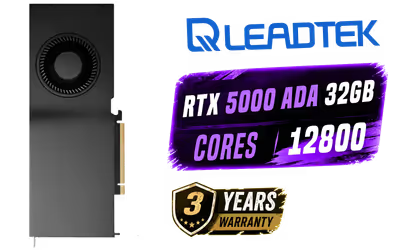
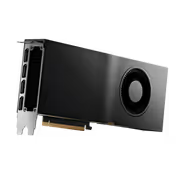
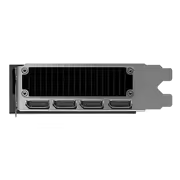
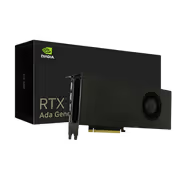
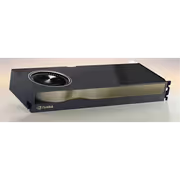
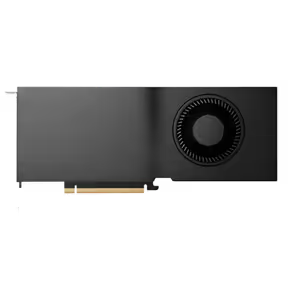
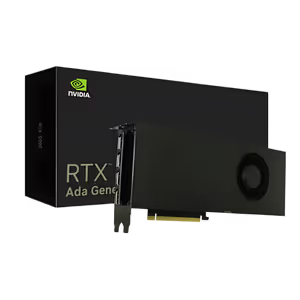
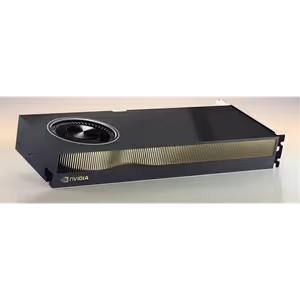
Leadtek NVIDIA RTX 5000 ADA 32GB GDDR6 Workstation Graphics Card
Leadtek NVIDIA RTX 5000 ADA 32GB GDDR6 Workstation Graphics Card / 12800 Nvidia CUDA Cores / 576GB/s Memory Bandwidth / Ada Lovelace GPU architecture / 126V5000100 / 126V5000100 + FREE DELIVERY !
3 Years Local Warranty
Model No : LEADTEK 126V5000100
Price Inc. Vat
R 97,699
Save R 12,300
ListR 109,999
97699Free Delivery
Qty:
In Stock with Evetech
Leadtek NVIDIA RTX 5000 ADA 32GB Workstation GPU
32GB GDDR6 With 12,800 CUDA Cores
The Leadtek NVIDIA RTX 5000 Ada Generation workstation graphics card combines 12,800 CUDA cores with 32GB of dedicated GDDR6 graphics memory, accelerating rendering, AI processes, graphics and compute workloads on the same card. That memory pool is sized for the memory-intensive side of professional work, where ray tracing, rendering and AI computation all compete for capacity at once.
32GB GDDR6 With 12,800 CUDA Cores
The Leadtek NVIDIA RTX 5000 Ada Generation workstation graphics card combines 12,800 CUDA cores with 32GB of dedicated GDDR6 graphics memory, accelerating rendering, AI processes, graphics and compute workloads on the same card. That memory pool is sized for the memory-intensive side of professional work, where ray tracing, rendering and AI computation all compete for capacity at once.
Ada Lovelace With 100 RT And 400 Tensor Cores
Built on the NVIDIA Ada Lovelace architecture, the RTX 5000 Ada Generation carries 100 third-generation RT Cores and 400 fourth-generation Tensor Cores. It is aimed at professionals across design, engineering, entertainment and healthcare, where accelerated computing and AI now sit inside the daily workflow rather than at the edge of it.
Ada Lovelace With 100 RT And 400 Tensor Cores
Built on the NVIDIA Ada Lovelace architecture, the RTX 5000 Ada Generation carries 100 third-generation RT Cores and 400 fourth-generation Tensor Cores. It is aimed at professionals across design, engineering, entertainment and healthcare, where accelerated computing and AI now sit inside the daily workflow rather than at the edge of it.
ECC Graphics Memory Protects Mission-Critical Work
Error Correcting Code (ECC) graphics memory maintains strict data integrity for mission-critical applications, which is one of the clearest lines between a professional card and a consumer one. It holds computing accuracy and reliability to the standard a professional workstation needs, so a silent memory error cannot quietly corrupt the result of a long-running job.
ECC Graphics Memory Protects Mission-Critical Work
Error Correcting Code (ECC) graphics memory maintains strict data integrity for mission-critical applications, which is one of the clearest lines between a professional card and a consumer one. It holds computing accuracy and reliability to the standard a professional workstation needs, so a silent memory error cannot quietly corrupt the result of a long-running job.
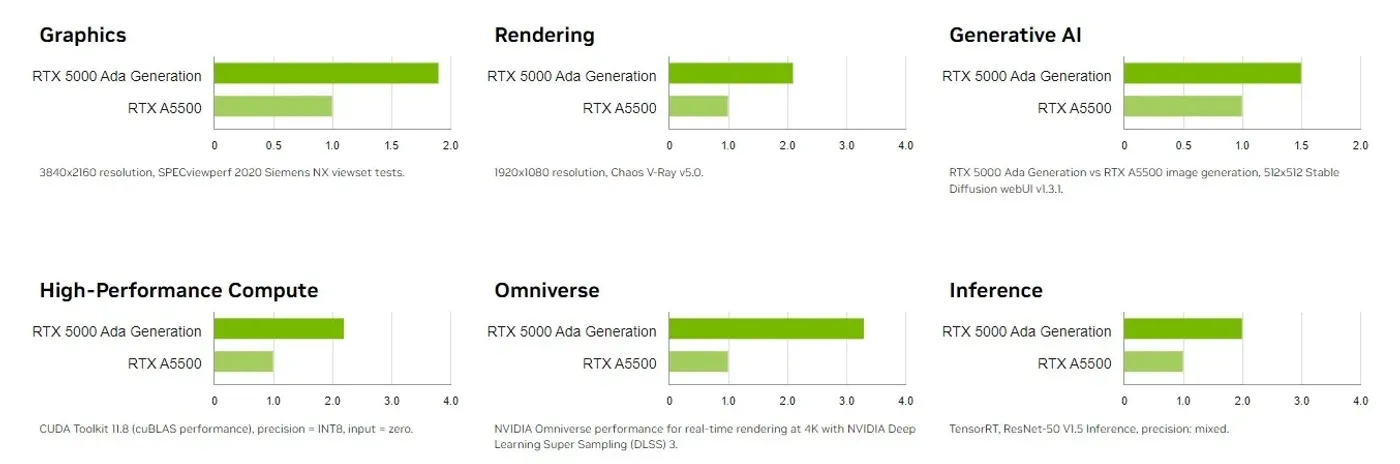
2X FP32 Throughput And 5X Tensor Efficiency
The Ada Lovelace architecture provides up to 2X the single-precision floating point (FP32) throughput of its predecessors for 3D modelling and compute-intensive CAE simulation. Fourth-generation Tensor Cores introduce Fine-Grained Structured Sparsity for up to 5X the tensor operation efficiency of previous models, third-generation RT Cores render realistic shadows, reflections and refractions through NVIDIA OptiX, Microsoft DXR and Vulkan, and PCI Express Gen 4 doubles data bandwidth.
2X FP32 Throughput And 5X Tensor Efficiency
The Ada Lovelace architecture provides up to 2X the single-precision floating point (FP32) throughput of its predecessors for 3D modelling and compute-intensive CAE simulation. Fourth-generation Tensor Cores introduce Fine-Grained Structured Sparsity for up to 5X the tensor operation efficiency of previous models, third-generation RT Cores render realistic shadows, reflections and refractions through NVIDIA OptiX, Microsoft DXR and Vulkan, and PCI Express Gen 4 doubles data bandwidth.
NVIDIA SLI Runs Multiple GPUs Together
NVIDIA SLI Technology lets multiple GPUs work as one to dynamically raise graphics performance, improve image quality, extend display capabilities and create a fully virtualized system environment. For a workstation that has outgrown a single card, adding another is a route forward rather than a rebuild around an entirely different class of machine.
NVIDIA SLI Runs Multiple GPUs Together
NVIDIA SLI Technology lets multiple GPUs work as one to dynamically raise graphics performance, improve image quality, extend display capabilities and create a fully virtualized system environment. For a workstation that has outgrown a single card, adding another is a route forward rather than a rebuild around an entirely different class of machine.
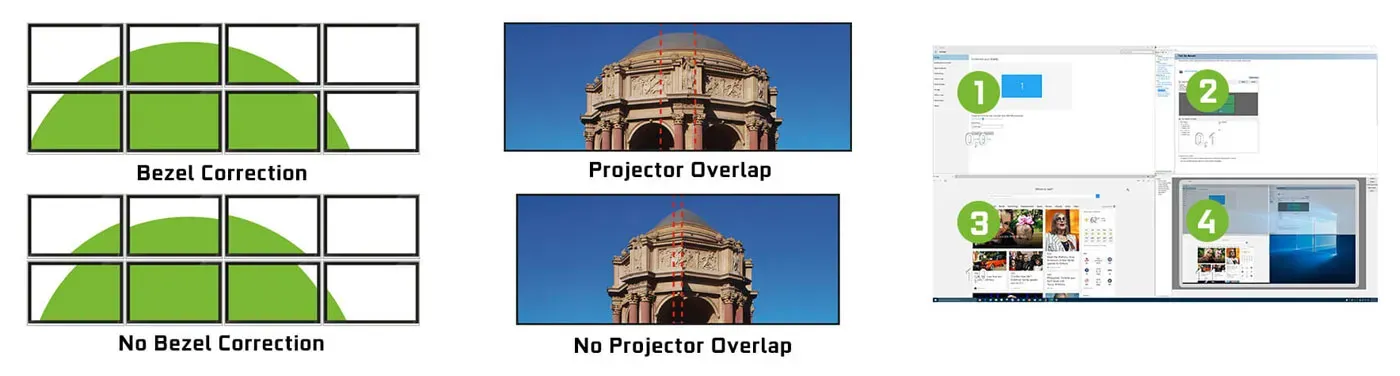
Mosaic Spans 16 Displays Across 4 GPUs
NVIDIA Mosaic Technology scales one desktop and its applications across up to 4 GPUs and 16 displays from a single workstation while holding performance and visual quality. For control rooms, simulators and visualisation walls, that turns a bank of separate screens into a single continuous canvas the operating system treats as one display.
Mosaic Spans 16 Displays Across 4 GPUs
NVIDIA Mosaic Technology scales one desktop and its applications across up to 4 GPUs and 16 displays from a single workstation while holding performance and visual quality. For control rooms, simulators and visualisation walls, that turns a bank of separate screens into a single continuous canvas the operating system treats as one display.
Four 5K Or Dual 8K Displays At 60Hz Per Card
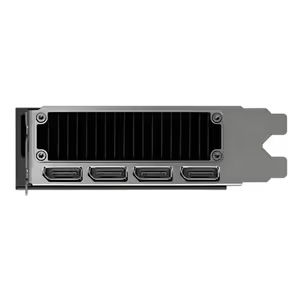
DisplayPort 1.4a connects up to four 5K monitors at 60Hz, or dual 8K displays at 60Hz per card, with HDR colour supported through 4K at 60Hz HEVC decoding. NVIDIA Quadro Sync II synchronises the output of up to 32 displays from 8 GPUs in one system, each frame lock connector self-locks onto its cable, and Mosaic topologies reach a maximum desktop size of 32K with OpenGL Quad Buffered Stereo available for professional 3D stereo.
Four 5K Or Dual 8K Displays At 60Hz Per Card
DisplayPort 1.4a connects up to four 5K monitors at 60Hz, or dual 8K displays at 60Hz per card, with HDR colour supported through 4K at 60Hz HEVC decoding. NVIDIA Quadro Sync II synchronises the output of up to 32 displays from 8 GPUs in one system, each frame lock connector self-locks onto its cable, and Mosaic topologies reach a maximum desktop size of 32K with OpenGL Quad Buffered Stereo available for professional 3D stereo.
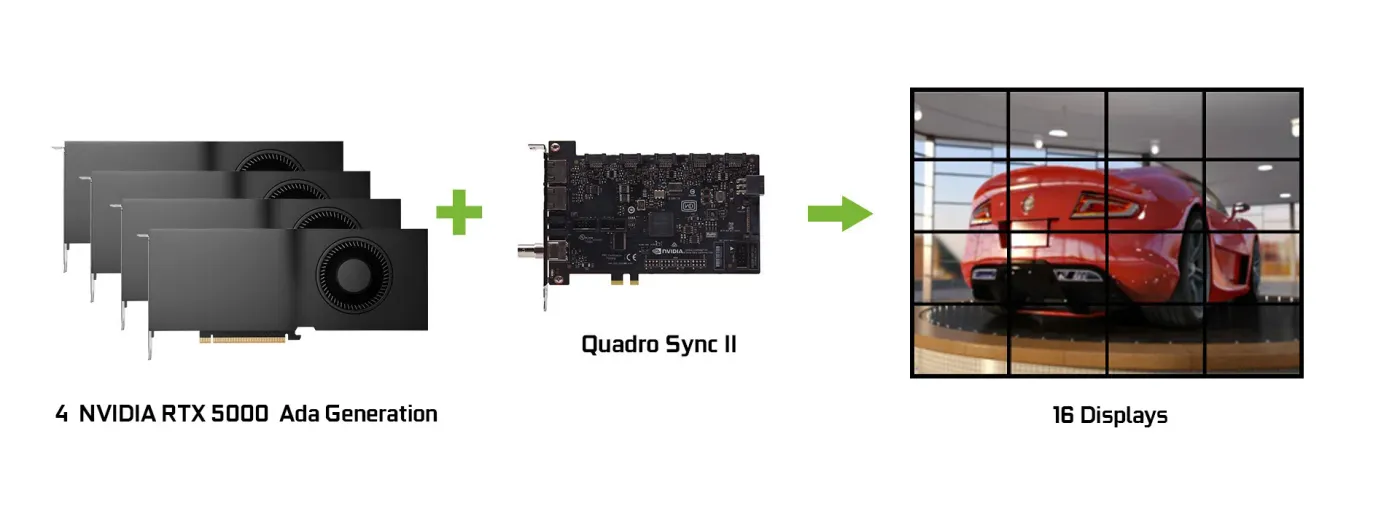
vGPU, CUDA And Deep Learning Library Support
NVIDIA Virtual GPU (vGPU) software repurposes a workstation into multiple high-performance virtual instances for shared design, AI and compute work. NVIDIA RTX Experience adds 8K desktop recording and alerts for new NVIDIA RTX Enterprise driver updates, the CUDA platform runs C/C++ and Fortran alongside OpenCL, OpenACC and Direct Compute, and a 49-bit unified virtual address space migrates data between CPU and GPU memory.
vGPU, CUDA And Deep Learning Library Support
NVIDIA Virtual GPU (vGPU) software repurposes a workstation into multiple high-performance virtual instances for shared design, AI and compute work. NVIDIA RTX Experience adds 8K desktop recording and alerts for new NVIDIA RTX Enterprise driver updates, the CUDA platform runs C/C++ and Fortran alongside OpenCL, OpenACC and Direct Compute, and a 49-bit unified virtual address space migrates data between CPU and GPU memory.
FAQ
Frequently Asked Questions
Everything you need to know about this product
It has 32GB of dedicated GDDR6 graphics memory.
The RTX 5000 Ada Generation has 12,800 CUDA cores.
It carries 100 third-generation RT Cores.
It has 400 fourth-generation Tensor Cores.
It is built on the NVIDIA Ada Lovelace architecture.
Yes. Error Correcting Code (ECC) graphics memory ensures strict data integrity.
DisplayPort 1.4a supports up to four 5K monitors at 60Hz or dual 8K displays at 60Hz per card.
Yes. NVIDIA SLI Technology lets multiple GPUs work together for more performance and display capability.
It supports PCI Express Gen 4, which doubles data bandwidth compared to prior generations.
Yes. The 8th generation NVENC engine handles 4K and 8K video and adds AV1 encoding.
The 5th generation NVDEC engine gives hardware-accelerated decoding of multiple codecs for real-time video processing.
NVIDIA Virtual GPU software turns a workstation into multiple high-performance virtual instances.

AI-Generated Content: These FAQs are generated by an automated AI system and may contain inaccuracies or omissions. Evetech makes no warranties, express or implied, regarding their completeness or reliability. For definitive information, please refer to the manufacturer's official specifications.
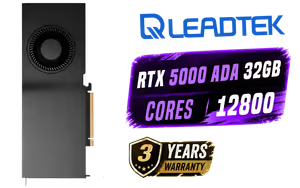
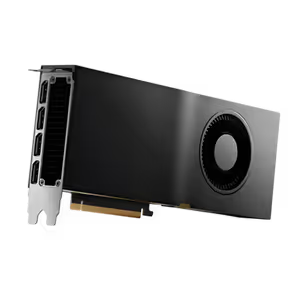
Please Note: Product images are for illustrative purposes only and may differ from the actual product.
Choose your
own PC
Hand-pick every part with live stock, compatibility, and instant pricing.
Try the new builderPrice Inc. Vat
R 97,699
Save R 12,300
ListR 109,999
97699Free Delivery
Qty:
In Stock with Evetech
Choose your
own PC
Hand-pick every part with live stock, compatibility, and instant pricing.
Try the new builderLeadtek NVIDIA RTX 5000 ADA 32GB GDDR6 Workstation Graphics