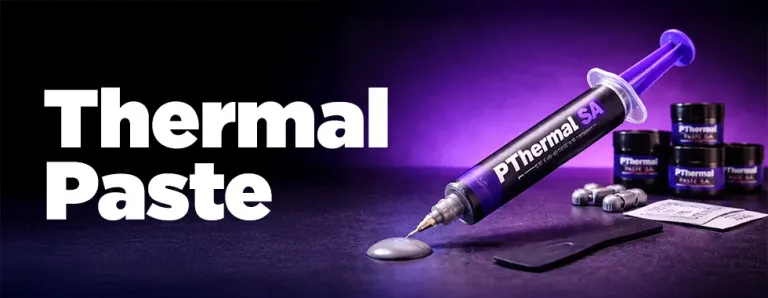
The Thin Layer That Decides Whether a Cooler Works
Two machined metal surfaces pressed together touch only at a scattering of high points, and the gaps between them hold air, which conducts heat poorly. Compound exists to fill those gaps. It is a far worse conductor than the metal on either side of it, so the aim is the thinnest continuous film that leaves no voids, not the most generous covering.
Material follows the job. Silicone, ceramic and carbon compounds are electrically inert and forgiving to apply, metal-loaded pastes buy a small margin in exchange for care around exposed contacts, phase-change film answers the specific problem of paste creeping out of a laptop over time, and pads exist only to bridge deliberate gaps a cooler cannot close. Evetech stocks compounds, pads and cleaning supplies at Limeroc Business Park in Centurion, with delivery to the major centres in one to three business days.
Top 5 Reasons to Buy Gaming Laptops
Gaming laptops offer portability, powerful performance, versatility, advanced features, and future-proofing capabilities, making them an attractive choice for gamers who want to enjoy their favorite titles anywhere, anytime. With their high-performance hardware, advanced features, and flexibility, gaming laptops provide users with a convenient and immersive gaming experience.
Summary: Gaming laptops provide portability, powerful performance, versatility, advanced features, and future-proofing capabilities. They are a popular choice for gamers looking for a convenient and immersive gaming experience without compromising on performance or versatility.
Getting the Layer Right: Amount, Pattern and Material
Most temperature problems blamed on compound are caused by something else, and most compound problems come from using too much rather than too little. The points below cover what genuinely moves the reading on the sensor.
An AMD heat spreader is close to square, and a single central dot spreads evenly outward under mounting pressure. Intel's spreaders are rectangular, so a short line along the long axis reaches the far corners more reliably than a dot. Independent comparisons of sensible patterns land within about a degree of one another once coverage ends up complete, which means completeness matters and artistry does not. A bare die on a laptop or graphics processor is far smaller and wants a measured amount, because any surplus runs off the edge onto the components beside it.
The watts-per-metre-kelvin number is taken from a sample far thicker than the film you will create. Once the cooler is torqued down, that film is a few microns of material squeezed between two surfaces that are never perfectly flat, and differences that look decisive on the packaging compress into a degree or two on a thermometer. Read it as a rough tier marker separating budget from premium, not as a ranking.
Silicone, ceramic and carbon-loaded formulations do not conduct electricity, so a smear that escapes onto the board is a cleaning job rather than a dead component. Metal-loaded pastes gain a small thermal margin and demand more care around socket pins and surface-mounted parts. Gallium-based liquid metal is a different category again: it corrodes aluminium on contact, which rules out the base plates and fin stacks used on many mainstream coolers.
Pads bridge deliberate gaps where a cooler or backplate passes over memory chips and power stages that stand shorter than the main die. They are much thicker than a paste layer and conduct less, so they belong nowhere near the processor's main contact patch. Thickness is specified per card in millimetres: too thin leaves an air gap, and too thick lifts the cooler off the die it was meant to touch.
Repeated heating and cooling slowly works ordinary paste outward from between a thin bare die and its heatsink, leaving voids in the middle where the heat is generated. Phase-change film resists this because it stays solid at room temperature and only softens around 45 degrees, so it cannot be squeezed out the way a paste can. It needs several heat cycles to settle and reads a little worse until it has had them.