Load Shedding Survival Guide
Gaming through load shedding. — Don't let stage 4 take your match.
From a R900 mini-UPS that keeps your fibre alive to a R95 000 hybrid solar build that makes Eskom irrelevant — every SA gamer needs a power plan. This is ours.
- power options
- 4 tiers
- UPS runtime
- 8-15 min
- SA budget range
- R900-R95k
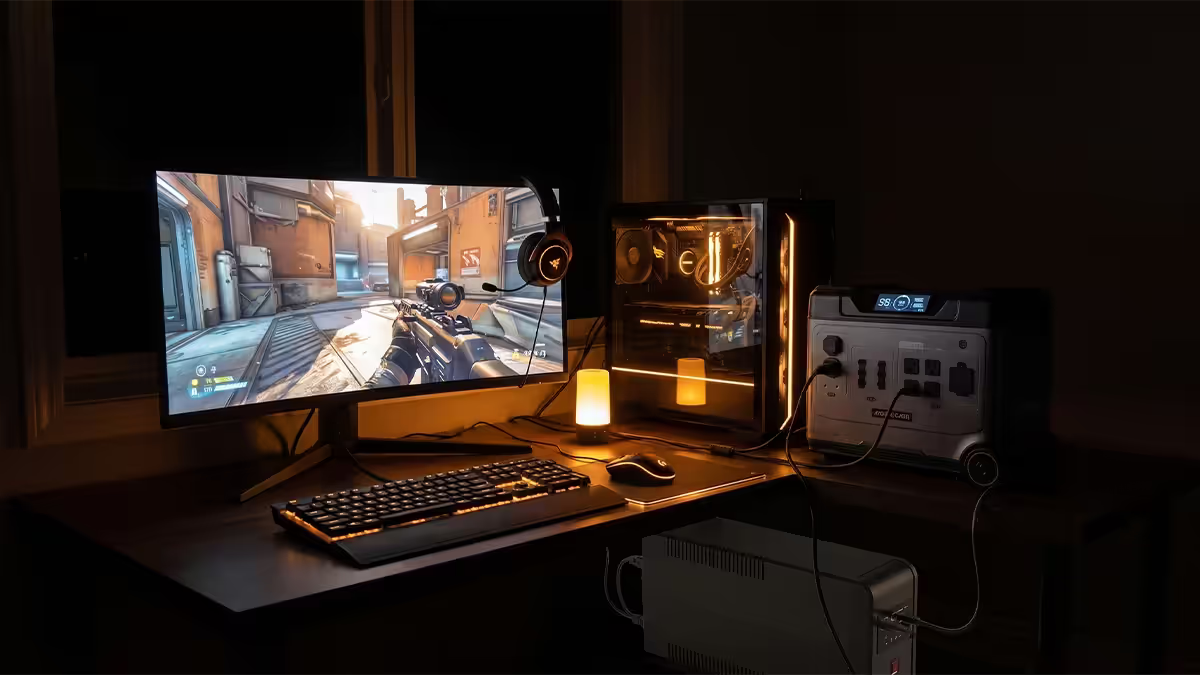
UPS tier ladder — 300VA to 3000VA

A UPS (uninterruptible power supply) is the first line of defence — and the cheapest. Its job isn't to keep you playing forever; it's to give you enough runtime to save and shut down without losing progress or corrupting drives.
| UPS size | Runs | Runtime | SA price |
|---|---|---|---|
| 300VA / 180W | Router + ONT only | 4-8 hours | R900-R1 500 |
| 600VA / 360W | Router + monitor + console | 20-40 min | R1 600-R2 400 |
| 1500VA / 900W | Full gaming desktop (mid) | 8-15 min | R2 800-R3 800 |
| 3000VA / 1800W | High-end PC + 2x monitors | 10-20 min | R6 500-R9 500 |
Always pure sine wave. Modified-sine UPS units are R400-R800 cheaper but stress modern PC PSUs, cause coil whine and trigger random shutdowns. Every reputable SA brand — RCT Megapower, Mecer Axpert, Mustek Sinetech, APC, Eaton — sells pure sine across the line. If a spec sheet doesn't say "pure sine wave" explicitly, walk away.
The line-interactive vs online double-conversion debate matters less for gaming than for servers. Line-interactive switches over in 4-10 ms — barely a flicker on a modern PC PSU. Online is gentler on hardware but costs roughly 2x. For a home rig, line-interactive is the right call.
Inverter + battery — for stage 4-6 sessions
When you want to play through the 2-hour outage rather than just shut down before it, you graduate from UPS to a proper inverter + battery setup. This is where SA gamers diverge from the rest of the world.
The SA inverter market
Three brand families dominate the local space:
- RCT Megapower (1kVA, 2kVA, 3kVA) — local SA brand, R6 500-R14 000 inverter-only. Easiest to get warranty serviced.
- Mecer Axpert VM / King (1-5kVA) — workhorse pure-sine inverters with built-in MPPT for later solar expansion. R8 500-R22 000.
- Mustek Sinetech (1-5kVA) — broad range, often best price-per-kVA. Strong dealer network in JHB / Centurion / Pretoria East.
Pair with a 100Ah LiFePO4 lithium battery (Pylontech US3000C, Hubble AM-2, RCT Lithium Wall) for 5-7 years cycle life, or two 100Ah deep-cycle gel batteries for the budget route (3-4 years). Lithium is roughly 2.5x the upfront cost but 4x the cycle life — long-term it's cheaper and lighter.
Hybrid solar — the end game
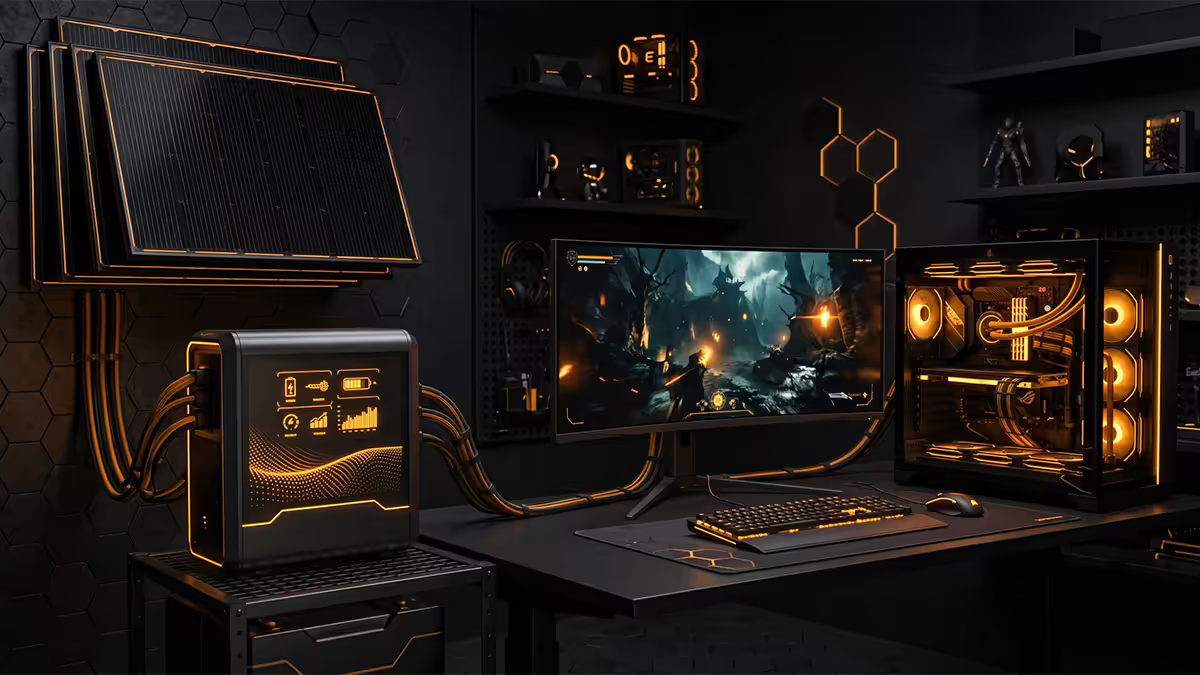
A hybrid inverter system charges from the grid and solar, with battery backup for outages and the ability to feed surplus back into the home. For SA gamers who can afford the capex, this is the only setup that makes Eskom truly invisible.
Entry-level hybrid (R65k-R95k installed)
- Deye 5kW hybrid inverter or Sunsynk 5kW — the two most-installed hybrid inverters in SA.
- 5-10 kWh lithium battery (Pylontech, Dyness, Hubble, Freedom Won) — runs essentials including a gaming desktop + monitor + fibre + lighting for 4-6 hours.
- 4-6x 550W solar panels on the roof (2.2-3.3 kWp) — daytime gaming runs free, battery recharges by mid-afternoon.
Full off-grid capable (R150k-R280k installed)
- Deye / Sunsynk 8-12kW hybrid + 15-20 kWh battery + 8-12 panels.
- Geyser, gaming, kitchen and HVAC all run through outages. Solar contributes 60-80% of annual usage depending on Joburg / Cape Town / Durban irradiance.
- Payback period 4-7 years at current Eskom tariffs (and shorter every time they increase).
The hidden gaming benefit: a properly configured hybrid system runs at constant clean voltage even during grid switchover. No millisecond flicker, no PSU stress, no UPS click-over. Your game doesn't even know load shedding started.
Gaming laptops — the built-in cheat code
The simplest load-shedding-proof gaming setup is one most SA gamers overlook: a gaming laptop with a strong battery. Since 2023, RTX 4060 and 4070 mobile chips combined with 80-99 Wh batteries have shifted what's possible.
Real-world runtimes (unplugged, full-load gaming):
- RTX 4050 / Ryzen 7 7735HS laptop (R18-25k): 90-150 min on medium settings at 60fps.
- RTX 4060 / Core i7-13700H laptop (R24-32k): 60-110 min on high settings at 1080p.
- RTX 4070 / 4080 mobile (R32-55k): 45-90 min on high at 1440p — battery saver mode extends to 2 hours on lighter titles.
Add a 600VA UPS for the fibre router (R1 600) and your stage-4 window becomes invisible — you're playing through it, online, on a laptop, while the desktop crowd shuts down. For SA students and remote workers especially, this is the most cost-effective path to load-shedding immunity.
Keeping fibre alive — the R900 hack
The single most-overlooked load-shedding upgrade in SA: a dedicated 12V mini-UPS for your fibre router + ONT. Combined draw is sub-30W; even a R900 unit gives you 4-8 hours.
Picks:
- RCT 8800 mAh mini-UPS (R900-R1 200) — 5-6 hours, 12V/9V output, the SA default.
- Geewiz / Ellies 10400 mAh router UPS (R1 100-R1 500) — slightly longer runtime, multiple voltage outputs for ONT + router.
- Builder.ai 15000 mAh (R1 600-R2 200) — 8-10 hour runtime, dual USB-C, often supports your laptop too.
The fibre-network reality: at stage 1-4, most SA fibre exchanges (Vumatel, Openserve, Frogfoot, MetroFibre) hold up well — backed by generators and lithium batteries at the FNO level. At stage 6+, exchange outages start cascading: even with your home setup running, the line goes dark when the upstream cabinet does. This is when dual-ISP failover earns its keep.
Save-game discipline — habits that save sessions
Hardware only goes so far. The cheapest load-shedding defence is behavioural.
Install EskomSePush — non-negotiable
EskomSePush tells you your area's exact schedule, current stage and active alerts. Enable notifications 30 and 15 minutes before outage. Premium tier (R20/month) unlocks home-zone monitoring and shared schedules with family — worth every cent for a gamer.
The 15-minute manual save rule
Many modern games autosave generously, but the worst-case games for SA gamers are precisely the ones we love most:
- Soulsborne (Elden Ring, Lies of P, Black Myth Wukong): save at every checkpoint; never start a boss fight with under 25 minutes of grid window.
- Strategy (Civ VII, Total War, CK3): manual save every turn block — the multi-hour campaign has nothing protecting it.
- Online competitive (CS2, Valorant, Apex, Marvel Rivals): a mid-match disconnect is a loss + ranked penalty. Don't queue ranked with under 30 minutes of buffer.
- MMOs (FFXIV, WoW, GW2): auto-saved server-side; you just lose login time. Safest category for load-shedding play.
Dual-ISP failover — for the online competitive crowd
Once you're playing on UPS + battery and your area's fibre exchange is dark, the only thing left is a second internet line on a different network — usually LTE or 5G from a different carrier.
Hardware
- TP-Link ER605 + Omada gateway (R1 800-R2 500) — entry-level dual-WAN with auto-failover, 5-15 second switchover.
- MikroTik hAP ax3 (R2 200-R3 000) — SA-darling brand, programmable failover, runs your VPN too.
- Ubiquiti Dream Machine SE (R12 000-R15 000) — overkill for most homes but the cleanest dashboard.
Backup LTE / 5G line
- MTN Supersonic Uncapped LTE — R349-R549/month, capped at 10-50 Mbps. Adequate for online gaming (low pings to Joburg).
- Vodacom Connect Unlimited — R399-R699/month, broader coverage outside metros.
- Rain 5G (R599/month) — fastest backup but coverage is patchy; check your suburb on the map first.
Latency reality: LTE/5G adds 15-40 ms compared to fibre. For CS2 / Valorant ranked you'll feel it; for Apex, Overwatch, Marvel Rivals it's acceptable. For MMOs and single-player online (D2R, PoE) it's invisible.
Key takeaways
- 1500VA pure sine UPS (R2 800-R3 800) is the right floor for any gaming desktop — 8-15 minutes of save-and-shutdown runtime.
- R900 mini-UPS for the fibre router is the cheapest gaming-quality-of-life upgrade in SA.
- 2kVA inverter + 100Ah LiFePO4 (R15-R22k) lets you play through stage 4-6 outages.
- Hybrid solar (Deye / Sunsynk 5kW + battery from R65k) makes Eskom invisible — payback 4-7 years.
- RTX 4060/4070 gaming laptops with 99Wh batteries run 60-120 min unplugged — cheapest immunity path.
- EskomSePush + 15-minute manual save habit + no ranked queue within outage window = no lost matches.
- Dual-ISP with LTE/5G failover (TP-Link ER605 + Rain/MTN) covers stage-6 exchange outages.
Frequently asked questions
What size UPS do I need for gaming during load shedding?
For a typical gaming PC (450-650W draw at full load) you need at minimum a 1500VA / 900W pure sine wave UPS — that gives you 8-15 minutes of runtime to save and shut down cleanly. A 600VA line-interactive UPS is only adequate for the router, monitor and a console-class PC at idle. For 2-hour stage-4 windows you're looking at an inverter + battery system from R12 000, or a 3000VA UPS stack.Can my gaming PC run on an inverter and battery?
Yes, but specifically a pure sine wave inverter — modified sine fries PC PSUs. The RCT Megapower 1kVA / 2kVA range, Mecer Axpert VM and Mustek Sinetech inverters are the most common SA picks. Pair with a 100-200Ah lithium battery (LiFePO4) or two 100Ah deep-cycle gel batteries. Expect R15 000-R28 000 for a setup that runs a 600W gaming rig plus monitor and router for 3-4 hours.Will a gaming laptop survive load shedding better than a desktop?
Yes — the built-in battery is effectively the best UPS money can buy. A modern RTX 4060/4070 gaming laptop unplugged runs 60-120 minutes of gameplay on internal battery alone (less at full GPU load, more on light titles). Add a small 600VA UPS for the router and you can game through entire stage-4 windows without disruption. This is why many SA gamers have shifted laptop-first since 2023.How do I keep my fibre router running during load shedding?
A dedicated 12V mini-UPS for the router and ONT (sub-30W combined draw) is the cheapest power-cut hack in SA — R900-R1 500 from RCT or Geewiz, runs 4-8 hours. If your fibre ISP also keeps their street cabinets and exchange on backup (Vumatel, Openserve and Frogfoot mostly do during stages 1-4), you stay online the entire window. Above stage 6, exchange-level outages become common regardless of your home setup.Will save-game progress be lost if the power cuts mid-game?
Yes, in single-player it cuts you back to the last save checkpoint — which can be 15-90 minutes of lost progress in games without autosave. The discipline: check EskomSePush before starting a session, manually quicksave every 10-15 minutes, and avoid starting a long Elden Ring boss run with 20 minutes to load shedding. In online competitive (CS2, Valorant, Apex) a mid-match disconnect is a loss and ranked penalty — schedule ranked sessions outside outage windows.Is solar worth it just for gaming?
Not on its own — but as part of a household hybrid inverter and 5-10 kWh battery setup, gaming becomes invisible to load shedding. Entry-level hybrid systems (Deye 5kW + 5kWh battery + 4-6 panels) start around R65 000-R95 000 installed in SA. Payback period of 4-7 years depending on Eskom tariff and stage frequency, but the lifestyle value (uninterrupted work, gaming, fridge, geyser scheduling) is what most SA buyers actually pay for.What is dual-ISP failover and do I need it for online gaming?
Dual-ISP means having both fibre and an LTE/5G backup line, with a router (TP-Link ER605, MikroTik hAP ax3, Ubiquiti Dream Machine) that auto-fails over when fibre drops. For competitive online gamers this is the difference between a ranked penalty and finishing the match when your ISP's exchange goes dark at stage 6. Budget R350-R600/month for an MTN/Vodacom/Rain unlimited LTE line as your backup.Does running a PC on an inverter damage components?
Only if the inverter is modified sine wave instead of pure sine wave. Modern PC PSUs (especially 80+ Gold and above) expect a clean sine and can have capacitor stress, coil whine or shutdown issues on dirty power. Every reputable SA brand we stock (RCT Megapower, Mecer Axpert, Mustek Sinetech, Deye, Sunsynk) is pure sine — confirm "pure sine wave" in the spec sheet before buying anything cheaper from a marketplace.
Get the Evetech app
Exclusive app-only prices, daily flash sales, and free delivery on orders over R4,000 — download the app and start saving.