SA Gaming ISP Buying Guide
Best ISPs for gaming in SA. — Ping over megabits. Always.
You don't need a gigabit line. You need clean peering, no throttling, and a 5ms route to the Teraco JB1 cabinet that hosts your CS2 server. Most South African gamers buy on the wrong axis.
- JHB ping target
- 3-8ms
- enough for any gamer
- 200 Mbps
- gaming-grade line
- R599-R999

Fibre infrastructure vs ISP — the SA distinction nobody explains
The single most confusing thing about buying internet in South Africa is that there are two completely separate companies involved, and gamers consistently confuse them. Get this distinction right and the rest of the guide makes sense.
The fibre running into your wall is owned by a fibre network operator (FNO) — Vumatel, Openserve, Frogfoot, Octotel, MetroFibre or Link Africa. They wired your suburb, they maintain the underground cable, and they own the optical line terminal (OLT) in the local exchange. You do not choose your FNO — whoever cabled your street is whoever you get.
The internet on top of that fibre is sold by an ISP — Cool Ideas, Afrihost, RSAWeb, Webafrica, Mweb, Vox, Axxess, and dozens of smaller operators. They lease capacity from the FNO and resell it with their own routing, peering and support. This is where your gaming experience is determined.
| Layer | Who owns it | What it controls |
|---|---|---|
| Fibre to the home (FTTH) | FNO — Vumatel, Openserve, Frogfoot, Octotel, MetroFibre, Link Africa | Raw line speed cap, physical reliability |
| Internet service | ISP — Cool Ideas, Afrihost, RSAWeb, Webafrica, Mweb, Vox | Ping, peering, throttling, support, billing |
| Router / Wi-Fi inside your home | You | Last-mile Wi-Fi quality, LAN routing |
What actually matters for gaming (it's not megabits)
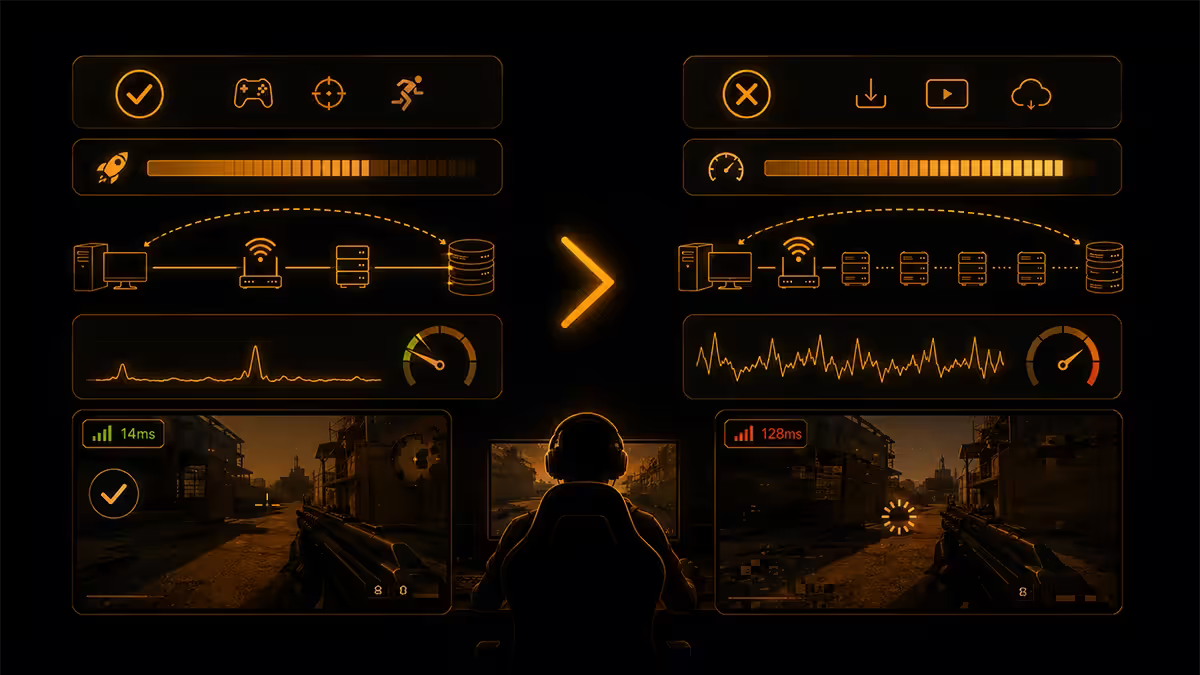
Most ISP marketing leads with line speed — "1 Gbps! Uncapped!" — because it's the easiest spec to compare and the easiest to oversell. For gaming, line speed past 50 Mbps is largely irrelevant.
Here's what actually moves the needle:
- Ping (latency) — round-trip time from your machine to the game server. 5ms is excellent, 30ms is acceptable, 80ms+ is competitively unplayable.
- Jitter — variation in ping between packets. A line averaging 8ms with 0.5ms jitter feels far smoother than one averaging 6ms with 15ms jitter.
- Packet loss — percentage of game-state packets dropped en route. Anything above 0.1% is felt in shooters; above 1% is unplayable.
- Peering — whether your ISP has direct links to Steam, Microsoft, Riot, Valve and Epic, or has to route via upstream transit.
- Contention ratio — how many neighbours share your trunk capacity at peak. Cheap ISPs oversell aggressively, causing 18:00-22:00 lag spikes.
Notice that line speed isn't on the list. A 50 Mbps line with 4ms ping and zero jitter will beat a 1 Gbps line with 40ms ping and 15ms jitter in every competitive title. Bandwidth gets you faster Steam downloads. Latency gets you headshots.
SA ISP gaming rankings — 2026
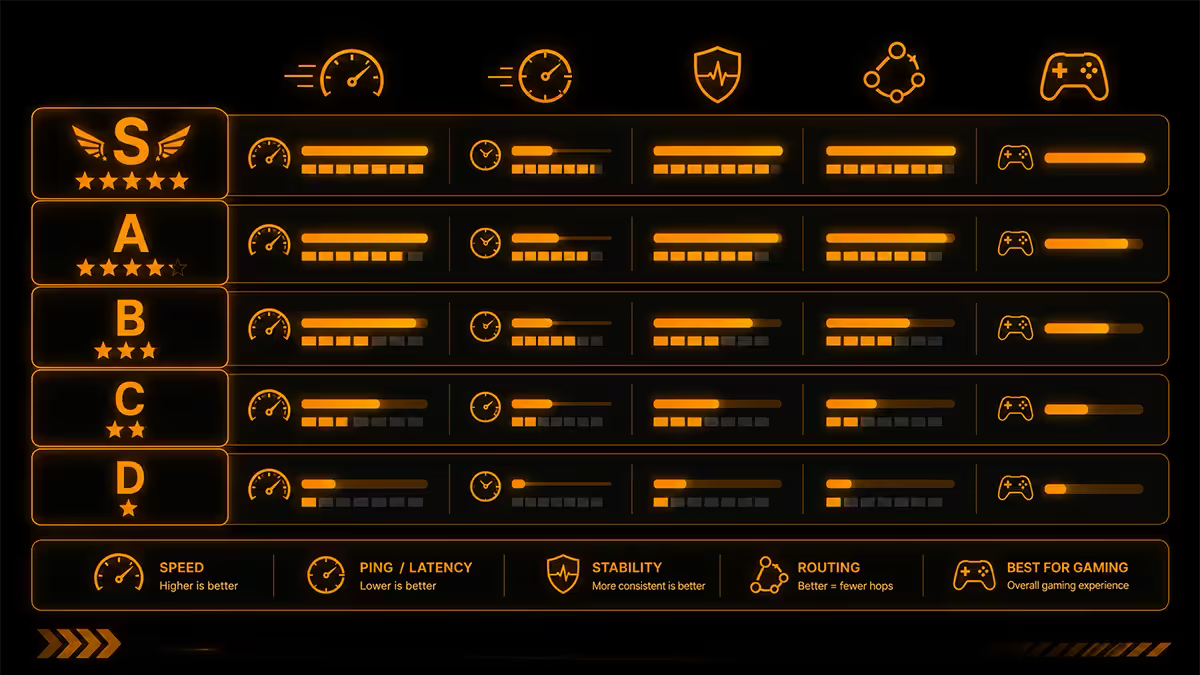
These rankings reflect real-world gamer experience across CS2, Valorant, League of Legends, Dota 2, PUBG and Apex Legends on JHB-hosted servers. Cape Town and Durban gamers will see consistent rankings but slightly higher absolute ping due to backbone distance.
Tier 1 — Premium gaming ISPs
| ISP | JHB ping | Strengths |
|---|---|---|
| Cool Ideas | 3-5ms | Best-in-class peering, no throttling, gamer-built community |
| RSAWeb | 3-6ms | Premium routing, enterprise-grade SLA, expensive but solid |
| Afrihost Pure Fibre | 4-7ms | Strong peering, mature support, best price in tier 1 |
Cool Ideas is the runaway favourite among the SA competitive scene. They peer directly with NAPAfrica at Teraco, Steam, Microsoft, Riot, Valve and Cloudflare. The community on MyBroadband and the Cool Ideas Discord is essentially a real-time peering watchdog — if routing degrades for 90 seconds, somebody posts about it. They cost roughly R699/month for 100 Mbps and R799/month for 200 Mbps on Vumatel — premium but justified.
RSAWeb targets the enterprise and prosumer market. Ping is essentially identical to Cool Ideas, support is faster (24/7 with named engineers), and prices run 10-15% higher. Worth it if you work from home on the same line and downtime costs you money.
Afrihost Pure Fibre is the smart-money pick. Peering is 90% as good as Cool Ideas, prices undercut by R50-R100/month, and the support quality has improved markedly since 2024. For most gamers this is the rational choice.
Tier 2 — Solid mid-range
| ISP | JHB ping | Notes |
|---|---|---|
| Webafrica | 5-10ms | Decent peering, occasional peak-hour contention, friendly pricing |
| Mweb | 6-12ms | Legacy ISP, improved 2024-2026, mid-tier peering |
| Axxess | 5-10ms | Strong on Vumatel routes, weaker on smaller FNOs |
| Vox | 6-12ms | Better for business than gaming, fine for casual play |
These ISPs are perfectly fine for the casual or semi-competitive gamer. You'll hit 5-10ms on a good day and 12-15ms during peak. For ranked play in CS2 or Valorant Champion-tier, you'll notice the difference vs Cool Ideas; for everything else, the ping cost is negligible and the rand saving is real.
Tier 3 — Avoid for serious gaming
Telkom Mobile Fibre, MTN Fibre, rain 101 and most discount uncapped products. The actual fibre line may be fine, but routing is typically via congested transit, peering is minimal, and peak-hour throttling is the norm. Fine for streaming Netflix; painful for ranked Valorant.
Peering and the Teraco / NAPAfrica story
NAPAfrica is the largest internet exchange point on the African continent, hosted inside Teraco's JB1, CT1 and DB1 data centres. It's where ISPs, content networks (Steam, Microsoft, Riot, Netflix, Cloudflare, Google, Akamai) and game-server operators physically interconnect.
When a Tier 1 ISP "peers" at NAPAfrica with Steam, the path looks like this:
Your house → ISP edge router → NAPAfrica switch → Steam servers — three hops, sub-5ms.
When a tier-3 ISP doesn't peer there, the path is:
Your house → ISP edge router → upstream transit (often via international cable) → back to SA → Steam servers — eight to twelve hops, 30-80ms, and congested during evening peak.
Same physical fibre, same line speed, vastly different gaming experience. This is the single most important spec nobody mentions in mainstream ISP marketing.
Throttling — the truth about "uncapped"
"Uncapped" in South Africa has a long, ugly history. The word implies unlimited usage with no traffic management, but the legal reality is that ISPs are allowed to deprioritise, shape and throttle traffic on uncapped plans — as long as they disclose it somewhere in the T&Cs.
Tier 1 fibre ISPs (Cool Ideas, Afrihost Pure Fibre, RSAWeb) do not throttle. They publish their AUPs prominently and stand by them. You can hammer the line at 100 Mbps for 30 days straight and your ping at hour 720 looks like hour 1.
Discount "uncapped" mobile-LTE and budget DSL successors almost universally throttle. The pattern is consistent: full speed until you cross a soft cap (often 200-500 GB), then aggressive shaping — UDP gaming traffic deprioritised, video downgraded, P2P starved. Combine that with peak-hour cell contention and you get the classic 19:00 lag spike.
Speed tiers and ZAR pricing — 2026
Here's the realistic range for tier 1 ISPs (Cool Ideas, Afrihost Pure Fibre, RSAWeb) on Vumatel or Openserve infrastructure as of mid-2026. Prices vary R50-R150 between FNOs.
| Line speed | Monthly price (tier 1) | Best for |
|---|---|---|
| 50 Mbps uncapped | R499-R599 | Solo gamer, light streaming |
| 100 Mbps uncapped | R599-R799 | Gamer + 1080p Netflix, 1-2 person household |
| 200 Mbps uncapped | R699-R999 | The gamer sweet spot — covers any realistic household |
| 500 Mbps uncapped | R999-R1,399 | Streamer / content creator with 4K uploads |
| 1 Gbps uncapped | R1,299-R1,899 | Tech showroom flex, large multi-gamer household |
For almost every gamer, the right answer is the 200 Mbps tier on a tier 1 ISP. It costs about R200/month more than the budget 100 Mbps options, removes any concurrent-user friction (someone downloading on Steam while you queue ranked is invisible), and you'll never look at the line again. The jump to 500 Mbps or 1 Gbps adds zero gaming benefit and only pays off if you regularly upload large video files.
Mobile fibre, 5G and LTE — when (and when not) to use them
rain 5G has matured significantly since 2024. On a clean tower line-of-sight in Gauteng, expect 20-40ms ping to JHB game servers, R699/month, no contracts. The catch is variability — same connection can spike to 200ms on a busy evening with no warning. Fine for casual play and as a backup; not a primary line for ranked.
Telkom Mobile Fibre ranges from "actually fine" in some Centurion / Pretoria suburbs to "actively painful" in oversold areas. If you're considering it, ask three neighbours about their evening ping before signing.
MTN, Vodacom and Cell C uncapped LTE products almost universally fail for competitive gaming. The radio link adds 15-25ms before any routing happens, and peak-hour cell contention adds another 30-50ms on top. They're sold as "uncapped" but in practice they're throttled-uncapped-with-priority-deprioritisation.
The recommendation: if fixed fibre is available at your address, take it. If not, rain 5G is the only mobile/wireless product I'd trust for any kind of competitive play, and only after you've measured ping at your address for a week before committing.
Key takeaways
- Vumatel/Openserve/Frogfoot/Octotel are infrastructure — your ISP (Cool Ideas, Afrihost, RSAWeb) determines your gaming experience.
- Ping, jitter, packet loss and peering matter for gaming. Line speed past 50 Mbps does not.
- Cool Ideas is the competitive favourite. Afrihost Pure Fibre is the value pick. RSAWeb is the no-compromise premium option.
- 200 Mbps on a tier 1 ISP is the gamer sweet spot — R699-R999/month covers any realistic household.
- Skip Telkom Mobile, MTN Fibre, rain 101 and uncapped LTE for ranked play. They throttle and oversubscribe.
Frequently asked questions
Which is the best ISP for gaming in South Africa in 2026?
Cool Ideas for the competitive gamer — direct peering with Steam, Riot, Microsoft and Valve, sub-5ms to JHB, no throttling. Afrihost Pure Fibre is the value alternative. RSAWeb is the premium no-compromise pick.What's the difference between a fibre infrastructure provider and an ISP?
Vumatel, Openserve, Frogfoot and Octotel own the physical fibre. Cool Ideas, Afrihost, RSAWeb etc. sell the internet on top. The ISP determines ping, peering and throttling — not the fibre owner.What ping should I expect from SA gaming servers?
3-8ms to JHB servers on a quality fibre ISP. Cape Town to JHB adds 18-22ms over the national backbone, Durban to JHB is 12-15ms. International servers are 150-250ms.Does fibre line speed matter for gaming?
Not really. 50 Mbps is enough for any online game. Going from 100 Mbps to 1 Gbps does nothing for ping or competitive performance. Gaming is bandwidth-light, latency-heavy.Do SA ISPs throttle gaming traffic?
Quality fibre ISPs (Cool Ideas, Afrihost Pure Fibre, RSAWeb) don't throttle. Budget uncapped LTE and discount providers deprioritise UDP gaming traffic during 18:00-22:00 peak.What is ISP peering and why does it matter for gaming?
Peering is a direct network link between your ISP and game content (Steam, Microsoft, Riot, Valve). Direct peering means lower ping and fewer hops. Cool Ideas and RSAWeb peer aggressively at NAPAfrica in Teraco.Is Telkom Mobile or rain 5G good enough for gaming?
For casual play yes, for competitive no. rain 5G can hit 30-60ms on good days but spikes wildly at peak. Fixed fibre on a tier 1 ISP is the only reliable competitive option.How much does a gaming-grade fibre line cost in SA in 2026?
100 Mbps on Cool Ideas, Afrihost Pure Fibre or RSAWeb is R599-R799/month. 200 Mbps is R699-R999. Budget around R800/month for a no-compromise gaming line.