Future Tech · GPU Timing 2026
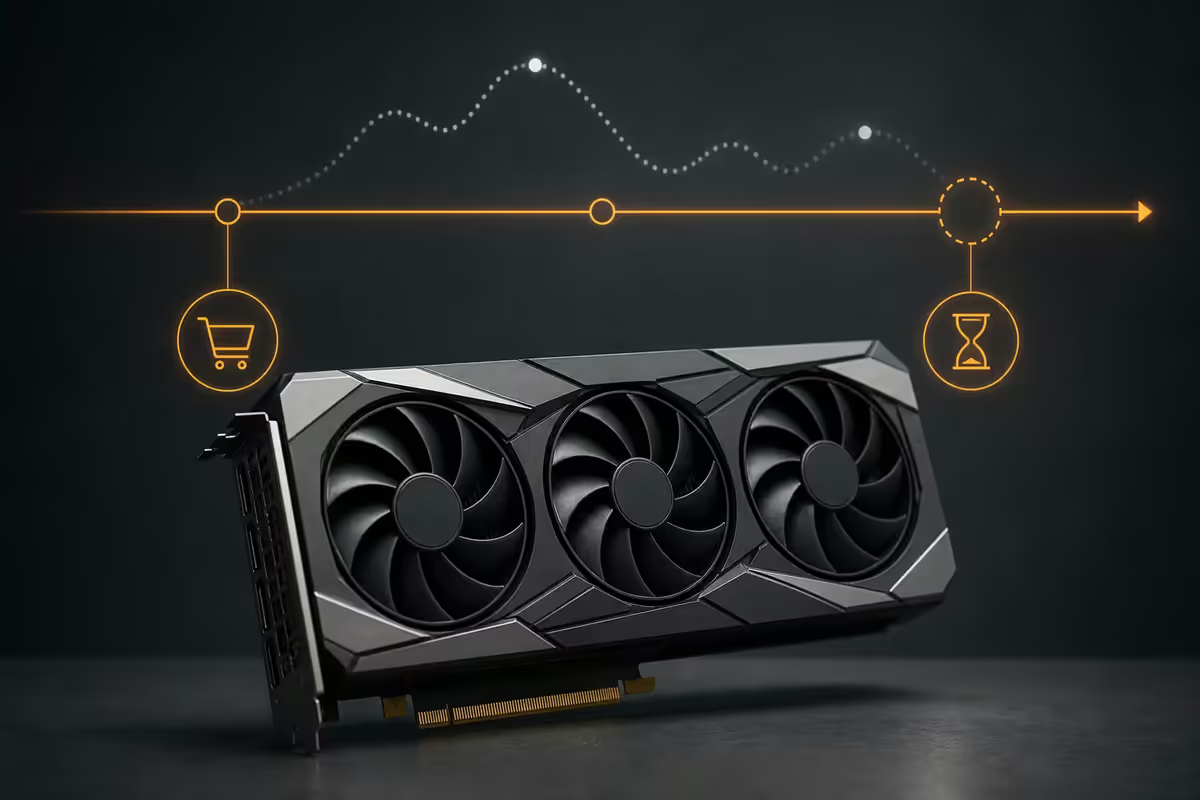
Is now a good time to buy a GPU? — Probably. The perfect window is a myth.
The RTX 50 series is mid-cycle. RX 9000 is mature. Rumours of an RTX 50 Super refresh are real. The ZAR moves daily. Here's how to time the buy without losing your mind — or 6 months of gameplay.
- RTX 50 launched
- Q1 2025
- to Super refresh
- ~18 mo
- Super perf gain
- 10-15%
The 2026 GPU landscape — where we actually are
Mid-2026 is an unusually clear moment in the GPU cycle. RTX 50 series launched in January 2025 with the RTX 5090, 5080, 5070 Ti and 5070, followed by RTX 5060 Ti and 5060 through the year. AMD's RX 9000 series (RX 9070 XT, RX 9070, RX 9060) launched in March 2025 and is now mature, well-driven and consistently in stock.
What this means in practice: you can go to Evetech, Wootware or Rebel Tech right now and buy a flagship-tier GPU at MSRP-adjacent pricing, without the launch-month scalping or stock shortages that defined Q1 2025. Inventory is healthy. Driver maturity is high. Pricing has normalised.
Compared to the disaster years of 2020-2022 (the great GPU shortage with crypto inflation) and the messy 2023 RTX 40 launch (overpriced 4070 Ti, awkward 4060 8GB), mid-2026 is one of the calmest, most rational moments to buy a GPU in years.
The complication is rumours. RTX 50 Super refresh leaks are circulating. RX 9070 XT prices fluctuate week-to-week. The temptation to wait one more month for a better deal is constant. The bulk of this guide is helping you reason about whether that wait pays off or not.
RTX 50 Super — what's likely and what's hype
Nvidia has refreshed mid-cycle for the past two generations (RTX 20 Super in 2019, RTX 40 Super in 2024) on a roughly 18-24 month cadence after the original generation launch. RTX 50 launched January 2025. An RTX 50 Super refresh in late 2026 or early 2027 fits the historical pattern exactly.
What's likely from RTX 50 Super, based on prior refreshes:
- 10-15% performance gain per tier vs original RTX 50, mostly from higher clock speeds and slightly more shader units.
- More VRAM on RTX 5070 Super (likely 18GB) — addressing the 12GB criticism of the original RTX 5070.
- Possibly a faster memory bus on RTX 5080 Super (GDDR7 at higher speeds).
- Pricing roughly matching the original tier MSRP — Nvidia rarely undercuts itself on Super pricing.
- No new feature unlocks — DLSS, frame generation and RT cores are already there in original RTX 50.
What's not likely: a generational performance leap (that's RTX 60's job), revolutionary new features, or significantly lower MSRPs.
RX 9000 — the most mature GPU in 2026
AMD's RX 9000 series has been on shelf since March 2025. By mid-2026 the drivers are stable, the supply is consistent, and pricing has settled. The RX 9070 XT in particular is one of the best value GPUs of the generation for SA buyers focused on raster gaming.
| Card | SA street price | Best for |
|---|---|---|
| RX 9060 (8GB) | R7,000-R8,500 | 1080p high-refresh esports |
| RX 9060 XT (16GB) | R9,500-R11,000 | 1080p / 1440p mixed |
| RX 9070 (16GB) | R12,500-R14,500 | 1440p ultra without RT |
| RX 9070 XT (16GB) | R14,500-R17,000 | 1440p ultra, light RT |
What AMD does well in 2026: price-to-raster performance is best in class, more VRAM at every tier than the Nvidia equivalent, FSR 4 is genuinely competitive with DLSS for upscaling (and works on more cards), no AI hype tax baked into pricing.
Where AMD still lags: ray tracing performance is 25-35% behind Nvidia at the same tier, no equivalent to DLSS Ray Reconstruction, weaker software ecosystem for AI/ML workloads, FSR adoption in games is slower than DLSS.
Bottom line: if you primarily play raster-focused games (Counter-Strike 2, Forza, Apex Legends, MOBAs, sports games), RX 9070 XT delivers 95% of RTX 5070 performance for 15-20% less rand. If you play Cyberpunk 2077 Path Tracing, Alan Wake 2 RT, or Black Myth Wukong with full RT — buy Nvidia.
ZAR exchange rate — the unspoken price driver
Every GPU sold in South Africa was imported, paid for in USD or EUR, marked up, and listed in rand. The rand-dollar exchange rate is the single biggest non-product factor in what you pay. It's also the factor most buyers don't track.
Through 2025-2026, USD/ZAR has bounced between R17.80 and R19.80. That's a 10% swing — meaningful when applied to a R20,000 GPU (R2,000 difference in import cost alone). Distributors and retailers price in based on the exchange rate at the time they bought the stock, plus margin, plus VAT.
How fast ZAR changes flow through to retail prices
Rand weakening hits within 30-90 days. When the rand drops 5%, importers absorb the loss on existing stock for the first few weeks (they paid the older rate). Within 8-12 weeks, they're replenishing at the new rate, and retail prices rise. The pass-through is roughly 60-80% of the exchange rate move — distributors and retailers absorb some of the volatility.
Rand strengthening rarely passes through fast. When the rand strengthens 5%, retailers hold prices to clear inventory they bought at the older rate. They earn extra margin instead of passing the saving to consumers. By the time pricing adjusts down, the rand has often moved again. Net effect: weak rand hurts you immediately, strong rand benefits you slowly.
The used GPU market — savings and risks
Used GPUs offer 30-40% savings over new in most categories — a tempting option if you're price-sensitive. The risks are real and often underestimated.
Where SA used GPUs come from
- Upgrade swap-outs: someone bought an RTX 5070 and is selling their RTX 4070. Usually low risk if the card was used for gaming.
- Ex-mining cards: from the 2020-2022 crypto era. Memory modules and fans often abused. Higher failure risk.
- System pull-outs: entire PC sold or cannibalised. Quality depends entirely on prior owner.
- RMA replacements: sometimes refurbished cards re-enter the used market with no clear history.
How to vet a used GPU safely
- Demand a recent GPU-Z screenshot showing the card's name, BIOS version, memory type and clocks. Compare to known-good values for that model.
- Ask for HWInfo or MSI Afterburner logs showing temperatures under load. Anything sustained above 85°C suggests heavy use.
- Inspect physically: dust buildup, scratches, modified fans (replacement fans often signal ex-mining), thermal pad degradation visible from heatsink edge.
- Insist on cash-on-delivery test: install the card, run a 10-minute Furmark or 3DMark stress test before paying. If they refuse, walk away.
- Avoid pickup-only listings with no inspection — the seller can vanish after the deal.
SA reputable second-hand channels: Wootware Pre-Loved, certain Reddit /r/PCSouthAfrica reputable sellers, Carbonite verified-seller listings. Avoid Facebook Marketplace and Gumtree GPU listings unless you can do cash-on-delivery inspection in person.
Across the <strong>200,000+ custom PCs we've shipped from Centurion</strong>, we've watched GPU buying anxiety play out the same way every cycle. Customers wait months for a perfect window, then either miss it entirely or buy something that's barely better than what was available when they started waiting. Our recommendation has stayed the same for years: <strong>if your current GPU works fine, wait for a clearly-defined product launch</strong> (RTX 50 Super qualifies). <strong>If your GPU is failing or you're missing the games you want to play, buy now</strong>. The opportunity cost of waiting 6 months for a modest improvement is bigger than the upgrade itself when those are 6 months of unplayed games.
From our service bench · Behind the Build
When waiting actually saves money
Waiting is rational in specific scenarios. It's irrational in most others. Here's the honest breakdown.
Waiting pays off when:
- A clearly-dated product launch is within 4 months — RTX 50 Super refresh, AMD's RX 9000 mid-cycle refresh.
- Black Friday is within 8-10 weeks — SA retailers' biggest GPU specials happen mid-November.
- The rand has weakened sharply in the past month — wait 6-10 weeks for price adjustment to complete, then buy.
- You're on the edge between two tiers — the 5070 is R2,000 above budget, but a known sale is coming.
- You already have a working GPU that runs everything you currently want to play at acceptable settings.
Waiting costs money when:
- You're waiting for "the next generation" 12+ months out. Hardware refreshes are continuous; you'll always be waiting for something.
- Your current GPU is failing — every week is a week of broken or slow gaming.
- The wait is unspecified — "I'll wait until prices drop" without a defined trigger almost always becomes "I waited 14 months and bought at the same price."
- You're losing months of gameplay — your real opportunity cost is enjoyment lost, not just rands.
- You're hoping for a "perfect" GPU — every generation has compromises. The next one will too.
The perfect buying window myth
"I'll just wait two more months." Every gaming forum has this conversation every week. Two months later, the same forum has the same conversation. The pattern is universal.
The myth is that there exists a perfect buying window where prices are lowest, performance is highest, and stability is guaranteed. This window does not exist. Every era of GPU buying has its compromises: launch-month buyers pay premium for newest tech, mid-cycle buyers get mature products at fair pricing but face refresh anxiety, end-of-cycle buyers get clearance pricing but face obsolescence anxiety.
The honest reframe: there is no perfect window. There is only your tolerance for using a slower GPU while you wait. Quantify the wait in "months without playing what I want" instead of "months until prices drop." That reframes the decision around your actual life rather than a future hypothetical.
Key takeaways
- Mid-2026 is a calm GPU moment. RTX 50 and RX 9000 are mature, well-driven, in stock at MSRP-adjacent pricing.
- RTX 50 Super refresh is rumoured for late 2026 / Q1 2027. Expect 10-15% perf gain at similar pricing — not a generational leap.
- RX 9070 XT is the value GPU of 2026 for raster gaming. 95% of RTX 5070 perf at 15-20% less rand.
- ZAR weakening hits prices in 8 weeks. Strengthening rarely passes through fast. Watch Black Friday.
- The perfect buying window is a myth. Buy when you need it. Wait only for clearly-dated launches within 4 months.
Frequently asked questions
Should I buy a GPU now or wait for RTX 50 Super?
Wait if you can stretch your current GPU another 4-6 months and want the absolute best price-to-performance. RTX 50 Super refresh is rumoured for late 2026 / early 2027 based on Nvidia's historical mid-cycle timing. Don't wait if your current GPU is failing or you're missing months of gameplay — the Super refresh typically improves price-perf by 10-15%, not 50%. The right answer depends on your current rig's health and how much patience your wallet has.Is the RX 9070 XT a good buy right now?
Yes — it's the most mature GPU in the current cycle as of mid-2026. AMD's drivers are stable, supply in SA is consistent, and pricing has settled. RX 9070 XT offers 95% of RTX 5070 raster performance for 15-20% less rand. Trade-off: noticeably weaker ray tracing and DLSS-less. If you primarily play raster-heavy titles (Forza, Counter-Strike 2, Apex Legends), RX 9070 XT is the value buy. If you want path-tracing in Cyberpunk or Wukong, lean Nvidia.How does the ZAR exchange rate affect GPU pricing?
Massively. SA GPU pricing tracks USD/ZAR within 30-90 days of exchange rate moves. The rand was R18.30-R19.50 to the dollar through most of 2025-2026. A 5% rand weakening adds 3-4% to retail GPU pricing within 8 weeks as importers replenish stock at the new rate. Conversely, rand strengthening rarely passes through to lower retail pricing fast — distributors hold price while clearing existing inventory bought at the older rate. Net effect: weak rand hurts you immediately, strong rand benefits you slowly.Is the used GPU market in SA a good source?
Depends on the listing. Carbonite, Bidorbuy and Facebook Marketplace can save you 30-40% on used GPUs but the risk profile is significant. Crypto-mining cards from 2021-2022 may have abused fans and memory modules. Used GPUs typically come with no warranty support. If you're buying used, demand a recent CrystalDiskInfo-equivalent SMART-like dump (GPU-Z stress test screenshot, HWInfo logs), insist on cash-on-delivery inspection, and avoid anything from a mining farm. Going through reputable SA second-hand retailers (Wootware Pre-Loved, certain Evetech traded-in stock) is safer than private sale.What is the perfect buying window myth?
The myth: 'If I just wait two more months, prices will drop / a better card will release / Super refresh will arrive.' Reality: every two months has the same conversation. Hardware refreshes happen annually, mid-cycle refreshes happen 18-24 months in. There is no perfect buying window — there's only your tolerance for using a slower GPU while you wait. If your current GPU is broken or unbearably slow, the perfect time to buy is now. If you have a working GPU and can wait 6 months for a clearly-defined launch, sometimes waiting pays off 10-15%.Are RTX 5090 prices still inflated in SA?
Yes, but less than at launch. Nvidia's MSRP for RTX 5090 was $1,999 USD. SA launch pricing was R44,000-R52,000 due to scalper-buying and limited stock. By mid-2026 pricing has settled to R36,000-R42,000 depending on AIB partner and cooling. Still 15-20% above pure exchange rate-implied pricing because RTX 5090 demand from AI workstation buyers keeps the price up. RTX 5080 ($999 MSRP) has normalised closer to R20,000-R23,000 — far better value per rand.When will RTX 60 series launch?
Nvidia's historical cadence is roughly 2-year generation cycles. RTX 50 launched January 2025; RTX 60 is most likely Q1 2027 based on past releases. Speculation about an earlier launch is exactly that — speculation. A mid-cycle RTX 50 Super refresh is the more realistic late-2026 / early-2027 expectation. If you're trying to time around the next-next generation, you're looking at 18-22 months of waiting. Most buyers aren't willing to wait that long without a working GPU.Should I buy the cheapest GPU now and upgrade in 2 years?
Sometimes. The 'buy cheap, upgrade soon' strategy works if you keep total spend within 90-100% of one mid-range GPU's cost — e.g., R6,000 used GPU now, then R12,000 fresh one in 2 years. It fails if you spend R10,000 on a low-end card and then need R15,000 for the upgrade — at that point you've spent R25,000 for two-year ownership versus R18,000-R20,000 for a single mid-range GPU that lasts the same time.
Get the Evetech app
Exclusive app-only prices, daily flash sales, and free delivery on orders over R4,000 — download the app and start saving.