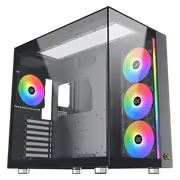
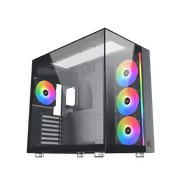
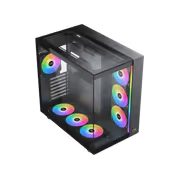
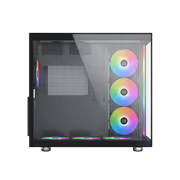
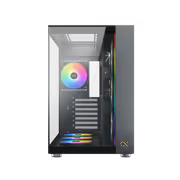
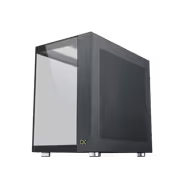
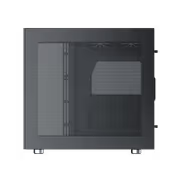
Xigmatek Aqua Ultra Mid Tower Gaming Case
Xigmatek Aqua Ultra RGB ATX Mid Tower Gaming PC Case - Black / 7 x Pre Installed ARGB Fans / EN40672 / EN40672 + FREE DELIVERY !
1 Year Local Warranty
Model No : Xigmatek EN40672
Price Inc. Vat
R 2,399
Save R 900
ListR 3,299
2399Free Delivery
Qty:
In Stock with Evetech
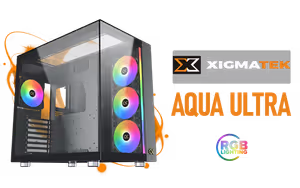
Xigmatek Aqua Ultra RGB EN40672 ATX Mid Tower Case
Mid Tower With Seven Pre-Installed ARGB Fans
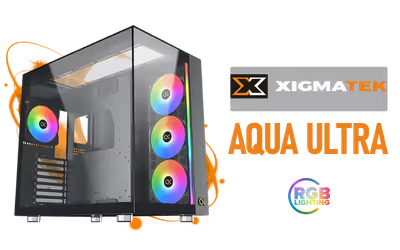
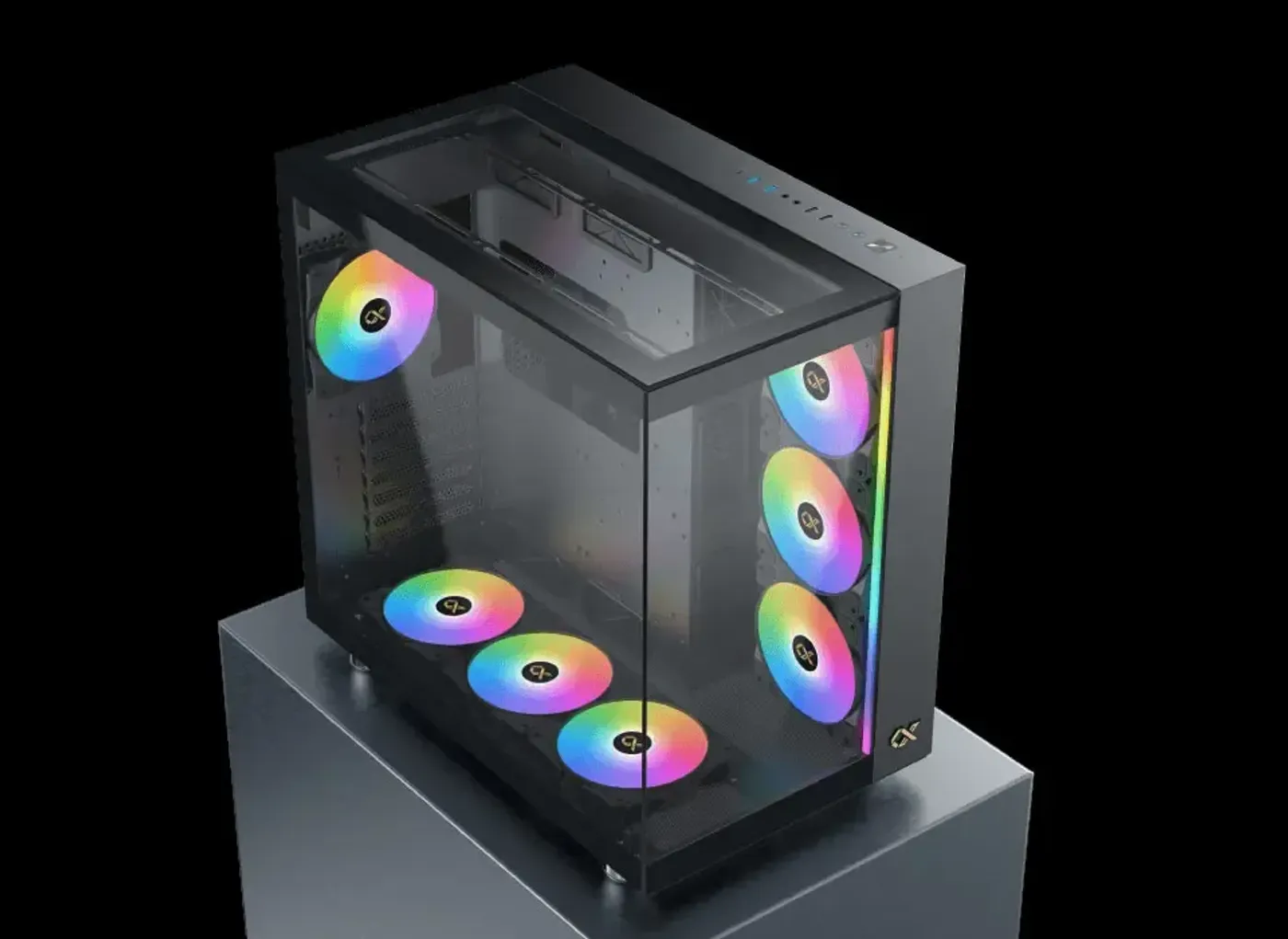
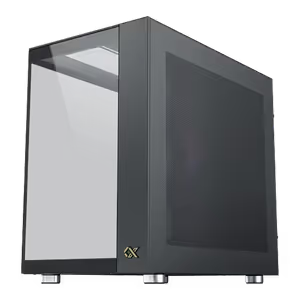
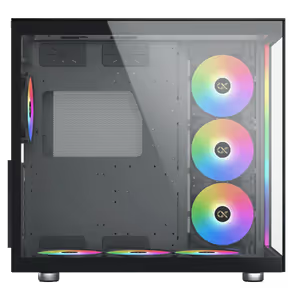
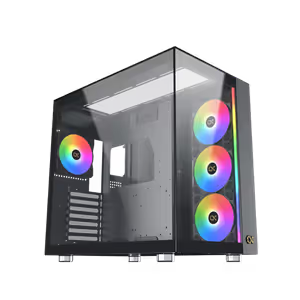
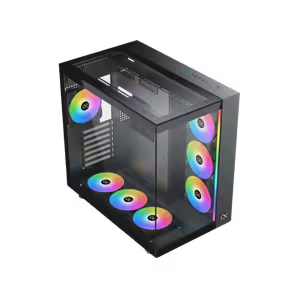
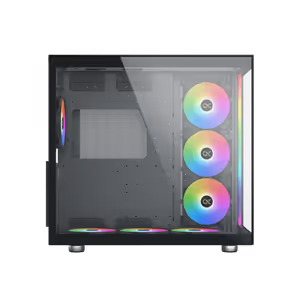
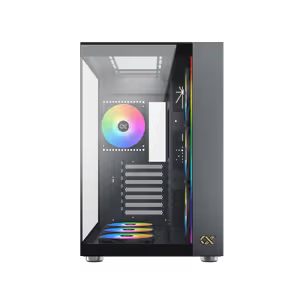
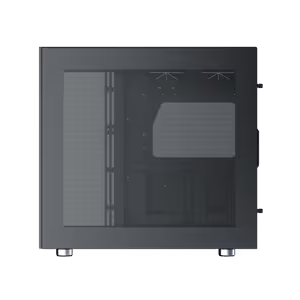
The Xigmatek Aqua Ultra is a black mid tower gaming case that arrives with seven ARGB LED fans already installed, so airflow is handled before you add a single component. It supports liquid cooling and leaves ample room for cables and large parts, which makes it workable for a first build as well as an experienced one. A tempered glass side panel puts the result on show.
Mid Tower With Seven Pre-Installed ARGB Fans
The Xigmatek Aqua Ultra is a black mid tower gaming case that arrives with seven ARGB LED fans already installed, so airflow is handled before you add a single component. It supports liquid cooling and leaves ample room for cables and large parts, which makes it workable for a first build as well as an experienced one. A tempered glass side panel puts the result on show.
Key Clearances For A Full-Size Build
The Aqua Ultra takes motherboards up to E-ATX, CPU coolers to 185mm, power supplies to 220mm and graphics cards to 430mm, with radiator support to 360mm and up to ten fans in total. Those six numbers decide whether a parts list fits, and every one of them sits at the generous end for a mid tower rather than the minimum.
Key Clearances For A Full-Size Build
The Aqua Ultra takes motherboards up to E-ATX, CPU coolers to 185mm, power supplies to 220mm and graphics cards to 430mm, with radiator support to 360mm and up to ten fans in total. Those six numbers decide whether a parts list fits, and every one of them sits at the generous end for a mid tower rather than the minimum.
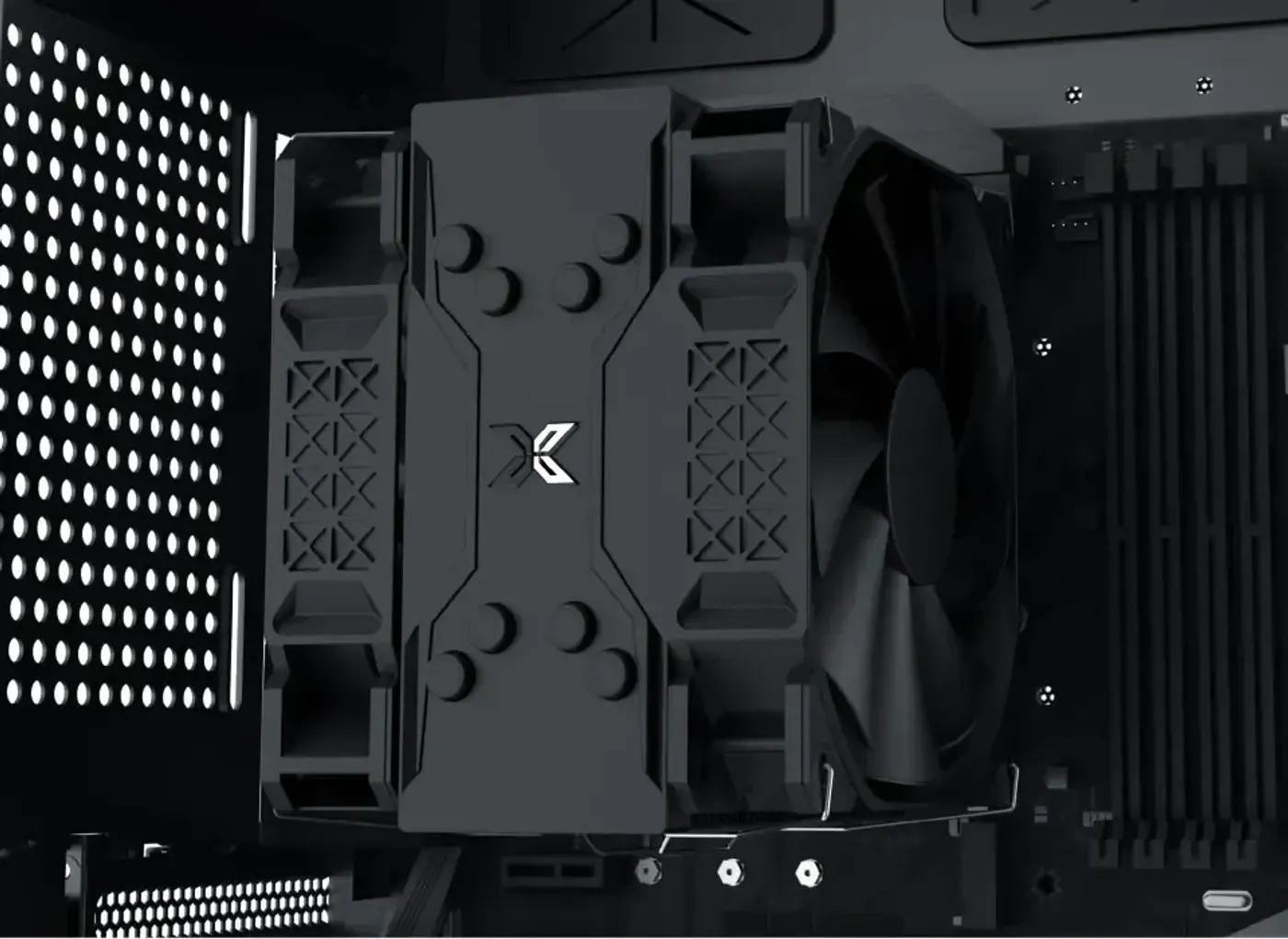
CPU Cooler Clearance Up To 185mm
Cooler clearance runs to 185mm, which is the height figure to check any tower air cooler against before ordering. Getting it right matters because a cooler that fouls the side panel cannot simply be repositioned, and 185mm gives room for the taller dual-tower designs rather than restricting the build to low-profile alternatives from the start.
CPU Cooler Clearance Up To 185mm
Cooler clearance runs to 185mm, which is the height figure to check any tower air cooler against before ordering. Getting it right matters because a cooler that fouls the side panel cannot simply be repositioned, and 185mm gives room for the taller dual-tower designs rather than restricting the build to low-profile alternatives from the start.

Room For A Maximum Of Ten Fans
The chassis supports a maximum of ten fans across its mounting positions, and seven of those are already fitted. Headroom above the supplied count matters because it lets you rebalance intake and exhaust later, once you know how the finished system actually behaves under load, rather than being locked into the layout the case shipped with.
Room For A Maximum Of Ten Fans
The chassis supports a maximum of ten fans across its mounting positions, and seven of those are already fitted. Headroom above the supplied count matters because it lets you rebalance intake and exhaust later, once you know how the finished system actually behaves under load, rather than being locked into the layout the case shipped with.

Power Supply Clearance Up To 220mm
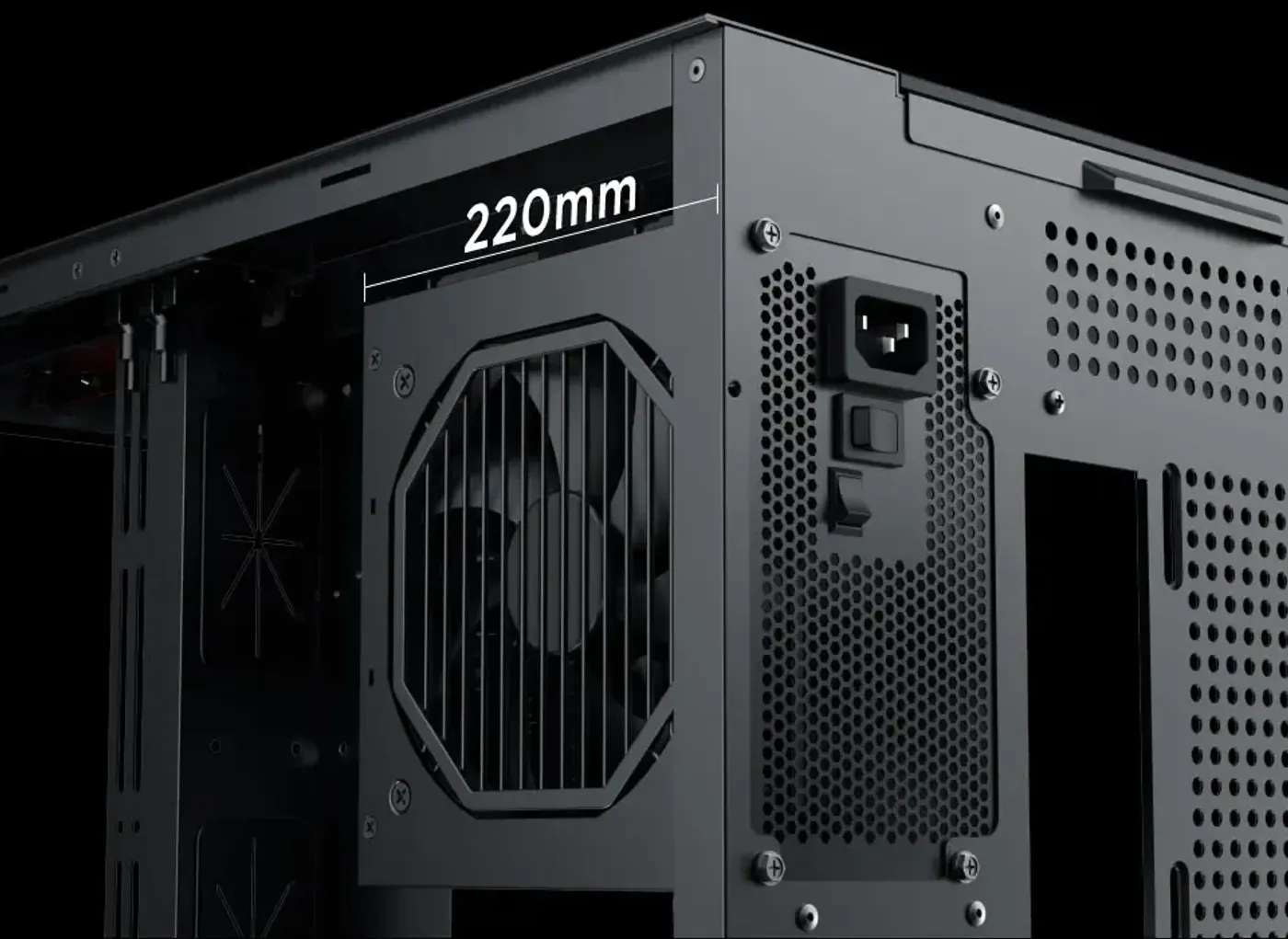
The power supply bay accepts units up to 220mm in length. That is a meaningful margin over a standard ATX unit, and it is what allows a high-wattage supply with a longer body to fit without the cable bundle at the back being crushed against the drive cage. Length is the specification that most often blocks a PSU upgrade.
Power Supply Clearance Up To 220mm
The power supply bay accepts units up to 220mm in length. That is a meaningful margin over a standard ATX unit, and it is what allows a high-wattage supply with a longer body to fit without the cable bundle at the back being crushed against the drive cage. Length is the specification that most often blocks a PSU upgrade.
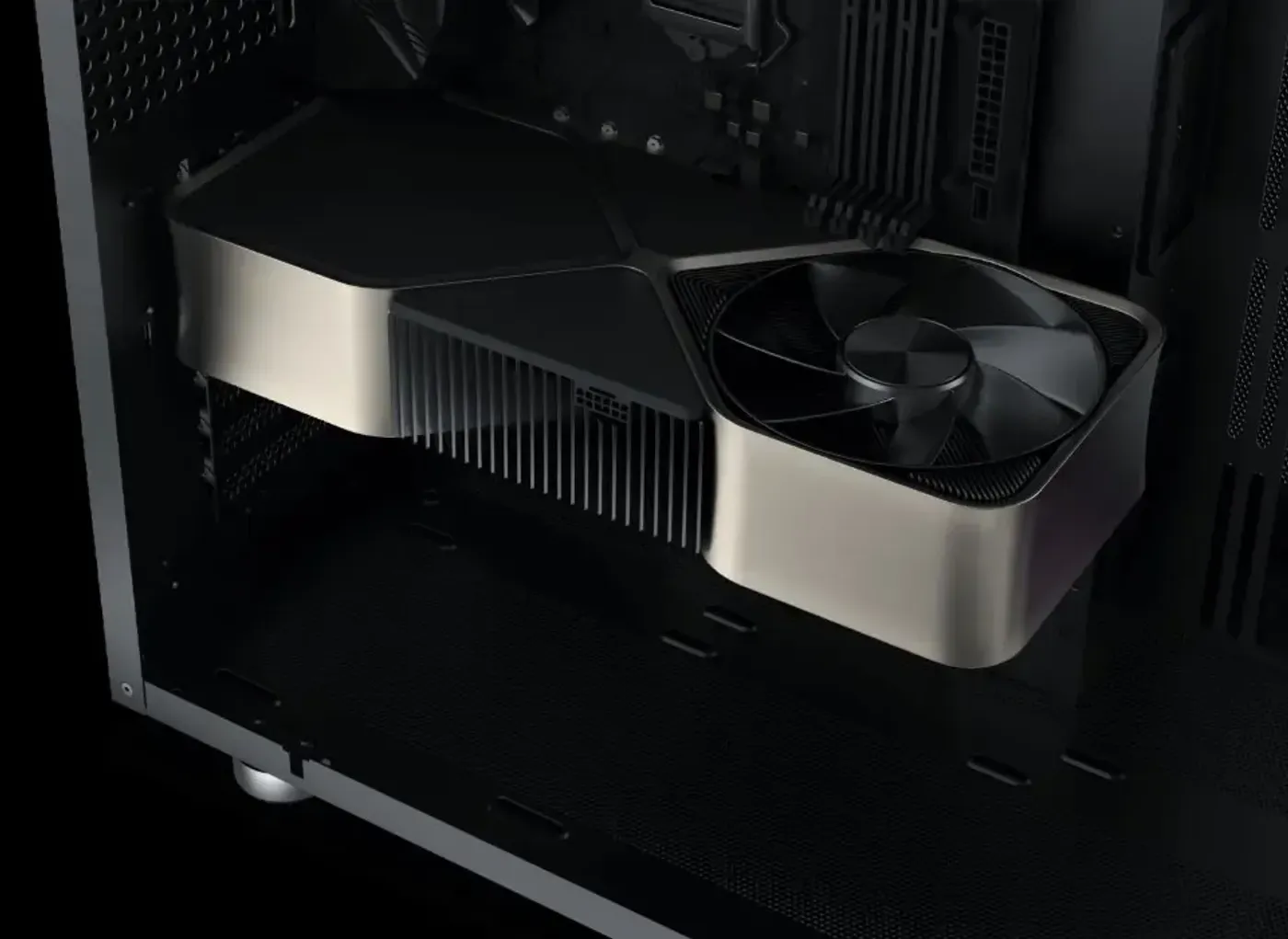
Graphics Cards Up To 430mm In Length
VGA cards up to 430mm in length are supported, which covers the longest triple-fan designs currently on the market with room to spare. Graphics card length is the single most common reason a build has to change case midway through, so a 430mm limit removes the constraint from the decision rather than making it the deciding factor.
Graphics Cards Up To 430mm In Length
VGA cards up to 430mm in length are supported, which covers the longest triple-fan designs currently on the market with room to spare. Graphics card length is the single most common reason a build has to change case midway through, so a 430mm limit removes the constraint from the decision rather than making it the deciding factor.
Radiator Support To A Maximum Of 360mm
Radiator support tops out at 360mm, the largest size most all-in-one liquid coolers are offered in. A case that only accepts 240mm caps how much heat a loop can shed regardless of what pump or block you fit, so having the full 360mm option available is what keeps a high-power CPU on liquid cooling a realistic plan.
Radiator Support To A Maximum Of 360mm
Radiator support tops out at 360mm, the largest size most all-in-one liquid coolers are offered in. A case that only accepts 240mm caps how much heat a loop can shed regardless of what pump or block you fit, so having the full 360mm option available is what keeps a high-power CPU on liquid cooling a realistic plan.
Bottom To Top Vertical Airflow Design
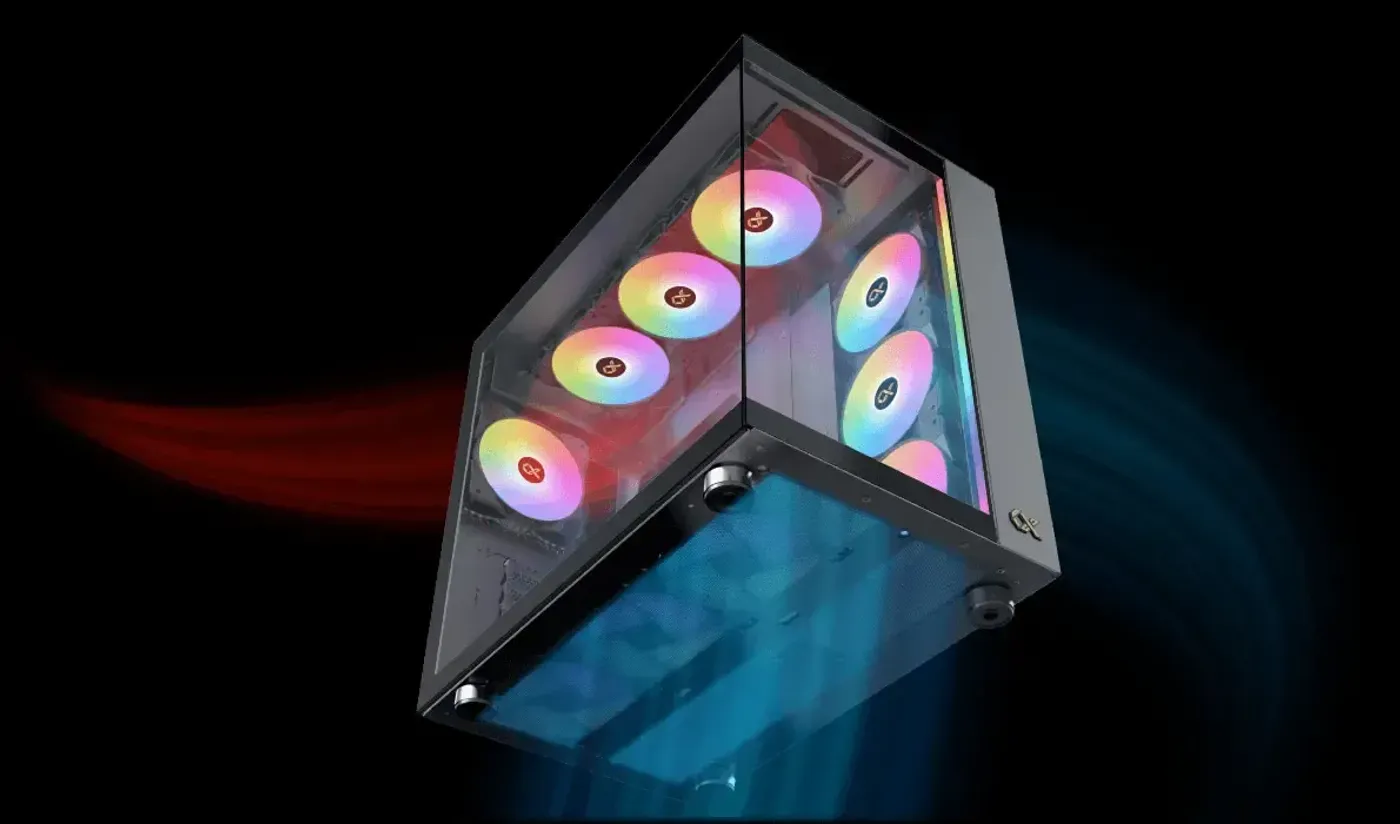
The Aqua Ultra is laid out for bottom-to-top vertical airflow, drawing cool air in low and letting it exit high. That direction works with heat rather than against it, since warm air rises on its own, and it keeps the graphics card and CPU cooler fed from the coolest part of the chassis instead of from air already warmed by other components.
Bottom To Top Vertical Airflow Design
The Aqua Ultra is laid out for bottom-to-top vertical airflow, drawing cool air in low and letting it exit high. That direction works with heat rather than against it, since warm air rises on its own, and it keeps the graphics card and CPU cooler fed from the coolest part of the chassis instead of from air already warmed by other components.
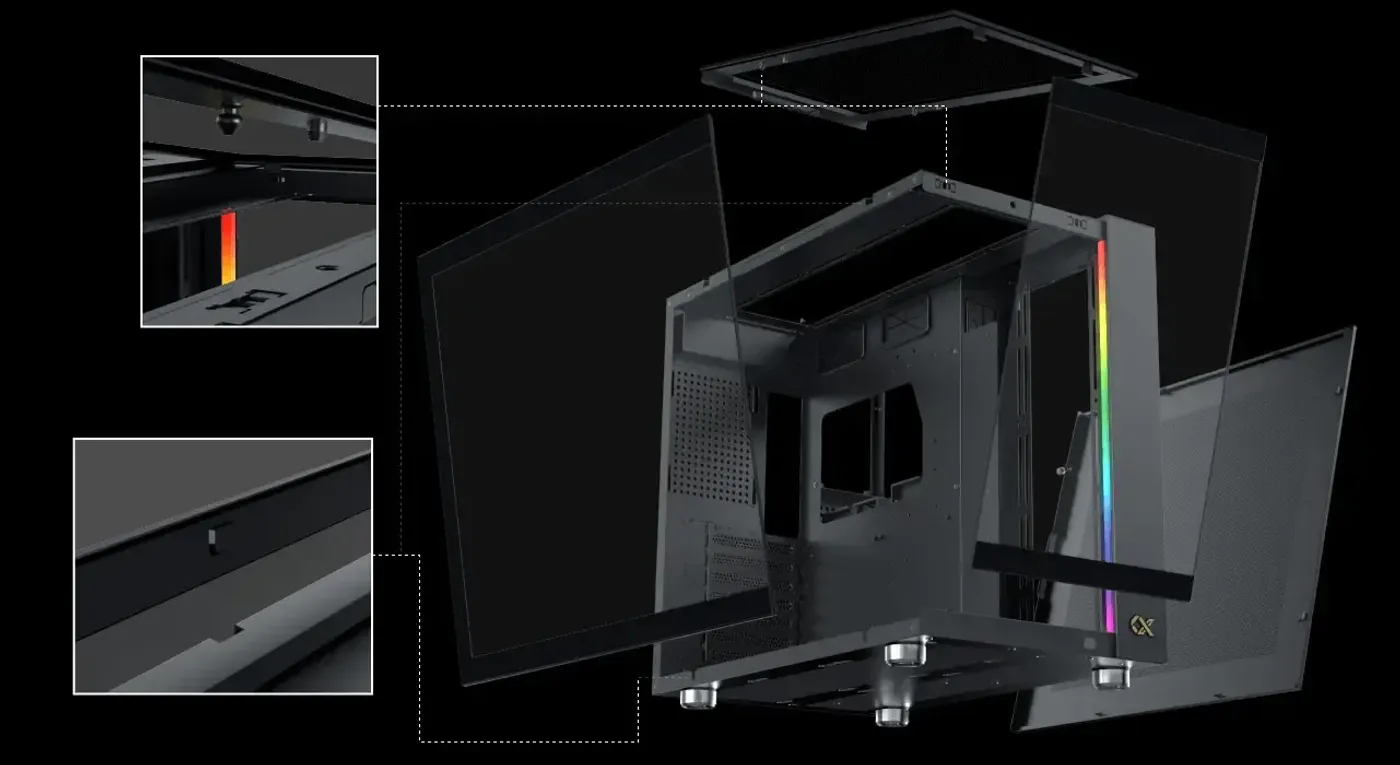
Three Tempered Glass Panels With Seamless Corner
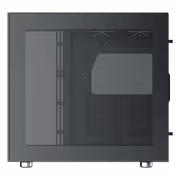
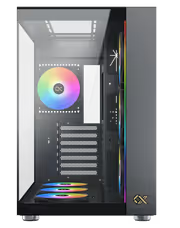
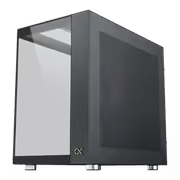
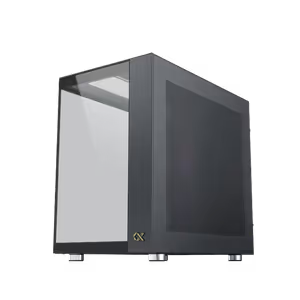
Three pieces of tempered glass make up the exterior, with the front and left panels meeting seamlessly so there is no frame breaking the corner view. A dynamic ARGB LED bar runs alongside them. The effect is a case that shows the whole front quarter of the build rather than one flat side of it through a bordered window.
Three Tempered Glass Panels With Seamless Corner
Three pieces of tempered glass make up the exterior, with the front and left panels meeting seamlessly so there is no frame breaking the corner view. A dynamic ARGB LED bar runs alongside them. The effect is a case that shows the whole front quarter of the build rather than one flat side of it through a bordered window.
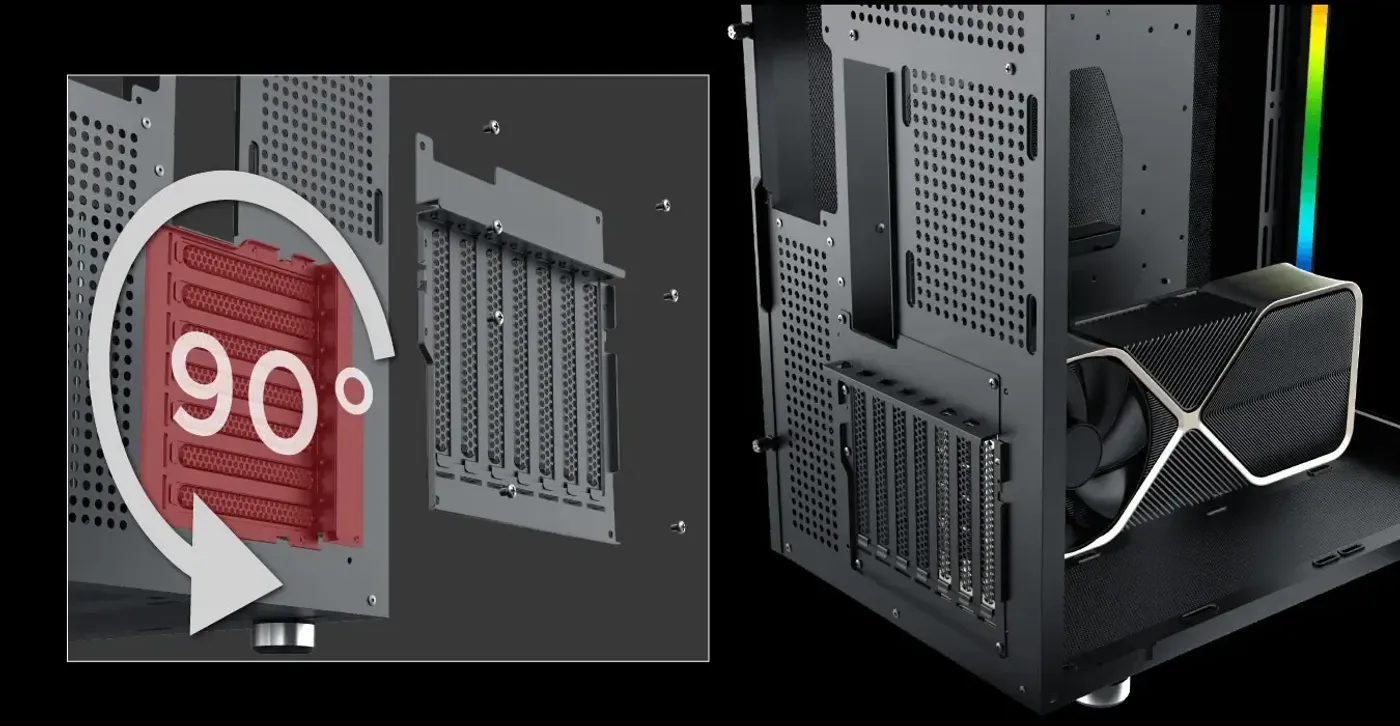
Supports Vertical VGA Card Installation
The Aqua Ultra supports vertical VGA installation, turning the graphics card to face the glass instead of sitting edge-on to it. On a case built around a seamless glass corner that is the orientation which actually shows the card, and it is the reason vertical mounting is worth having rather than being a novelty on a solid-panel chassis.
Supports Vertical VGA Card Installation
The Aqua Ultra supports vertical VGA installation, turning the graphics card to face the glass instead of sitting edge-on to it. On a case built around a seamless glass corner that is the orientation which actually shows the card, and it is the reason vertical mounting is worth having rather than being a novelty on a solid-panel chassis.
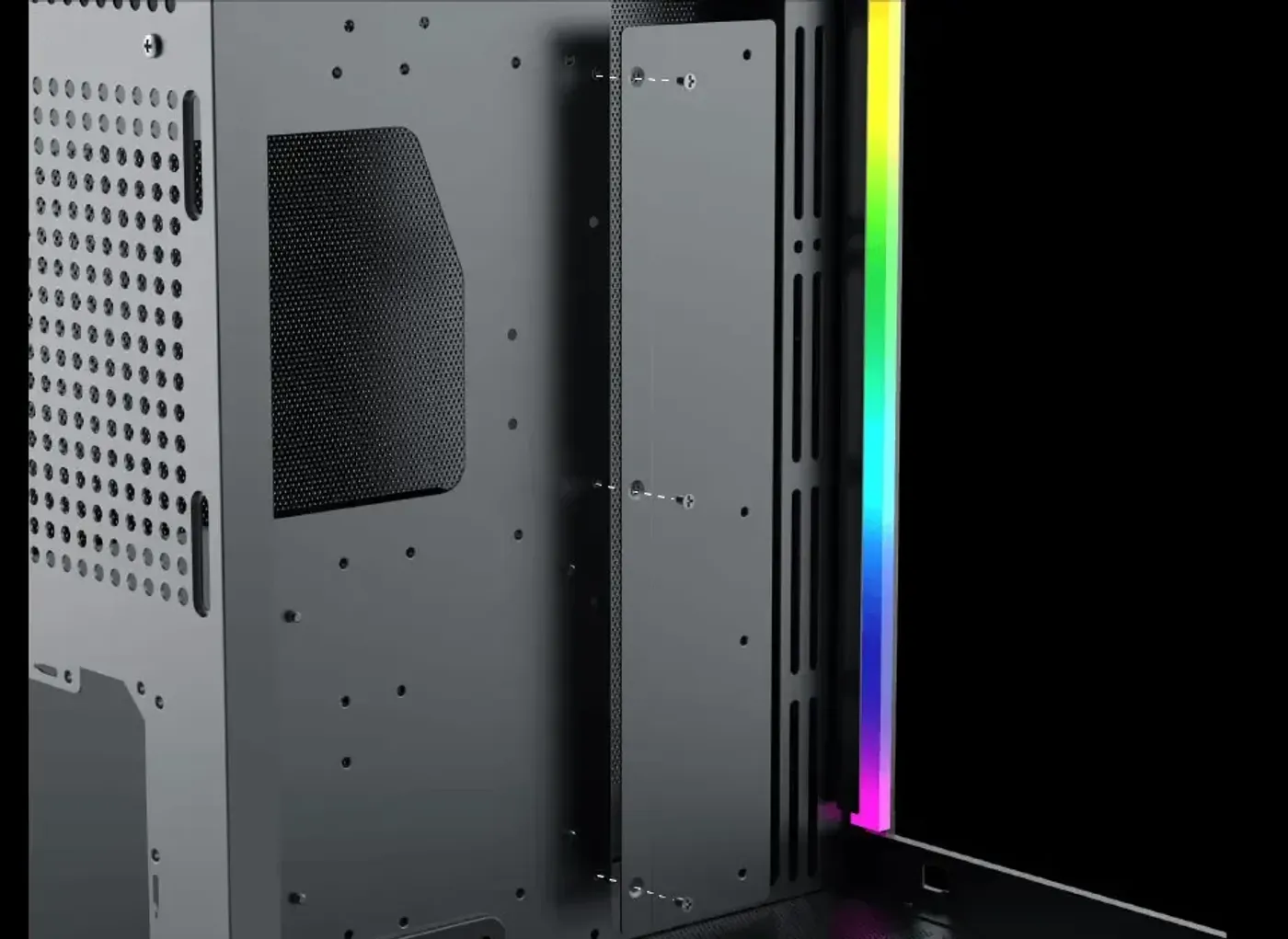
Removable Motherboard Extension Panel
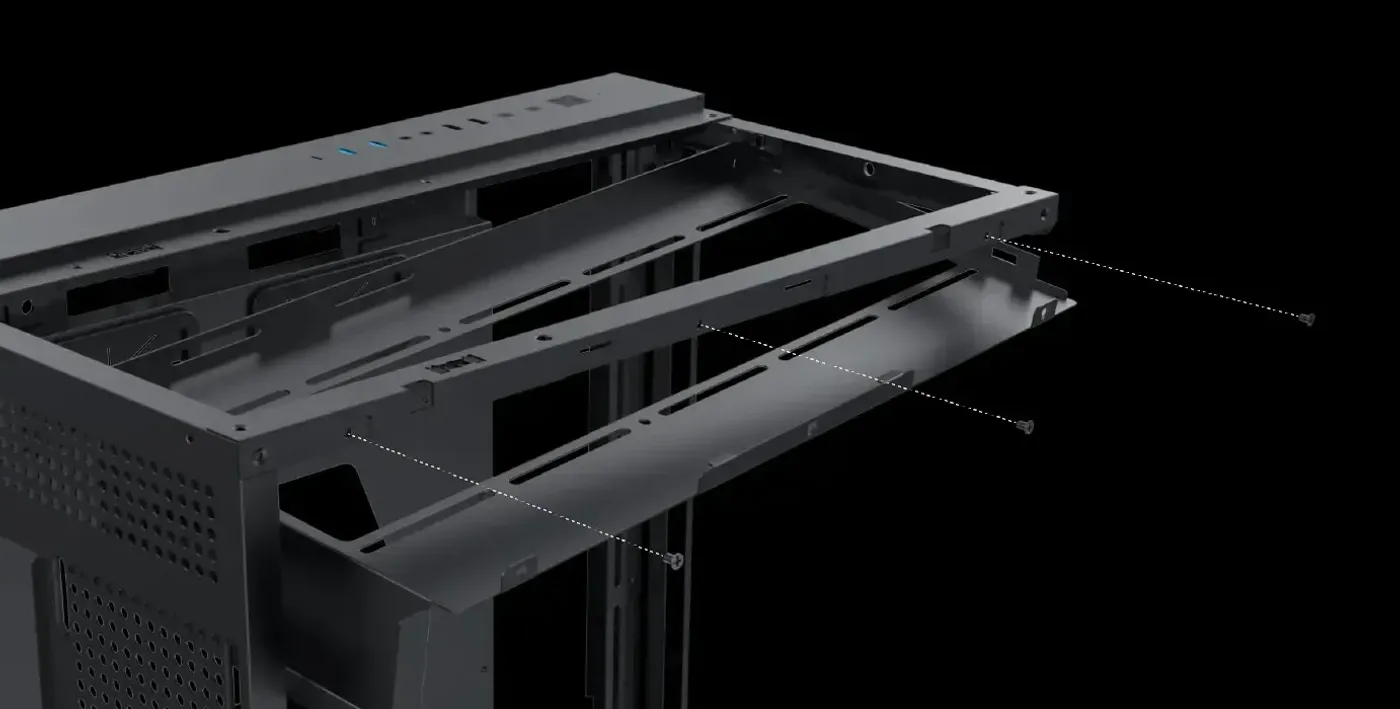
A removable motherboard extension panel is built into the chassis, which means the section behind the board comes out rather than forcing you to work around it. That access is what turns a cooler backplate change or a cable reroute into a ten-minute job instead of a full strip-down of an already finished system.
Removable Motherboard Extension Panel
A removable motherboard extension panel is built into the chassis, which means the section behind the board comes out rather than forcing you to work around it. That access is what turns a cooler backplate change or a cable reroute into a ten-minute job instead of a full strip-down of an already finished system.
Motherboard Support Up To E-ATX
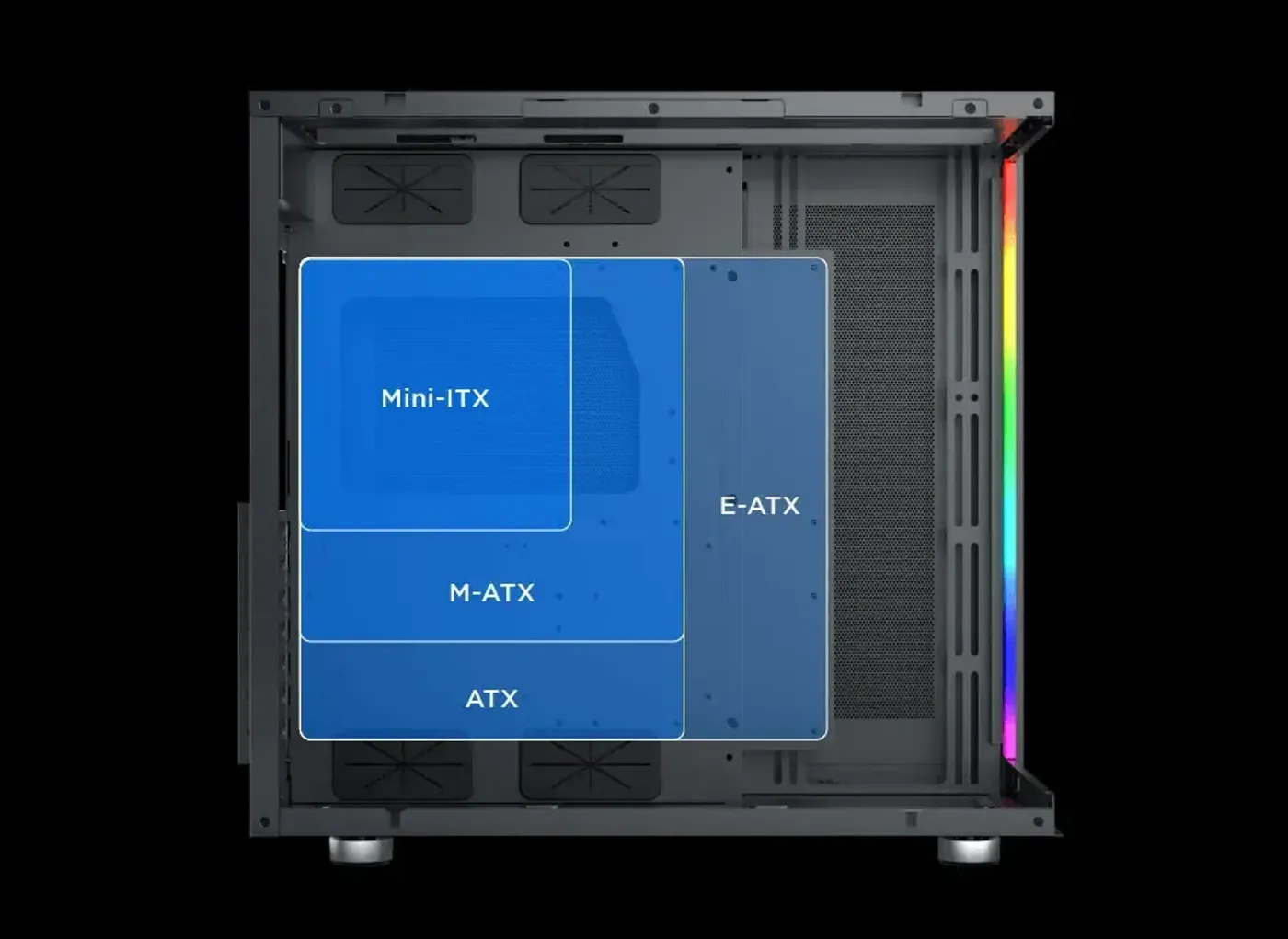
Motherboard support extends to E-ATX, so a workstation-class board fits alongside the gaming hardware without needing a full tower. E-ATX boards carry more VRM area, more memory slots and more expansion, and a mid tower that accepts them keeps the option of a heavier platform open without committing to a larger case footprint on the desk.
Motherboard Support Up To E-ATX
Motherboard support extends to E-ATX, so a workstation-class board fits alongside the gaming hardware without needing a full tower. E-ATX boards carry more VRM area, more memory slots and more expansion, and a mid tower that accepts them keeps the option of a heavier platform open without committing to a larger case footprint on the desk.
Four 3.5-Inch HDDs And Four 2.5-Inch SSDs
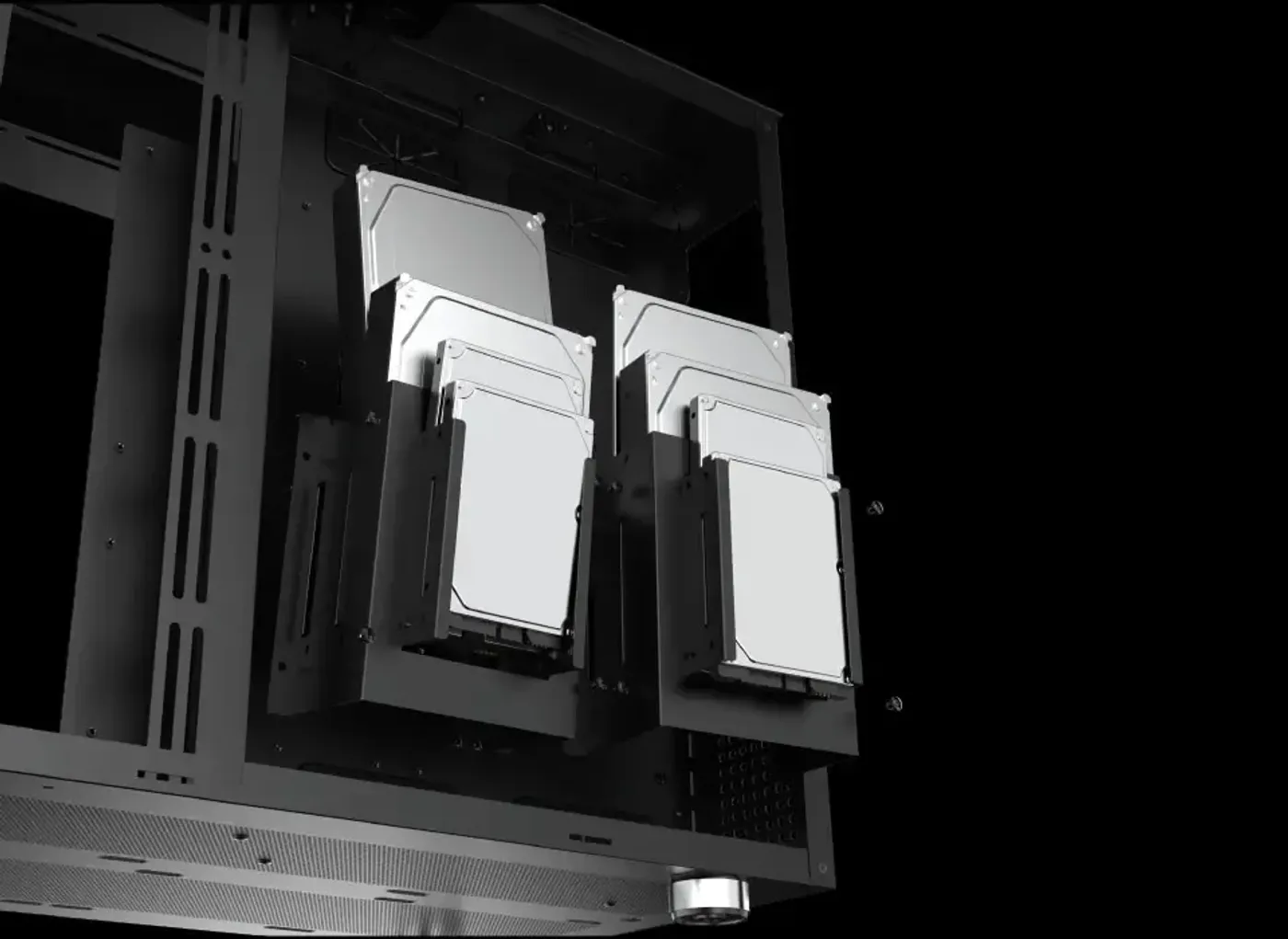
Two removable HDD and SSD cages are included, together supporting four 3.5-inch hard drives and four 2.5-inch solid state drives. Because the cages come out, storage capacity is a trade against airflow that you control: keep them for a media library, or pull them entirely to open the lower chamber for a cleaner front intake path.
Four 3.5-Inch HDDs And Four 2.5-Inch SSDs
Two removable HDD and SSD cages are included, together supporting four 3.5-inch hard drives and four 2.5-inch solid state drives. Because the cages come out, storage capacity is a trade against airflow that you control: keep them for a media library, or pull them entirely to open the lower chamber for a cleaner front intake path.
Top And Motherboard Panel Fan Mounting
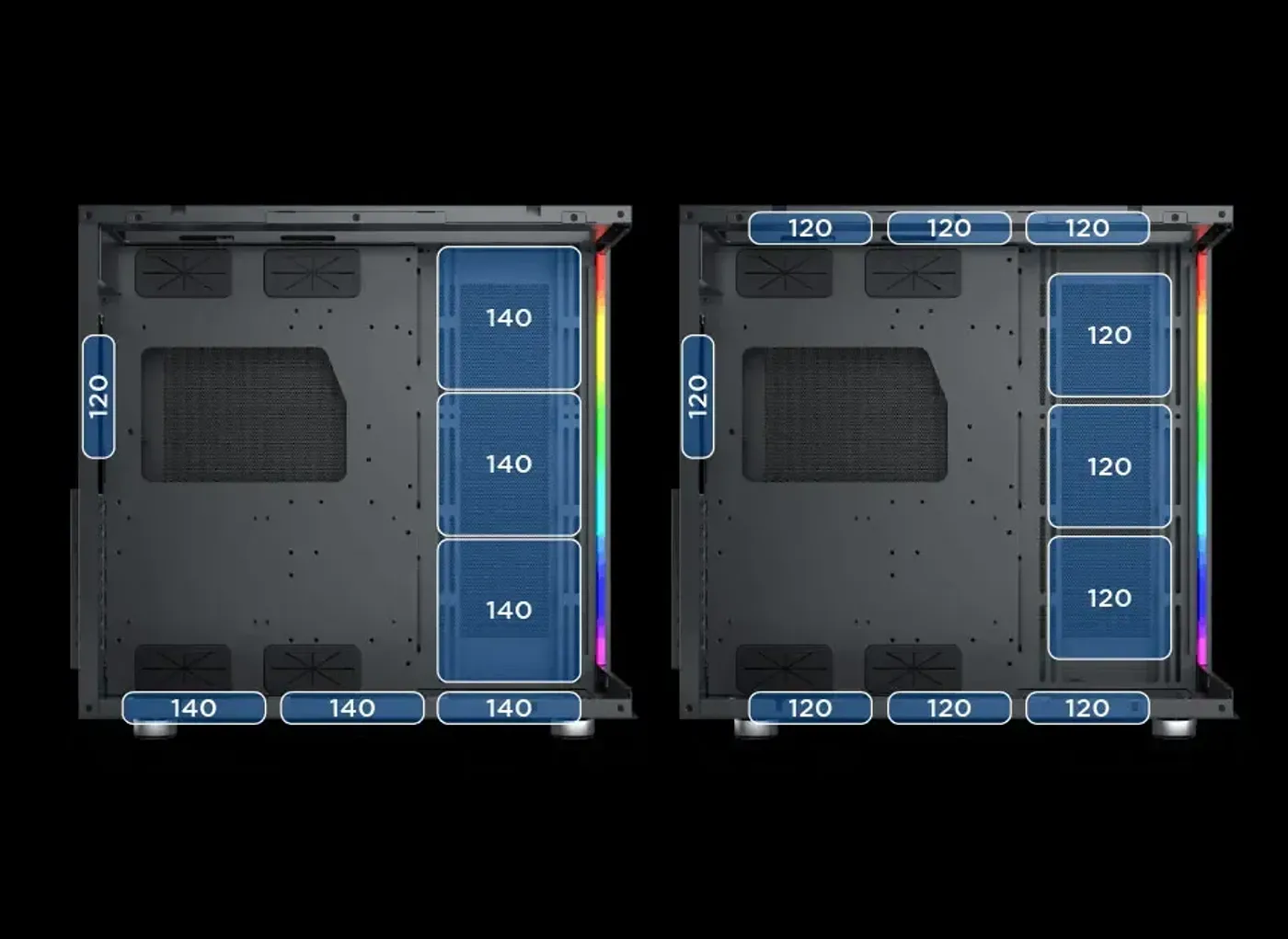
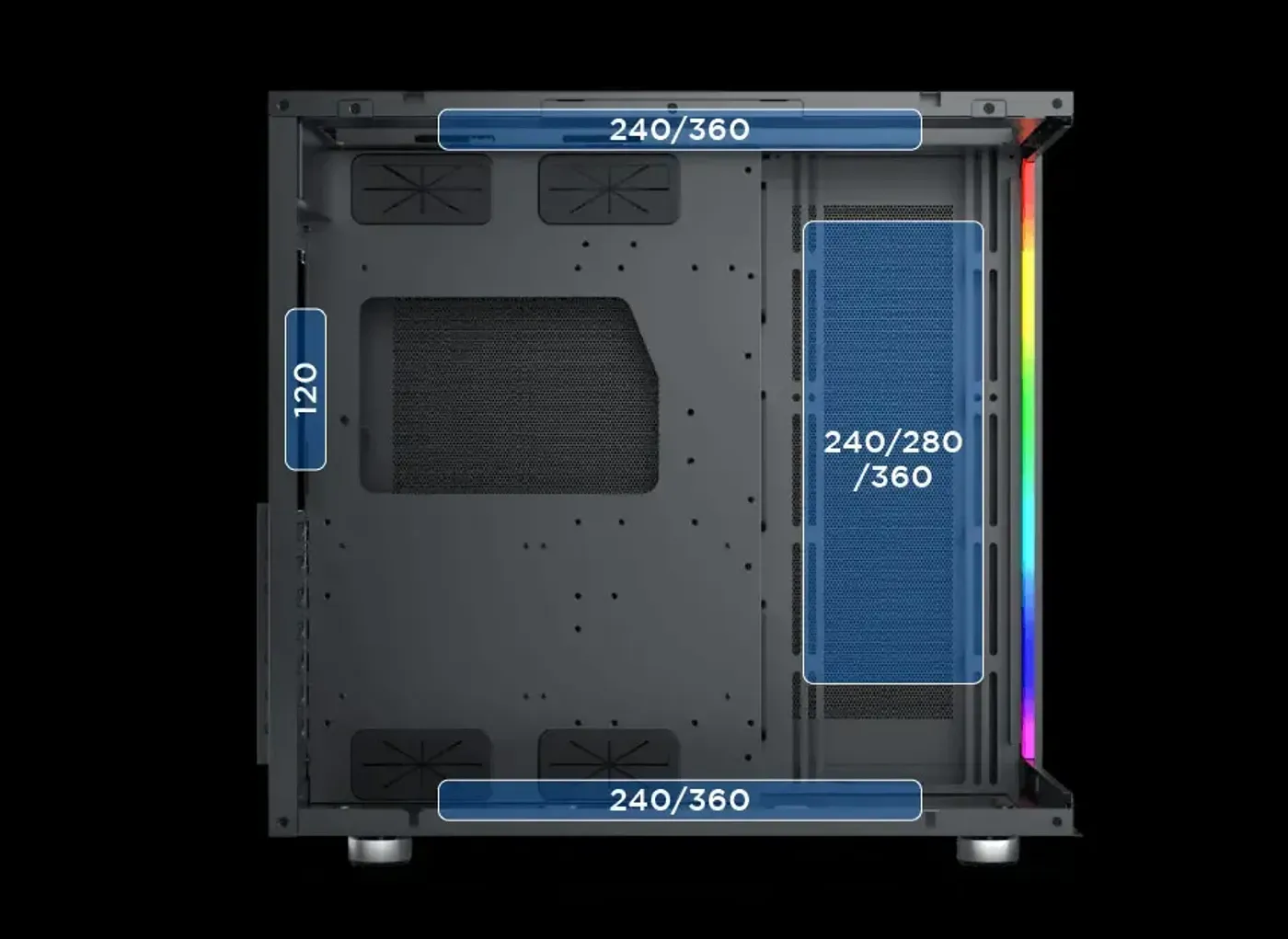
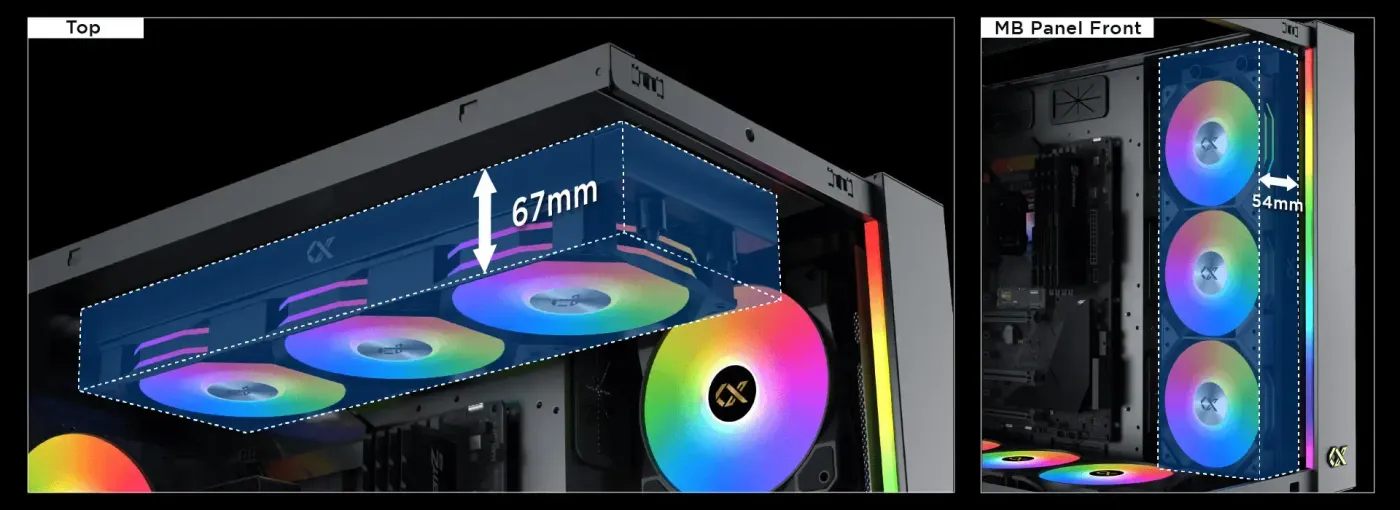
The top panel takes three 120mm fans, and the motherboard panel accepts either three 120mm or three 140mm units. That second position is unusual and useful: fans mounted on the board panel blow directly across the graphics card and VRM area rather than past them, which is where the heat concentrates in a modern gaming build.
Top And Motherboard Panel Fan Mounting
The top panel takes three 120mm fans, and the motherboard panel accepts either three 120mm or three 140mm units. That second position is unusual and useful: fans mounted on the board panel blow directly across the graphics card and VRM area rather than past them, which is where the heat concentrates in a modern gaming build.
Dynamic ARGB LED Bar Across The Front
A dynamic ARGB LED bar runs with the seamless front and left panels, giving the case a lighting element that is part of the structure rather than an accessory clipped on afterwards. Combined with the seven pre-installed ARGB fans, the lighting reads as one continuous scheme instead of several components each doing their own thing.
Dynamic ARGB LED Bar Across The Front
A dynamic ARGB LED bar runs with the seamless front and left panels, giving the case a lighting element that is part of the structure rather than an accessory clipped on afterwards. Combined with the seven pre-installed ARGB fans, the lighting reads as one continuous scheme instead of several components each doing their own thing.
Removable Fan Or AIO Liquid Cooler Bracket
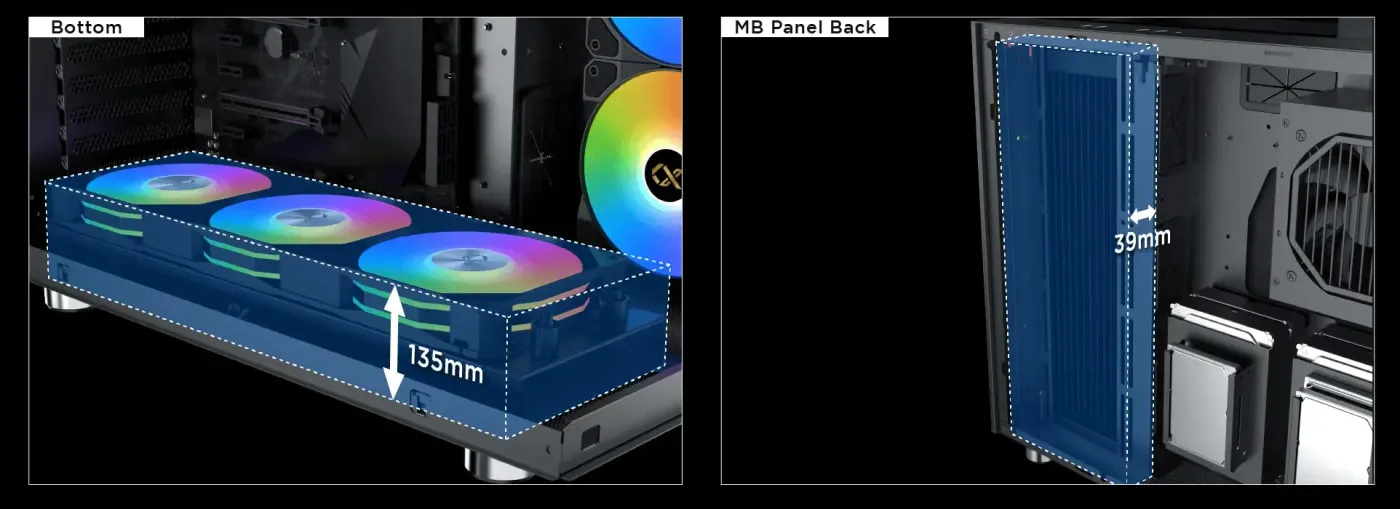
A removable bracket carries either fans or an AIO liquid cooler, so the cooling hardware is assembled outside the case and then dropped in as a finished unit. Anyone who has tried to align a 360mm radiator and six screws inside a populated chassis will recognise what that saves, and it makes later cooling changes far less disruptive.
Removable Fan Or AIO Liquid Cooler Bracket
A removable bracket carries either fans or an AIO liquid cooler, so the cooling hardware is assembled outside the case and then dropped in as a finished unit. Anyone who has tried to align a 360mm radiator and six screws inside a populated chassis will recognise what that saves, and it makes later cooling changes far less disruptive.
Top I/O Carries USB-C And Four USB Ports
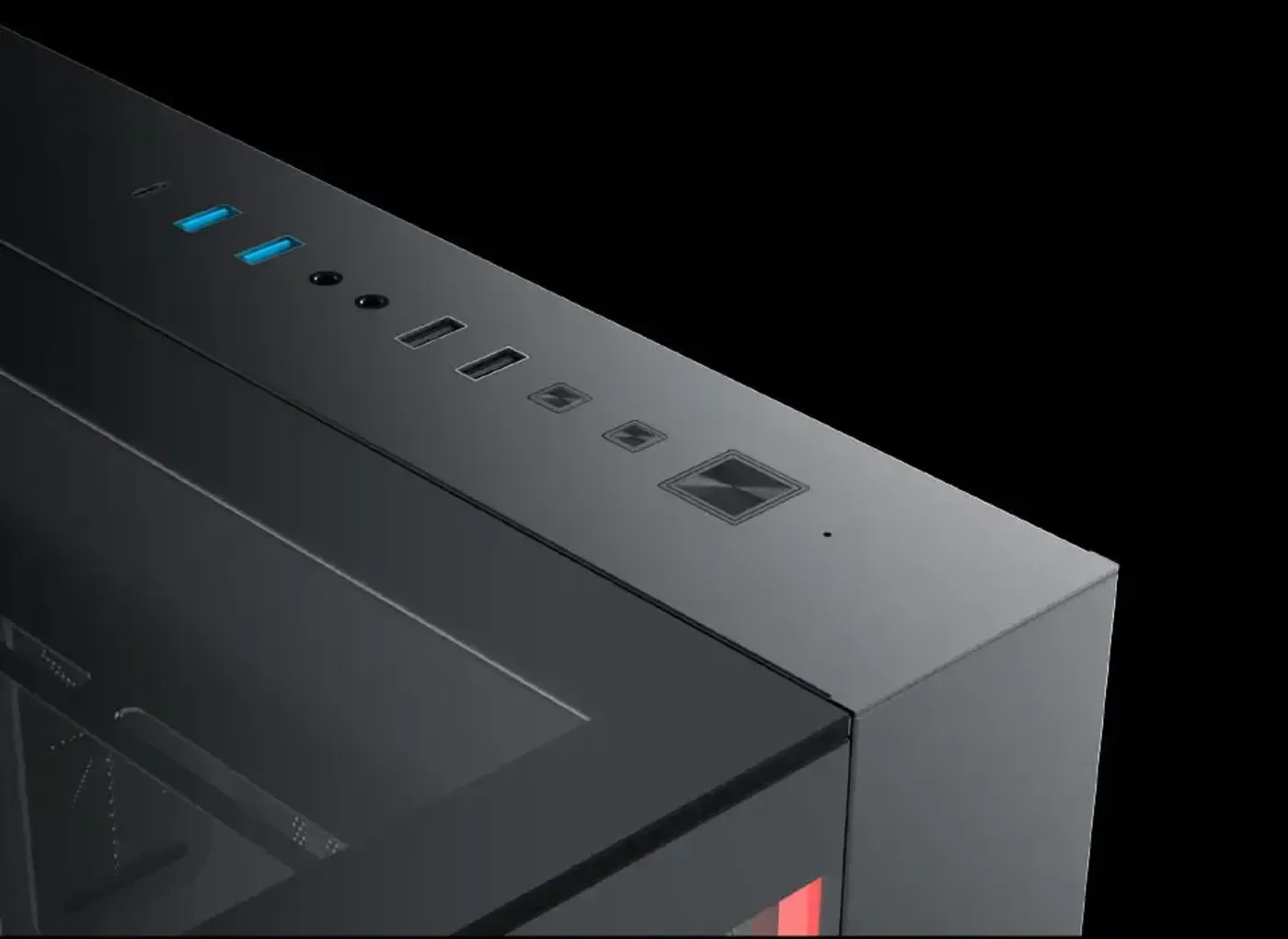
The top-mounted I/O panel provides two USB 2.0 ports, two USB 3.0 ports, a single USB-C port and an HD audio jack. Five USB connectors within reach of the desk covers a headset, a drive, a controller and a phone at the same time, which is the point at which you stop reaching around the back of the machine.
Top I/O Carries USB-C And Four USB Ports
The top-mounted I/O panel provides two USB 2.0 ports, two USB 3.0 ports, a single USB-C port and an HD audio jack. Five USB connectors within reach of the desk covers a headset, a drive, a controller and a phone at the same time, which is the point at which you stop reaching around the back of the machine.
Top And Motherboard Tray Radiator Positions
Radiators mount at 240mm or 360mm on the top of the chassis, and the motherboard tray position accepts 240mm, 280mm or 360mm. Having two full-size positions available means a dual-loop build is possible, or simply that a single 360mm radiator can be placed wherever it interferes least with memory height and cable routing.
Top And Motherboard Tray Radiator Positions
Radiators mount at 240mm or 360mm on the top of the chassis, and the motherboard tray position accepts 240mm, 280mm or 360mm. Having two full-size positions available means a dual-loop build is possible, or simply that a single 360mm radiator can be placed wherever it interferes least with memory height and cable routing.
Power, Reset And LED Switch On Top
Alongside the connectors, the top panel carries a power button, a reset button and a dedicated LED switch. The LED switch is the practical one: it changes the lighting without any software running, which means the case can be dimmed for a late session or a video call without opening a control application to do it.
Power, Reset And LED Switch On Top
Alongside the connectors, the top panel carries a power button, a reset button and a dedicated LED switch. The LED switch is the practical one: it changes the lighting without any software running, which means the case can be dimmed for a late session or a video call without opening a control application to do it.
Reverse Blade Fans On The Motherboard Panel
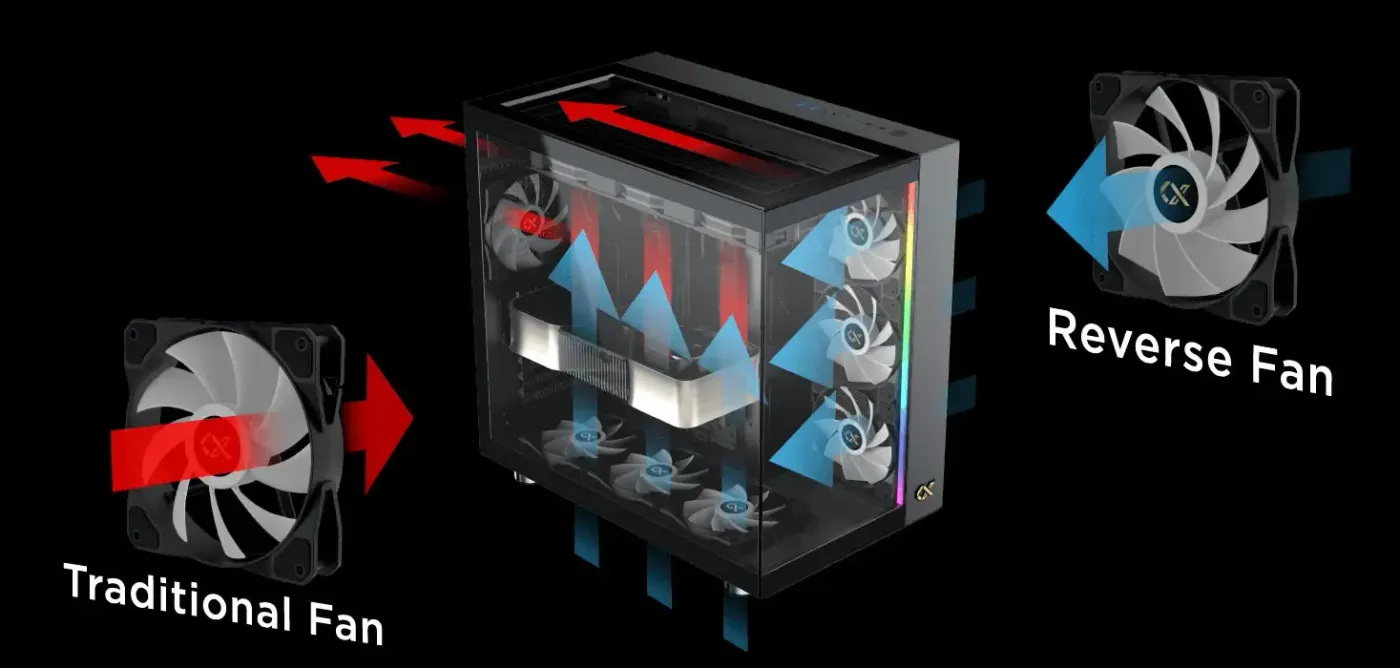
Reverse fan blades come pre-installed on the motherboard panel and on the bottom side of the chassis. A reverse blade is designed to look correct from the front while pushing air in the intended direction, which is what allows fans in a display-facing position to be both visually tidy and functional rather than one at the expense of the other.
Reverse Blade Fans On The Motherboard Panel
Reverse fan blades come pre-installed on the motherboard panel and on the bottom side of the chassis. A reverse blade is designed to look correct from the front while pushing air in the intended direction, which is what allows fans in a display-facing position to be both visually tidy and functional rather than one at the expense of the other.
Traditional Blade Fan Fitted At The Rear
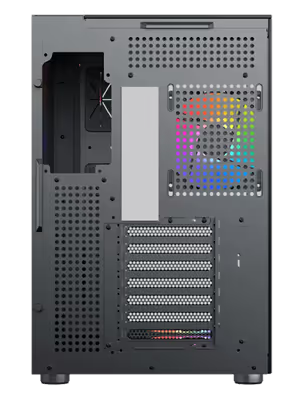
A traditional fan blade is pre-installed on the rear side, where the single 120mm exhaust position sits. The rear fan is not on display, so a conventional blade is the right choice there, and pairing it with the reverse blades elsewhere is how the case keeps a consistent look from the front without compromising the exhaust path.
Traditional Blade Fan Fitted At The Rear
A traditional fan blade is pre-installed on the rear side, where the single 120mm exhaust position sits. The rear fan is not on display, so a conventional blade is the right choice there, and pairing it with the reverse blades elsewhere is how the case keeps a consistent look from the front without compromising the exhaust path.
Bottom And Rear Radiator Mounting Options
The bottom of the chassis takes 240mm or 360mm radiators and the rear position accepts 120mm. A bottom-mounted radiator suits the case's low-intake airflow direction, drawing cool air straight through the fins, while the rear slot is there for a compact loop or an additional exhaust point in a build already using the top and tray positions.
Bottom And Rear Radiator Mounting Options
The bottom of the chassis takes 240mm or 360mm radiators and the rear position accepts 120mm. A bottom-mounted radiator suits the case's low-intake airflow direction, drawing cool air straight through the fins, while the rear slot is there for a compact loop or an additional exhaust point in a build already using the top and tray positions.
Easy Panel Mounting System For Quick Access
An easy panel mounting system holds the exterior together, so panels come off and go back on without a hunt for the right screwdriver. On a glass-heavy case that is a safety feature as much as a convenience, because panels that are awkward to remove get handled awkwardly, and tempered glass is unforgiving of being levered at an angle.
Easy Panel Mounting System For Quick Access
An easy panel mounting system holds the exterior together, so panels come off and go back on without a hunt for the right screwdriver. On a glass-heavy case that is a safety feature as much as a convenience, because panels that are awkward to remove get handled awkwardly, and tempered glass is unforgiving of being levered at an angle.
Dual Chamber Layout Improves PSU Cooling
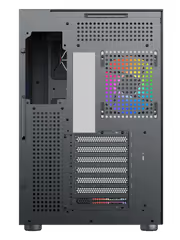
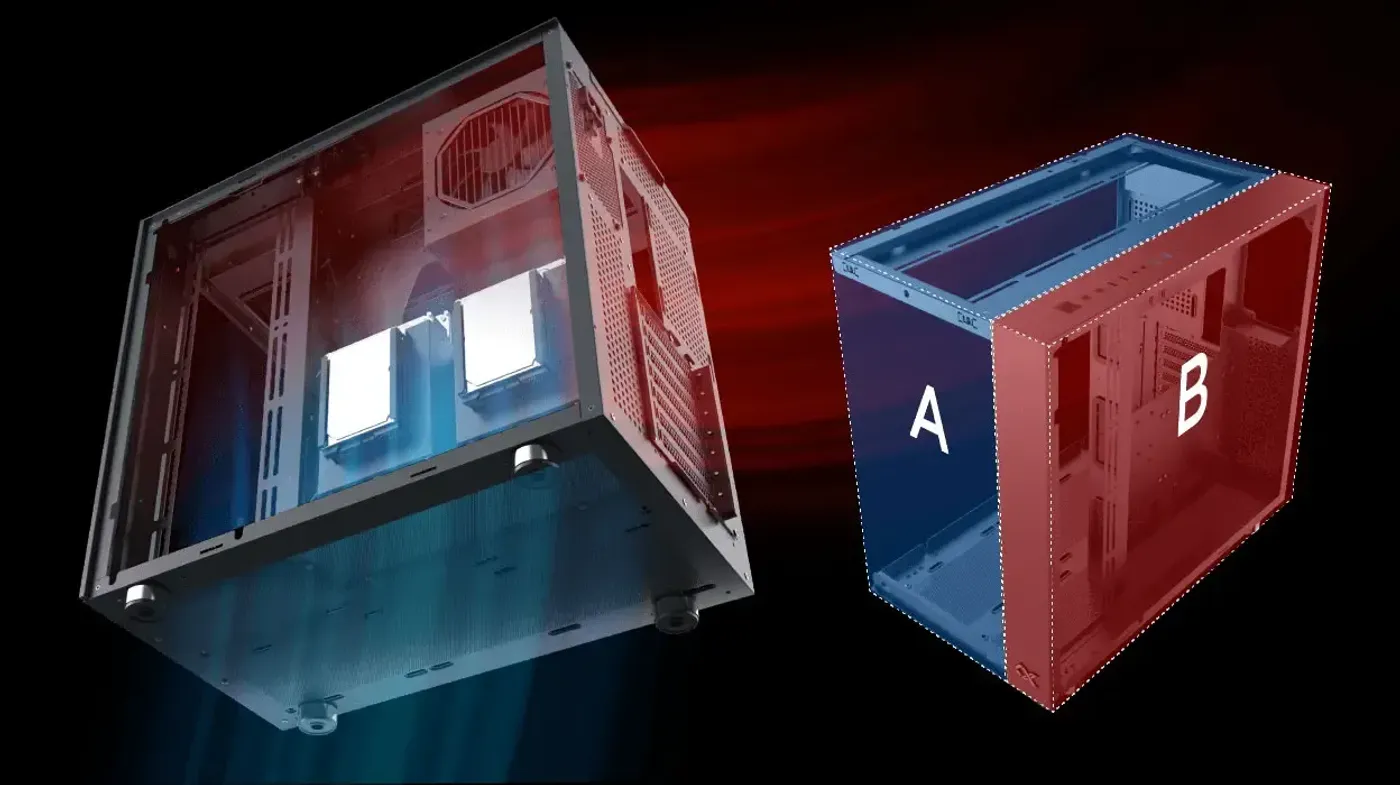
The Aqua Ultra uses a dual chamber layout, separating the power supply and cable mass from the main component area. Keeping the PSU in its own compartment means it draws its own air rather than sharing warmed air with the graphics card, and it hides the cable bundle behind a divider instead of leaving it in the glass view.
Dual Chamber Layout Improves PSU Cooling
The Aqua Ultra uses a dual chamber layout, separating the power supply and cable mass from the main component area. Keeping the PSU in its own compartment means it draws its own air rather than sharing warmed air with the graphics card, and it hides the cable bundle behind a divider instead of leaving it in the glass view.
Anti-Dust Mesh Bottom Panel Takes Three Fans
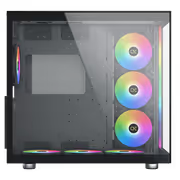
A high-airflow anti-dust mesh grill forms the bottom panel and supports three 120mm cooling fans for efficient GPU and CPU cooling. Filtering at the bottom intake is what stops the case pulling carpet and desk dust straight into the loop, and mesh with that much open area keeps the filter from becoming a restriction in its own right.
Anti-Dust Mesh Bottom Panel Takes Three Fans
A high-airflow anti-dust mesh grill forms the bottom panel and supports three 120mm cooling fans for efficient GPU and CPU cooling. Filtering at the bottom intake is what stops the case pulling carpet and desk dust straight into the loop, and mesh with that much open area keeps the filter from becoming a restriction in its own right.
FAQ
Frequently Asked Questions
Everything you need to know about this product
It supports motherboards up to E-ATX size.
Seven ARGB LED fans are pre-installed in the chassis.
Graphics cards up to 430mm are supported, and vertical VGA installation is possible.
CPU coolers up to 185mm in height are supported.
Top 240/360mm, motherboard tray 240/280/360mm, bottom 240/360mm and rear 120mm.
Two removable cages take four 3.5-inch HDDs and four 2.5-inch SSDs in total.
Two USB 2.0, two USB 3.0, one USB-C, an HD audio jack, power, reset and an LED switch.
The chassis supports a maximum of ten fans.
Three tempered glass panels, with seamless front and left panels plus an ARGB LED bar.
Power supplies up to 220mm in length are supported.
A high-airflow anti-dust mesh grill bottom panel supports three 120mm cooling fans.
Yes. It uses a dual-chamber layout designed to improve PSU cooling.

AI-Generated Content: These FAQs are generated by an automated AI system and may contain inaccuracies or omissions. Evetech makes no warranties, express or implied, regarding their completeness or reliability. For definitive information, please refer to the manufacturer's official specifications.
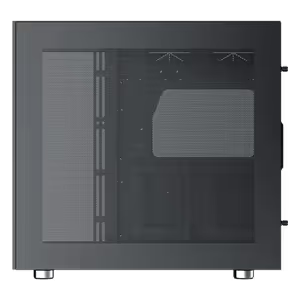
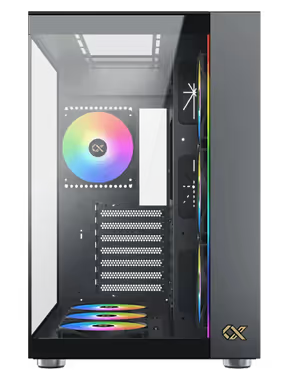
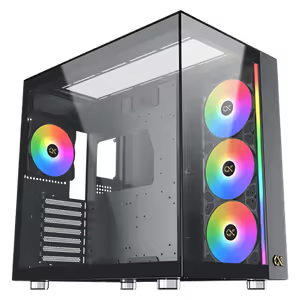
Please Note: Product images are for illustrative purposes only and may differ from the actual product.
Choose your
own PC
Hand-pick every part with live stock, compatibility, and instant pricing.
Try the new builderPrice Inc. Vat
R 2,399
Save R 900
ListR 3,299
2399Free Delivery
Qty:
In Stock with Evetech
Choose your
own PC
Hand-pick every part with live stock, compatibility, and instant pricing.
Try the new builderXigmatek Aqua Ultra Mid Tower Gaming Case