SA Budget Discipline Guide
How to buy tech on a South African budget. — Buy quality once, not cheap twice.
Refurb, open-box, marketplaces, price tracking, BNPL, layby and the ZAR/USD timing question. Honest math for the rand-stretched buyer — without the gimmicks.
- Black Friday delta
- 15-35%
- PayJustNow split
- 3 × 0%
- open-box savings
- R200-R6k
Used, refurbished and open-box — the SA discipline
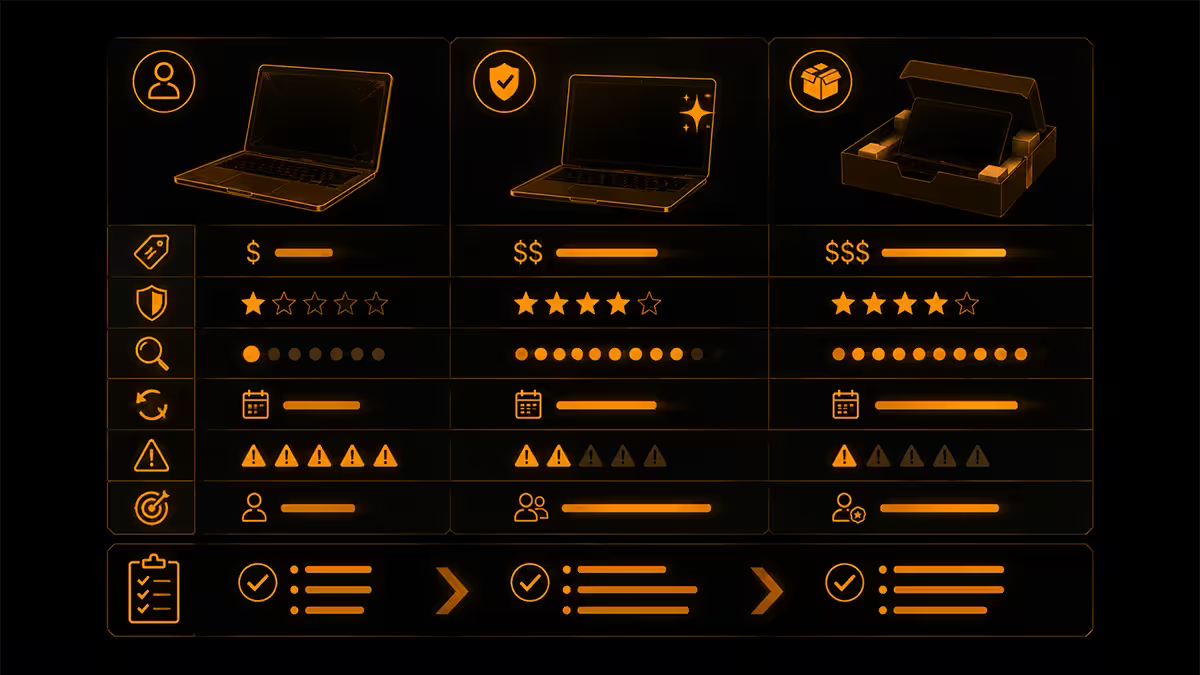
South African tech is priced in landed Rands. Every step away from "brand new sealed retail" buys you back currency the rand never gave you in the first place. The discipline is knowing which step trades real money for real risk, and which trades fictional savings for very real heartbreak.
| Channel | Typical discount | Warranty & risk |
|---|---|---|
| New sealed retail | Baseline | Full mfr warranty · zero risk |
| Open Box (Evetech / Takealot) | 10-25% | Full warranty · negligible risk |
| Manufacturer refurbished (HP Renew, Lenovo, Dell Outlet) | 15-35% | 6-12 month warranty · low risk |
| Retailer refurbished (Evetech, Wootware) | 20-40% | 3-6 month warranty · moderate risk |
| Marketplace used (Carbonite, FB) | 30-60% | No warranty · high risk |
Evetech's Open Box & Refurbished section is where most savvy SA buyers should start. The unit was returned, inspected, retested and is sold with the same manufacturer warranty as new — for 10-25% less. The box has been opened. That's it.
Manufacturer refurbished routes — HP Renew, Lenovo Outlet, Dell Outlet — sit one tier deeper. The OEM rebuilds the unit, certifies it, ships it in a brown box with a fresh 6-12 month warranty. The savings sit at 15-35% on premium business laptops and workstations that would otherwise be out of budget reach. This is the route to a R28,000 ThinkPad for R19,000.
SA marketplaces — Carbonite, Facebook and the realistic playbook
South Africa's second-hand tech ecosystem is fragmented across four real venues: Carbonite (carbonite.co.za), Facebook Marketplace SA, Facebook tech buy/sell groups (PC Builders SA, Mac Resellers SA, Audio Buy/Sell), and the dwindling remains of Gumtree. Each has a different risk profile and a different etiquette.
Carbonite is the cleanest. Listings are tech-only, escrow is available, and the community self-polices scam sellers fast. Expect to pay 5-15% more than Facebook Marketplace, but the trust premium is genuinely worth it on items above R5,000.
Facebook Marketplace is the chaotic middle. You'll find the best prices and the most scams in the same hour. Rules: meet in a busy public place (Sandton or Centurion mall food courts work), test the item before paying, never EFT in advance, always verify serial numbers against the box.
Facebook tech buy/sell groups are where the enthusiast inventory lives — used GPUs from someone upgrading, used CPUs from someone moving platforms, mech keyboards being thinned out. Group reputation matters: check sale history, look for "trusted seller" tags, prefer face-to-face over courier.
Deal tracking — never buy a price you haven't validated
The single biggest budget skill in SA tech is knowing what a thing actually costs over time. Retailers love a fake-discount cycle: bump price 18% in mid-October, knock 15% off on Black Friday, and call it a "saving". The buyer who tracks prices sees through it in seconds.
isitabargain.co.za is the SA equivalent of CamelCamelCamel for Takealot. It charts the 90-day price history of any SKU. A genuine Black Friday deal sits below the 90-day average. A fake one matches the 30-day average. The tool makes the difference visible in one glance.
PriceCheck.co.za compares the same SKU across SA retailers in real time. Useful when you've identified what you want and need to find who has it in stock at the best price. Cross-reference with Evetech, Wootware, Rebel Tech, Takealot and Loot before committing.
Wishlist hygiene matters too. Evetech and Takealot wishlists notify you of price drops. Add items 4-8 weeks before you intend to buy — you'll often catch a 5-15% drop without doing anything. The patient buyer doesn't hunt the deal; the deal arrives in their inbox.
BNPL honest — PayJustNow, Mobicred, FLOAT and the trap
Evetech does not offer BNPL, layby, credit or instalments. We accept Pay by Bank, Capitec Pay, Absa Pay, Nedbank Direct EFT, Visa and Mastercard, Apple Pay, Google Pay and manual EFT. The options below exist elsewhere in the SA market — this section is here so you can judge them properly, not because we sell them. Buy-now-pay-later has reshaped how SA buyers approach R5,000-R30,000 tech purchases. Used correctly, it's a genuinely free cashflow tool. Used badly, it's the most expensive credit you'll ever take.
PayJustNow splits the purchase into three equal interest-free instalments — pay 1/3 today, 1/3 in 30 days, 1/3 in 60 days. No fees if you pay on time. Accepted by Takealot, Incredible Connection, HiFi Corp and a number of other SA tech retailers (not Evetech). It's the cleanest BNPL option for genuine cashflow smoothing.
FLOAT works on top of your existing Visa or Mastercard. It uses your existing credit limit but splits the purchase into 3 equal instalments — still interest-free. The advantage: no separate signup, no separate credit check. The same risk applies — miss an instalment and your card issuer's standard interest rate kicks in.
Mobicred is genuinely different. It's a revolving credit facility — typically 19-22% annual interest if you carry a balance beyond the first month. It can stretch payments over 6-12 months, which makes it tempting for big purchases. But the maths gets ugly fast: a R15,000 gaming PC stretched over 12 months at 20% interest costs R16,500, plus admin fees. Use Mobicred only when you've planned to settle within 1-2 months.
Layby vs interest-free — when discipline beats convenience
Layby is the unglamorous SA cousin to BNPL. You pay a deposit, make monthly instalments over 3-6 months, and collect the item only once it's fully paid. Incredible Connection, Game and Makro all offer it. So does Takealot on selected categories. Evetech does not — we are card, instant-EFT and bank-transfer only.
Layby's strength is discipline. You can't impulse-buy a R20,000 gaming PC on layby — you sign up, you commit, you pay it off over 6 months without the temptation of using the item before it's settled. It teaches the habit of waiting that BNPL erodes.
Layby's weakness is opportunity cost. The R20,000 PC you've laybyed in March arrives in your hands in September. By September, the GPU range has shifted, the bundled monitor deal has expired, and the same R20,000 might have built you a stronger machine if you'd waited and paid lump sum. Layby commits to a specific configuration at today's prices.
Practical rule: use layby for the high-ticket purchases where discipline is the real problem (gaming PCs, premium laptops, expensive monitors). Use PayJustNow for the medium-ticket purchases where cashflow timing is the real problem (peripherals, components, accessories). Use lump-sum cash where you can — it leaves room to negotiate.
ZAR/USD timing — and the import question
Most SA tech is denominated in USD upstream. The local price is the USD wholesale, plus shipping, plus duties, plus VAT, plus retailer margin, plus a hedge against rand volatility. When the rand strengthens, prices don't drop the next day — there's a 4-8 week lag while existing stock clears at the old landed cost. When the rand weakens, prices jump within 1-2 weeks because new stock arrives at the new cost almost immediately. The asymmetry favours the patient buyer.
Practical timing for large purchases: watch the ZAR/USD rate for 4-6 weeks before any big spend. A move from R18.50 to R17.80 (a 3.8% strengthening) typically translates to 2-4% lower SA tech pricing within 6 weeks. Coupled with a Black Friday sale, that's a real 18-30% saving on a flagship GPU.
The import question. "Can't I just buy it from Amazon US and ship it in?" The maths almost never works. A R10,000 SA price typically equates to roughly $420 in the US — sounds great — until you add 15% VAT on arrival, 0-20% customs duty, R600-R900 in courier fees, R300-R500 in clearance fees, plus 4-6 weeks of waiting with no SA warranty coverage. Landed cost usually lands within 3-8% of the local SA price, with significantly more risk.
When imports do make sense: niche items not stocked locally — a specific Cherry MX silent switch, a Kailh Choc keycap set, an Adafruit prototyping board, an obscure DAC. Mainstream GPUs, CPUs, laptops, monitors, mice, keyboards and headphones almost never beat local landed cost. The SA retail chain is more efficient than its reputation suggests.
Across the 200,000+ custom PCs we've shipped from Centurion, the single biggest budget mistake we see is buying the R600 generic PSU to save money — then having it fail at 18 months and take a R6,500 motherboard or R12,000 GPU with it. The "buy quality once, not cheap twice" rule has hard receipts. A Corsair RM850x (~R3,200) or Seasonic Focus GX-850 (~R3,500) with a 10-year warranty has a measurable failure rate near zero across our service bench. Spending the extra R2,500 upfront is the cheapest insurance policy you'll ever buy. Apply the same logic to monitors, keyboards, mice and chairs — categories where build quality compounds across years of use.
Behind the Build · From our Centurion warehouse
Budget playbook — the SA buyer's order of operations
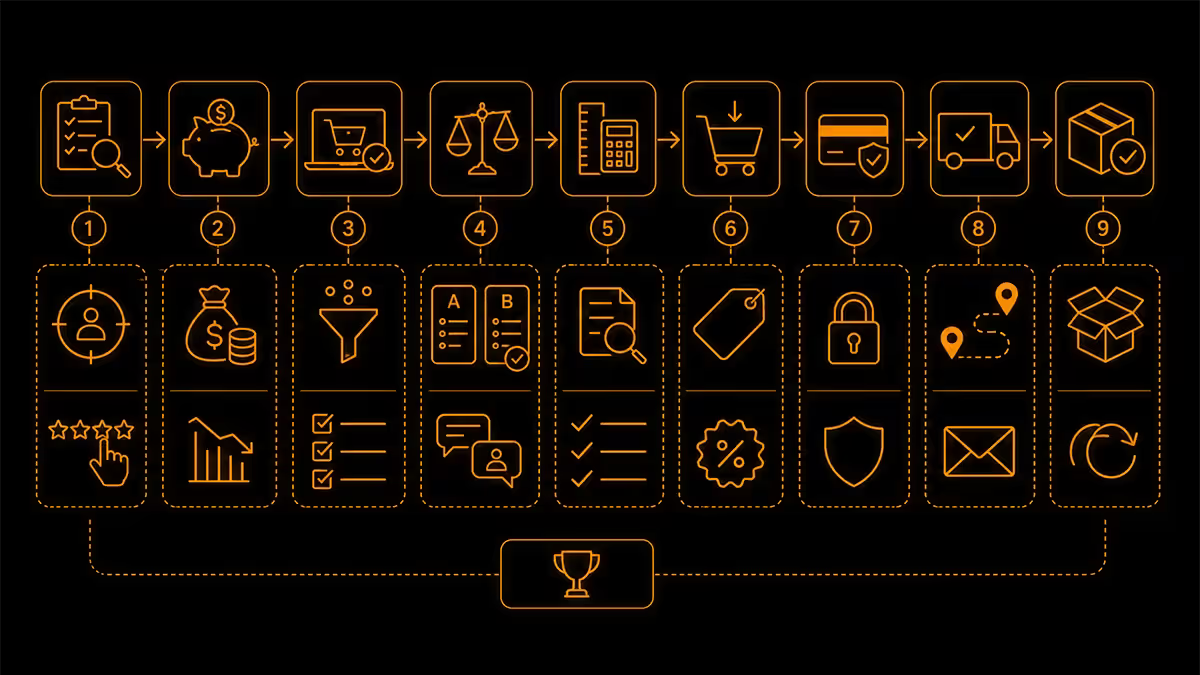
| Step | Action | Typical saving |
|---|---|---|
| 1. Define the need | Use case + 3-year horizon | Avoids R5k-R15k mis-spend |
| 2. Set the budget envelope | Cash + max BNPL split you can absorb | — |
| 3. Shop Open Box first | Evetech Open Box, Takealot Daily Deal | 10-25% |
| 4. Manufacturer refurb route | HP Renew, Lenovo Outlet, Dell Outlet | 15-35% |
| 5. Add to wishlist + track | isitabargain, PriceCheck | 5-15% (passive) |
| 6. Wait for Black Friday (tier 1/2) | GPUs, laptops, monitors, pre-builts | 15-35% |
| 7. Apply "quality once" rule | PSUs, monitors, peripherals, chairs | Compounds over 5-10 years |
| 8. Use PayJustNow / FLOAT | Cashflow split, not borrowing | Free if on-time |
| 9. Layby for discipline | High-ticket impulse risks | 0% interest |
Categories worth paying for new
PSU, monitor, primary keyboard, primary mouse, chair, headphones. These compound. A premium PSU saves you a destroyed motherboard. A premium monitor saves you eye strain across 8-10 hours daily. A premium chair saves you a back. Don't buy these used or generic — the math is brutal against you over 3-5 years.
Categories worth buying refurbished or open-box
GPU, CPU, RAM, storage, motherboard, laptops, pre-built PCs. These are warranty-backed silicon that either work or don't. Open-box and certified refurb shave 10-35% with zero meaningful risk. This is where the budget headroom is.
Categories worth buying second-hand from individuals
Secondary peripherals, niche enthusiast gear, hobbyist parts. A second mech keyboard, a backup mouse, a niche audio interface, a non-critical SSD. Low downside, high savings — and the local enthusiast community generally takes good care of gear.
Common SA budget mistakes
Buying the cheap PSU. The fastest way to destroy a R20,000 build is a R600 generic PSU. Spend R2,500-R3,500 on Corsair, Seasonic, Be Quiet or Cooler Master. The 10-year warranty is the cheapest insurance you'll ever buy.
Trusting "Black Friday" prices without checking history. Many SA retailers inflate prices 2-3 weeks before Black Friday so the "discount" lands at the normal price. Always cross-check with isitabargain.co.za.
Treating BNPL as borrowing instead of cashflow timing. If you couldn't afford the item outright, BNPL doesn't fix that — it just shifts the financial pain forward 60 days. Use BNPL to split affordable purchases, not to access unaffordable ones.
Buying from sketchy marketplace sellers to "save" R1,500. The savings vanish the first time a R12,000 GPU turns out to be a dud with no warranty recourse. Carbonite, Facebook tech groups with seller reputation, or just walking into Evetech for an open-box unit all beat the random Marketplace listing.
Importing mainstream tech from abroad. By the time VAT, duty, courier fees and clearance fees land, you've matched the local SA price with none of the warranty support. The maths only works on genuinely niche items.
Buying cheap peripherals repeatedly. Four R500 keyboards over 8 years costs R2,000 and frustration. One R1,800 mechanical keyboard lasts 8-10 years. The "expensive" option is the cheap one.
Key takeaways
- Shop Open Box & Refurbished first — 10-35% off with full or partial warranty, almost zero risk.
- Validate every "deal" on isitabargain.co.za before committing — fake Black Friday discounts are common.
- Wait for Black Friday on GPUs, laptops, monitors and pre-builts; don't bother waiting for CPUs, RAM or storage.
- PayJustNow and FLOAT are free cashflow tools; Mobicred is real credit. Don't confuse the two.
- Buy quality once on PSUs, monitors, keyboards and chairs — categories where build quality compounds.
- Don't import mainstream tech — landed cost matches SA retail with none of the warranty.
Frequently asked questions
Is buying refurbished tech in South Africa safe?
Manufacturer-refurbished and authorised-retailer-refurbished units are safe and typically come with a 6-12 month warranty. Evetech's Refurbished and Open Box section, HP Renew, Lenovo Outlet and Dell Outlet are all CPA-protected with documented testing. Avoid 'as-is' Facebook Marketplace listings with no warranty — the R2,000 you save evaporates the first time something fails.What is open-box tech and is it worth buying?
Open-box stock is brand-new product that was returned within 7 days, inspected, and resold at a 10-25% discount. The unit is functionally new — the box has just been opened. Evetech's Open Box section, Takealot Daily Deal returns and Incredible Connection clearance all carry full manufacturer warranty. It's the highest-yield discount you can capture without any risk.Should I use BNPL like PayJustNow, Mobicred or FLOAT for tech?
PayJustNow (3 interest-free instalments) and FLOAT (3 instalments on your existing credit card) are genuinely free if you pay on time. Mobicred is a revolving credit facility with 19-22% interest — only sensible if you settle within 1-2 months. The rule: if you can't comfortably afford instalment 2 today, you can't afford the item. BNPL works as a cashflow tool, not a borrowing tool.When is the best time of year to buy tech in South Africa?
Black Friday (last Friday of November) and Cyber Monday deliver the deepest discounts of the year on GPUs, monitors, laptops and pre-built PCs — typically 15-35% off. Mid-year sales (June-July) target back-to-school laptops and accessories. January sees post-festive clearance on overstocked components. Avoid buying flagship GPUs in October-November at full price — wait the extra 4 weeks.How do I track tech prices in South Africa?
isitabargain.co.za tracks Takealot price history and tells you whether a 'deal' is actually below the 90-day average. PriceCheck.co.za compares the same SKU across SA retailers. Add items to Evetech's wishlist and you'll be notified of price drops. The discipline: never buy a 'Black Friday deal' without checking whether the pre-sale price was inflated two weeks earlier.Is it cheaper to import tech from overseas?
Rarely once you add 15% VAT, 0-20% customs duty, courier fees (R400-R900), clearance fees (R200-R500) and a 6-week delivery wait with no SA warranty support. The maths only works on niche items not stocked locally — a specific keyboard switch, a hard-to-find cable, an obscure SBC. For mainstream GPUs, CPUs, laptops, monitors and peripherals, local SA retailers beat import landed cost almost every time.What is the 'buy quality once, not cheap twice' rule?
It's the discipline that saves South Africans the most money long-term. A R1,500 mechanical keyboard that lasts 8 years is cheaper than four R500 membrane keyboards that fail every 18 months. A R6,000 power supply with a 10-year warranty is cheaper than three R2,500 generic PSUs that take your motherboard with them. Apply this rule to PSUs, monitors, mice, keyboards, headphones and chairs — categories where build quality compounds.Should I use layby instead of BNPL or credit?
Layby is interest-free but you don't get the item until it's fully paid off — typically 3-6 months. It's great discipline for high-ticket items (gaming PCs, laptops) where you'd otherwise be tempted to use credit. The downside: prices can shift, stock can run out, and you sit without the item for months. Use layby when discipline is the goal; use PayJustNow when you need the item today and can comfortably afford the instalments.
Get the Evetech app
Exclusive app-only prices, daily flash sales, and free delivery on orders over R4,000 — download the app and start saving.