SA Fibre Guide
Fibre internet, decoded for SA. — Network first. ISP second.
The cable in your wall and the company on your bill are two different things. Understand both and you'll never pick a bad fibre package again.
- Mbps tiers
- 25-1000
- major SA ISPs
- 7+
- monthly band
- R450-R1.5k

How SA fibre actually works — two layers, two bills
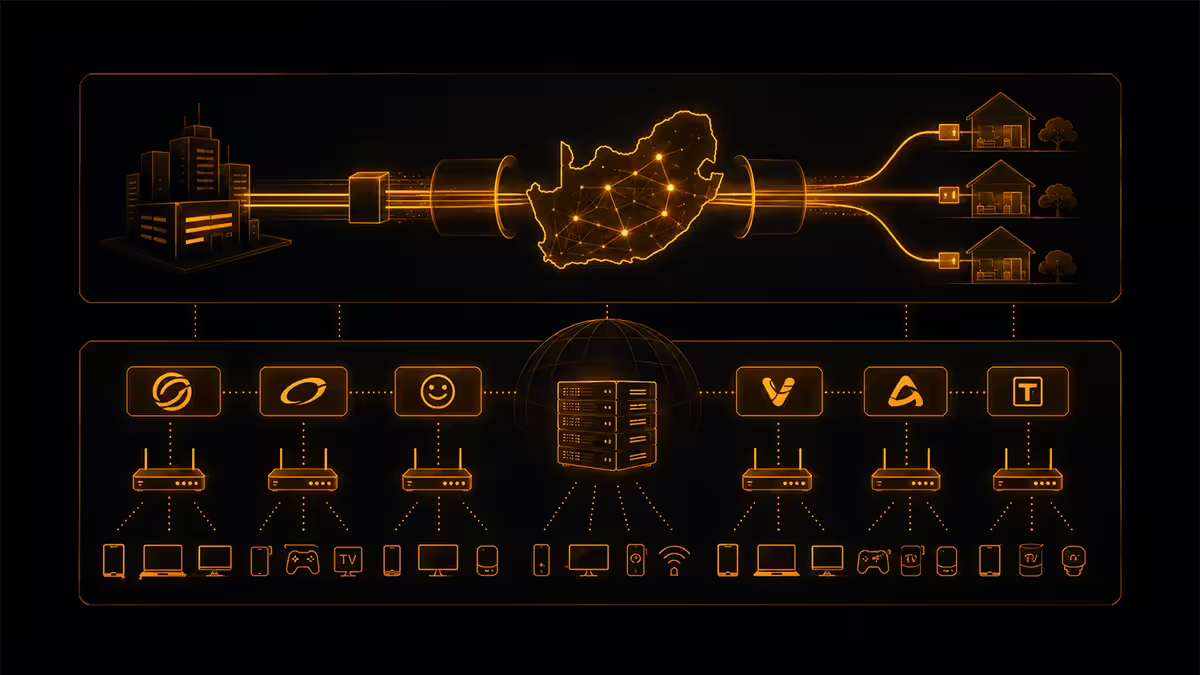
The single most useful thing to understand about South African fibre is that it's built in two layers, and most consumer confusion comes from missing this point.
Layer one is the physical fibre network. Companies called NLDs (National Long Distance operators, also called FNOs — Fibre Network Operators) physically dig the trenches, run the cables, install the street cabinets and connect the fibre to your wall. The major NLDs are Vumatel, Openserve, Frogfoot, Octotel, Metrofibre / Link Layer, MetroFibre Networx and Mitsol. Your home address determines which NLDs serve you — usually one, sometimes two competing networks, occasionally three.
Layer two is the ISP. The ISP doesn't own any cable. They buy wholesale bandwidth from the NLDs, route your traffic through their core network and out to the global internet, and sell you a monthly package. The major SA ISPs are Afrihost, Webafrica, RSAweb, Cool Ideas, Vox, Axxess, Mweb, Telkom Mobile / Openserve and Vodacom. Most ISPs resell on multiple NLDs.
In practice this means: check NLD coverage first, then pick the ISP. If only Vumatel serves your address, you can only buy ISPs that resell Vumatel — Afrihost Vumatel, Webafrica Vumatel, Cool Ideas Vumatel and so on. The line speed and price will vary by ISP even on the same underlying network.
The major SA fibre networks (NLDs)
Vumatel
The largest SA fibre network by suburb count. Vumatel went into upper- and middle-class suburbs first in 2015-2018, then expanded aggressively into townships from 2020 onward (Vuma Reach, Vuma Key). Excellent in Gauteng, Western Cape, KZN. Coverage is patchy in the Free State and Eastern Cape outside metro areas. Strong ISP support — every major ISP resells Vumatel.
Openserve
A Telkom subsidiary, Openserve inherited the country's biggest copper-line footprint and converted aggressively to fibre. Wide reach — especially strong in older suburbs and small towns where Vumatel hasn't built. Slightly more business-flavoured. Symmetrical upload speeds on most packages. All major ISPs resell.
Frogfoot
Competitive middle-tier network. Strong in Western Cape, Gauteng and parts of KZN. Frogfoot was first to push aggressive uncapped pricing and remains one of the cheaper underlying networks. Quality is good; coverage is more focused than Vumatel or Openserve.
Octotel
Western Cape-focused, dominating Cape Town, Stellenbosch, Paarl and surrounding areas. Excellent network quality and good ISP support. If you live in the Western Cape, Octotel is often the highest-quality option at your address.
Metrofibre / Link Layer / Networx
Mid-tier urban networks in Gauteng — Centurion, Pretoria, Joburg South. Generally good quality at competitive prices. ISP support is solid but slightly thinner than Vumatel.
Other networks
Mitsol, Lightstruck, TT Connect, Clearaccess and Evotel are smaller regional networks. Quality varies. Coverage is local. If you find one of these at your address with a major ISP behind it, the experience can be excellent.
The major SA fibre ISPs
| ISP | Reputation | Best for |
|---|---|---|
| Afrihost | Volume leader, aggressive pricing | Best general-purpose value |
| Webafrica | Very competitive pricing, big rebrand 2024 | Budget households |
| RSAweb | Premium quality, low latency | Gaming, content creators |
| Cool Ideas | Best-in-class routing, gaming favourite | Competitive gaming |
| Vox | Business heritage, strong SLAs | Work-from-home, SOHO |
| Axxess | Mid-tier value, technical user base | Static IPs, custom routing |
| Mweb | Legacy ISP, decent service | Brand familiarity |
| Telkom Openserve | Bundles with Telkom Mobile | Mobile + fibre bundle |
| Vodacom Fibre | Bundles with mobile | Mobile + fibre bundle |
The volume leaders (Afrihost, Webafrica) compete aggressively on price and are the right default for most households. Their support is fine, their networks are stable, their packages are clear.
The premium quality ISPs (Cool Ideas, RSAweb, Vox) charge slightly more but maintain better international routing, lower contention and friendlier technical support. Gamers, content creators, work-from-home professionals notice the difference.
Mobile network ISPs (Telkom, Vodacom, MTN through some networks) make sense if you're already in their mobile ecosystem and the bundle saves real money. Watch for activation delays and routing that's optimised for mobile, not fibre.
Line speed reality — what you actually need
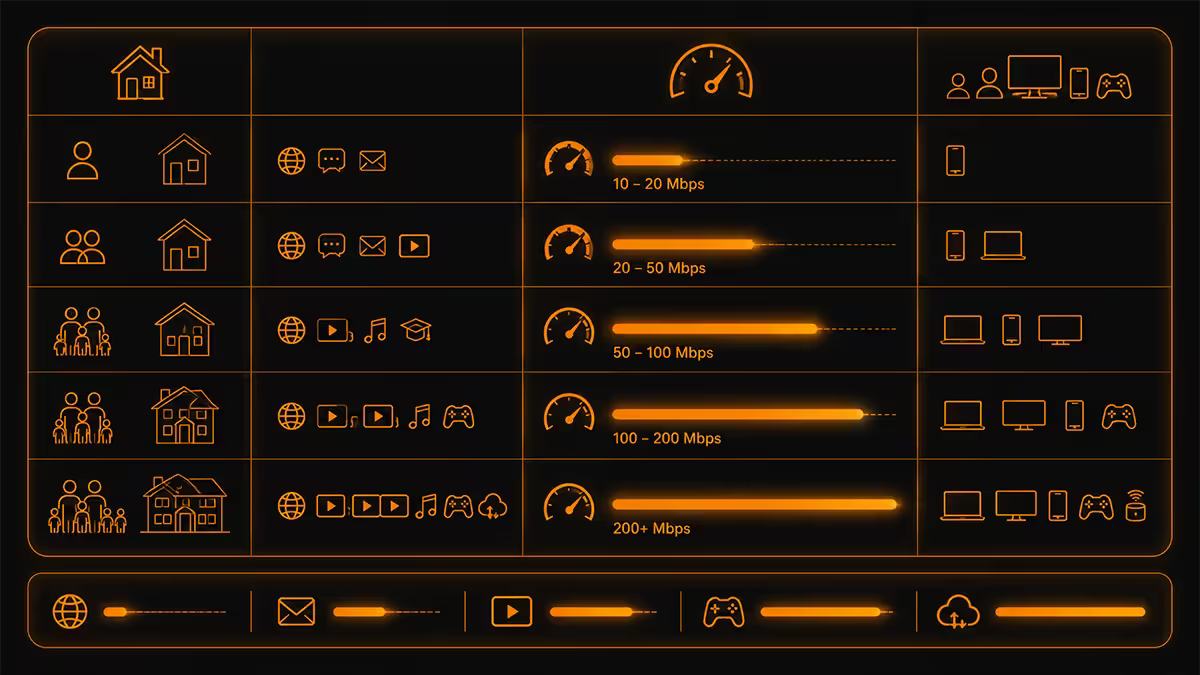
SA fibre packages typically come in tiers of 10, 25, 50, 100, 200, 500 and 1000 Mbps (1 Gbps). The marketing implies more is always better. The reality is more nuanced.
| Line speed | Real-world fit | SA monthly |
|---|---|---|
| 25 Mbps | Single person, basic browsing + 1 stream | R450-R600 |
| 50 Mbps | Couple, 2 streams + work-from-home | R550-R700 |
| 100 Mbps | Family of 4, multiple streams, gamer | R650-R850 |
| 200 Mbps | Heavy household, 4K streams, big downloads | R750-R1,000 |
| 500 Mbps | Content creators, cloud workflows | R900-R1,200 |
| 1 Gbps | Power users, multiple gamers, NAS backups | R1,100-R1,500 |
The honest answer for most SA households: 100-200 Mbps is the sweet spot. Below 100 you start feeling congestion with multiple simultaneous streams. Above 200, you're paying for capacity you rarely use unless you specifically download huge files.
The jump from 100 Mbps to 1 Gbps doesn't feel different for browsing, video calls, streaming or general use. Web pages, YouTube and Netflix all stream well below 50 Mbps. Where 1 Gbps shines is downloading a 90GB Call of Duty patch in 12 minutes instead of 2 hours, or syncing 200GB of footage to Dropbox in 30 minutes instead of 6 hours.
Gaming latency — speed isn't the answer
For gaming, the metric that matters is latency (ping), not download speed. A 100 Mbps line with 15ms ping to a Joburg game server beats a 1 Gbps line with 60ms ping to that same server, every time.
Latency in SA gaming is determined by:
- Whether the game has SA servers. CS2, Valorant, Apex Legends, Rocket League, Dota 2, LoL — all have SA servers. Ping should be 5-30ms within the country.
- Your ISP's peering and routing quality. Cool Ideas, RSAweb and Vox typically deliver 5-15ms to local servers. Afrihost and Webafrica are competitive but occasionally route suboptimally during peak hours.
- Your home network. WiFi adds 5-30ms. Ethernet adds 1-3ms. For competitive gaming, run a cable.
- NLD congestion. Some neighbourhoods have over-subscribed cabinets and feel slow at peak.
For overseas servers (US, EU, Asian games without local servers), expect 130-250ms ping regardless of ISP. The undersea cable distance is fixed by physics. Premium ISPs do route slightly better via SEACOM / EASSy / WACS cables but the difference is in the order of 10-20ms — not the 50-100ms some marketing implies.
Contention ratios — why peak hours feel slow
Residential fibre in SA is contended. That means multiple customers share the upstream bandwidth from your local cabinet to the ISP core. Typical residential contention is 20:1 to 50:1 — your 100 Mbps line is shared with 20-50 other 100 Mbps lines on the same node.
This is why speed tests run at 3am hit 100 Mbps full throttle and 7pm tests during peak drop to 40-60 Mbps. The cabinet upstream is congested, not your line.
Lower-contention ISPs (Cool Ideas, RSAweb, Vox) deliberately provision their upstream to avoid heavy contention. Their packages cost slightly more but feel more consistent at peak. Higher-contention ISPs (the budget tier) cut peak-hour speeds more visibly.
If 7-9pm is when your household uses the internet most and the experience is frustrating, you may benefit more from switching ISP than from upgrading speed tier. A 100 Mbps Cool Ideas line at full peak speed beats a 200 Mbps budget line throttled to 80 Mbps.
How to switch ISP without downtime
Switching ISP in SA is far easier than it was five years ago. Most NLDs allow concurrent provisioning, meaning you can have both old and new ISP active on the same physical fibre line for a few days during transition.
The clean switching process:
- 1
Sign up with new ISP.
They handle the NLD provisioning request. Typically 1-3 business days to activation. - 2
Wait for activation confirmation.
Don't cancel the old ISP yet. - 3
Test the new connection.
Speed test, latency test, run normal household traffic for at least 48 hours. - 4
Cancel old ISP only after the new one is proven stable.
Most ISPs are now month-to-month, no early-termination fees. - 5
Return the old router if it was rented.
Some ISPs include router in monthly fee. Keep your old router if you bought it — useful as a spare or for a separate WiFi network.
If you're staying on the same NLD, transition is usually seamless. If you're changing NLD (e.g., from Octotel to Vumatel because both serve your address), the new NLD will physically install separate equipment, sometimes drilling a new wall hole.
Across the 200,000+ custom PCs we've shipped from our Centurion warehouse, we've heard every fibre horror story and every win. The pattern is consistent: customers who pick the lowest price often regret it; customers who pick by latency and contention quality almost never do. Our staff run a mix — Cool Ideas and RSAweb dominate at home for the gamers, Afrihost and Webafrica for the budget-conscious, Vox for the business-leaning. The one universal: every staff member runs a mini-UPS on the router. Once you've experienced uninterrupted internet through stage 6 loadshedding, you don't go back.
Behind the Build · From our network desk
Recommended SA fibre packages by use case
| You are... | Recommended line | ISP picks |
|---|---|---|
| Single person, light use | 25-50 Mbps uncapped | Afrihost, Webafrica |
| Couple working from home | 100 Mbps uncapped | Afrihost, Vox, Webafrica |
| Family of 4 with streams | 100-200 Mbps uncapped | Cool Ideas, Afrihost, RSAweb |
| Competitive gamer | 100 Mbps minimum, low latency | Cool Ideas, RSAweb, Vox |
| Content creator / streamer | 200-500 Mbps symmetrical | RSAweb, Vox, Cool Ideas |
| Heavy household + downloader | 500 Mbps to 1 Gbps | Cool Ideas, RSAweb, Afrihost |
| Small business / SOHO | 200 Mbps + business SLA | Vox, RSAweb, Telkom Business |
Key takeaways
- SA fibre is two layers — NLD owns the cable, ISP sells the connection. Check NLD first, ISP second.
- Major NLDs: Vumatel, Openserve, Frogfoot, Octotel, Metrofibre. Major ISPs: Afrihost, Webafrica, Cool Ideas, RSAweb, Vox.
- 100-200 Mbps is the sweet spot for most households. 1 Gbps is overkill unless you genuinely download huge files.
- For gaming, latency > speed. Cool Ideas, RSAweb and Vox are the low-latency picks.
- Add a R600-R1,500 mini-UPS on your router. Fibre stays up during loadshedding; only your power drops.
Frequently asked questions
What's the difference between an NLD and an ISP in South Africa?
NLD owns the physical fibre cable (Vumatel, Openserve, Frogfoot, Octotel, Metrofibre). ISP sells you a connection over that cable (Afrihost, Webafrica, RSAweb, Cool Ideas, Vox). Address determines NLDs; you then pick any ISP that resells on those networks.Which is the best fibre ISP in South Africa for 2026?
Gaming/low-latency: Cool Ideas, RSAweb, Vox. Best value: Afrihost, Webafrica. Business: Vox, Vodacom Business. Also depends on which NLD covers your address.What fibre line speed do I actually need?
Single user 25-50 Mbps, family of 4 with gaming 100-200 Mbps, content creators 500 Mbps to 1 Gbps. Above 200 Mbps mostly affects huge downloads, not browsing or streaming.Is gigabit fibre worth it for gaming in South Africa?
For latency, no — gaming feels the same on 100 Mbps. For download speed, yes — Steam patches and game updates download dramatically faster. 90GB game in 12 mins vs 2 hours.What is contention ratio and does it matter?
How many subscribers share upstream bandwidth at your local cabinet. SA residential is 20:1 to 50:1. Causes 4-9pm peak slowdowns. Premium ISPs (Cool Ideas, RSAweb) maintain lower contention.How do I switch ISP without losing internet?
Sign up with new ISP, wait for activation (1-3 days), test stable for 48hrs, then cancel old. Most NLDs allow concurrent provisioning on the same line. Most ISPs now month-to-month.What's the difference between Vumatel, Openserve, Frogfoot and Octotel?
Competing physical fibre networks. Vumatel is largest by suburb count. Openserve has wide reach including older suburbs. Frogfoot competitive pricing. Octotel dominates Cape Town. Coverage check tools show your options.Will load shedding affect my fibre internet?
Fibre cables have battery backup at street cabinets — line stays up. Your home router needs power. R600-R1,500 mini-UPS keeps you online through stage 4-6.