Future Tech · PCIe Roadmap
What is PCIe 6.0 — and when does it actually arrive?
Gen 6 doubles bandwidth again using a brand-new signalling scheme borrowed from high-end Ethernet. AI servers are buying it now; gamers won't see it in motherboards until 2027 at the earliest. Here's the honest timeline and the wait-or-buy maths.
- peak x16 bandwidth
- 128 GB/s
- consumer chipsets
- 2027+
- per generation
- 2×
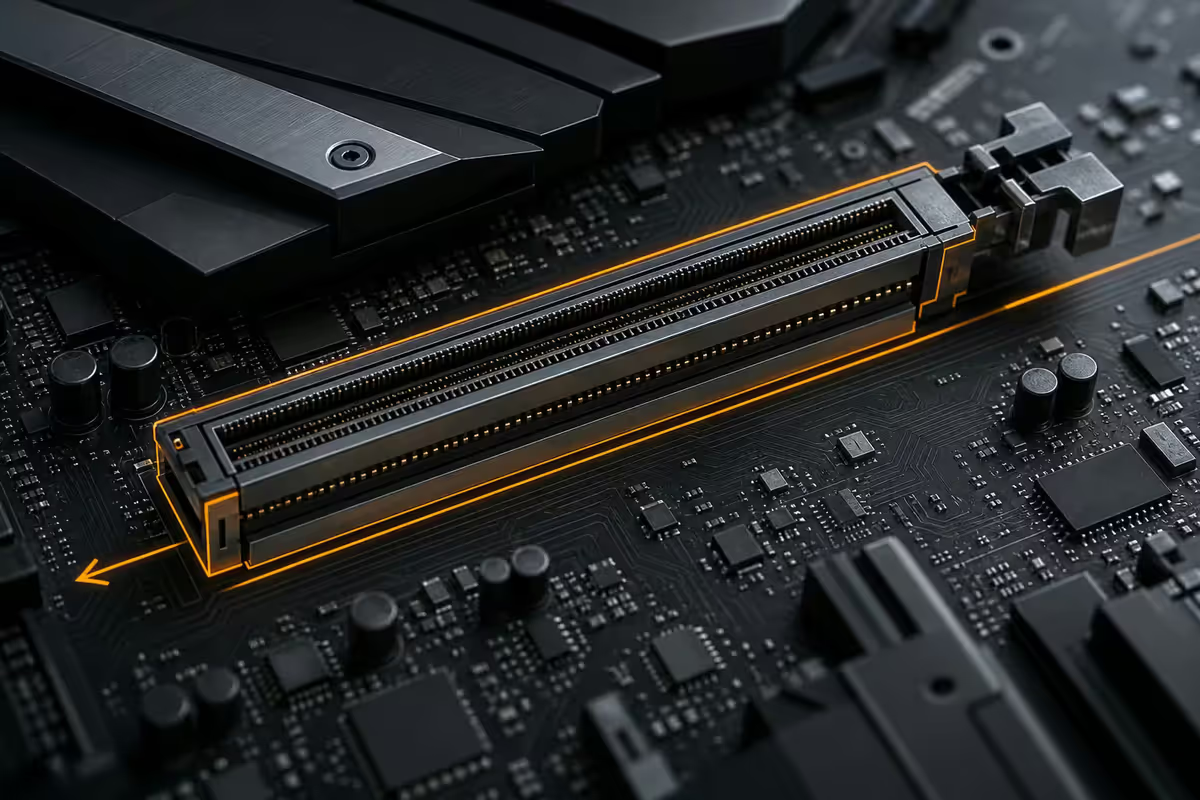
The PCIe 6.0 spec, in plain English
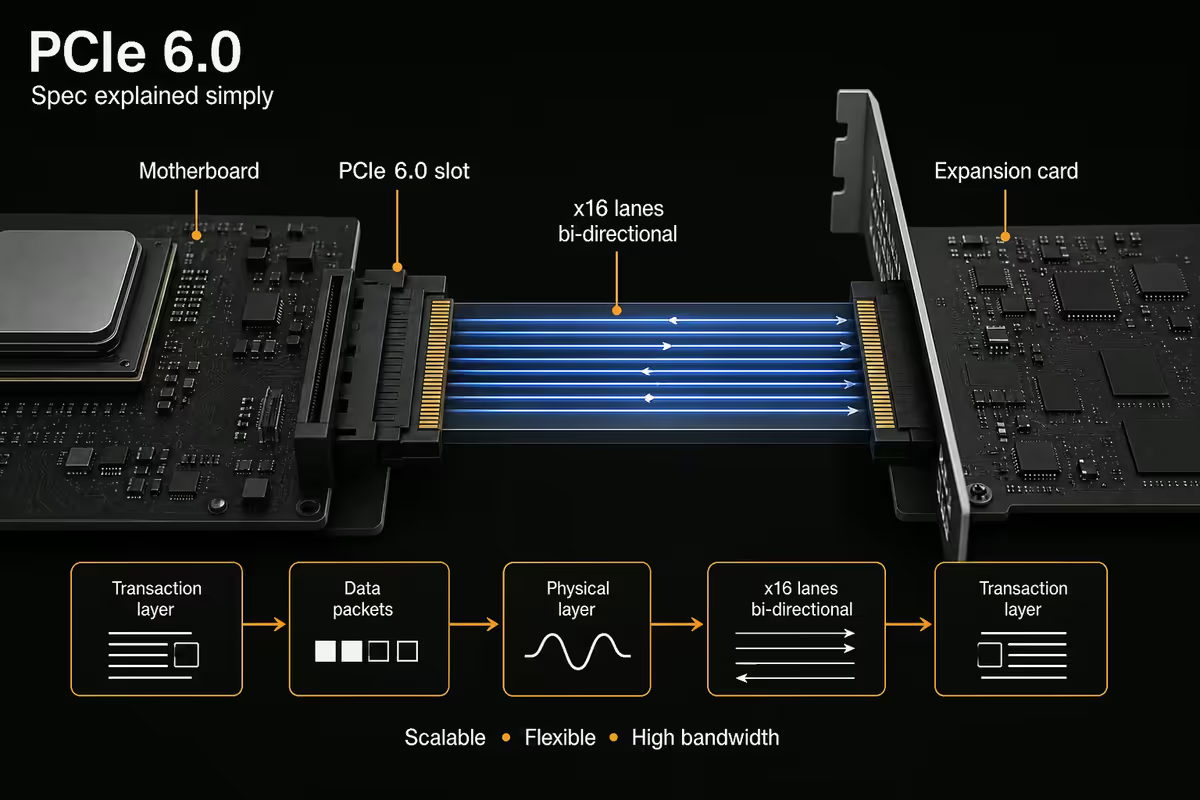
PCI-SIG ratified the PCIe 6.0 specification in January 2022. Four years later, in 2026, the spec is mature, the first silicon exists, and almost none of it is in anything you can buy at retail. Here's what the headline numbers actually mean.
| Generation | x16 bandwidth | Signalling | Spec year | Consumer availability |
|---|---|---|---|---|
| PCIe 3.0 | 32 GB/s | NRZ · 8 GT/s | 2010 | Ubiquitous since ~2012 |
| PCIe 4.0 | 64 GB/s | NRZ · 16 GT/s | 2017 | Mainstream since 2019 (X570, Z590) |
| PCIe 5.0 | 128 GB/s | NRZ · 32 GT/s | 2019 | Current high-end (X870E, Z890) |
| PCIe 6.0 | 256 GB/s | PAM4 · 64 GT/s | 2022 | Enterprise 2025+, consumer 2027+ |
The pattern PCI-SIG has held to since Gen 1 is simple: double the bandwidth every generation, roughly every three years. Gen 6 keeps the pattern but had to reach for a new trick to get there.
Note the bandwidth figure: 256 GB/s is the bidirectional figure for a x16 link (128 GB/s each direction simultaneously). The "128 GB/s" you'll see in marketing usually refers to unidirectional throughput — the practical number for one device pushing data to another.
PAM4 — why Gen 6 needed new signalling
From PCIe 1.0 through 5.0, every generation used NRZ (Non-Return-to-Zero) signalling: one bit encoded per signal transition, two voltage levels (high and low). Doubling bandwidth meant doubling the clock rate. By Gen 5 at 32 GT/s, the analog physics of PCB traces were straining — signal integrity over the distances inside a desktop motherboard was already marginal.
PAM4 — 4-level Pulse Amplitude Modulation — solves this differently. Instead of two voltage levels, PAM4 uses four (00, 01, 10, 11). Each signal transition now carries two bits instead of one. Bandwidth doubles without doubling the clock rate.
There's a catch: with four voltage levels packed into the same signal envelope, the margin between levels is narrower. That makes PAM4 more susceptible to noise, so PCIe 6.0 also mandates FLIT (Flow Control Unit) mode with Forward Error Correction. Both add a small latency overhead, but the spec compensates with deeper buffering and tighter encoding.
If PAM4 sounds familiar, it should — it's already deployed in 100 GbE and 400 GbE Ethernet. PCIe is borrowing a technique the networking industry validated years ago.
Enterprise gets Gen 6 first — by years
Every PCIe generation has launched on enterprise hardware before consumer. Gen 5 silicon shipped on server platforms (Intel Sapphire Rapids, AMD EPYC Genoa) a full year before AMD's Ryzen 7000 and Intel's Raptor Lake brought it to desktop in late 2022. Gen 6 is following the same pattern, just with a wider gap.
What's shipping now (2025-2026):
- AI accelerators. NVIDIA's Blackwell-generation H200/B100 successors and AMD's Instinct MI400 series are designed around Gen 6 for memory pooling via CXL 3.0. AI training clusters consume bandwidth in ways no consumer workload comes close to.
- Hyperscale switches and NICs. Broadcom, Marvell and Astera Labs are shipping Gen 6 retimers and switches for data-centre fabric in 2025-2026.
- Workstation early-adopters. AMD Threadripper 9000 (later 2026 / early 2027) is the first plausible non-server platform with Gen 6 lanes — but only on the WX/PRO variants, not consumer.
The economics drive the order. A hyperscale customer paying R200 000+ per AI accelerator absorbs early-silicon costs that no gamer would tolerate. By the time Gen 6 reaches consumer chipsets in 2027, enterprise will have funded two years of yield improvements, retimer maturation and motherboard PCB iteration.
When consumer PCIe 6.0 actually arrives
Here's the honest 2026 read on consumer Gen 6:
2026 — Gen 5 holds the throne. AMD's flagship X870E and Intel's Z890 are PCIe 5.0 chipsets. AM5 socket lifespan extends through 2027+ but AMD has not announced any Gen 6 silicon for the platform. Intel's LGA 1851 will see Arrow Lake refreshes through 2026, all Gen 5.
2027 — first plausible consumer Gen 6. The earliest realistic window is AMD's Zen 6 / AM5+ refresh or Intel's Nova Lake on a new socket. Even then, Gen 6 will initially appear as just the GPU slot and the primary M.2 slot, with the rest of the board still on Gen 4/5 lanes from the chipset. Full top-to-bottom Gen 6 boards arrive later.
2028+ — SA retail mainstream. Local retail follows global launches by 6-12 months for high-end and 12-18 months for mainstream. Expect Gen 6 motherboards on Evetech and Wootware shelves at scale from 2028, with early-adopter pricing (R12 000+ for entry-level Gen 6 boards versus R5 000-R8 000 for current X870E equivalents).
Gen 5 is already overkill for gamers
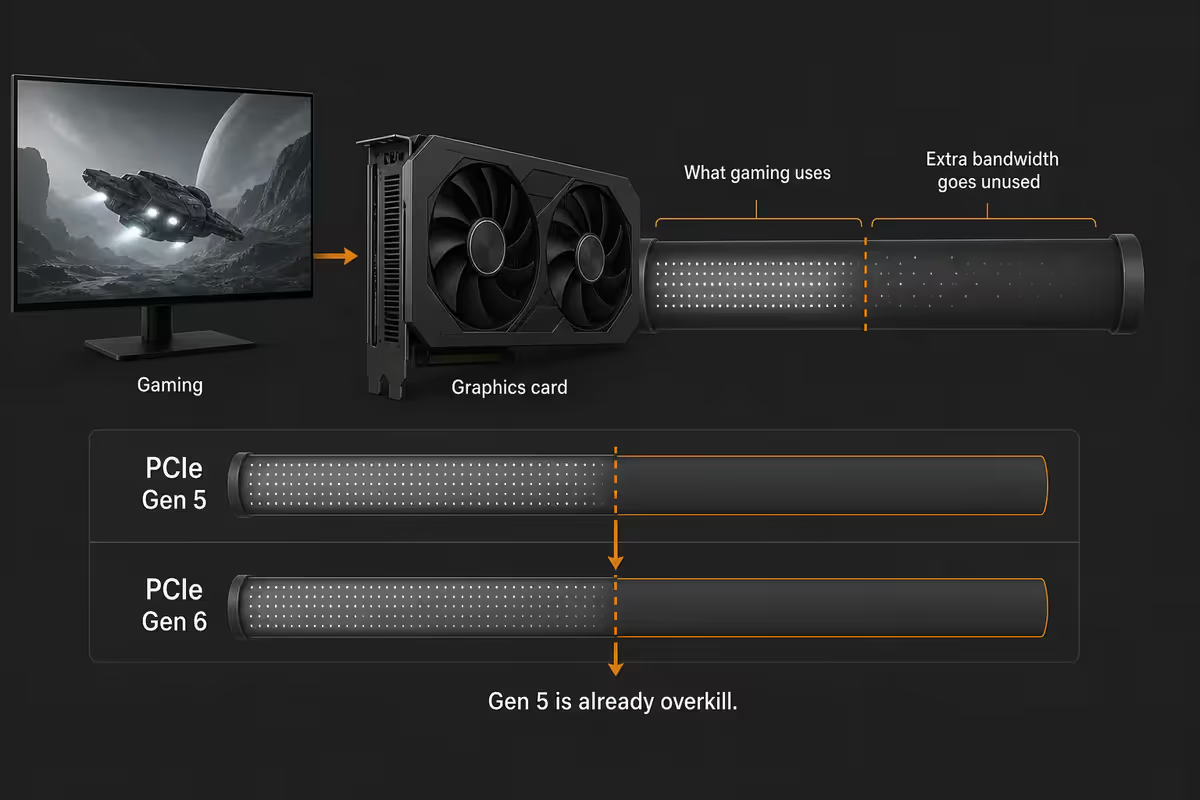
Here's the part the hype cycle doesn't want you to hear: PCIe 5.0 is wildly underutilised by current consumer hardware. The bandwidth argument has been theoretical for two generations.
- GPUs don't saturate Gen 4 x16. Independent benchmarks from Hardware Unboxed and TechPowerUp consistently show the RTX 5090 — the most bandwidth-hungry consumer GPU on the market — losing less than 2% performance dropping from Gen 5 x16 to Gen 4 x16, and only 4-5% from Gen 4 x16 to Gen 3 x16. The card is not bottlenecked at the PCIe link.
- SSDs are saturated, then it stops mattering. A Crucial T705 Gen 5 NVMe reads at ~14 000 MB/s sequential. That's faster than your file system, your game's asset loader, and Windows' I/O scheduler can usefully consume. Gen 6 doubling that to ~28 000 MB/s improves benchmark numbers but nothing you'd feel.
- Latency > bandwidth for gaming. Game load times are dominated by CPU-side asset decompression and shader compilation, not raw NVMe throughput. DirectStorage helps, but it's a software story.
The honest summary: Gen 6 is built for AI workloads that move tens of terabytes through accelerator memory per second, not for gamers loading a Cyberpunk save.
Gen 6 SSDs — the one realistic consumer use case
The first wave of Gen 6 hardware to genuinely matter for consumers will be NVMe SSDs for content creators and ML engineers. Phison has confirmed work on the E36 controller targeting PCIe 6.0, with first samples expected in late 2026 and consumer drives in 2027 once host platforms exist.
Expected Gen 6 SSD performance ceiling:
- Sequential read: 28 000-32 000 MB/s (vs ~14 500 MB/s on the Crucial T705)
- Sequential write: 25 000+ MB/s (vs ~12 500 MB/s on top Gen 5)
- Random 4K read IOPS: 2.5M+ (vs ~1.5M on Gen 5)
Who actually benefits: 8K RAW video editors moving 600+ GB/hr of footage, ML engineers loading multi-hundred-GB model checkpoints, database engineers pushing OLAP workloads, and 3D artists with massive texture libraries. For everyone else — gamers, streamers, office workers, Photoshop users — a Samsung 990 EVO Plus at Gen 4 speeds is functionally identical in day-to-day use.
Heat is the other story. Gen 5 SSDs already need active heatsinks; Gen 6 controllers running PAM4 at 64 GT/s will need genuinely serious cooling. Expect M.2 drives with built-in mini-fans or motherboards with active SSD coolers as a standard feature on Gen 6 boards.
Wait for Gen 6 or buy Gen 5 now — the SA maths
If you're planning a build in 2026, the temptation to "wait for the next thing" is real. Here's the actual maths for South African builders:
| Scenario | Buy now (mid-2026) | Wait for Gen 6 (2027-2028) |
|---|---|---|
| Platform | AM5 X870E / LGA 1851 Z890 | Unknown next-socket Gen 6 chipset |
| Motherboard cost | R5 000-R9 000 | R12 000-R18 000 (early adopter) |
| SSD ceiling | Gen 5 · 14 GB/s read | Gen 6 · 28 GB/s read |
| GPU bottleneck | None at Gen 5 x16 | None at Gen 6 x16 |
| Time without a PC | 0 months | 12-24 months |
| Realistic gain | — | ~0% for gaming, ~50% for content work |
The verdict for almost everyone: buy a Gen 5 build now. AM5 lifespan runs to at least 2027 with future drop-in CPU upgrades. The Crucial T705 and Samsung 9100 PRO Gen 5 SSDs are at the practical performance ceiling for non-content-creation workloads. The motherboard you'd buy in 2028 for Gen 6 will cost roughly double what an equivalent X870E costs today.
The narrow case for waiting: you're a professional video editor moving daily 8K RAW workloads, you're building an ML workstation for fine-tuning large models locally, or you already have a working PC and the upgrade is genuinely optional. Otherwise, the opportunity cost of two years without a current PC isn't worth recovering for negligible gaming benefit.
What to actually buy in 2026
| Component | Pick (2026) | SA price band |
|---|---|---|
| Gen 5 AMD motherboard | ASUS / Gigabyte X870E | R5 500-R9 500 |
| Gen 5 Intel motherboard | MSI / ASUS Z890 | R5 500-R10 000 |
| Gen 5 flagship SSD (1TB) | Crucial T705 / Samsung 9100 PRO | R3 500-R4 800 |
| Best-value NVMe (2TB) | Samsung 990 EVO Plus (Gen 4) | R3 200-R3 800 |
| Workstation upgrade path | AMD Threadripper 9000 (Gen 6 early bird) | R45 000+ platform |
| Skip for now | Any "Gen 6 ready" consumer board marketing | — |
Key takeaways
- PCIe 6.0 delivers 128 GB/s unidirectional on a x16 link via PAM4 signalling — double Gen 5.
- Enterprise and AI accelerators get Gen 6 in 2025-2026. Consumer chipsets are 2027 at the earliest.
- No 2026 consumer motherboard has Gen 6 — X870E and Z890 are both Gen 5 ceilings.
- Gaming doesn't benefit. GPUs don't saturate Gen 4 x16, let alone Gen 5 or Gen 6.
- Buy Gen 5 now — Gen 6 motherboards will cost R7 000-R10 000 more at launch for a benchmark gain you won't feel.
Frequently asked questions
When will PCIe 6.0 motherboards be available in South Africa?
Consumer Gen 6 boards are not expected before 2027 globally, with SA retail availability following 6-12 months later. Current X870E and Z890 platforms are PCIe 5.0 only — no announced 2026 chipset changes that.Do I need PCIe 6.0 for gaming?
No. Gen 5 x16 already delivers far more bandwidth than any current GPU can consume. The RTX 5090 barely uses Gen 4 x16. Gen 6 will not improve gaming performance.Will PCIe 6.0 slots work with my Gen 4 or Gen 5 GPU?
Yes. PCIe is fully backwards-compatible. A Gen 6 slot accepts any Gen 1-5 card and runs it at the card's native speed. You only lose peak bandwidth, never functionality.What is PAM4 signalling and why does it matter?
PAM4 uses four voltage levels per signal transition instead of NRZ's two, encoding two bits per transition. It's how Gen 6 doubles bandwidth without doubling clock speed. Requires forward error correction to stay reliable.Should I wait for PCIe 6.0 or buy a Gen 5 system now?
Buy now. Consumer Gen 6 is 18-24 months away with an R7 000-R10 000 motherboard premium at launch. Gen 5 already exceeds gaming needs. The opportunity cost of waiting outweighs any realistic benefit.Will PCIe 6.0 SSDs be much faster than Gen 5?
On paper, ~28 000 MB/s versus Gen 5's ~14 000 MB/s. In practice, this matters for 8K RAW video editing and ML work, not gaming or general use. Gen 5 already exceeds what most software requests.Why is PCIe 6.0 launching on enterprise first?
AI training and inference need every gigabyte of bandwidth available. NVIDIA Blackwell and AMD Instinct MI400 are designed around Gen 6 plus CXL. Enterprise customers also absorb early-silicon costs gamers cannot.Does PCIe 6.0 require new cables or connectors?
No new connectors — same M.2 and slot form factors. But PAM4 signal integrity demands higher-grade PCB traces, retimers and tighter tolerances, which is why Gen 6 motherboards will cost more at launch.
Get the Evetech app
Exclusive app-only prices, daily flash sales, and free delivery on orders over R4,000 — download the app and start saving.