Future Tech · Rubin Watch
RTX 6000 / Rubin. — Everything we actually know, mid-2026.
NVIDIA's next consumer architecture is real, scheduled and leaking. Rubin moves to TSMC 3nm with CoWoS-L packaging, GDDR7 across the stack, and a 30-40% performance lift over Blackwell. Here's what's confirmed, what's speculated and what SA buyers should do right now.
- over Blackwell
- 30-40%
- expected launch
- 2027
- SA flagship tier
- R30-45k
01 · Rubin architecture — what we actually know
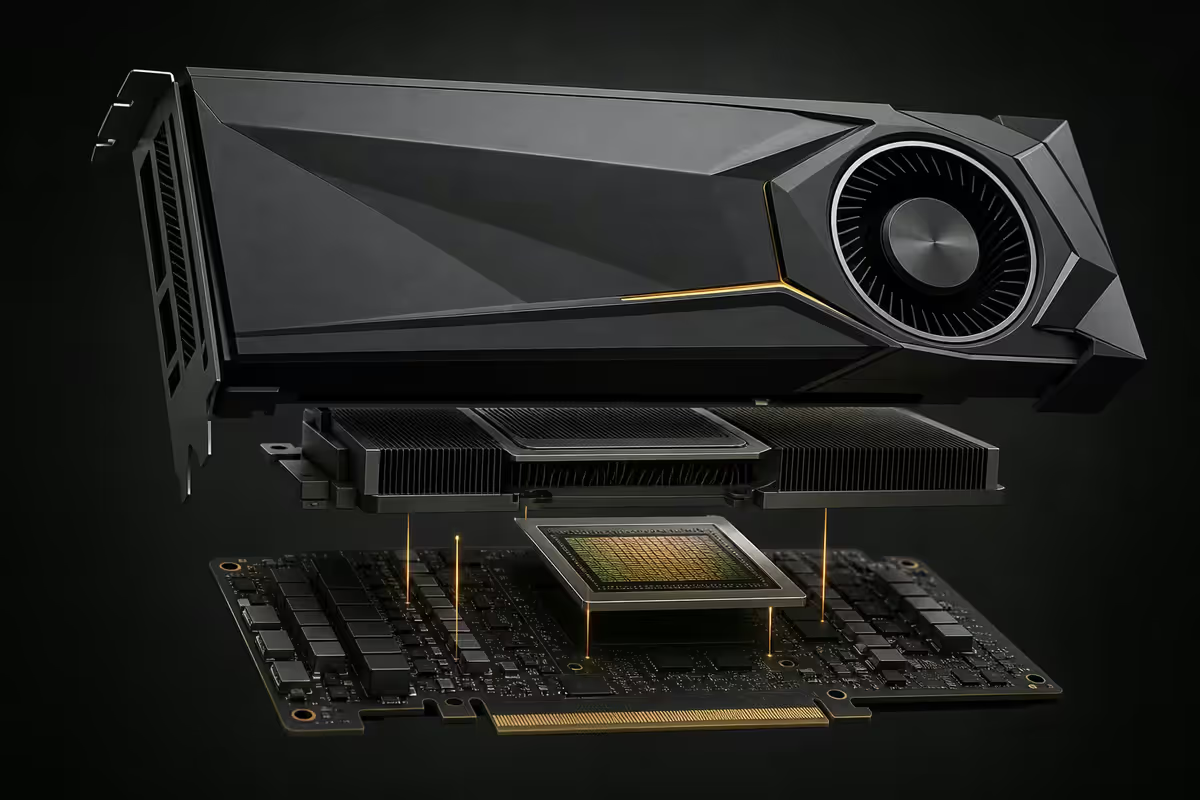
Rubin is NVIDIA's next-generation GPU architecture, named after astrophysicist Vera Rubin. The data-centre Rubin parts (Rubin GR100 / Rubin Ultra) are already deep into qualification at TSMC, with shipments to hyperscalers expected late 2026. The consumer Rubin — the GeForce RTX 6000 series — follows the same cadence we saw with Hopper → Ada and Blackwell server → Blackwell consumer.
Here's what's reported with reasonable confidence from supply-chain leaks, NVIDIA roadmap slides shown at investor days, and analyst notes:
- TSMC 3nm-class node — specifically N3P. A real shrink from Blackwell's TSMC 4NP, with roughly 20-25% better power efficiency at iso-frequency.
- CoWoS-L advanced packaging on the flagship dies. This allows larger combined die area than reticle-limited monolithic designs and is the foundation for the rumoured chiplet-style flagship configuration.
- GDDR7 memory across the entire stack, starting at 36 Gbps with a path to 40 Gbps refreshes mid-cycle.
- Next-gen RT cores with — reportedly — a significant uplift in BVH traversal throughput, addressing the path-tracing bottleneck that limits Blackwell at 4K.
- Tensor cores inherited from the Rubin data-centre architecture, which is where the speculated DLSS 5 / neural rendering gains come from.
What we do not know with confidence: exact SM counts per SKU, clock targets, final TDPs, or whether the very top of the stack ships as a true multi-die chiplet or a monolithic-on-CoWoS configuration. Treat anything specific in those areas as informed speculation until NVIDIA confirms at announcement.
02 · The expected line-up — 6090 / 6080 / 6070
The current best-guess consumer Rubin stack mirrors Blackwell's structure but with the usual generation shifts. Here's the leaked / projected configuration:
| SKU | Memory | Expected TDP | Slot above |
|---|---|---|---|
| RTX 6090 | 32 GB GDDR7 · 512-bit | 575-600 W | Replaces RTX 5090 |
| RTX 6080 Ti | 24 GB GDDR7 · 384-bit | 400-425 W | New tier — slots above 5080 |
| RTX 6080 | 20 GB GDDR7 · 320-bit | 350-375 W | Replaces RTX 5080 |
| RTX 6070 Ti | 18 GB GDDR7 · 288-bit | 300-320 W | Replaces RTX 5070 Ti |
| RTX 6070 | 16 GB GDDR7 · 256-bit | 250-275 W | Replaces RTX 5070 |
| RTX 6060 Ti (later) | 12 GB GDDR7 · 192-bit | 200-220 W | Mid-cycle 2027/2028 |
A few things to notice. The 6090 stays at 32 GB — NVIDIA already pushed Blackwell to that ceiling with the 5090, and there's little incentive to expand consumer VRAM further when professional workloads have RTX 6000 Ada / Blackwell Pro for that. The 6080 tier finally moves off the 16 GB ceiling that frustrated Blackwell buyers; 20-24 GB on the 6080 / 6080 Ti should give it real legs at 4K.
The 6070 finally landing with 16 GB is the meaningful change for mid-range buyers. Blackwell's 12 GB 5070 was the most criticised SKU of the generation — Rubin should fix that, assuming the leaks hold.
03 · Performance expectations vs Blackwell
Cross-referencing supply-chain leaks, projected SM count increases, the TSMC 3nm node uplift and historical NVIDIA generation cadence, here's the realistic performance band we're projecting:
| Workload | Expected lift vs Blackwell | What it means in practice |
|---|---|---|
| Rasterised 1440p | +25-30% | Already overkill — diminishing returns |
| Rasterised 4K | +30-40% | The headline figure most outlets quote |
| Ray tracing (no PT) | +40-50% | Bigger gen-on-gen RT lift than raster |
| Path tracing 4K | +50-65% | Where Rubin actually matters |
| AI inference / DLSS | +50-70% | Tensor architecture jump |
| Productivity (Blender, render) | +35-45% | Scales with CUDA core count |
A few realistic translations of those numbers. If your current target is 1440p high refresh-rate gaming, Rubin is largely irrelevant. The RTX 5080 already pushes 240 FPS on competitive titles and 120+ FPS on AAA at maxed settings; a 30% lift takes you from "comfortable" to "ridiculous", with no perceivable benefit unless you upgrade your monitor too.
If you're targeting 4K path tracing — Cyberpunk 2077 Overdrive, Alan Wake 2 Path Tracing, Black Myth: Wukong, the next wave of UE5.6 titles — that's the regime where Rubin earns its price. A 50-65% lift in path tracing means the 6090 should hit 4K 120 FPS path-traced with DLSS 4/5 frame generation in workloads that currently force the 5090 into 60-90 FPS territory.
For productivity — local LLM inference, Blender, DaVinci Resolve, Topaz Video AI — the AI architecture lift is the real story. If you bought a 5090 specifically for local Stable Diffusion or Llama inference, the 6090 should approximately 1.7x your throughput at the same wall power.
04 · DLSS 5 and Neural Shaders
NVIDIA's software stack is increasingly the actual product. DLSS 4 (Blackwell) already shifted to a unified transformer model with multi-frame generation; DLSS 5 — speculated to launch with Rubin — reportedly continues that trajectory with three specific upgrades:
- Lower input latency on frame generation. The current 2x / 3x / 4x multi-frame modes add latency at the high multipliers; DLSS 5 reportedly closes most of that gap thanks to faster tensor inference on Rubin's new cores.
- Better temporal stability in motion. DLSS 4 already crushed DLSS 3 on this; DLSS 5 is reportedly close to native at quality preset, with ultra-quality approaching imperceptible difference from native in most titles.
- Neural Shaders as a developer primitive — a new API that lets game engines run inference inside shaders for neural texture compression, real-time material synthesis and procedural detail. Think 8x texture density at the same VRAM cost, or material variation that doesn't ship as assets.
A note on backward compatibility. NVIDIA's pattern has been to keep new DLSS features Rubin-only at launch, then progressively backport reduced-feature versions to Blackwell and (sometimes) Ada. DLSS 5 base upscaling will almost certainly come to Blackwell; multi-frame generation 5x or higher modes probably won't.
Neural Shaders is the bigger long-term story. If it gets meaningful adoption — UE5.6, Unity, the major bespoke engines — it changes what's possible at the 16 GB and 20 GB VRAM tiers. A 6070 with neural texture compression could effectively behave like it has 24-32 GB of VRAM for texture-bound workloads. That's the kind of architectural shift that makes mid-range cards stay relevant for longer.
05 · Launch timing — when does Rubin land?
The realistic timeline, cross-referenced from NVIDIA's investor commentary, TSMC's CoWoS-L capacity ramp schedule, and the data-centre Rubin pre-orders already known:
| Milestone | Expected window | Confidence |
|---|---|---|
| Data-centre Rubin shipping | Q4 2026 | High — supply chain confirmed |
| NVIDIA GTC reveal | March 2026 or March 2027 | Moderate — depends on cadence |
| CES announcement | January 2027 | High — fits historic pattern |
| RTX 6090 retail (global) | Q1-Q2 2027 | Moderate-high |
| RTX 6080 retail (global) | Q2 2027 | Moderate |
| RTX 6070 retail (global) | Q3 2027 | Moderate |
| SA stock at MSRP | Q3-Q4 2027 | Realistic, not optimistic |
| RTX 6060 / Super refreshes | 2028 | Speculative |
A few caveats. NVIDIA could pull the consumer Rubin announcement earlier — a late 2026 CES preview is technically possible — but retail availability at MSRP is a different question. The Blackwell 5090 launched January 2025 and was still scarce at MSRP in SA through to July 2025. Expect the same dynamic with Rubin: announcement does not mean buyable.
The 4070 / 5070 tier launches usually trail flagship by 3-6 months, which means realistic buyer-with-a-budget Rubin doesn't really start until late 2027. If you're building a mid-range gaming rig now and waiting for Rubin, you're effectively waiting 18 months from today.
06 · Wait for Rubin vs buy Blackwell now — the actual maths
This is the question we get asked most often at the moment, and the honest answer depends on three things: what GPU you have right now, what resolution you play at, and how long you can comfortably wait. Let's walk through the realistic scenarios.
Scenario 1: You're on an RTX 3060 / 3070 / 3080
Buy a Blackwell card now. The jump from Ampere to Blackwell is enormous — a 5070 already beats your 3080 by 40-60%, the 5070 Ti by 60-80%. Waiting 18 months to play current games on a 3-generation-old GPU for the chance to buy something better isn't a real trade. Get the 5070 Ti or 5080, enjoy two years of cutting-edge gaming, then re-evaluate at Rubin Super refresh time in 2028.
Scenario 2: You're on an RTX 4070 / 4080 / 4090
Skip Blackwell, wait for Rubin. The Ada → Blackwell jump is 20-30% at most for raster, which isn't worth the upgrade cost. Your 4080 / 4090 will hold up perfectly through 2027 in any modern title. Rubin gives you a meaningful generational leap; Blackwell gives you a lateral move.
Scenario 3: You're building from scratch right now
Buy Blackwell. The "wait tax" is real — you give up 12-18 months of using a great GPU for the chance to buy a hard-to-find next-gen card at inflated SA street prices. Unless you specifically need 4K path tracing or local 70B LLM inference, the RTX 5070 Ti at R20-22k or 5080 at R30-35k is the right call.
Scenario 4: You're on an RTX 5090 already
Stay put. The 5090 will not be obsolete in 2027. At 1440p it will still crush anything for years. The only reason to upgrade is if you specifically need 4K path tracing at maxed settings, in which case the 6090 is your target — but you can comfortably wait through the launch chaos to Q3 2027 when SA stock normalises.
07 · SA pricing realism
South African pricing for any new NVIDIA flagship comes down to four moving parts: NVIDIA's USD MSRP, the rand/dollar exchange rate at the time, AIB premium markups (ROG, Suprim, AORUS), and 15% VAT plus distributor margin. Here's how we expect that math to land for Rubin at retail launch:
| SKU | Expected SA launch price | Expected 6-month settled price |
|---|---|---|
| RTX 6090 (Founders / reference) | R65,000-R75,000 | R55,000-R65,000 |
| RTX 6090 (AIB premium — ROG, Suprim) | R75,000-R85,000 | R65,000-R72,000 |
| RTX 6080 Ti | R38,000-R45,000 | R32,000-R38,000 |
| RTX 6080 | R30,000-R36,000 | R25,000-R30,000 |
| RTX 6070 Ti | R22,000-R26,000 | R19,000-R22,000 |
| RTX 6070 | R16,000-R19,000 | R14,000-R16,000 |
These numbers assume an exchange rate of approximately R18-R19 to the dollar at launch. A weaker rand pushes everything higher; a stronger rand is the rare upside scenario. Don't budget for launch MSRP, budget for AIB stock plus AIB premium plus VAT plus the SA distributor margin. That's the realistic out-of-pocket cost.
Stock availability will be brutal at launch. Every Blackwell flagship was hard to find at MSRP for at least 4 months. Rubin is starting from a lower TSMC 3nm wafer capacity baseline and competing with data-centre Rubin demand from the same fab capacity. Expect 6090 stock to be hard to find at any price for at least 3 months after SA launch.
08 · Key takeaways
- Rubin is real and scheduled. TSMC 3nm with CoWoS-L packaging, GDDR7 across the stack, expected H1 2027 global launch.
- Expected 30-40% raster lift over Blackwell, larger jump in ray tracing and AI workloads. Path tracing at 4K is where Rubin actually matters.
- Line-up follows Blackwell structure: RTX 6090 / 6080 Ti / 6080 / 6070 Ti / 6070, with the 6070 finally landing at 16 GB VRAM.
- SA pricing expected R65-75k for 6090 at launch, settling toward R55-65k. R30-45k for the 6080 tier. R16-19k for the 6070.
- If you need a GPU now, buy Blackwell. If you specifically want 4K path tracing and can comfortably wait 18 months, Rubin is the right target.
- The RTX 5090 is not made obsolete by Rubin — it remains a 1440p crusher for years. Don't sell yours into a panic.
09 · Frequently asked questions
When does the RTX 6000 / Rubin series launch?
Industry leaks and supply-chain reports point to first half of 2027 for the consumer RTX 6000 series, with a CES January 2027 announcement and SA stock at MSRP arriving Q3-Q4 2027. Treat anything more specific than that as speculation until NVIDIA confirms.How much faster is Rubin expected to be than the RTX 5090?
Roughly 30-40% in raster, 40-50% in ray tracing, 50-65% in path tracing, and 50-70% in AI workloads. The path-tracing and AI numbers are where Rubin earns its price; raster gains are real but diminishing returns at the top of the stack.What will the RTX 6090 cost in South Africa?
Realistic SA launch pricing: R65,000-R75,000 for reference / Founders Edition, R75,000-R85,000 for AIB premium cards (ROG, Suprim, AORUS). Expect that to settle to R55,000-R65,000 after 6 months as stock normalises. Add 15% VAT and AIB premium to NVIDIA's MSRP at the prevailing rand/dollar rate.Should I wait for Rubin or buy a Blackwell card now?
Buy Blackwell now unless you have a specific reason to wait 12-18 months. The RTX 5070 Ti, 5080 and 5090 give you 18+ months of cutting-edge performance before Rubin even arrives in SA at stable stock. The wait tax is real.Will Rubin make the RTX 5090 obsolete?
No. The 5090 will still dominate 1440p gaming through 2028 and remain excellent at 4K raster. Where Rubin pulls ahead is 4K path tracing and AI workloads. If you don't need those specifically, your 5090 stays elite for years.What is DLSS 5 and Neural Shaders?
DLSS 5 is the speculated next iteration of NVIDIA's upscaling and frame generation stack, reportedly with lower latency and improved temporal stability. Neural Shaders is a developer-facing API that lets shaders run AI inference inline, enabling neural texture compression and real-time material synthesis at much lower VRAM cost.Will Rubin GPUs use GDDR7 memory?
Yes — GDDR7 is expected across the entire RTX 6000 stack, starting at 36 Gbps. The RTX 6090 is expected with 32 GB on a 512-bit bus, the 6080 with 20-24 GB, the 6070 with 16 GB on 256-bit.What manufacturing node will Rubin use?
TSMC's 3nm-class node — likely N3P — with CoWoS-L advanced packaging on the flagship dies. That's a real shrink from Blackwell's TSMC 4NP and is the source of most of the projected power-efficiency gain.
Get the Evetech app
Exclusive app-only prices, daily flash sales, and free delivery on orders over R4,000 — download the app and start saving.