GPU Buying Decision · Wait vs Now
Should you wait for the next-gen GPU?
— The wait-trap is real. The maths usually says no.
- Q4 2026 expected
- 50-Super
- wait-tax average
- 8-14 mo
- actually buy launch
- ~22%

What "next gen" actually means right now
"Next gen" in May 2026 has a specific meaning that's shifted over the past year. Both NVIDIA and AMD launched their current architectures in late 2024 / early 2025 — RTX 50 (Blackwell) and RX 9000 (RDNA 4). Neither is "old" yet.
The realistic "next gen" question in 2026 is either:
- RTX 50-Super refresh — expected Q4 2026 / Q1 2027 based on NVIDIA's historical Super cadence. Typically 10-20% faster than the equivalent non-Super card at similar price.
- RX 9000 XT refresh — AMD doesn't always do mid-cycle refreshes; rumours suggest a 9070 XT/XTX bump but timing unclear.
- RTX 60 / "Rubin" — full architectural shift expected late 2027. Real "next gen". Long way off.
- AMD "UDNA" successor to RDNA — late 2027 / 2028. AMD has hinted at unifying RDNA gaming and CDNA compute architectures.
So when someone asks "should I wait for next gen?" in May 2026, they're usually asking about RTX 50-Super (~6-9 months out) or, more rarely, the full RTX 60 architecture (~18 months out).
Current generation maturity
A counter-intuitive truth: buying mid-to-late in a generation is often better than launch. The drivers are mature, BIOS issues fixed, the AIB lineup has settled, and prices have stabilised below launch hype.
| Current GPU maturity factor | Status in May 2026 |
|---|---|
| Driver stability | 15+ months of refinement — issues largely resolved |
| Price-to-MSRP ratio | Stable or below MSRP at most SA retailers |
| AIB partner range | ASUS, MSI, Gigabyte, Sapphire, PowerColor — full lineup |
| Reviews available | Long-term reviews, real-world game data, thermal data |
| Game optimisation | Most current games specifically tuned for RTX 50 / RX 9000 |
| DLSS / FSR support | DLSS 4, FSR 4 well-supported in current AAA releases |
| Warranty support | Full 3-year warranties available; RMA paths well-established |
| Supply chain | Consistent stock at all tiers from R5,000 to R55,000+ |
Known GPU launch roadmap (as of May 2026)
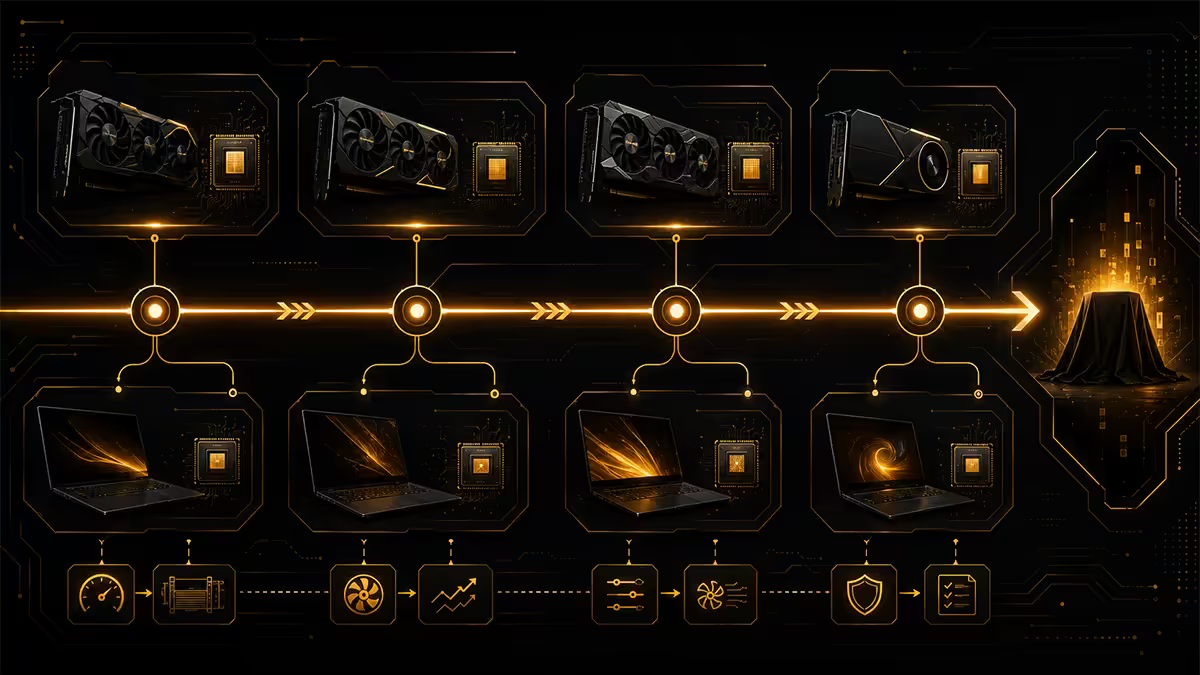
The realistic GPU release calendar, based on official statements, supply chain leaks, and historical NVIDIA/AMD cadence:
| Product | Realistic timing | Performance jump (vs current) |
|---|---|---|
| RTX 50-Super (5080 Super, 5070 Super) | Q4 2026 / Q1 2027 | ~10-20% over non-Super tier |
| RTX 5060 Ti / 5050 launch | Mid-2026 (already announced) | Filling lower-tier gaps |
| RX 9000 XT refresh | Possibly late 2026, unconfirmed | ~10-15% over current XT |
| RTX 60 series (Rubin architecture) | Late 2027 / early 2028 | ~50-70% over RTX 50 expected |
| AMD UDNA architecture | Late 2027 / 2028 | ~50% over RX 9000 expected |
| Intel Arc Battlemage / Celestial | Drip-feed 2026-2027 | Mid-tier price disruption |
The cost of waiting — what you actually lose
Waiting has hidden costs that buyers rarely calculate. Let's quantify them honestly.
Hard costs of waiting 6-9 months for a new GPU launch:
- 6-9 months of missed gaming. If you'd buy at, say, R18,000 today for an RTX 5070, that's R67-R100 per month of utility you forfeit. A new game released this month plays at 60+ FPS instead of being shelved or running at 30 FPS.
- Outgoing GPU resale value softens over the wait period. If you're upgrading, your current GPU drops in value while you wait — the Rand-value loss on a year-old card can be R1,500-R3,000 just from time passing.
- Inflation and Rand-USD risk. Over 6-9 months, weakening Rand can add 8-15% to imported tech pricing. SA prices in 2026 have already absorbed ~12% Rand-driven uplifts.
- Opportunity cost. The next-gen card you're waiting for will likely be MORE expensive at launch, not less, due to launch-day MSRP being higher than current-gen current price.
- Build/system half-complete. If this is for a new system build, your other components sit unused. CPU, motherboard, RAM, storage — depreciating in value while you wait.
The "I'll save R2,000 by waiting" maths usually loses once you count all the hidden costs above.
Launch price reality — paper launches and scalping
New GPU launches don't deliver MSRP-priced supply on day one. The pattern, repeated across every recent NVIDIA and AMD launch:
| Launch phase | Reality |
|---|---|
| Launch day | "Available at MSRP" — gone within minutes globally |
| Week 1-2 | Scalper market at MSRP +30-80% |
| Week 3-6 | Sporadic restocks, MSRP +10-20% real-world prices |
| Month 2-3 | Most SKUs trickle into supply; demand outstrips at MSRP |
| Month 4-6 | Pricing normalises; AIB variants widely available |
| Month 6+ | True maturity — buy this window if you wait |
So even if RTX 50-Super launches in Q4 2026, getting one at a realistic price likely means waiting until Q2 2027. That's potentially 12+ months of waiting from a May 2026 decision point. Almost half the lifespan of the current generation.
Historical wait-pattern data
Looking at customer build data from previous generation transitions (RTX 20→30, RTX 30→40, RTX 40→50), a clear pattern emerges of what actually happens to people who say "I'm waiting for next gen".
| Outcome for "I'll wait" customers | % of those who waited |
|---|---|
| Bought the new-gen GPU at launch | ~22% |
| Bought current-gen by time new-gen arrived ("I gave up waiting") | ~58% |
| Delayed further to next-next launch ("Now I'll wait for the Ti") | ~20% |
Only ~22% of waiters get the thing they were waiting for. The majority — 58% — end up buying current-gen anyway, just 6-12 months later than they would have, having missed all that time of using a faster GPU. The remaining 20% fall deeper into the wait trap (more on that below).
When waiting genuinely makes sense
All three of these must be true for waiting to be the smart play:
- The launch is confirmed and within 4 months. Not rumoured. Not "expected eventually". Officially announced with a hard date.
- You currently have a working GPU. Your existing card runs the games you play at acceptable settings. You're optimising, not unblocking.
- You specifically need a feature only the new architecture offers. For example, a particular DLSS generation, hardware ray-tracing improvement, VRAM tier (24GB+ for AI/3D workloads), or memory bandwidth class. Vague "more performance" isn't enough.
Example "valid wait" cases: "RTX 50-Super launches in November, I have a 4070 that handles my games at 1440p OK, and I do Blender work that would benefit from the larger VRAM expected on the 5080 Super." Three boxes ticked — wait makes sense.
Example "invalid wait" cases: "My GPU is failing but I'll just wait for next-gen." (Box 2 fails.) "I want to upgrade and there might be something better in 2027." (Box 1 fails — too far off.) "I want more frames in CS2." (Box 3 fails — current gen handles this fine.)
When buying now is the right call
The default position. The case for buying current-gen RTX 50 / RX 9000 today:
- You need a GPU now for gaming, work, or a system build that's bottlenecked.
- You have no GPU or a failing one. Doesn't matter what's coming — you need to function.
- Current-gen at current prices hits your performance target. If RTX 5070 / RX 9070 handles your monitor at the framerate you want, you've solved the problem.
- Drivers, support and game compatibility are mature. Lower risk than launch-day adoption.
- You'll use the GPU for 3-4+ years. The next-gen launch happens in the middle of your ownership anyway. Waiting changes which years you use what — not the total cost-per-year significantly.
- Black Friday or end-of-financial-year promo timing. November-December and February often see 8-15% discounts on outgoing-tier current-gen — better real-money savings than launch-day risk.
The wait-trap psychology

The "wait trap" is the psychological pattern that turns a 6-month wait into an 18-month wait into a 30-month wait. It's remarkably consistent across hardware buyers.
How the trap works:
- "I'll wait 6 months for the new gen." You commit to wait.
- Six months pass. The new gen launches but at MSRP+30% scalper prices with limited stock.
- "I'll wait until prices stabilise." Now you're waiting 3-4 more months.
- Prices stabilise but the Ti variant is rumoured. "I'll just wait for that — it's only a few months away."
- Ti launches. By now there are rumours of the next-next-gen.
- Cycle continues indefinitely. You never buy. Years pass.
The trap exploits two cognitive biases: (1) sunk-cost fallacy — "I've already waited 6 months, I might as well wait for the next thing", and (2) loss aversion — fear of buying just before something better launches outweighs the realised loss of not having a GPU now.
Escape the trap by setting a hard buy-date. "If RTX 50-Super isn't priced reasonably and in stock by 31 January 2027, I'm buying RTX 5070 instead." Pre-committing prevents the infinite-wait pattern.
SA-specific factors — Rand, Black Friday, Tariffs
The Rand-timing play: if you're flexible on timing and the Rand strengthens to under R17.50/USD, that's a buy signal — savings of R1,500-R3,000 on a mid-range card vs the same card during Rand-weakness windows. Watch the rate but don't paralyse on it.
Import duties and VAT: SA GPU pricing includes 15% VAT and varying import duties depending on classification. New flagship SKUs sometimes face initial customs hold-ups that delay availability further — another reason launch-day SA pricing is unreliable.
Used current-gen — the strategic play after next-gen launches
There's one wait strategy that often does work: wait for next-gen to launch, then buy used current-gen from upgraders.
The mechanics:
- RTX 50-Super launches in Q4 2026.
- Within 2-3 months, enthusiasts upgrade their RTX 50 Ti / 5090 cards and sell on Facebook Marketplace, Bidorbuy, OLX and forum trades.
- Used current-gen flagships drop 25-40% from new MSRP — a R45,000 RTX 5090 becomes R27,000-R33,000 used.
- You get last-gen flagship performance at 60-70% of new pricing.
Caveats: mining residue (check fan condition, run benchmarks), warranty status (some warranties transfer to new owner, some don't), reseller trust (Bidorbuy + payment-protection = safer than cash-and-carry), and patience required (the right card at the right price often takes weeks of searching).
Common wait-vs-buy mistakes
Waiting for a rumoured launch with no confirmed date. Tech leaks are wrong about timing more often than right. Don't pause life around "expected" launches.
Assuming current-gen prices will collapse at next-gen launch. They don't — historical drop is 10-15%, mostly over the following year. Used market drops faster than new retail.
Ignoring opportunity cost of months without a working GPU. If your current GPU is dying or absent, waiting "to save money" while not using your PC for 9 months costs more than the saving.
Believing launch-day stock will be normal. It won't be. Every GPU launch since 2020 has been paper-launch flavoured. Plan for 2-3 months post-launch before realistic supply.
Letting "Ti / Super / XT will be out soon" prevent any decision. Each tier launches every 6-10 months; if you optimise for "the next one", you'll never buy. Set criteria. Buy when met.
Chasing absolute top-tier when mid-tier matches your need. If you game at 1440p/144Hz, RTX 5070 / RX 9070 handles it. Waiting for 5090 Super to "future-proof" wastes money you'd never recoup. Match GPU tier to monitor.
Discounting the Rand-USD risk. Waiting 9 months for next-gen also means 9 months of Rand-USD exposure. If the Rand weakens 8% in that window, your "next gen savings" evaporate.
Key takeaways
- Default to buying current-gen now — RTX 50 / RX 9000 are mature, well-priced and well-supported in May 2026.
- RTX 50-Super expected Q4 2026 / Q1 2027 — paper launch + scalping will eat the first 2-3 months. Real supply: Q2 2027.
- Current-gen prices drop only 10-15% at next-gen launch — far less than waiters expect.
- Only ~22% of waiters end up buying the thing they were waiting for — most settle for current-gen months later.
- The strategic wait: skip next-gen launch entirely, buy used current-gen 3-6 months later at 25-40% off new MSRP.
Frequently asked questions
Should I wait for the RTX 50-Super or buy RTX 50 now?
If a confirmed launch is within 4 months and you already have a working GPU, waiting can make sense. Otherwise buy now. RTX 50-Super likely Q4 2026/Q1 2027 — paper launch and scalping will eat the first 2-3 months.How long is a typical GPU generation cycle?
Roughly 2 years between major architecture launches, with mid-cycle Super refreshes 8-12 months in. Next architectural shifts (RTX 60 / UDNA) likely 2027 territory.How much do current-gen GPU prices drop when next-gen launches?
Less than expected. MSRPs drop 10-15% at next-gen launch, only over 6-12 months. Used market softens faster — 20-30% within 3 months. The "wait for cheaper" play is mostly about used markets.What is a paper launch and why does it matter?
A paper launch is when a GPU is announced with reviews but real supply is essentially zero for weeks. Scalpers and bots clear available stock. SA gets allocation in proportion to demand — meaning even less per capita at launch.When does it actually make sense to wait for a new GPU?
Three conditions must all be true: (1) confirmed launch within 4 months, (2) you have a working GPU, (3) you need a feature only the new architecture offers. If any fail, buy now.Is it better to buy used current-gen after next-gen launches?
Strategically smart if you can wait and accept used-buying risks. Within 3-6 months of next-gen launch, used current-gen drops 25-40%. Check for mining wear, warranty status, fan condition.How does Rand-USD exchange affect GPU buying timing?
Significant. GPU pricing is dollar-anchored. Rand weakness adds 8-15% within 2-4 weeks. For R20,000+ purchases, watch the rate — buying during Rand strength can save R2,000-R3,000 vs 6 months later.What percentage of waiters actually buy the new generation?
In our customer data: ~22% bought the new generation at launch. ~58% ended up buying current-gen anyway. ~20% delayed further to the next launch. The wait-and-actually-buy path is the minority.
Get the Evetech app
Exclusive app-only prices, daily flash sales, and free delivery on orders over R4,000 — download the app and start saving.