Future Tech · Memory
GDDR7 changes the VRAM rules.
— 32 Gbps. PAM3 signalling. 8GB that finally breathes. For two generations, "8GB is dead" has been the loudest take in PC hardware. GDDR7 doesn't kill that take — it complicates it. The memory subsystem is suddenly fast enough that capacity matters less than it did six months ago.
- launch speed
- 32 Gbps
- vs RTX 4090 bandwidth
- +78%
- operating voltage
- 1.1V
GDDR7 spec basics
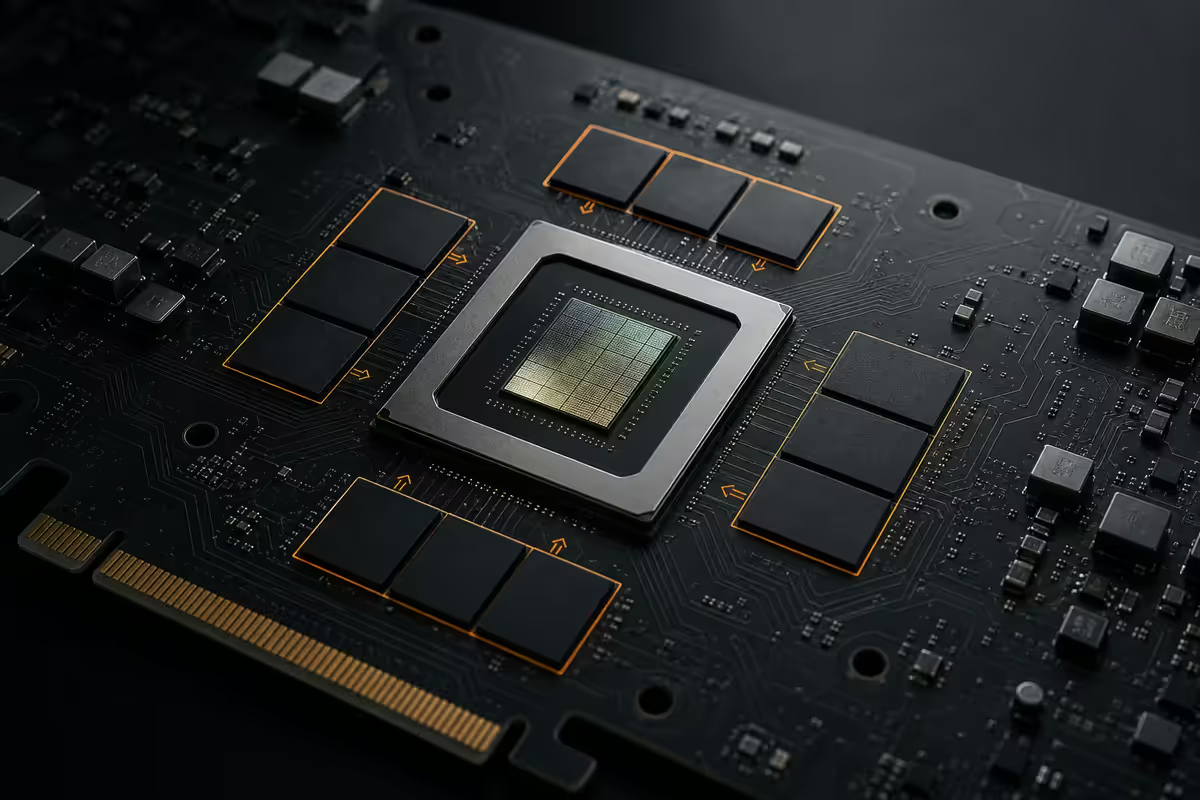
GDDR7 is the JEDEC standard that replaces GDDR6 and GDDR6X across consumer GPUs. The headline numbers are simple: 32 Gbps per pin at launch, with the roadmap pushing toward 36 Gbps and a 40 Gbps "extreme" tier that vendors are already sampling internally.
| Spec | GDDR6 | GDDR6X | GDDR7 |
|---|---|---|---|
| Launch speed | 16 Gbps | 21 Gbps | 32 Gbps |
| Roadmap push | 20 Gbps | 24 Gbps | 40 Gbps |
| Signalling | NRZ (PAM2) | PAM4 | PAM3 |
| Operating voltage | 1.35V | 1.35V | 1.1V |
| Module density | 8-16 Gb | 8-16 Gb | 16-32 Gb |
| Suppliers | Samsung, SK Hynix, Micron | Micron exclusive | Samsung, SK Hynix, Micron |
Module density matters more than people realise. GDDR7 launching with 16 Gb (2GB) modules — and 24 Gb (3GB) and 32 Gb (4GB) modules in the pipeline — means future cards can hit higher VRAM capacities without doubling the bus width. A 192-bit bus paired with 3GB modules gives you 18GB. That capacity flexibility is partly why NVIDIA can ship narrower-bus mid-range cards without the 8GB problem they had on the 4060.
PAM3 vs PAM4 — why signalling matters
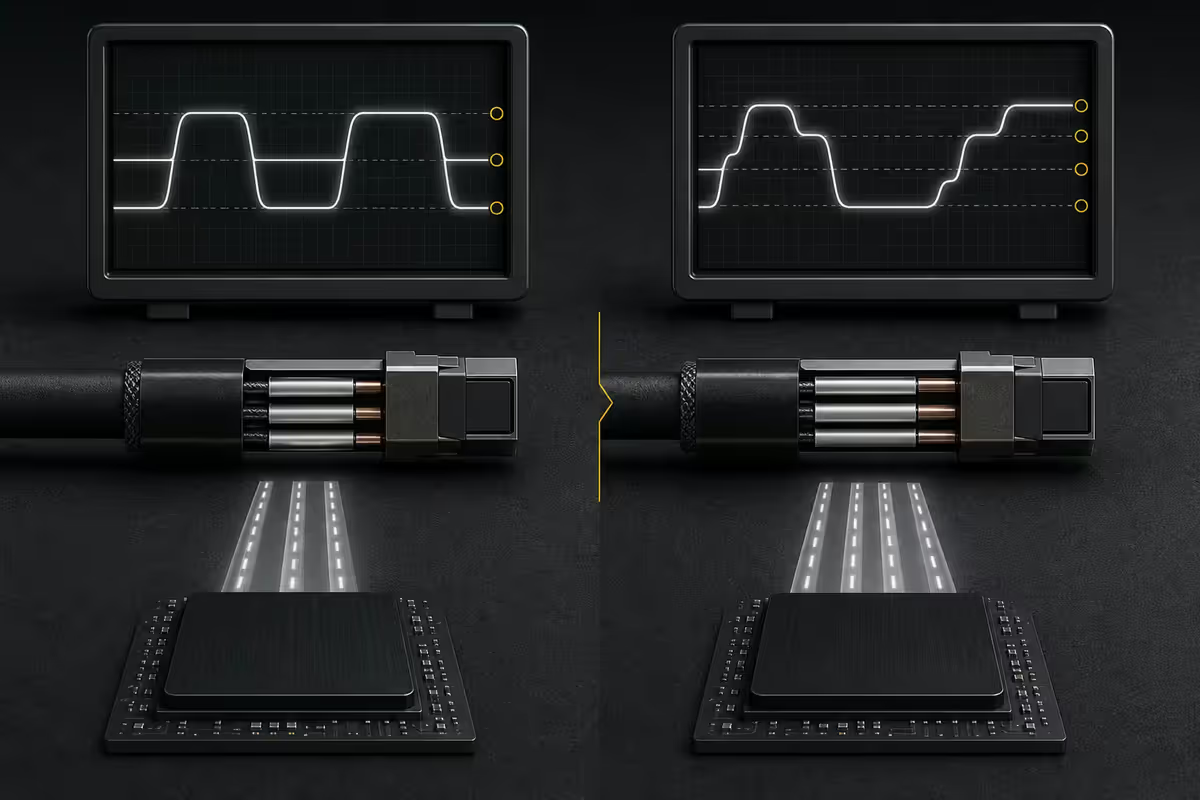
Here's where GDDR7 gets technically interesting. GDDR6X used PAM4 (4-level pulse amplitude modulation) — encoding two bits per signal transition by switching between four voltage levels. Smart in theory, painful in practice: PAM4 needed tight signal-integrity margins, ran hot, and was Micron-exclusive (Samsung and SK Hynix never licensed it).
GDDR7 uses PAM3 instead — three voltage levels encoding roughly 1.5 bits per transition. It's a compromise: less raw theoretical bandwidth per cycle than PAM4, but dramatically better signal integrity, lower power per bit, and easier PCB routing for board partners.
The win shows up in three places:
- Signal integrity at 32 Gbps is achievable on standard 8-layer board designs — PAM4 needed expensive 10-12 layer PCBs at 21 Gbps.
- Power per bit is roughly 30% lower than PAM4 at equivalent speeds — the entire memory subsystem runs cooler.
- All three major DRAM suppliers ship PAM3 — competitive supply rather than the Micron monopoly of GDDR6X.
The bandwidth jump in real numbers
Memory bandwidth is the product of per-pin speed × bus width. GDDR7 raises the speed; bus width is set by the GPU die. Here's how it shakes out across the RTX 50 stack:
| Card | VRAM | Bus width | Bandwidth |
|---|---|---|---|
| RTX 5090 | 32GB GDDR7 | 512-bit | 1,792 GB/s |
| RTX 5080 | 16GB GDDR7 | 256-bit | 960 GB/s |
| RTX 5070 Ti | 16GB GDDR7 | 256-bit | 896 GB/s |
| RTX 5070 | 12GB GDDR7 | 192-bit | 672 GB/s |
| RTX 4090 (reference) | 24GB GDDR6X | 384-bit | 1,008 GB/s |
The 5090 number is the headline — 78% more memory bandwidth than the 4090 on a card already overkill for any gaming workload. But the more important figure is the 5070: 672 GB/s on a 192-bit bus. The RTX 4070 had 504 GB/s on the same bus width. That's a 33% bandwidth uplift on a mid-range card without expanding the memory bus — exactly what mainstream gamers needed.
The RTX 50 series — first GDDR7 generation
NVIDIA was first to GDDR7 by a wide margin. The Blackwell-based RTX 50 series shipped with GDDR7 across every consumer SKU, and SA pricing has stabilised through mid-2026:
| Card | VRAM | SA street price |
|---|---|---|
| RTX 5090 | 32GB GDDR7 | R64,000-R72,000 |
| RTX 5080 | 16GB GDDR7 | R28,000-R34,000 |
| RTX 5070 Ti | 16GB GDDR7 | R20,000-R24,000 |
| RTX 5070 | 12GB GDDR7 | R14,500-R17,000 |
| RTX 5060 Ti | 8GB / 16GB GDDR7 | R9,500-R12,500 |
The mid-range positioning is the interesting story. The RTX 5070 with 12GB GDDR7 lands roughly where the 4070 Super sat in real-world performance — but with significantly more headroom for ray tracing and high-resolution texture work. The 5060 Ti's 8GB variant ships specifically because GDDR7's bandwidth makes 8GB workable at 1080p/1440p in a way GDDR6's 8GB couldn't be.
Looking forward, NVIDIA's Rubin architecture (expected late 2026 / early 2027) will pair GDDR7 with HBM4 — HBM4 on the flagship compute SKUs, GDDR7 on consumer and prosumer inference cards. Speeds should push toward the 36 Gbps tier by Rubin launch, taking the equivalent 5090-class card past 2,000 GB/s.
Why bandwidth matters for ray tracing and 4K
Traditional rasterisation is bandwidth-friendly. The GPU walks through geometry in a predictable order, pulls textures coherently, and writes to a frame buffer linearly. Caches help enormously. GDDR6 was fast enough.
Ray tracing breaks all of that. Rays bounce in unpredictable directions, hit incoherent texture and material data, traverse BVH (bounding volume hierarchy) structures scattered across memory, and generate access patterns that don't fit cleanly into any cache. The GPU spends a much larger fraction of its time waiting for memory to return data.
Path tracing is worse still. Cyberpunk 2077 with path tracing enabled, Alan Wake 2 with full RT, Black Myth: Wukong at 4K — these workloads can saturate GDDR6X bandwidth on a 4090. The card has compute headroom it can't use because memory can't feed it fast enough.
GDDR7 directly addresses this. The 78% bandwidth uplift on the 5090 translates to roughly 25-40% real-world uplift in path-traced workloads — measurably more than the raw shader-count improvement would predict. The bottleneck moved.
Power, voltage and thermal advantages
The voltage drop from 1.35V (GDDR6X) to 1.1V (GDDR7) is the single biggest power saving. Combined with PAM3's lower power-per-bit profile, the entire memory subsystem on an RTX 5080 draws less power than the GDDR6X subsystem on an RTX 4080 — despite delivering more bandwidth.
Real numbers from board-partner thermal testing:
- Memory junction temps drop 10-15°C at equivalent fan speeds on RTX 50 cards versus their RTX 40 predecessors.
- VRM load on the memory rails is roughly 18% lower — meaning cheaper memory VRM designs are viable on cost-down board partner SKUs.
- Per-card memory power consumption is roughly 15-25W on a 5070, 25-35W on a 5080, around 50-65W on a 5090 — down from 35-90W on the equivalent RTX 40 tier.
The RTX 4090's notoriously hot GDDR6X (regularly 95-100°C memory junction) is the cautionary tale this generation avoided. The 5090 ships with memory running 75-85°C under the same workload — comfortable territory.
Supply chain and pricing — Samsung, SK Hynix, Micron
Three major DRAM suppliers shipping GDDR7 is a huge structural improvement over GDDR6X (Micron-only). Competition keeps pricing honest. Here's the supply picture as of mid-2026:
Samsung hit volume production first, late 2024, with the K4VAF325ZC 16Gb modules. They're the primary supplier to NVIDIA's RTX 50 series and dominate consumer card BOMs.
SK Hynix followed in Q2 2025 with the HKMG7QQ4-32B parts. They're heavily weighted to NVIDIA datacenter and AI inference SKUs, with consumer allocation increasing through 2026.
Micron arrived last (Q4 2025) but brought the densest modules — including early 24Gb samples that show up on professional / workstation cards before consumer.
Looking forward, the supply expansion in late 2026 (Samsung's Pyeongtaek P4 line and Micron's Hiroshima fab) should drop GDDR7 pricing premiums significantly. Expect GDDR7 to be at price parity with GDDR6 by Q4 2027, after which there's no reason for any new GPU launch to use GDDR6 outside of true entry-level.
Key takeaways
- GDDR7 launches at 32 Gbps per pin — 50%+ faster than GDDR6X, with roadmap targets at 36-40 Gbps.
- PAM3 signalling is the smart compromise — cleaner integrity, lower power, and three-supplier competition.
- RTX 5090 gains 78% bandwidth over the 4090 — biggest single-generation jump since GDDR5 to GDDR5X.
- Path tracing and 4K RT workloads benefit most — sometimes 25-40% real-world uplift from bandwidth alone.
- Memory power is down 20-30% per bit — cards run cooler, cheaper PCBs are viable, no more 100°C VRAM.
Frequently asked questions
What is GDDR7 and how is it different from GDDR6X?
GDDR7 is the next-gen graphics memory standard launching at 32 Gbps per pin (up from GDDR6X's 21-24 Gbps), with roadmap targets of 36-40 Gbps. It uses PAM3 signalling instead of GDDR6X's PAM4 — trading peak theoretical bandwidth for cleaner signal integrity, lower power and easier PCB routing.Which GPUs use GDDR7?
The NVIDIA RTX 50 series (5090, 5080, 5070 Ti, 5070, 5060 Ti) is the first consumer launch with GDDR7 across the full stack. AMD's RDNA 5 generation is expected to follow in late 2026 / early 2027. NVIDIA's Rubin datacenter architecture will pair GDDR7 with HBM4.Does GDDR7 make 8GB cards viable again?
For 1080p and 1440p — partly yes. The higher bandwidth means an 8GB GDDR7 card streams data faster than an 8GB GDDR6 card. Rough framing: 8GB of GDDR7 feels like 10-12GB of GDDR6. At 4K with ray tracing, 8GB is still tight regardless of speed.How much memory bandwidth does an RTX 5090 have?
1,792 GB/s — 32 Gbps GDDR7 on a 512-bit bus. That's a 78% bandwidth jump over the RTX 4090's 1,008 GB/s. The RTX 5080 sits at 960 GB/s, the 5070 Ti at 896 GB/s, the 5070 at 672 GB/s.Why does VRAM bandwidth matter for ray tracing?
Ray tracing generates incoherent memory accesses — rays scatter unpredictably and pull texture, BVH and material data from non-contiguous locations. This thrashes caches and bottlenecks on raw VRAM bandwidth. GDDR7 directly addresses this.Is GDDR7 more power-efficient than GDDR6X?
Yes. GDDR7 runs at 1.1V versus GDDR6X's 1.35V, and PAM3 signalling is more power-efficient per bit than PAM4. Real-world numbers indicate roughly 20-30% better performance-per-watt on the memory subsystem.Who supplies GDDR7 and is there a shortage?
Samsung first (K4VAF325ZC), then SK Hynix (HKMG7QQ4-32B), then Micron. Supply has been tight through early 2026 because RTX 50 and AI-card demand consume most output. We expect normalisation by late Q3 2026.Will GDDR7 be available on AMD and Intel GPUs?
AMD's RDNA 5 will use GDDR7 on higher-end SKUs, with mid-range possibly staying on GDDR6 for cost. Intel's Celestial generation is also expected to adopt GDDR7. By 2027 it should be standard above entry-level.
Get the Evetech app
Exclusive app-only prices, daily flash sales, and free delivery on orders over R4,000 — download the app and start saving.