Future Tech · DRAM Market Watch
RAM prices are going up. — HBM is eating DDR5. Buy now, not later.
A 32GB DDR5-6000 kit was R1950 in 2024. R2400 in 2025. R3500 today. The DRAM market is restructuring around AI accelerator memory and consumer RAM is the casualty. Here's what that means for your next upgrade.
- DDR5 vs 2024
- +79%
- 32GB sweet spot
- R3,500
- DDR6 retail SA
- 2027+
2026 RAM prices in South Africa — the actual numbers
Forget the spot-market headlines. Here's what you'll actually pay at Evetech, Wootware, Rebel Tech and similar SA retailers in mid-2026, alongside the same kit's price 12 and 24 months ago. The deltas are not subtle.
| Kit | Mid-2024 | Mid-2025 | Mid-2026 |
|---|---|---|---|
| 16GB (2x8GB) DDR5-5600 Kingston Fury | R1,150 | R1,450 | R2,100 |
| 32GB (2x16GB) DDR5-6000 CL30 G.Skill Z5 Neo | R1,950 | R2,400 | R3,500 |
| 32GB (2x16GB) DDR5-6400 CL32 Corsair Vengeance | R2,200 | R2,700 | R3,750 |
| 64GB (2x32GB) DDR5-6000 CL30 G.Skill Z5 Neo | R3,800 | R4,700 | R6,900 |
| 96GB (2x48GB) DDR5-6400 CL32 Corsair Vengeance | R5,400 | R6,500 | R9,800 |
| 16GB (2x8GB) DDR4-3600 Kingston Fury Beast | R750 | R1,050 | R1,650 |
| 32GB (2x16GB) DDR4-3600 Corsair Vengeance | R1,400 | R1,900 | R2,600 |
The pattern is identical across every brand and capacity tier: a steady 25-35% rise in 2025, then a sharp 40-55% jump into 2026. The mid-2026 prices above aren't a temporary spike — they are the new floor.
Why RAM prices are rising — the supply-side story
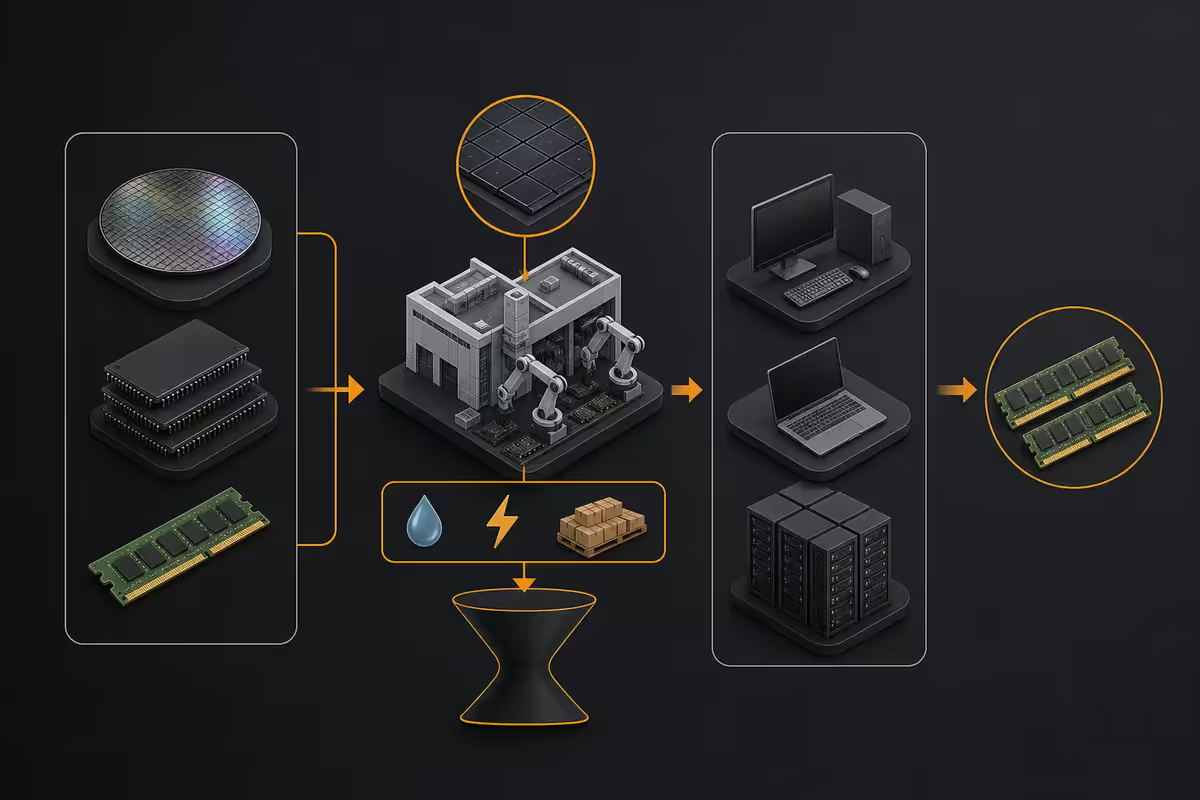
Three companies make almost all the world's DRAM: Samsung (Pyeongtaek, South Korea), SK Hynix (Cheongju, South Korea), and Micron (Hiroshima, Japan). Together they hold roughly 95% of global DRAM output. When those three change their wafer allocation, the entire consumer RAM market moves.
In 2024-2025 all three made the same strategic decision: move as much wafer capacity as possible from consumer DDR5 to HBM for AI accelerators. HBM (High Bandwidth Memory) is the stacked memory bolted onto NVIDIA's H200, B200 and the upcoming Rubin GPUs, plus AMD's Instinct MI355X and the forthcoming MI400. AI hyperscalers can't get enough of it.
Three reasons HBM is irresistible to the DRAM makers:
- Revenue per wafer is 4-5x higher than consumer DDR5. SK Hynix's HBM3E gross margins are reported above 60%; consumer DDR5 hovers around 25%.
- Demand is uncapped. NVIDIA, AMD, Google TPU, Amazon Trainium and Microsoft Maia are all sold out of accelerator stock through 2026.
- Customers pre-pay. Hyperscalers like Microsoft, Meta and Oracle lock in 12-18 month forward HBM contracts at fixed pricing, giving the DRAM fabs guaranteed revenue.
The result: consumer DDR5 has gone from a high-volume, low-margin commodity to a low-volume product that the fabs make only enough of to keep the channel alive. Your RAM upgrade is competing for wafer time with $40,000 AI GPUs. It's losing.
The HBM shift in plain English
A normal DDR5 die is a flat slab of silicon. An HBM stack is 8, 12 or now 16 of those dies stacked vertically and bonded together with through-silicon vias (TSVs). Per gigabyte, HBM consumes 3-4x the wafer area of plain DDR5 because of the packaging overhead and lower yield on stacked assembly.
When SK Hynix moves a wafer line from DDR5 to HBM3E, it doesn't lose 1GB of consumer RAM for 1GB of HBM — it loses 3-4GB of consumer RAM for every 1GB of HBM produced. Multiply that across thousands of wafers per month and the consumer DDR5 hole gets enormous fast.
Server DDR5 takes priority too. Within the consumer-grade-DDR5 wafers that remain, server DDR5 (RDIMMs, MRDIMMs for AMD EPYC and Intel Xeon-6) gets the first allocation because hyperscale data centres pay better than channel retail. By the time the remaining stock reaches DIY builders, supply is genuinely limited.
The same dynamic applied during the 2018 NAND shortage and the 2020-2021 GPU crypto crunch. The difference now is that AI demand has no natural ceiling — every major cloud is racing to deploy more accelerators, and every accelerator needs HBM.
DDR5 vs DDR4 in 2026 — DDR4 is not the bargain it looks
A reasonable question: with DDR5 so expensive, shouldn't I just build a DDR4 system? In 2026, the answer is no for new builds — and even for existing AM4 / LGA1700 owners, the calculus is uncomfortable.
Here's why: DDR4 production is winding down at all three major DRAM makers. Micron stopped new DDR4 wafer starts in late 2025. Samsung and SK Hynix have shifted DDR4 to "end-of-life" status with declining monthly volumes. The remaining DDR4 supply is being sold into industrial, automotive and embedded markets at premium prices.
As a result, DDR4 prices have risen faster in percentage terms than DDR5 during 2025-2026. A 32GB DDR4-3600 kit that was R1,400 in 2024 is now R2,600 — an 86% jump. Meanwhile DDR5-6000 32GB at R3,500 is "only" 79% up over the same window.
What to do:
- New build: always DDR5. Pay the R3,500 once, get 6+ years of relevance with the platform.
- AM4 or LGA1700 upgrade from 16GB to 32GB: reluctantly worth it if you genuinely need the headroom. Don't expect bargain prices.
- Building a budget DDR4 system from scratch in 2026: hard no. By the time you save R1,500 on RAM you've spent R3,000+ on a platform with no upgrade path.
The buy-now case — boring but correct
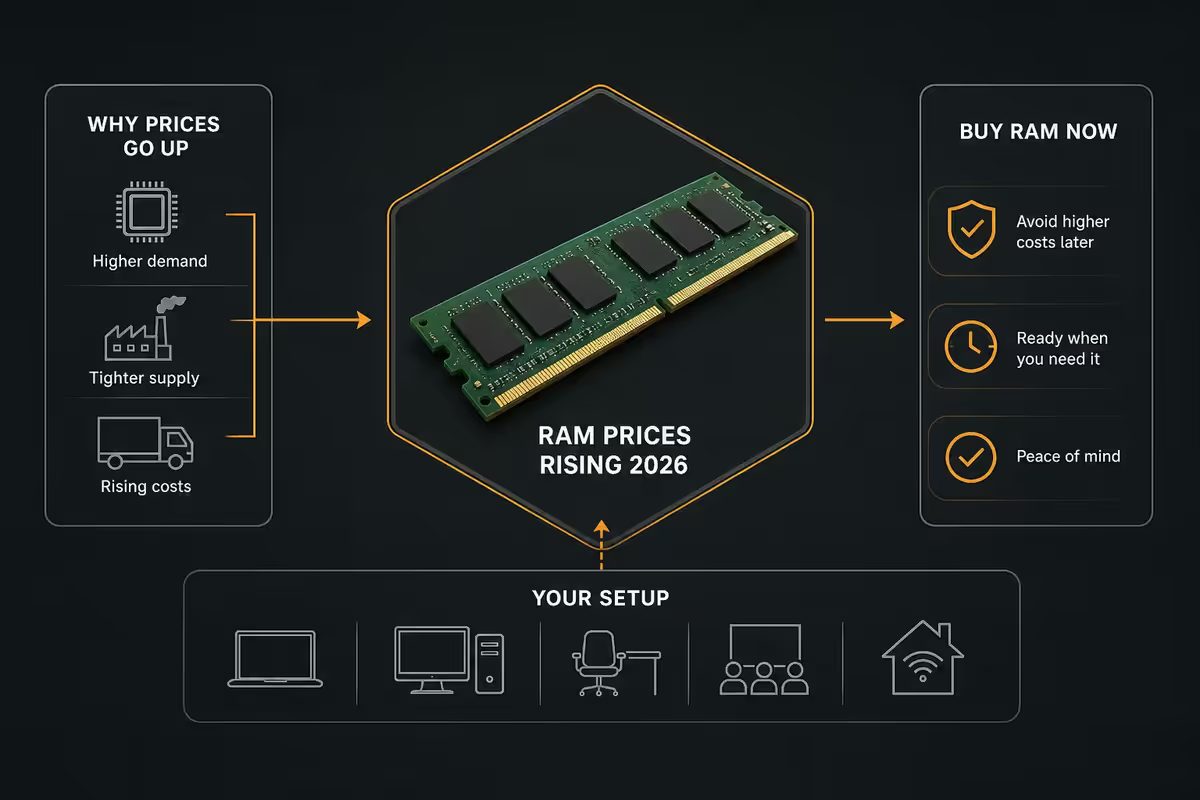
If you've been waiting for the right moment to buy RAM, it has already passed. The next-best moment is today. Here's the bull case for pulling the trigger this week:
- Spot DRAM prices are forward-looking. What you pay at Evetech in June reflects supply contracts signed 60-90 days ago. The contracts being signed today are 15-25% higher. By Q4 2026 those will hit retail.
- SA importers commit in USD. ZAR weakness against the dollar amplifies every DRAM price increase. The 2025-2026 ZAR/USD range hasn't helped.
- The HBM-driven shift is multi-year, not a quarter-long spike. Samsung's 2026 capex announcement specifically called out further HBM expansion through 2027 — not a return to consumer DDR5.
- DDR6 is 18+ months away from real retail availability in SA. When it lands it will be expensive and supply-constrained, exactly like DDR5 was in 2022.
- RAM is the cheapest meaningful upgrade you can make. Doubling from 16GB to 32GB DDR5 transforms your machine for less than the price of a mid-range graphics card.
The 2026 SA sweet spot — what to actually buy
In a rising-price environment, the goal isn't to find the cheapest kit — it's to find the one that won't need to be replaced for at least 4-5 years. Here are the picks that hit that brief at every budget level.
| Tier | Pick | SA price |
|---|---|---|
| Budget DDR5 (entry) | 16GB (2x8GB) Kingston Fury Beast DDR5-5600 CL36 | R2,100 |
| Sweet spot (most builders) | 32GB (2x16GB) G.Skill Trident Z5 Neo DDR5-6000 CL30 EXPO | R3,500 |
| Intel sweet spot | 32GB (2x16GB) Corsair Vengeance DDR5-6400 CL32 XMP | R3,750 |
| Creators / streamers | 64GB (2x32GB) G.Skill Trident Z5 Neo DDR5-6000 CL30 EXPO | R6,900 |
| Workstation / local AI | 96GB (2x48GB) Corsair Vengeance DDR5-6400 CL32 | R9,800 |
| Budget DDR4 upgrade | 32GB (2x16GB) Crucial Pro DDR4-3200 CL22 | R2,400 |
| AM4 enthusiast DDR4 | 32GB (2x16GB) G.Skill Ripjaws V DDR4-3600 CL18 | R2,700 |
Why DDR5-6000 CL30 EXPO for AMD: the Ryzen 7000 and 9000 Infinity Fabric clock (FCLK) hits a sweet spot at DRAM 6000 MHz with 1:1 mode and CL30 timings. Faster RAM forces FCLK out of 1:1, hurting latency.
Why DDR5-6400 CL32 XMP for Intel: Core Ultra (Arrow Lake) and 14th-gen Raptor Lake Refresh both prefer the slightly higher DRAM clock. The memory controller stays happy and gaming 1% lows benefit.
Should you wait for DDR6?
JEDEC is expected to finalise the DDR6 specification in late 2026. First retail DDR6 modules and consumer DDR6-capable platforms (AMD Zen 6 desktop, Intel "Nova Lake") are targeting late 2027 / early 2028. So — should you wait?
For most people, no. Three reasons:
- DDR6 will launch expensive. Early DDR6 yields will be poor (as DDR5 was in 2022), and the major fabs will allocate scarce DDR6 wafers preferentially to server and HBM-stack derivatives. Expect day-one DDR6 32GB kits to launch in SA at R5,500-R6,500.
- DDR5 won't crash when DDR6 arrives. The 2017-2019 DDR4-to-DDR5 transition saw DDR4 prices remain stable for 12-18 months after DDR5 launched. The same pattern will hold — partly because fabs will be moving DDR5 wafers to DDR6, not making more DDR5.
- You'll need a new platform anyway. DDR6 requires AM6 (or whatever AMD calls it) and Intel's Nova Lake socket. You're not just buying RAM — you're buying a new CPU, motherboard, and likely cooler too. That's a R20,000+ swap for what is, in the first generation, a modest IPC improvement.
When waiting makes sense: if you're building a brand-new mid-2027 system from scratch and have flexibility on timing, holding off until the second wave of DDR6 boards / kits (mid-2028) is reasonable. For an upgrade to a current AM5 or Intel Core Ultra system, buy DDR5 today.
Key takeaways
- Samsung, SK Hynix and Micron have shifted wafer capacity to HBM for AI accelerators — consumer DDR5 supply is contracting and won't loosen before 2027.
- The SA sweet spot is a G.Skill Trident Z5 Neo 32GB DDR5-6000 CL30 EXPO kit at R3,500 — the cheapest that exact spec will be for the next 18-24 months.
- DDR4 is no longer the bargain alternative. Production is winding down and prices are up 86% vs 2024.
- DDR6 launches late 2027 / early 2028 in SA at premium pricing — it will not make DDR5 cheap.
- Buy now. The next-best moment to buy RAM has already passed; today is the second-best.
Frequently asked questions
Why are RAM prices rising in 2026?
Samsung, SK Hynix and Micron have moved enormous wafer capacity to HBM3E and HBM4 for AI accelerators (NVIDIA Blackwell, AMD MI400). Every HBM stack consumes 3-4x the wafer area of a normal DDR5 die, so consumer DRAM supply has contracted while AI demand stays insatiable. Contract DRAM prices are up 60-90% year-on-year.Should I buy RAM now or wait for prices to drop?
Buy now if you need it in the next 12 months. HBM allocation is set to increase through 2027, so consumer DDR5 supply gets tighter not looser. DDR6 won't be retail-available in SA before late 2027 and launches at premium pricing. The R3,500 32GB DDR5-6000 EXPO kit today is the cheapest that spec will be for the next 18-24 months.How much does a 32GB DDR5 kit cost in South Africa in 2026?
A G.Skill Trident Z5 Neo 32GB (2x16GB) DDR5-6000 CL30 EXPO kit lands at R3,500 at Evetech in mid-2026 — up from R2,400 in mid-2025 and R1,950 in mid-2024. Corsair Vengeance and Kingston Fury Beast equivalents sit between R3,200 and R3,750. 64GB kits start near R6,900.Is DDR4 still worth buying in 2026?
Only for keeping an existing AM4 or LGA1200/1700 system alive. DDR4 production is winding down so its prices have risen faster than DDR5 in percentage terms. A 32GB DDR4-3600 Corsair Vengeance kit is around R2,600 in SA — not a great new-build proposition versus DDR5 at R3,500.What is HBM and why is it affecting my DDR5 prices?
HBM (High Bandwidth Memory) is the stacked memory bolted onto AI accelerators like the NVIDIA H200, B200 and the upcoming Rubin. It uses the same DRAM fab lines as your DDR5 sticks but the die is much larger and packaging far more expensive. The fabs have prioritised HBM because it generates 4-5x the revenue per wafer.What is the cheapest acceptable DDR5 kit for a new build in SA?
A 32GB (2x16GB) DDR5-5600 CL36 kit from Kingston Fury Beast or Crucial Pro lands at R2,900-R3,100 in mid-2026. For Ryzen 7000/9000 builds, spend the extra R400 to step up to a DDR5-6000 CL30 EXPO kit — it materially improves 1% lows in gaming. For Intel Core Ultra builds, the DDR5-5600 kit is acceptable.Will DDR6 make DDR5 cheap in 2027?
Probably not in the near term. When DDR6 launches it will share fab capacity with DDR5 and HBM, and early DDR6 yields will be poor. The 2017-2019 DDR4-to-DDR5 transition saw DDR4 prices stay stable for 12-18 months after DDR5 launched. Expect the same pattern.Is it worth buying 64GB or 96GB instead of 32GB in 2026?
32GB remains the sweet spot for pure gaming. Step up to 64GB for local LLM inference, video editing, Unreal Engine 5 development or virtual machines. 96GB DDR5 kits (2x48GB) are interesting for creators because they hit DDR5-6400 EXPO speeds with two-DIMM stability, where four-DIMM 128GB kits often need to be clocked down.
Get the Evetech app
Exclusive app-only prices, daily flash sales, and free delivery on orders over R4,000 — download the app and start saving.