Power Bank Buying Guide
How to choose a power bank. — Wh is the real number. mAh is marketing.
The number on the box (mAh) tells you very little about how many times your phone or laptop will actually charge. Watt-hours, USB-C PD wattage and transfer efficiency are what matter — and the airline 100 Wh ceiling decides how big you can go.
- mAh tier range
- 10k-32k
- USB-C PD output
- 18W-140W
- TSA airline limit
- 100 Wh
mAh vs Wh — why watt-hours is the only honest number
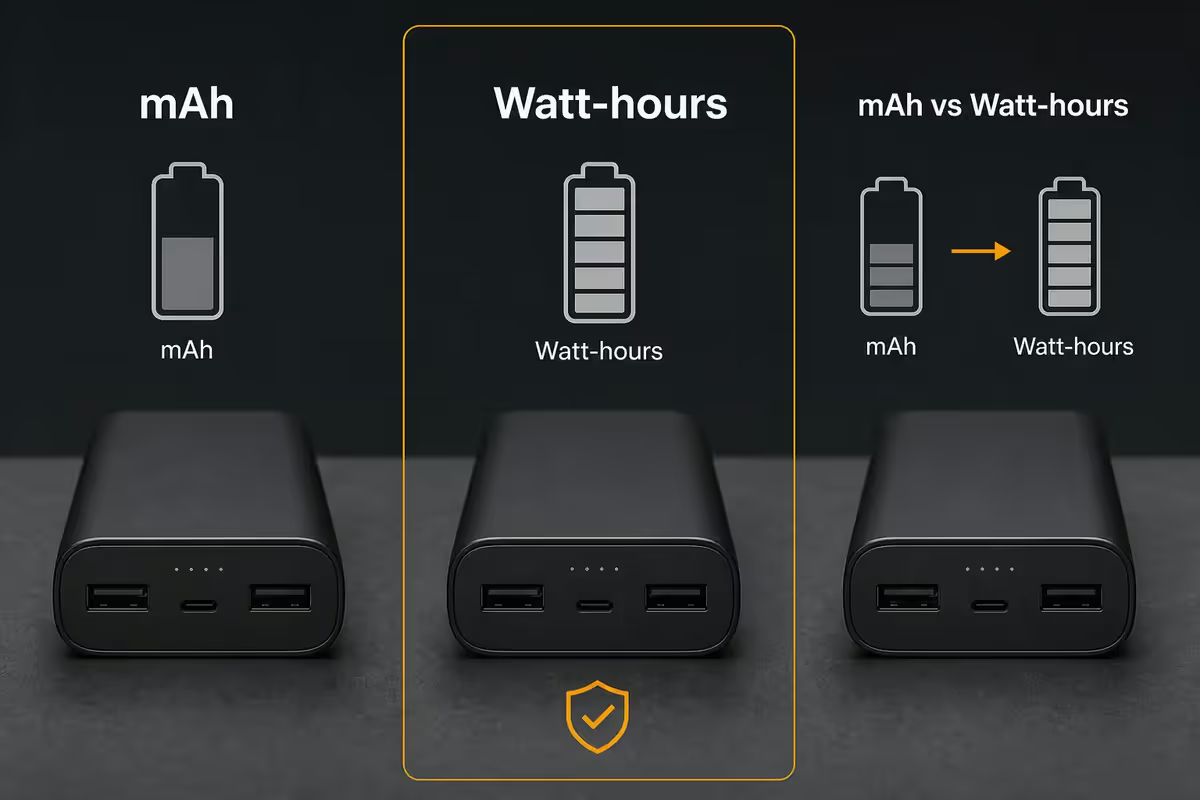
Every power bank box shouts an mAh figure — 10000, 20000, 26800, 30000. That number, on its own, tells you very little about how much energy is actually inside.
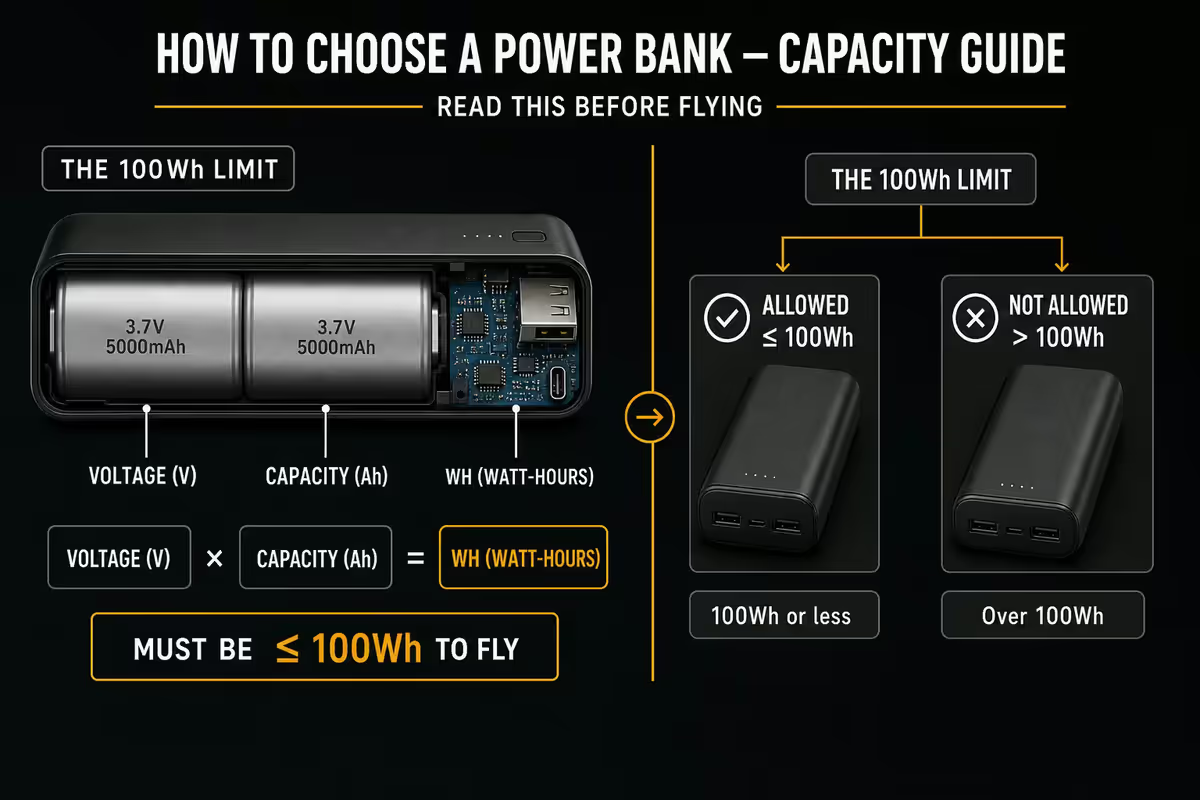
mAh (milliamp-hours) is capacity at a given voltage. The lithium cells inside a power bank are 3.7V. So real stored energy is:
Why Wh matters: airlines regulate by watt-hours (100 Wh max), laptop chargers are quoted in watt-hours per hour, and Wh is the only voltage-agnostic way to compare two banks honestly. A "30000 mAh" bank at 3.7V (~111 Wh) and a "20000 mAh" bank at 5V (~100 Wh) are nearly identical in real energy — but the spec sheet makes them look very different.
| Bank rating | Real Wh (at 3.7V) | Realistic phone charges |
|---|---|---|
| 5000 mAh | ~18.5 Wh | ~0.8 charges |
| 10000 mAh | ~37 Wh | 1-1.5 charges |
| 20000 mAh | ~74 Wh | 2.5-3 charges |
| 26800 mAh | ~99 Wh | 3.5-4 charges |
| 32000 mAh | ~118 Wh (over TSA) | 4-5 charges |
Real charges per cycle — the efficiency math. The Wh stored isn't the Wh delivered. Conversion from 3.7V (cells) up to 5V/9V/15V/20V (USB-C PD output) costs 25-35% in heat and resistance. A 74 Wh bank therefore delivers ~50 Wh to your devices. Phone batteries are 15-20 Wh — so 50 ÷ 17 ≈ 3 real phone charges, not the 5 the box claims.
Capacity tiers — picking the right size for your real usage
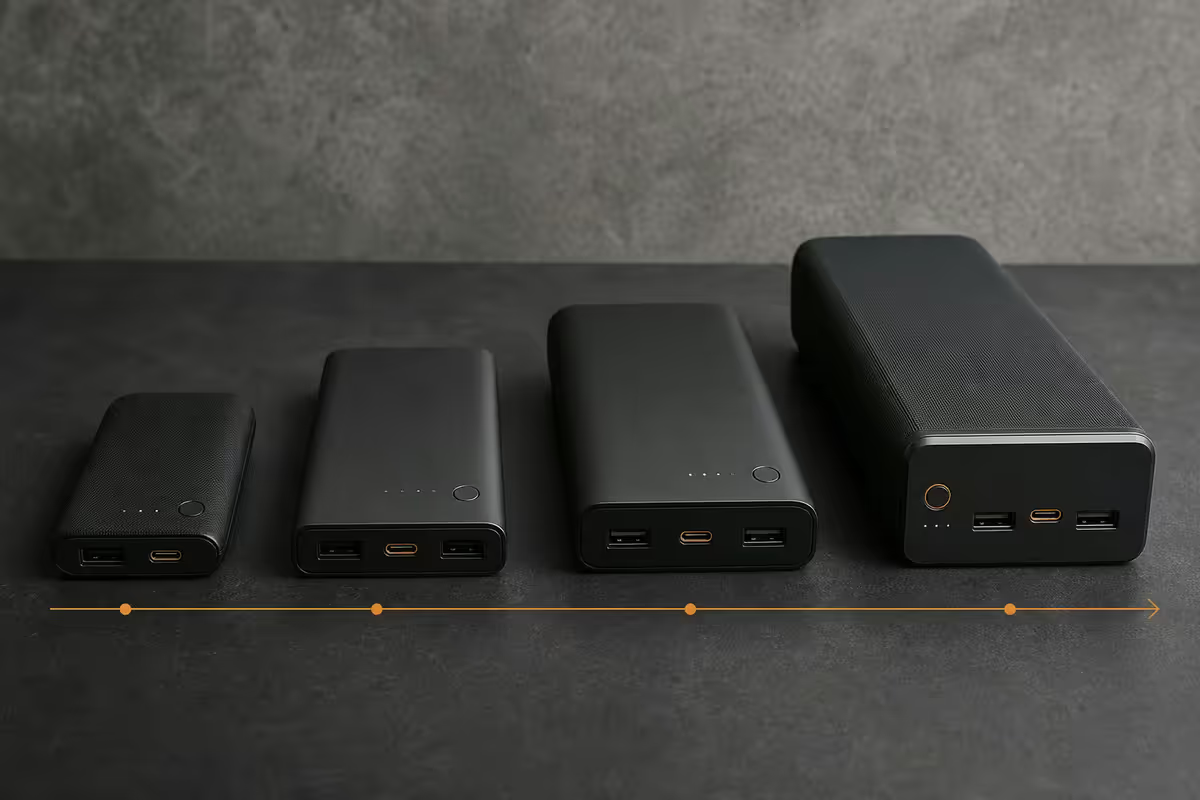
There are four practical tiers in 2026. The "more is better" instinct usually leads to dead weight in your bag and money wasted on cells you never discharge.
10000 mAh (~37 Wh) — phone-only daily top-up
Best for: people who want to top a phone from 30% to 100% once or twice during a day out. Fits in a jacket pocket. Roughly R350-R600 in SA. Won't charge a laptop. Won't last a weekend camping trip charging multiple devices.
20000 mAh (~74 Wh) — the 95% sweet spot
Best for: travel, work-from-anywhere, weekend trips. 3 phone charges, or 1 ultrabook top-up (MacBook Air, XPS 13). Lives in a backpack pocket without weighing you down. Stays well under the 100 Wh airline limit. Sweet spot pricing R1200-R1800 with 65W USB-C PD. This is the recommendation for almost everyone.
26800-27000 mAh (~99 Wh) — laptop-class, airline-legal upper bound
Best for: digital nomads, frequent flyers, photographers running cameras and laptops. Right at the airline edge but legal in carry-on. Can fully recharge a MacBook Air or refill a ThinkPad twice. R2200-R3500. Heavier — typically 500-600g.
32000 mAh+ (~118 Wh and up) — workshop / off-grid only
Cannot be taken on a plane. Best for: off-grid work, festivals, multi-day camping, content creators with multiple cameras. R3500-R6000+. Usually 140W+ USB-C PD so they handle gaming laptops and MacBook Pro 16. Bricks at 700-900g — heavy.
USB-C Power Delivery — the wattage ladder that actually matters
Capacity tells you how long the bank lasts. USB-C PD wattage tells you what the bank can charge in the first place. Buying a 20000 mAh bank with only 18W output means it can charge a phone fast but cannot charge a laptop at all — laptops need 45W minimum to break even on power draw.
| PD wattage | What it charges | Typical bank tier |
|---|---|---|
| 18W PD | Phones fast (iPhone, Galaxy) | Entry banks, 10000 mAh |
| 30W PD | Tablets, Steam Deck, Switch | Mid-range, 10000-20000 mAh |
| 65W PD | MacBook Air, Dell XPS 13, Lenovo ThinkPad | The sweet spot — 20000 mAh |
| 100W PD | Gaming laptops, MacBook Pro 14 | Pro tier, 20000-27000 mAh |
| 140W PD 3.1 | MacBook Pro 16, RTX gaming laptops | Top tier, 27000 mAh+ |
Rule of thumb: match output wattage to your laptop's wall charger. If your MacBook Air ships with a 30W or 35W charger, a 65W PD bank gives you headroom. If your MacBook Pro 16 ships with a 140W charger, a 65W bank will charge it but only slowly — and may not keep up with active use.
GaN — why the latest power banks run cooler
GaN (gallium nitride) describes the semiconductor material inside the charging chip, not the battery cells themselves. GaN handles high voltage and current at far lower thermal loss than silicon, so a 100W GaN bank can be palm-sized while a 100W silicon bank would be the size of a hardback book.
Why GaN matters in a power bank:
- Runs cooler under load — your bag pocket doesn't turn into a hot pocket on a 65W laptop top-up.
- Smaller form factor at the same wattage — a 100W GaN brick fits in a jeans pocket.
- Higher peak output — 140W from a single port becomes feasible without overheating.
- Lower heat = longer cell life — heat is the enemy of lithium cells.
Anker Prime, UGREEN Nexode, Baseus Blade and Belkin BoostCharge Pro all run GaN chips in their 65W+ models. Worth the R200-R400 premium if you charge a laptop from the bank regularly.
The airline 100 Wh limit — read this before buying
The TSA, IATA, EASA and SACAA all align on the same rule: power banks travel in carry-on luggage only, never checked, and must be under 100 Wh. Between 100 and 160 Wh requires written airline approval (rarely granted for personal travel). Above 160 Wh is banned outright.
| Bank capacity | Wh equivalent | Airline status |
|---|---|---|
| 10000 mAh | ~37 Wh | Carry-on legal |
| 20000 mAh | ~74 Wh | Carry-on legal |
| 26800 mAh | ~99 Wh | Carry-on legal (just) |
| 27000 mAh | ~99.9 Wh | Carry-on legal (technically) |
| 32000 mAh | ~118 Wh | Airline approval required |
| 40000 mAh+ | ~148 Wh | Often refused at check-in |
Most reputable bank brands print Wh clearly on the device — usually moulded into the rear casing or laser-etched near the ports. If you cannot find a Wh marking on a bank, expect security to confiscate it. The 99 Wh "27000 mAh" Anker 737 has its Wh figure stamped on the back precisely for this reason.
Recommended power banks by use case
| Use case | Pick | SA price |
|---|---|---|
| Phone top-up daily carry | Anker PowerCore III 10000 (18W PD) | R450-R650 |
| The 95% sweet spot | UGREEN Nexode 20000 (65W PD, GaN) | R1200-R1500 |
| Travel + laptop power | Anker 737 (24000 mAh, 140W PD, LED display) | R2400-R2900 |
| Airline upper bound | Anker Prime 27650 (250W total, 99.5 Wh) | R3200-R3800 |
| Gaming laptop on the go | Baseus Blade 100W (20000 mAh, slim profile) | R1800-R2400 |
| Premium build / iOS | Mophie Powerstation Pro XL | R2000-R2800 |
| Reliable mid-tier | Belkin BoostCharge Pro 25K (PD 3.1) | R1600-R2100 |
| Off-grid / workshop | Anker 757 PowerHouse (1024 Wh — not airline) | R18,000+ |
Common power bank buying mistakes
Buying mAh without checking output wattage. The most common mistake. A 30000 mAh bank with only 18W USB-C output cannot charge a laptop — and lots of people buy them assuming it can. Always confirm the PD wattage matches your laptop's wall charger.
Expecting laptop charging from an 18W bank. Laptops need 45W minimum to charge while off, 65W+ to charge while in use. An 18W bank can slow-charge a laptop only when it's switched off — and most people don't realise this until they're stranded at an airport.
Ignoring the 100 Wh airline limit. A 32000 mAh bank cannot fly. Even if it's R200 cheaper than a 26800 mAh Anker, you cannot take it on a flight. If you ever travel by air, stay at 26800 mAh / 99 Wh and below.
No USB-C PD = no laptop charging. Generic banks with USB-A and "USB-C output" (without specifying PD wattage) almost certainly top out at 15W shared. Look for the explicit PD wattage on the spec sheet (18W, 30W, 65W, 100W, 140W).
Trusting marketing charge counts. "Charges your iPhone 8 times" is a lab number at 100% efficiency on a 2017 phone with a 7 Wh battery. Real-world charge counts on a 2026 phone are roughly 60-65% of marketing claims.
Buying a R200 no-name on Marketplace. Capacity fraud is rampant (a 30000 mAh listing often holds 8000 mAh of cells), and the lack of proper battery management chips creates real fire risk under fast charging. The R500 difference between a no-name and a real Anker is the cheapest insurance you'll ever buy.
Key takeaways
- 20000 mAh + 65W USB-C PD covers almost everyone — UGREEN Nexode 20000 or Anker 737 at R1200-R2500.
- Wh is the honest number. mAh × 3.7 ÷ 1000 = Wh. 20000 mAh = 74 Wh, not "five charges".
- USB-C PD wattage is what enables laptop charging. 18W = phone only. 65W = ultrabook. 140W = gaming laptop.
- 100 Wh is the airline ceiling. Stay at 26800 mAh / 99 Wh max if you ever fly. Carry-on only, never checked.
- Real-world transfer efficiency is 65-75%. Marketing charge counts overstate by ~40%. Plan accordingly.
Frequently asked questions
What size power bank should I buy?
20000 mAh with 65W USB-C PD — the sweet spot for almost everyone. ~3 phone charges or one ultrabook top-up, well under the 100 Wh airline limit, R1200-R1800 in SA.What does mAh actually mean — and why is Wh the real number?
mAh is voltage-dependent. Power bank cells are 3.7V, so Wh = mAh × 3.7 ÷ 1000. A 20000 mAh bank is 74 Wh. Wh is what airlines regulate and the only honest comparison number.How many phone charges will a 20000 mAh power bank give me?
Around 3 full phone charges in practice. 74 Wh stored, ~50 Wh delivered after 65-75% efficiency loss. Phone batteries are 15-20 Wh, so 50 ÷ 17 ≈ 3 charges.Can I take my power bank on a plane?
Yes, in carry-on only, under 100 Wh. That covers most banks up to 26800 mAh. 32000 mAh+ is over the limit. Pack the Wh marking visible to security.What is USB-C Power Delivery (PD) and why does it matter?
PD is the protocol that lets a USB-C port deliver high wattage at variable voltage (5V to 28V). Without PD, USB-C tops out around 15W. With PD, the same bank can hit 65W (ultrabook) or 140W (MacBook Pro 16).GaN power banks — are they actually better?
Yes for 65W+ output. GaN chips run cooler, support higher wattage in a smaller form factor and waste less energy as heat. Worth the small premium on Anker Prime, UGREEN Nexode and Baseus Blade.What is pass-through charging?
The bank charges a connected device while it itself is being charged from a wall plug — useful at a hotel desk with only one outlet. Anker, UGREEN and Mophie support it reliably.Are cheap no-name power banks safe?
Be cautious. Capacity fraud is common (advertised mAh well above real cells) and weak battery management creates fire risk. Stick to Anker, UGREEN, Baseus, Mophie, Belkin or other branded models with certifications on the box.
Get the Evetech app
Exclusive app-only prices, daily flash sales, and free delivery on orders over R4,000 — download the app and start saving.