Laptop Power Bank Buying Guide · SA
How to choose a power bank for your laptop. — Match the wattage. Do the Wh math. Survive the stage.
Most “laptop power banks” sold in SA cannot actually charge a laptop under load. The numbers on the box are written for phones, not laptops — and load-shedding doesn't care about marketing.
- USB-C PD target
- 65-100W
- TSA carry-on cap
- 100 Wh
- SA price band
- R900-R3.5k
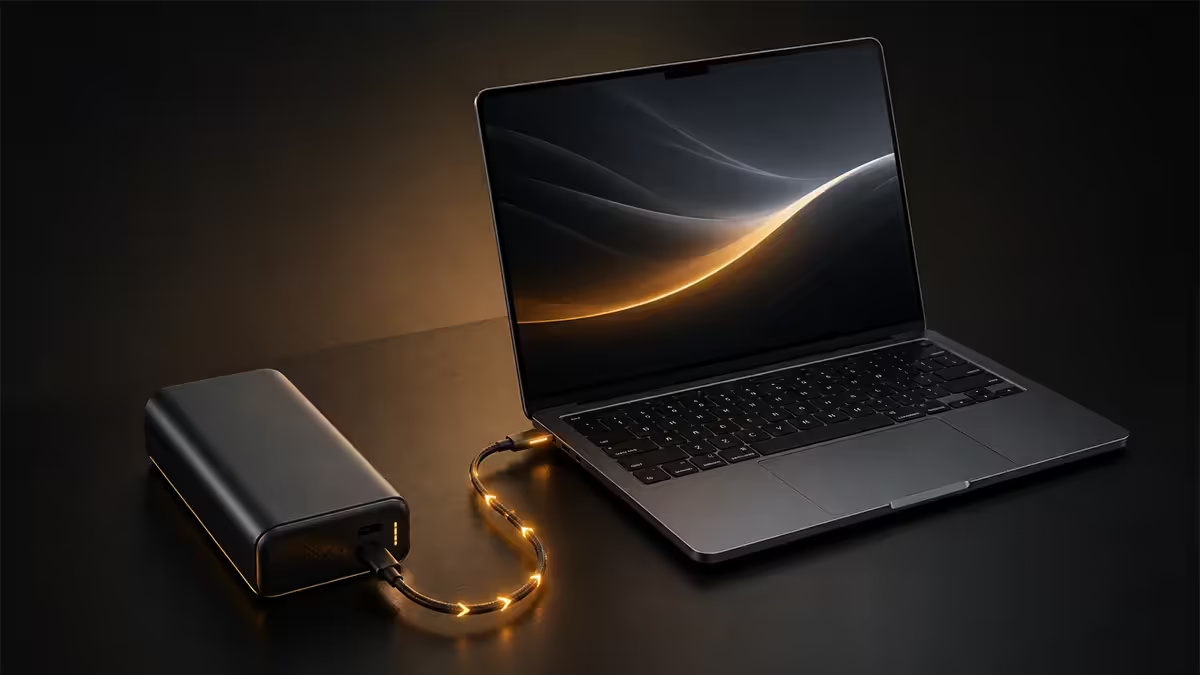
Match the wattage — the number that actually matters
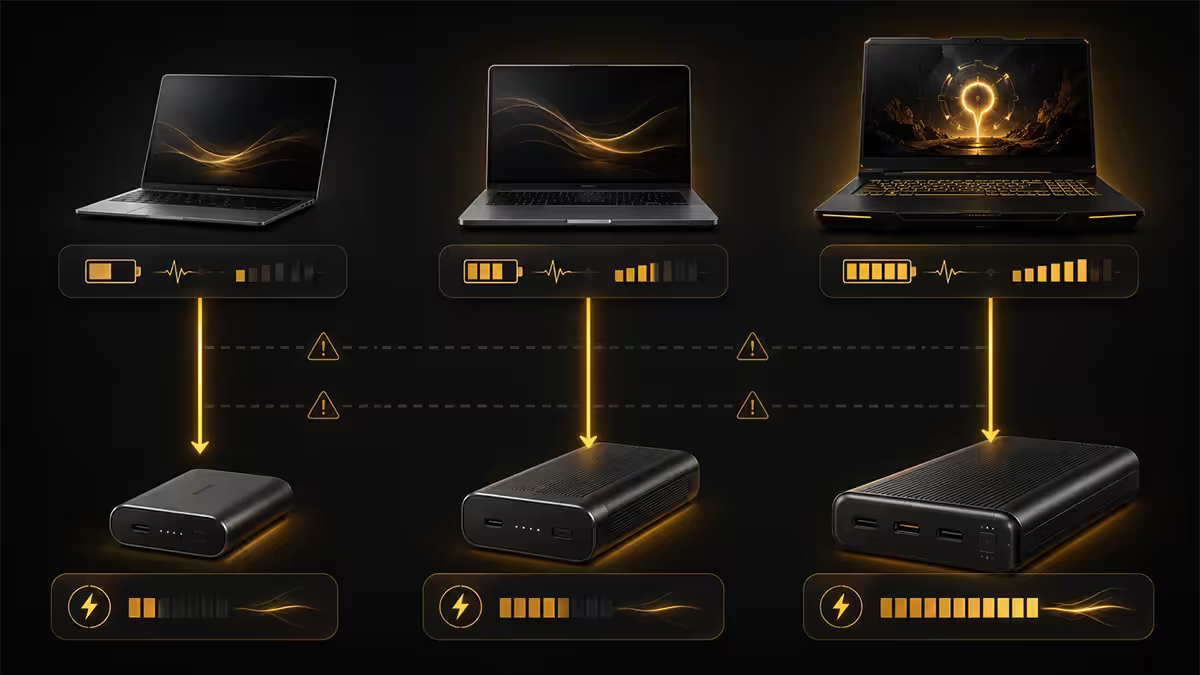
Almost every wrong power bank purchase in SA starts with mAh worship and ignores the single spec that decides whether your laptop charges at all: USB-C Power Delivery (PD) output wattage.
Pull out the brick that came with your laptop and look at the small print. It'll say something like "20V / 3.25A · 65W" or "20V / 5A · 100W". That number is the target. Buy a power bank that matches or exceeds it — anything below will either trickle-charge or hold-level while you work.
| Laptop class | Brick wattage | Power bank target |
|---|---|---|
| 13-14" ultrabook (MacBook Air, XPS 13, X1 Carbon) | 30-65W | 65W PD minimum |
| 15-16" mainstream (Inspiron 15, IdeaPad 5, MacBook Pro 14) | 65-96W | 100W PD recommended |
| 15-17" gaming / workstation (ROG, Razer, MacBook Pro 16) | 100-240W | 100W PD (charges slowly under full GPU load) |
| 17" mobile workstation w/ dGPU (P17, ZBook Fury) | 180-300W | Power bank cannot keep up — use for top-ups only |
A power bank advertised at "100W total output" split across three ports may deliver only 45W per port when you plug in two phones alongside the laptop. Always check the spec sheet for single-port maximum wattage, not aggregate output. That's the number that feeds your laptop.
Capacity math — mAh lies, Wh tells the truth
Every power bank prints two numbers: mAh (milliamp-hours) and Wh (watt-hours). For laptops, only Wh matters. Here's why.
Your laptop's battery is rated in Wh — typically 50Wh for an ultrabook, 70-99Wh for a 15-16 inch, and 99Wh max for any laptop that wants to fly on commercial aircraft. To charge your laptop fully once externally, your power bank needs at least the same Wh as your laptop battery, plus 15-20% for voltage conversion losses.
| Bank capacity | Real Wh | What it actually charges |
|---|---|---|
| 10000mAh | ~37 Wh | ~0.5 laptop charge · phone top-up territory |
| 20000mAh | ~74 Wh | 1 full ultrabook charge · ~0.8 of a 16-inch |
| 27000mAh | ~100 Wh | 1 full charge of almost any laptop · airline legal |
| 32000mAh | ~118 Wh | 1.5 ultrabook charges · airline carry-on banned |
| 40000mAh | ~148 Wh | 2 laptop charges · bag-only · airline banned |
The conversion: Wh = (mAh × voltage) ÷ 1000. Lithium cells are nominally 3.7V, so a 27000mAh power bank holds 27000 × 3.7 ÷ 1000 = 99.9Wh. That's why 27000mAh is the magic number — it's the largest capacity that's still legally a carry-on item internationally.
There's also a conversion loss of 15-20% when stepping voltage up to 20V for laptop charging. So a 100Wh power bank actually delivers ~80Wh into your laptop battery. Frame your expectations: "one full charge" is the realistic ceiling for most 15-16 inch laptops, not "a charge and a half" like the marketing implies.
Capacity tiers and SA-available brands
In SA there are basically three brackets worth shopping. Anything outside these is either underpowered for laptop use or overweight for daily carry.
20000mAh / 74Wh tier — the daily carry
Light enough for a backpack daily (around 400-500g), covers one full ultrabook charge plus a phone top-up. Right pick if you commute with a MacBook Air, Dell XPS 13, or ThinkPad X1 Carbon. Look for: Anker 737 (PowerCore 24K) at R1,800-R2,200, UGREEN Nexode 100W 20000 at R1,400-R1,800, Baseus Blade 100W 20000 at R1,200-R1,600.
27000mAh / 100Wh tier — the airline-legal sweet spot
The right pick if you travel or if your laptop is a 15-16 inch model. Anker Prime 27650 (250W) at R3,200-R3,800 is the premium choice. UGREEN Nexode Pro 100W at R2,400-R2,900 is the value play. Baseus Blade 2 100W at R2,000-R2,500 if budget is tight. All three hold airline carry-on certification and deliver true 100W single-port output.
32000-40000mAh / 118-148Wh tier — the desk anchor
Bag-only territory. You're not flying with this. The use case is a workshop, photo shoot, or extended outdoor work session where one laptop and two phones all need keeping alive for an 8-hour day. Anker 757 PowerHouse and UGREEN PowerRoam models fit here. Expect R3,500-R6,500 depending on capacity and inverter options.
GaN vs lithium-polymer — what's actually in the box
Marketing copy throws "GaN" around like it's a battery chemistry. It isn't. GaN (gallium nitride) refers to the charging circuitry, not the cells. The actual energy storage is still lithium-polymer or lithium-ion.
What GaN buys you is thermal efficiency. Gallium nitride transistors run cooler than older silicon ones, which means the power bank can pack the same wattage output into a smaller, lighter shell without overheating. A GaN 100W power bank is typically 30-40% smaller than a non-GaN equivalent at the same Wh capacity. The trade-off is price — GaN models cost R300-R600 more.
For a 100W laptop power bank, GaN is worth it. The size and weight difference for daily carry justifies the cost. For a 20000mAh phone-focused bank that occasionally tops up a laptop, GaN matters less.
On the battery cell side, all reputable brands use lithium-polymer (LiPo) pouch cells, which are more compact and slightly safer in puncture scenarios than cylindrical 18650 lithium-ion cells. Some larger workstation-class power banks use LiFePO4 (lithium iron phosphate) cells — heavier but far longer-lived (2000+ cycles vs LiPo's 500).
The 100Wh airline limit — why 27000mAh is the magic number
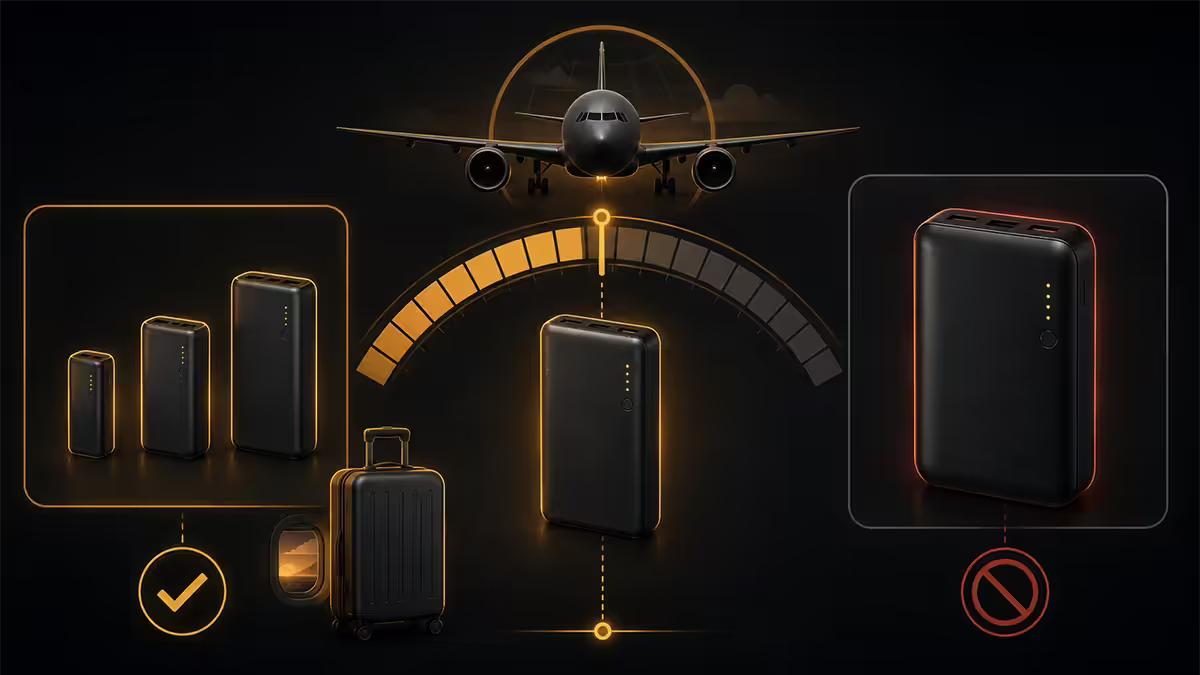
IATA aviation rules (followed by SAA, FlySafair, Lift, British Airways, Emirates, Qatar — basically every airline you'd fly out of SA) split lithium battery rules at three thresholds:
- Under 100Wh — carry-on only, no airline approval needed, no quantity limit on most carriers.
- 100Wh-160Wh — carry-on only, requires airline approval ahead of travel (usually granted, sometimes free, sometimes a R200-R500 fee per battery).
- Above 160Wh — banned on commercial aviation entirely. No carry-on, no checked, no exceptions.
Power banks may never go in checked luggage. Ever. SAA, FlySafair and Lift will pull bags off the conveyor if they detect a power bank inside. If you've packed one in your check-in, security will find it at the X-ray and you'll either remove it or miss the flight.
The Wh rating must be printed on the device itself — security will check. mAh ratings alone are not accepted; if your power bank only prints mAh, the agent does the (mAh × 3.7 ÷ 1000) calculation. If the number exceeds 100Wh and you don't have airline approval, the bank gets confiscated.
This is why 27000mAh (99.9Wh) is the sweet spot: maximum legal capacity for hassle-free travel, biggest realistic single-charge for a laptop, no paperwork.
Load-shedding survival math — surviving a Stage 6 slot
This is the real test for an SA buyer. Forget travel — most people buy a laptop power bank to keep working through a 4-hour Stage 6 slot when the inverter dies or you're at a coffee shop without one. Let's do the actual math.
Power draw under typical work load:
- 13-inch ultrabook, web + docs + Zoom: 15-25W
- 15-16 inch laptop, web + docs + Zoom: 25-40W
- 15-16 inch laptop, video calls + light Lightroom: 40-55W
- 15-17 inch gaming laptop, full GPU load: 120-180W (no bank survives this)
The 4-hour Stage 6 slot calculation (assuming starting from 100% laptop battery + 100% power bank, 30W average draw):
- Laptop's internal 70Wh battery alone: 70Wh ÷ 30W = 2.3 hours. Doesn't survive the slot.
- + 74Wh power bank (20000mAh): 70Wh + (74Wh × 0.85) = ~133Wh total → 4.4 hours. Just survives Stage 6, comfortable through Stage 4.
- + 100Wh power bank (27000mAh): 70Wh + (100Wh × 0.85) = ~155Wh total → 5.2 hours. Survives Stage 6 with margin for the slot running long.
- + 148Wh power bank (40000mAh): 70Wh + (148Wh × 0.85) = ~196Wh total → 6.5 hours. Survives two back-to-back Stage 8 slots.
The "1 full charge vs 1.5 charges" framing: if you only need to recover your laptop battery once during a slot, a 74Wh bank is enough. If you want to keep working continuously across multiple slots, you need 100Wh+. Most SA users land in the second camp — buy the 27000mAh.
Pass-through charging is the load-shedding feature worth paying for. Pass-through means the bank can charge from the wall while simultaneously feeding your laptop. When grid returns, the bank refills without you having to plug-swap. Anker, UGREEN and Baseus 100W models all support it; most no-name banks do not.
We've shipped a great many laptop power banks from our Centurion warehouse. The unit we see returned the least is the Anker 100W 27000mAh class — returns are rare. The unit we see returned the most is generic 30000mAh+ banks bought from Wish, AliExpress and bidorbuy — actual measured capacity is routinely far below the printed mAh, output ports fail within months, and there's no warranty path. Buy from a brand with local stock and local warranty. The R400 you save on a no-name bank turns into R2,500 wasted when it dies before year one.
Evetech Mobility Team — Behind the Bench
Common laptop power bank mistakes
Buying on mAh alone. A 30000mAh phone-focused bank with 20W ports cannot charge your laptop. Always check Wh and single-port wattage before the mAh number.
Trusting "fast charge compatible" without USB-C PD certification. Older Quick Charge (QC 3.0/4.0) standards don't deliver the voltage your laptop needs. You want USB-C Power Delivery (PD 3.0 or PD 3.1) explicitly listed.
Buying a 30000mAh+ bank for travel. Anything over 100Wh will get confiscated or refused boarding internationally. 27000mAh / 99.9Wh is the absolute maximum for hassle-free travel.
Cheap no-name banks from marketplace sellers. Capacity ratings are routinely overstated by 30-50%, cells are repurposed laptop pulls, and there's no warranty path when the bank swells (and it will swell). The R400-R800 savings vs an Anker or UGREEN unit don't survive contact with reality.
Leaving the bank in a hot car. Heat is the single biggest killer of lithium-polymer cells. A bank that lives in a closed car in a Joburg parking lot in summer will lose 50% of its capacity within 18 months. Store it indoors at room temperature.
Skipping pass-through charging. In SA, pass-through is the difference between "the bank survived load-shedding" and "the bank survived load-shedding and was full when grid came back". It's the single most useful feature for the SA use case.
Key takeaways
- Match the brick. 65W PD minimum for ultrabooks, 100W PD for 15-16 inch and gaming laptops.
- Wh is the only capacity number that matters. 27000mAh (99.9Wh) is the airline-legal sweet spot.
- 100Wh bank + laptop's own battery survives a Stage 6 (4hr) slot at typical office workload.
- Pass-through charging is the SA must-have feature — bank refills while still feeding laptop.
- Anker, UGREEN and Baseus are the SA picks. Skip no-name marketplace brands — capacity is overstated and warranty is fiction.
Frequently asked questions
What wattage power bank do I need for my laptop?
Match the brick. 65W USB-C PD for 13-14 inch ultrabooks, 100W PD for 15-16 inch and gaming laptops. Anything under 65W will only trickle-charge a modern laptop.How many Wh do I actually need?
A 27000mAh / 99.9Wh bank gives one full charge of almost any laptop and is the largest size airline-legal as carry-on. 20000mAh / 74Wh is enough for ultrabooks and daily commute use.Can I take a laptop power bank on a plane?
Yes, up to 100Wh in carry-on with no airline approval. 100-160Wh needs airline approval. Above 160Wh is banned outright. Power banks must never go in checked luggage.GaN vs lithium-polymer — what's the difference?
GaN is the charging circuit material, LiPo is the battery cell. GaN runs cooler so the bank can be 30-40% smaller at the same wattage. The cells are still lithium-polymer either way.Will a power bank keep my laptop running through load-shedding?
A 100Wh bank + your laptop's own battery covers ~5 hours of typical office work at 30W average — enough to survive a Stage 6 slot. Gaming workloads (120W+) overwhelm any power bank.What's pass-through charging and do I need it?
Pass-through lets the bank charge from the wall while simultaneously feeding your laptop. When grid power returns after a slot, the bank refills without you having to swap plugs. Essential for SA use.Which power bank brands are reliable in SA?
Anker is the safest default — widely stocked, warranty replacement is fast in SA. UGREEN and Baseus are the value tier. Avoid no-name brands on marketplace sites — capacity is overstated and warranties are fiction.How long do laptop power banks actually last?
Quality LiPo cells hold 80% of original capacity through ~500 cycles — about 3-4 years of daily use. Heat is the killer; never leave a bank in a hot car.
Get the Evetech app
Exclusive app-only prices, daily flash sales, and free delivery on orders over R4,000 — download the app and start saving.