Music Production Setup Guide
How to build a music production setup. — Bedroom to broadcast, four pieces deep.
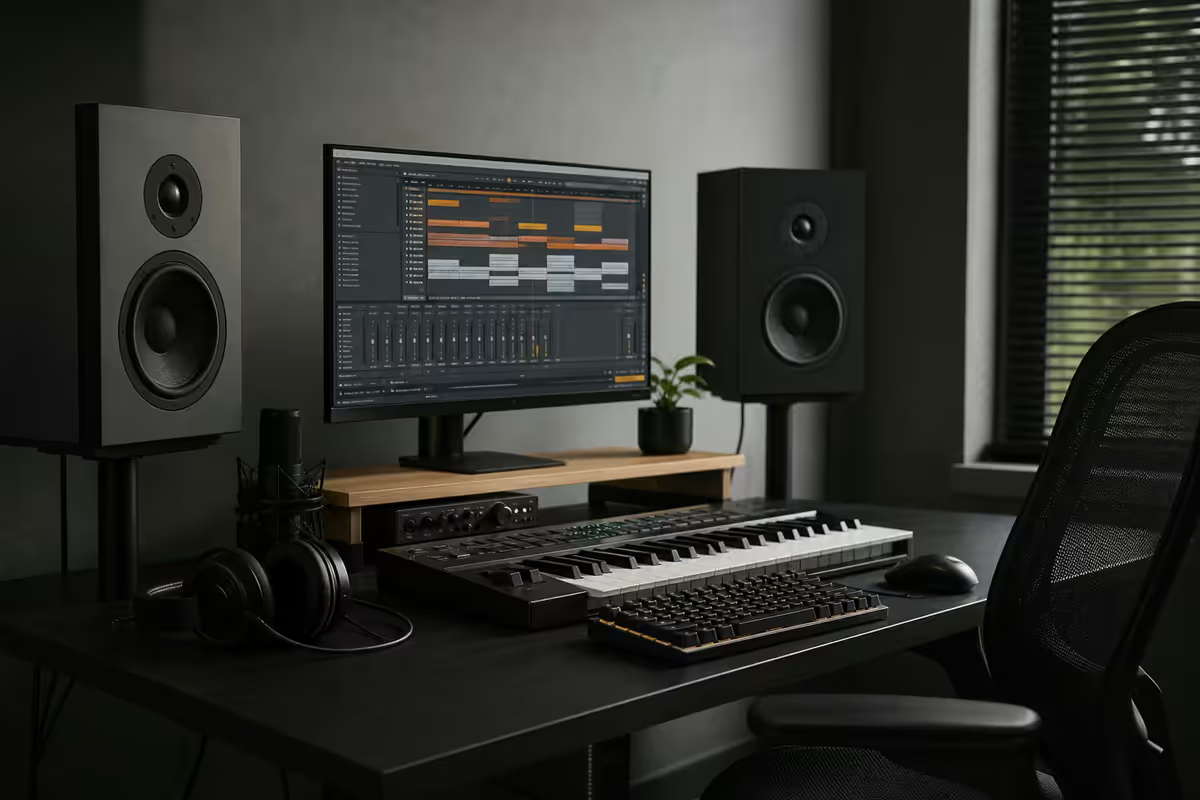
You don't need a R150k mixing console. A R12k starter rig — speakers, interface, MIDI, treatment — produces release-quality tracks today. The trick is buying the right four things in the right order.
- core kit
- 4 pieces
- round-trip latency
- < 5ms
- SA spend tier
- R10k-R75k
Studio monitors — the most important purchase
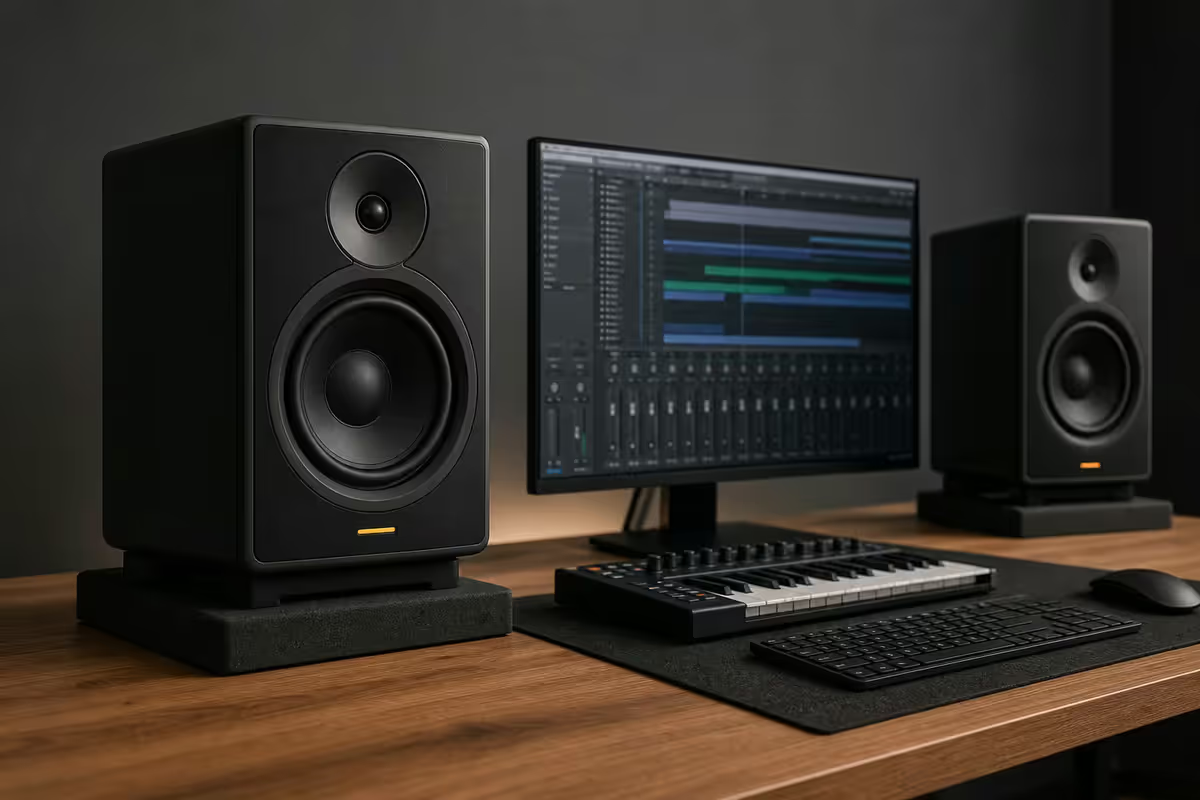
Your monitors are how you hear everything else. Spend more of your budget here than anywhere else. Cheap monitors lying to you about the low end will cost you ten times more in remixes than the speakers themselves.
| Monitor | Character | SA price (pair) |
|---|---|---|
| Presonus Eris E3.5 | Budget honest, small rooms | R3,500-R4,500 |
| Yamaha HS5 | Flat, neutral, slightly thin bass | R7,500-R9,000 |
| Yamaha HS7 / HS8 | Same character, more low-end authority | R10,000-R14,000 |
| KRK Rokit 5 G4 / 7 G4 | Hype-y low end, fun, lies a bit | R6,500-R10,000 |
| Adam Audio T5V / T7V | Brilliant high-end, ribbon tweeter | R10,000-R14,000 |
| Genelec 8010A | Truly pro small-room reference | R12,000-R14,000 |
| Genelec 8030C / 8330A | Mastering-grade with room correction | R28,000-R55,000 |
Yamaha HS5 is the safest first choice for genre-flexible producers. They're slightly thin in the low end, which sounds boring at first — but that thinness forces you to mix the kick and bass honestly. Mixes that sound balanced on HS5s translate to every other speaker in the world.
Audio interface — your computer's ears
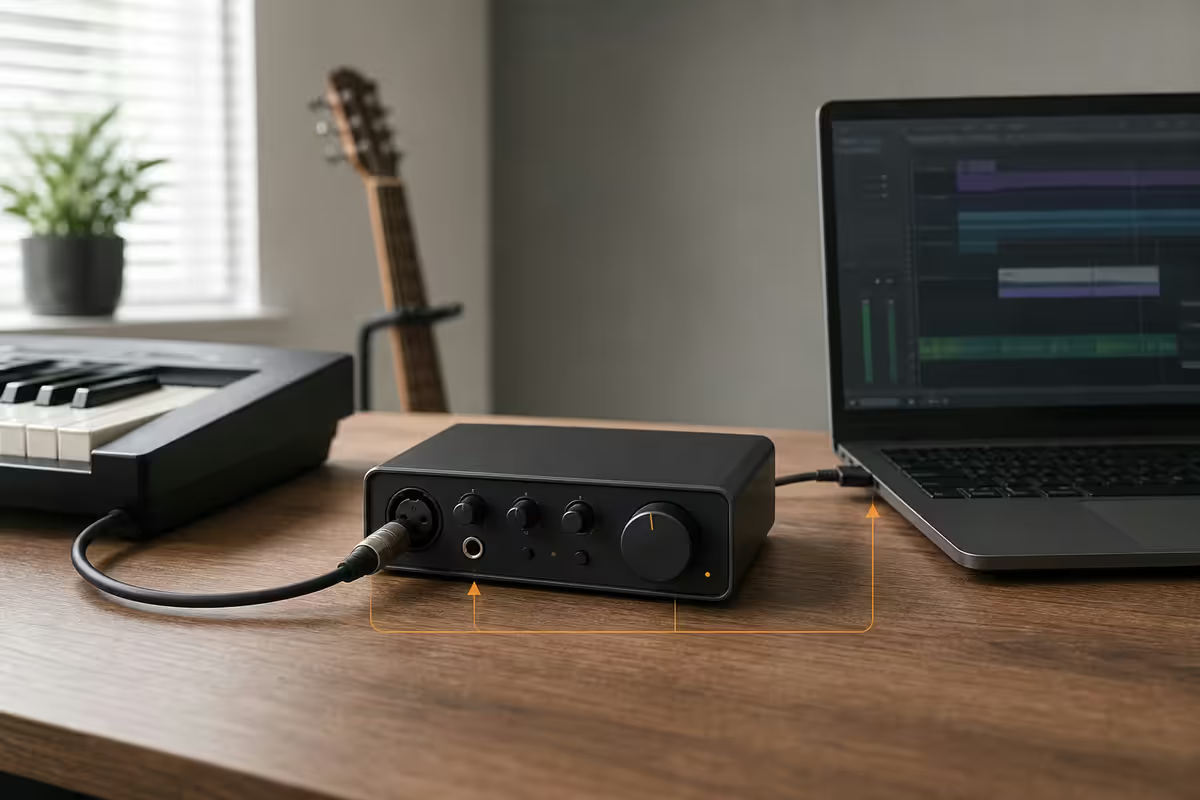
The interface converts analogue signals (microphones, guitars, synths) to digital audio your DAW can record, and converts the digital playback back to analogue for your speakers. Modern USB-C interfaces sound transparently clean from R3,500 upwards.
| Interface | Inputs / character | SA price |
|---|---|---|
| Focusrite Scarlett Solo 4th Gen | 1 mic + 1 line, beginner-perfect | R3,500-R4,200 |
| Focusrite Scarlett 2i2 4th Gen | 2 mic, the SA studio standard | R5,500-R6,800 |
| Audient EVO 4 / EVO 8 | Smart Gain auto-set, low latency | R3,800-R7,500 |
| Universal Audio Volt 276 | Built-in 1176 compressor on input | R7,500-R9,500 |
| SSL 2+ | Slick "4K" analogue colour switch | R6,500-R8,500 |
| RME Babyface Pro FS | Reference-grade DSP routing | R22,000-R28,000 |
| Universal Audio Apollo Twin X | Thunderbolt + UAD plugin DSP | R28,000-R38,000 |
Focusrite Scarlett 2i2 is the default SA studio choice for good reason — bulletproof drivers, two clean mic preamps, in stock everywhere. For producers who never record more than themselves, the Solo 4th Gen is genuinely all you need.
MIDI controller — input for ideas
A MIDI keyboard turns musical thinking into notes. Don't overthink the size — start with 25 keys unless you're already a piano player.
- 25 keys (compact) — AKAI MPK Mini MK3, Native Instruments Komplete Kontrol M32. Perfect for beat-making, melodic sketching, two octaves with octave-shift buttons.
- 49 keys (sweet spot) — Arturia KeyLab Essential 49 Mk3, AKAI MPK 249. Two-handed playing, chord progressions and melody simultaneously.
- 61 keys (semi-pro) — Arturia KeyLab 61 Mk3, NI Komplete Kontrol S61. Enough range for orchestral work, full chord voicings.
- 88 keys (pianist) — NI Kontrol S88 Mk3, Arturia KeyLab 88 Mk3, M-Audio Hammer 88. Weighted keys, for trained pianists tracking real piano parts.
Look for velocity-sensitive pads on the MIDI controller — they make finger-drumming and sample triggering feel responsive. MPK Mini's 8 pads and Komplete Kontrol's 16 pads are both fine for most workflows.
Acoustic treatment — the cheat code
An untreated bedroom is the single biggest reason home mixes don't translate. Standing waves and first-reflections wreck your low-mid range and lie about your stereo image. R2,500 of acoustic treatment delivers more mix improvement than R20,000 of plugins.
What you actually need:
- 4-6 mid-frequency panels (100mm rockwool wrapped in fabric, 600x600mm). Place at first-reflection points on side walls (clap test: where the wall makes the loudest echo) and behind the listening position.
- 2 bass traps in the front corners of the room. Stacked rockwool floor-to-ceiling, or commercial GIK Tri-trap.
- 1 cloud panel on the ceiling directly above the mix position. Optional but huge for stereo imaging.
Don't buy foam tiles from Takealot. 25-50mm acoustic foam only absorbs above 1kHz. The problems wrecking your mixes are at 100Hz-500Hz — exactly the range foam ignores. Rockwool (Cape Fibre) at 100mm thickness absorbs down to 100Hz. DIY costs about R350 per panel including frame and fabric.
Room layout — the equilateral triangle
Position matters more than gear. The same Yamaha HS5s sound 80% better in a properly arranged room than 60% in a corner-jammed one.
The equilateral triangle: your two monitors and your head form a 1m-on-each-side equilateral triangle. Tweeters at ear height (use stands if your desk is wrong). Monitors angled inward 30° to point at your face.
Distance from wall: at least 30cm behind the monitors, ideally 50cm+. Speakers pushed against the wall exaggerate the low end and confuse the bass response. The bigger the room, the further you can pull them out.
Symmetry: the desk should sit centred between the side walls. Mixing in a corner means one ear hears more reflections than the other — you'll mix bias into every track.
PC and DAW pairing
Modern DAWs run on modest hardware. The bottleneck for big template sessions is RAM and sample-drive speed, not raw CPU clock.
| Tier | Spec target | SA price |
|---|---|---|
| Entry production PC | Ryzen 5 7600 + 16GB DDR5 + 1TB NVMe | R14,000-R18,000 |
| Mid production PC | Ryzen 7 7700X + 32GB DDR5 + 2TB NVMe | R22,000-R28,000 |
| Pro production PC | Ryzen 9 7900X + 64GB DDR5 + 4TB NVMe | R38,000-R48,000 |
| Apple equivalent | M3 Mac mini / Studio M3 Max | R22,000-R65,000 |
DAWs ranked by SA producer use: FL Studio (R3,500-R9,000 perpetual, biggest SA hip-hop / amapiano user base), Ableton Live (R3,200-R12,000), Logic Pro (R3,500 Mac-only one-time), Cubase (R2,800-R10,000), Studio One (R3,500-R10,000). Free options: Cakewalk Sonar, Reaper (R1,200 personal licence).
Complete bundle tiers — what to buy together
Entry — R10,000-R12,000 (bedroom starter)
- Presonus Eris E3.5 or Yamaha HS5 monitors — R3,500-R8,000
- Focusrite Scarlett Solo 4th Gen — R3,800
- AKAI MPK Mini MK3 — R2,200
- 4 DIY acoustic panels — R1,500
- Free DAW (Cakewalk, Reaper, or bundled with interface)
Mid — R28,000-R35,000 (serious bedroom / project studio)
- Yamaha HS7 or Adam T5V — R10,000-R12,000
- Focusrite Scarlett 4i4 4th Gen or Audient EVO 8 — R7,500
- NI Komplete Kontrol M32 or Arturia KeyLab Essential 49 Mk3 — R6,000-R8,000
- 6 GIK or DIY panels + 2 bass traps — R4,500
- FL Studio Producer / Ableton Live Standard — R5,000-R7,500
Pro — R75,000+ (release-ready home studio)
- Adam T7V or Genelec 8030C — R14,000-R30,000
- RME Babyface Pro FS — R24,000
- NI Kontrol S61 Mk3 or Arturia KeyLab 88 Mk3 — R18,000-R22,000
- GIK Acoustics full treatment kit + bass traps + cloud — R12,000+
- Production PC (Ryzen 9 + 64GB) — R40,000+
- Full DAW + plugin suite (Komplete 15, FabFilter, etc.) — R25,000+
Common production setup mistakes
Buying KRK Rokits because they look cool. The yellow cones look great on Instagram. The hyped low end teaches you to mix kick drums too thin. By the time you realise this, you've released six muddy tracks. Yamaha HS5 or Adam T5V are honest options for the same money.
Spending the gear budget without treating the room. A R30,000 monitor + interface combo in an untreated room sounds worse than a R12,000 entry rig in a treated room. Always budget acoustic treatment from day one.
Skipping the interface preamps and using the PC's headphone jack. Onboard audio adds noise to your recordings and runs latency 30-50ms — way too slow for live MIDI playing. Any USB interface is a 10x improvement.
Buying an 88-key controller "to grow into". If you don't play piano now, you won't suddenly start. 88-key controllers take up massive desk space and cost 3x a 25-key. Buy 25 keys, upgrade later if you genuinely need it.
Mixing on headphones only. Headphones flatter low end and exaggerate stereo width. Mixes done exclusively on headphones almost always have muddy mid-bass and over-panned stereo image. Cross-check on monitors.
Key takeaways
- The four-piece core: monitors + interface + MIDI + treatment. Skip any one and the rest is wasted.
- Yamaha HS5 + Scarlett Solo + MPK Mini = R12k entry rig that releases real tracks.
- Acoustic treatment beats every plugin upgrade. Budget R2,500 on day one.
- Equilateral triangle — tweeters at ear height, 1m sides, symmetric in the room.
- Production PC bottlenecks are RAM and NVMe sample drive — not GPU.
Frequently asked questions
What's the cheapest way to start producing music?
A bedroom-tier entry setup runs about R10,000-R12,000: Yamaha HS5 monitors (R8,000 pair) or Presonus Eris E3.5 (R3,500 pair) as a fallback, a Focusrite Scarlett Solo 4th Gen (R3,800) for the audio interface, an AKAI MPK Mini MK3 (R2,200) for MIDI input, and a free DAW like Cakewalk Sonar or the lite version included with the interface. You already have the PC. Add basic acoustic panels (R1,500 for 6 DIY rockwool panels) and you can produce release-quality tracks from a bedroom.Do I need studio monitors or can I just use headphones?
You need both, but monitors are non-negotiable for mixing. Headphones lie about stereo width and low-end response — a mix that sounds balanced on AKG K371 or Sennheiser HD 600 will often have a muddy mid-bass on speakers. Studio monitors let you hear the room and check the mix's translation. Even cheap Eris E3.5 monitors (R3,500/pair) plus the headphones you already own give you the cross-check you need for serious mixing decisions.Yamaha HS5 vs KRK Rokit 5 vs Adam T5V — which is best?
Yamaha HS5 (R8,000/pair in SA) is the safest pick — flat, neutral, slightly thin in the low end which forces honest mixing. KRK Rokit 5 G4 (R6,500/pair) is hype-y in the low end, fun to listen to but lies about your kick drum. Adam T5V (R10,000/pair) has the best high-end of the three thanks to the X-ART ribbon tweeter. For genre-flexible producers: HS5. For bass-music producers who want energy: Rokit. For mixing engineers: T5V. The Genelec 8010A (R12,000/pair) is the smallest of the truly pro-grade picks if your room is tiny.How much acoustic treatment do I need?
In a typical SA bedroom studio (3x4m), you need 4-6 panels of 100mm rockwool wrapped in fabric — placed at the first reflection points on the side walls and behind the listening position. That's roughly R1,500-R2,500 DIY or R3,500 for ready-made GIK Acoustics or Auralex panels. Add bass traps in the front corners (R1,000 DIY or R2,500 pro) for the biggest mix improvement. Skip foam tiles from Takealot — they only absorb high frequencies and ignore the mid-bass problems that wreck mixes. Room treatment delivers more mix translation improvement than any single piece of gear you can buy.What PC specs do I need for music production?
For modern DAWs like Ableton, Logic, FL Studio and Cubase running soft synths and VST plugins, target a Ryzen 7 7700X or Core i7-14700K, 32GB DDR5 RAM and a 1TB NVMe SSD for samples. The GPU barely matters — integrated graphics drive a 1440p monitor fine. The bottleneck for big template sessions (orchestral libraries, large plugin chains) is RAM and sample-drive speed, not CPU clock. Budget R18,000-R25,000 for a production-ready desktop, or step up to R35,000-R45,000 if you're running 200+ VST instances or Vienna / EastWest orchestral libraries.USB vs Thunderbolt audio interface — which do I need?
USB-C is fine for 95% of producers. Modern USB interfaces (Focusrite Scarlett 4th Gen, Audient EVO, Universal Audio Volt) run at 2.5ms-4ms round-trip latency, low enough for tracking vocals and MIDI playing. Thunderbolt interfaces (Universal Audio Apollo, RME Babyface Pro FS) drop latency to under 2ms and add onboard DSP for monitoring with plugins. Pick Thunderbolt if you're tracking a band and need 16+ inputs, or if you want UAD plugin acceleration. Otherwise USB-C delivers identical recording quality.Do I need a MIDI keyboard with 25, 49 or 88 keys?
25 keys (MPK Mini MK3, NI Komplete Kontrol M32) is perfect for beat-making, melodic sketching and triggering one-shot samples. 49 keys (Arturia KeyLab Essential 49, MPK 249) is the sweet spot for producers who play piano lines and use both hands. 88 keys (NI Kontrol S88 Mk3, Arturia KeyLab 88 Mk3) is only needed if you're a trained pianist tracking real piano parts. Start with 25 unless you're already a player — most produced music is written on 25-key controllers.Do I need an external monitor controller?
Not for a first studio. Modern audio interfaces (Scarlett 4th Gen, EVO 4, Volt 276) include a quality monitor output with hardware volume control. Once you're working with multiple sets of speakers, headphone amps, or talkback for vocal sessions, a dedicated controller like the Mackie Big Knob (R3,500) or Audient Nero (R8,500) becomes essential. For solo bedroom production, the interface's built-in monitor section is plenty.
Get the Evetech app
Exclusive app-only prices, daily flash sales, and free delivery on orders over R4,000 — download the app and start saving.